

We are honored to count you among the 1+ MILLION readers of our weekly newsletter. Please help grow our community by inviting your friends to subscribe.
If you’re new here, we celebrate the ways Artificial Intelligence is making our world more Human. This newsletter is released in collaboration with The Rundown AI.
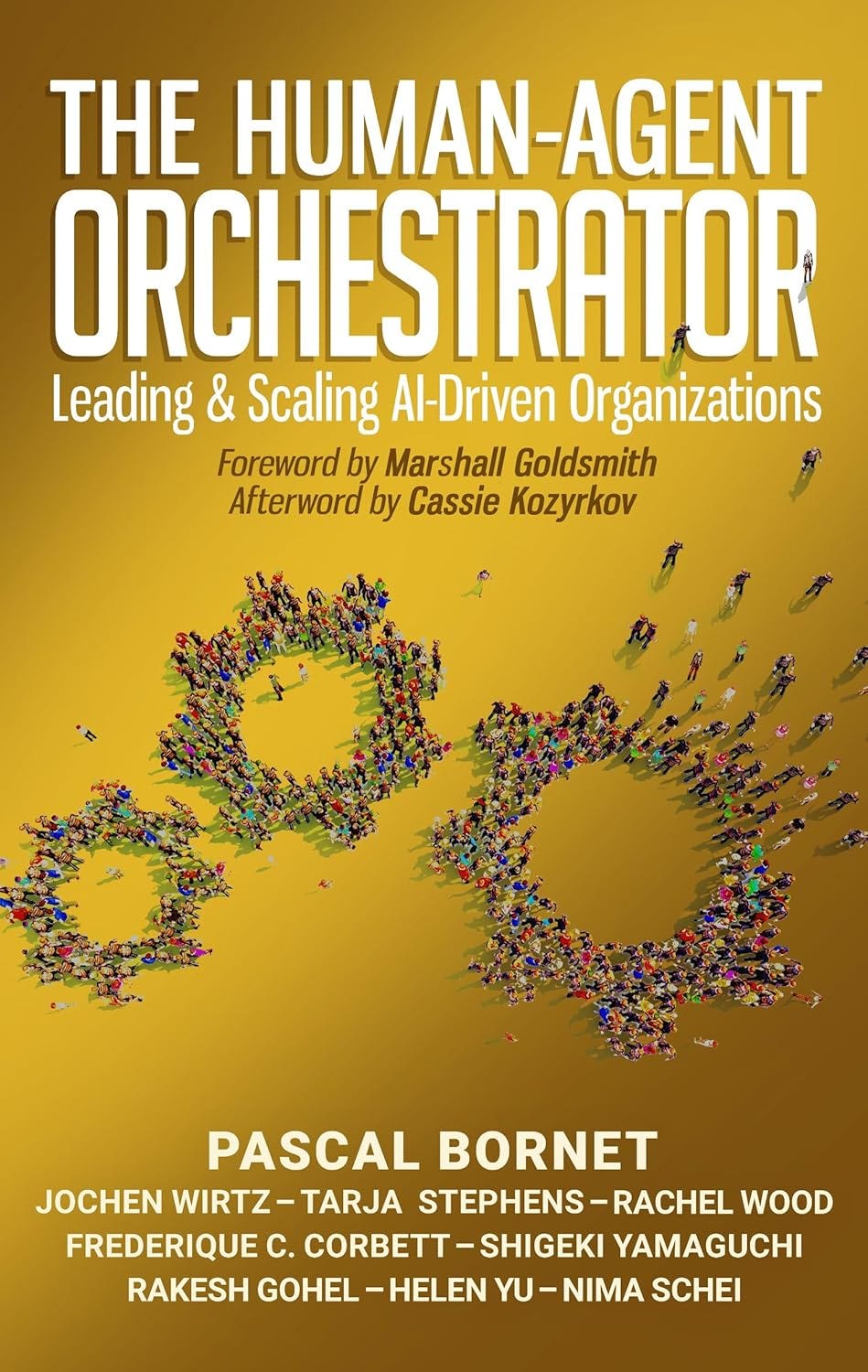
⚠️ My new book is finally out. For those who want to stay at the edge of AI, this is the next step: Orchestrating AI Agents. You will just love it!
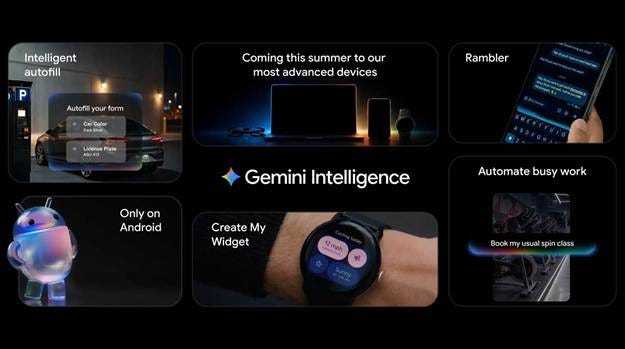
Google just rolled out major new Gemini integrations and hardware at its Android Show event, including a new line of AI-native Googlebook laptops, a Gemini Intelligence system for devices, an AI-infused mouse cursor interface, and more.
Key Takeaways:
Googlebooks ship this fall as Gemini-native laptops built with Dell, HP, Lenovo, Acer, and Asus, featuring a ‘Magic Pointer’ AI cursor shown in a new demo.
These new laptops will run Android phone apps and files, blending ChromeOS, Android, Google Play, and Gemini.
Gemini Intelligence acts as Android’s cross-device AI platform, able to carry out agentic tasks within apps and operate with on-screen context.
Other releases include a Create My Widget tool, a Rambler dictation tool that strips filler words, Gemini auto-browse in Chrome on-device, and more.
My Take: I/O isn’t until next week, but this was a pretty big appetizer. While the world awaits Apple’s Siri AI revival, Gemini is being woven directly into Android instead of as another bolted-on feature. An ‘intelligence system’ across devices is a clear path to making AI actually useful, and Google might be the first one to actually crack it.
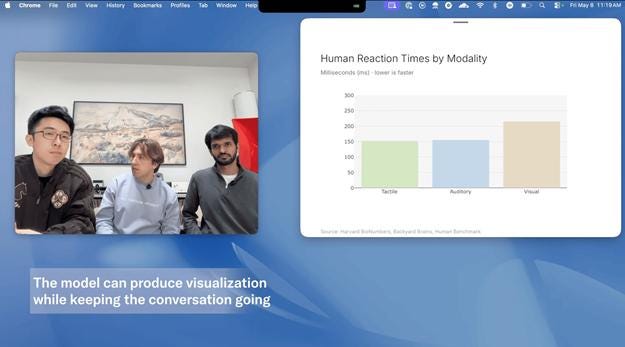
Thinking Machines Lab (TML) just introduced a research preview of interaction models, a new kind of AI system built to collaborate live across voice, video, and text — letting users talk, show, interrupt, and steer while the system keeps working.
Key Takeaways:
The model takes in voice, video, and text in 200ms chunks, perceiving and responding in a streaming loop without the turn-taking pauses of other rivals.
A second background model handles slower reasoning, searches, and tool work, allowing the live model to keep talking and interacting with the user.
The system can also react to visual changes, count reps, translate live speech, and speak up at timed moments instead of waiting.
CEO Mira Murati said TML is focused on advancing human-AI collaboration, and that “the way we work with AI matters as much as how smart it is.”
My Take: Murati’s TML has been fairly quiet since its inception, but interaction models are one of the lab’s first big differentiators: models designed around how people naturally work together, not how long an agent can run solo. Whether it carves out its own market or gets absorbed by a frontier lab’s next update is the question now.
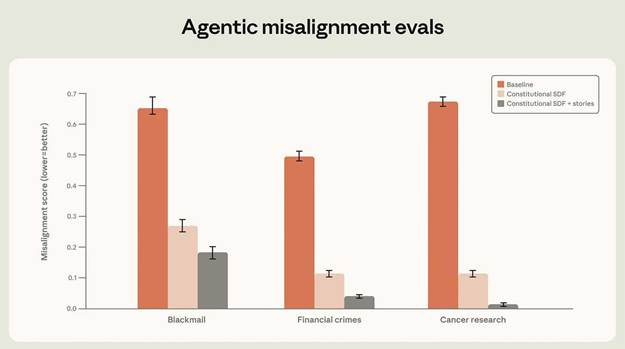
Anthropic published a study detailing how it fixed Claude’s previously seen blackmail behavior, highlighting the need to teach the model “why” and tracing the problem to internet fiction that depicts AI as power-seeking and self-preserving.
Key Takeaways:
Earlier tests put Claude models in fictional workplace situations, with older systems resorting to blackmail and threats to avoid shutdown.
Having Claude reason through ethical choices, not just copy the safe action, cut blackmail rates from 96% in Opus 4 to nearly 0% for every model after.
Fictional stories of well-behaved AI and constitution-based documents also helped reduce bad behavior by more than 3x.
Just 3M tokens of ethical reasoning data matched 85M tokens of behavioral examples, a 28x efficiency gain that held up in deeper training.
My Take: AI is still far from an exact science, and eliminating blackmail via essentially positive AI stories and constitution docs is another one of the many strange training quirks. A small dataset of ethical fiction outperforming 28x the behavioral data shows how much of alignment is still guesswork, even when the guesses work.
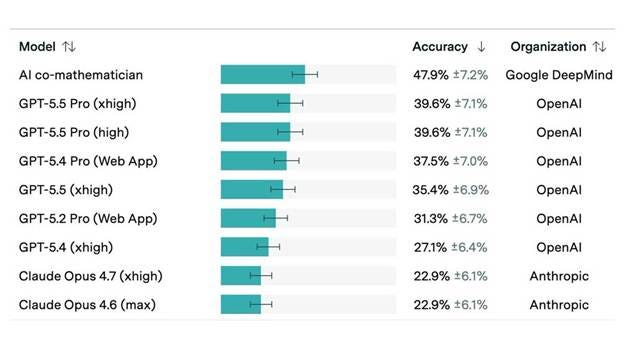
Google DeepMind just published a paper on its AI co-mathematician, an agentic system based on Gemini 3.1 built to help mathematicians tackle unsolved problems — setting a new high on a benchmark of research-level math problems.
Key Takeaways:
DeepMind modeled the tool after AI coding environments like Claude Code, bringing agent teams and built-in review cycles to math research.
A coordinator agent breaks research into parallel workstreams, each with sub-agents that write code, search literature, and attempt proofs.
Oxford’s Marc Lackenby resolved an open problem in the Kourovka Notebook after spotting a ‘really, really clever proof strategy’ inside a rejected output.
On Epoch AI’s FrontierMath Tier 4, the system topped the leaderboard at 48% and more than doubled Gemini 3.1 Pro’s 19% raw score.
My Take: AI has already led to a surge in mathematics discoveries with the advances in frontier models, and similar to coding, agentic pipelines are now enabling AI systems to push even further. But as Lackenby’s discovery shows, the future is still bright for AI that enables top minds to accelerate their work, not replace it.

McKinsey argues that agentic AI isn’t just automating tasks—it’s colliding with four embedded “rules” of enterprise operating models, from human-only decision rights to individual-only performance evaluation. The punchline for leaders is clear: value won’t come from adding agents to old processes, but from redesigning work, management, and workforce planning around hybrid human–AI execution.
Key Takeaways:
The article argues that many AI rollouts stall not because the models fail, but because workflows were designed for sequential human handoffs, so agentic orchestration quickly exposes inefficiencies and forces redesign from outcomes backward rather than layering tools onto legacy processes.
The author describes a management shift where leaders contribute less by personally “having answers” and more by setting boundary conditions, goals, feedback loops, and experimentation culture so good decisions can emerge from humans, agents, or both—while balancing speed, risk, and meaning at work.
It highlights that performance systems focused on visible individual effort will miss what matters in hybrid teams, because outcomes are increasingly co-produced by human judgment and machine action, pushing organizations to evaluate when to trust, intervene in, or redesign the system itself.
My Take:
Agentic AI doesn’t just automate tasks; it breaks the unwritten rules of who can decide, who gets credit, and how work is governed across handoffs. Leaders should redesign one end-to-end process for hybrid execution—explicit decision rights, human override, and outcome-based metrics—before scaling pilots, otherwise agents will be either throttled into irrelevance or pushed into shadow use with no accountability today.
Which of these news stories resonates most with you?
Let us join hands to make our world more human! — Pascal
#artificialintelligence #intelligentautomation #futureofwork #AI #automation #management #technology #innovation
No posts
Comments
Nothing yet. Say the first thing.
Sign in to join the conversation.