
Hey Friends!
For those of you following the Quantum Mechanics section of this newsletter, solutions to the exercises are long overdue.
There has been some mild disconnect between the exercises in these notes and those from the associated lecture videos1. Going forward we going to be better about keeping things in synch.
We’re going to start by shipping the exercises from our series on Stern-Gerlach experiment. The solutions to older exercises will get backfilled and we’ll update you on where to find them as they come out.
Going forward, the solutions will appear on our website.
Suppose that we have a uniform beam of silver atoms whose spin is pointed at an angle 𝜃 with respect to the Stern-Gerlach detector. Because measurement in Quantum Mechanics restricts us to “spin up” or “spin down” states, we know that the spin angular momentum of each atom will either be aligned parallel or antiparallel to the device’s orientation. Let 𝑁up be the number of silver atoms observed exiting the spin up output terminal and 𝑁down be the number of silver atoms observed down. We are asked to show that the rati0

approaches the cos 𝜃.
Hopefully its clear that (1) takes values between −1 and 1, so it’s at least conceivable that it might approach cos 𝜃. Additionally, if 𝜃 = 0, the beam of silver atoms will be entirely aligned with the Stern-Gerlach magnet, so the beam should be measured entirely as spin up. In this case, 𝜃 = 0, which is consistent with cos 𝜃. If 𝜃 = 𝜋 radians, the beam’s spin will be antiparallel with the detector, and thus each atom will be measured spin down. This is consistent with the fact that cos 𝜋 = −1. Finally, note that if the beam is perpendicular to the device - if 𝜃 = 𝜋/2 radians - then the probability of finding those silver atoms up or down is identical, which is consistent with the fact that cos 𝜋/2 = 0.
Three comments are in order. First, this exercise was unfair. Are there plenty of other functions that behave like cos 𝜃 at these important points? Sure. We will learn how to compute this precisely in the coming lectures.
Second, that this ratio approaches cos𝜃 is an example of statistical limiting behavior. It will only approach cos𝜃 for the case when the total number of silver atoms observed, 𝑁_up + 𝑁_down is very, very large. Fortunately, the number of silver atoms present in a macroscopic beam is quite high.
Finally, you can see how this takes shape if 𝜃 is in between 0 and 𝜋/2 . What will happen between those two angles is more silver atoms will be observed as spin up than spin down, although as 𝜃 → 𝜋/2 radians, 𝑁_up → 𝑁_down. These limits are of course understood in the large number limit just discussed.
As a solid, silver has a crystal lattice of silver atoms. When heat is applied, those covalent bonds break and silver atoms are allowed to float into the air. This occurs randomly, perhaps due to collisions with other molecules in the gas around the lump. As we’ll learn in this course, temperature and random behavior are interrelated. Inside the box, the silver atoms that leave the solid state become part of the gas - the air - inside the box. As such, the atoms are colliding at random with each other and perhaps other air molecules present, if any. These collisions also occur randomly, and randomly affect the orientation of those silver atoms. Because both the positions and velocities of the silver atoms are essentially random, the event that one such silver atoms leaves the tiny pin-hole in the side of the box is certainly a random event.
Even if the atoms had a preferred orientation after sublimating off the silver lump, the individual atoms experience many collisions before they find the pin-hole and escape. The collective result of all these collisions is that the orientation of those atoms has become totally random, and in particular totally independent of their motion through space. If this assumption is not valid, we can always close the pin-hole until enough time has elapsed to make it so. These kinds of assumptions - where all information about spin orientation that the silver atoms may have had from the former state is lost due to random collisions - is an example of what we mean when we say a system has thermalized.
If Quantum Mechanics were wrong and we could really observe all possible spin orientations of a silver atom, we would see a continuous distribution on the detector screen. The oval region, in other words, would have been filled in.
For the case of an atom spinning with an angular momentum of |S| = 15h/4𝜋, we would see that distribution smeared over a greater extent, because the maximum kicked experienced by the atom would be much higher. Again if Quantum Mechanics were wrong, this would present as a larger smear. Given that Quantum Mechanics does restrict the number of possible measurements we can make, we would expect to 15 + 1 = 16 individual bands on the detector screen, assuming we could achieve that fine a resolution.
Thermal individual conditions mean that the parameters 𝛼 and 𝛽 are random variables. They are different for each individual atom inside the beam. This should be contrasted with the case where
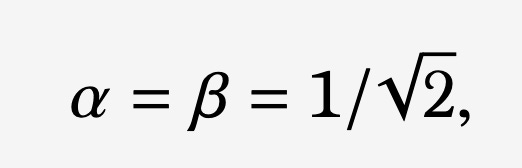
which is a precise set of initial conditions. Beams of both have the same net effect on the final detector screen: a pair of evenly split beams. They achieve this differently, however. For the case of precise initial conditions where 𝛼 = 𝛽, this precision split in the beams is a consequence of the finite information carrying capacity of those silver atoms. It’s because of Quantum Mechanics. For the thermal case, the distributions of spins themselves are totally random, which only compounds this additional, information-based randomness associated to Quantum Mechanics.
It is important to understand this distinction as clearly as possible.
If we managed to find an atom which has spin angular momentum set to h/2𝜋, the angles of S we could measure would be 0◦, 90◦ and 180◦. These are three physical states, so we could model it as a three-component vector
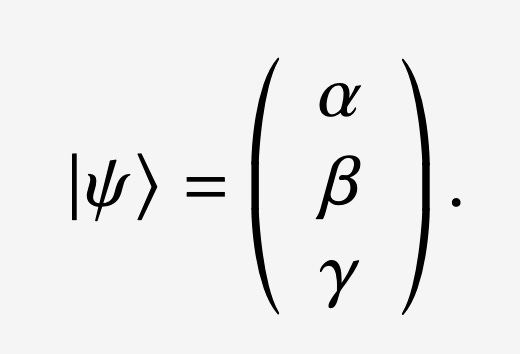
As with the two-component case, these parameters codify the relative likelihood of finding the atom in those three spin states. That is we normalize things so that
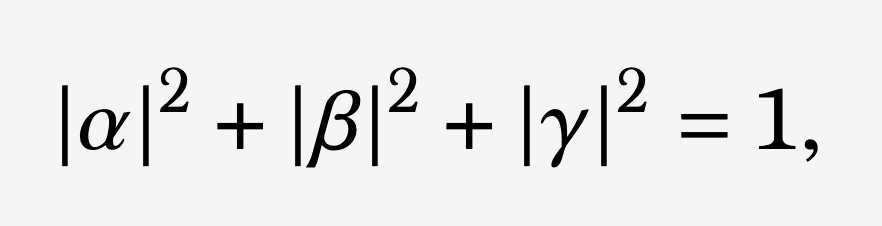
and |𝛼|^2 is the probability of finding the atom in the “spin up” state, corresponding to the angle of 0◦. |𝛽|^2 and
|𝛾|^2 are the probabilities of finding it at 90◦ and 180◦, respectively.
Generically, the Stern-Gerlach device will split the beam of these atoms into three separate beams. If the beam was initially randomly orientated - as with the silver atoms - this is clear. Of course, if we can choose the parameters 𝛼, 𝛽 and 𝛾 at will, uniformly for every atom in the beam, we can arrange for there to be an output to have whatever number of beams we like by setting any of these parameters to zero. In particular, we can have a two-beam set up, in principle. The question is how can we influence those parameters.
As with the silver atoms, we can use a strong, uniform magnetic field to prepare the spins of the beam in a particular direction. For example, we can align the magnetic moments of the beam parallel or antiparallel to the orientation of the Stern-Gerlach device. In both of these cases, there will be a single output beam, either spin up or spin down, respectively. This amounts to choosing 𝛽 = 𝛾 = 0 in the parallel case, or 𝛼 = 𝛽 = 0 in the antiparallel case.
You might wonder if we can find a way to choose 𝛼 = 𝛾 = 0. This case is tricky.
For concreteness, let us suppose that the Stern-Gerlach device is orientated along the 𝑧-direction. Given that the magnitude of the atom’s spin is fixed, there is only one way to make its spin parallel to 𝑧. Similarly, there is only one way to make it antiparallel to 𝑧. But there is a infinite collection of ways to make it orthogonal to 𝑧! Any combination of the 𝑥- and 𝑦-directions will accomplish this. We will learn how to investigate these ideas with precision in coming lessons, but for now let’s embrace the finite information carrying capacity of the atom’s spin.
For a beam of silver atoms with spins aligned in the 𝑥-direction, the Stern-Gerlach device - aligned with 𝑧 - split the beam in two. Despite the silver atoms having a spin orthogonal the magnet, they were kicked maximally either up or down. The way we understood this was the finite resolution of the angle of that spin. A single silver atom can only be measured as up or down. The aggregate total of all spin angular momentum of all atoms measured - however - was zero, at least in the statistical limit of large numbers of atoms.
The silver atoms couldn’t carry the information about being orthogonal to the 𝑧-direction individually, but in aggregate they could model that information.
For a three-state atom, we can also ask about the aggregate spin. If 𝛼 corresponds to spin up - here h/2𝜋 and 𝛾 corresponds to spin down or −h/2𝜋, the parameter 𝛽 corresponds to the state where the spin in the 𝑧-direction is zero. Therefore the total angular momentum of all the atoms measured in general will be given by:
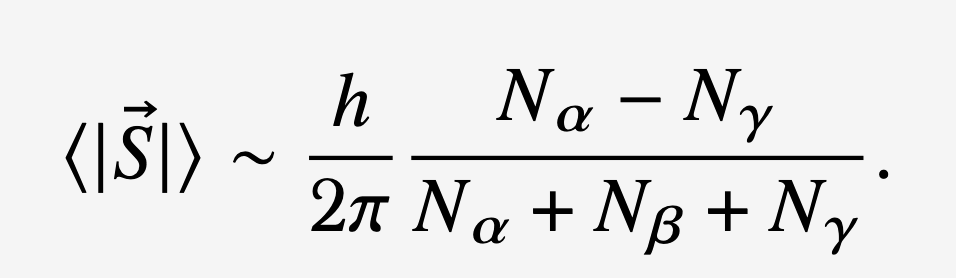
Here, for example, 𝑁_𝛼 are the number of silver atoms observed with spin h/2𝜋, etc. While it is true that the state parametrized by 𝛼 = 𝛾 = 0,
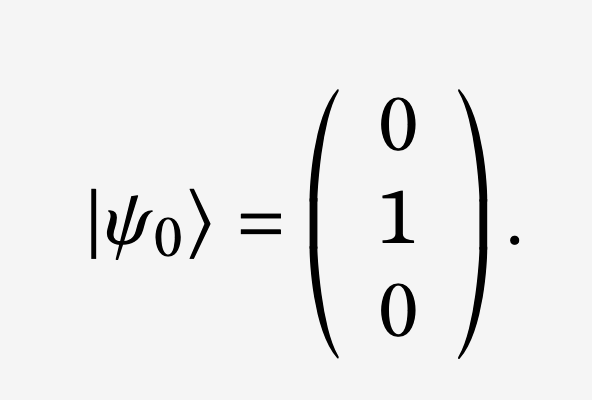
would give ⟨|𝑆|⟩ = 0, it is far from the only state. Indeed, any state where 𝛼 = 𝛾 would do the same:
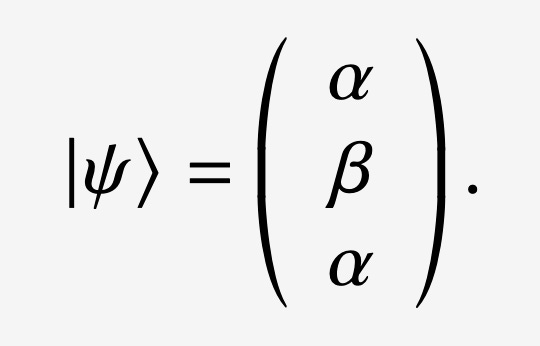
So we see how there is an infinite freedom in choosing parameters that correspond to a beam average angular momentum observation of zero. Each choice here corresponds to a choice of initial conditions orthogonal to 𝑧. So we cannot, for example, merely arrange all the atoms to be pointed in the 𝑥-direction and hope to get a single beam out.
As we will learn later, a beam arranged pointing purely in the 𝑥-direction would have the parameterization:
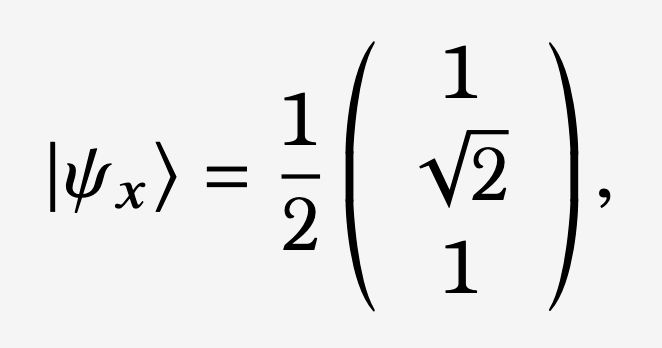
which means a Stern-Gerlach device in the 𝑧-direction would be split: 25% up, 25% down and 50% unchanged.
Although in the videos I often do as you to check simple calculations in real time, which is usually important when you need to understand them for later sections of the video. I won’t usually ask you to do that in these write-ups because you’re typically free to read at your own pace. Videos can sometimes move more quickly than our brains, or at least my brain.
No posts
Comments
Nothing yet. Say the first thing.
Sign in to join the conversation.