
Every so often on twitter/X posts (sometimes accompanied by a graph) will do the rounds claiming that testosterone without training beats training for various combinations of strength/size/muscle growth.
See for example here or here or here and here.
As best I can tell (it is sometimes explicitly cited) every one of these claims trace back to Bhasin et al., "The Effects of Supraphysiologic Doses of Testosterone on Muscle Size and Strength in Normal Men” published in 1996. They split subjects into 4 groups: placebo, placebo with lifting, testosterone, and testosterone with lifting over 10 weeks, then tracked various parameters (fat free mass gain, strength in squat and bench, triceps area and quad area).
This study should influence your thoughts around lifting by approximately 0.
I contend that: this study is wildly underpowered to show anything. Even if it wasn’t, the results don’t suggest testosterone beats lifting for the metrics you’d care about. Even if it did show that, the subjects as reported in the data are so different from you (yes you) physiologically as to be completely irrelevant. Finally, even if we solved all of this and the headline result were true it still shouldn’t have any bearing on your life and lifting / steroid habits.
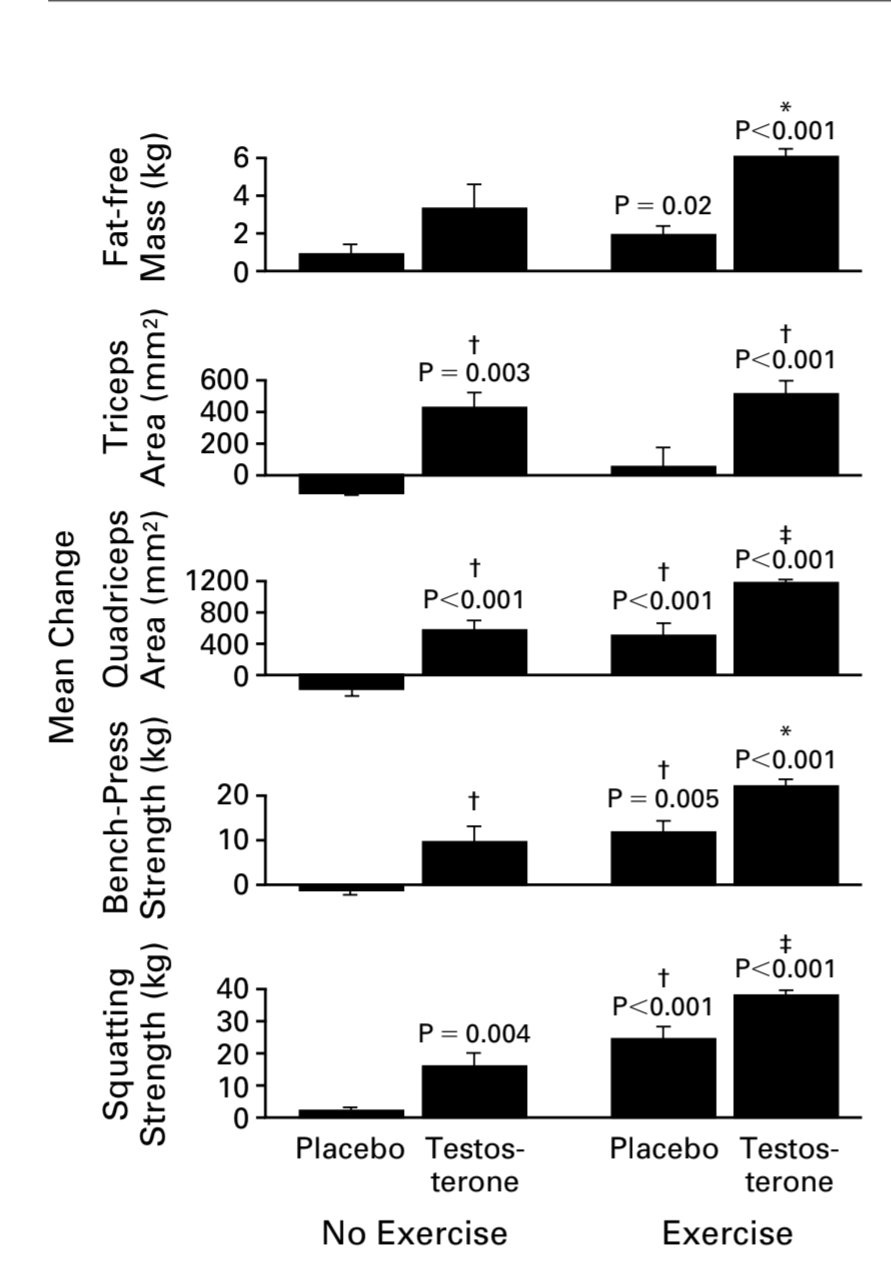
First off the headline claim: you can gain more muscle using steroids without lifting as you can lifting. This is the graph most commonly pulled out of the paper and shared around.
Here’s a post that got 1.4 million views with this claim:
Here is how this was presented in a post that got 350k views.
Here’s the original graph from the paper:
Those error bars are SEM (standard error of the mean) which is SD / square root (n). We have the n and the SEM so we can pull out the numbers and redo the bar graph with standard deviations. Here it is:
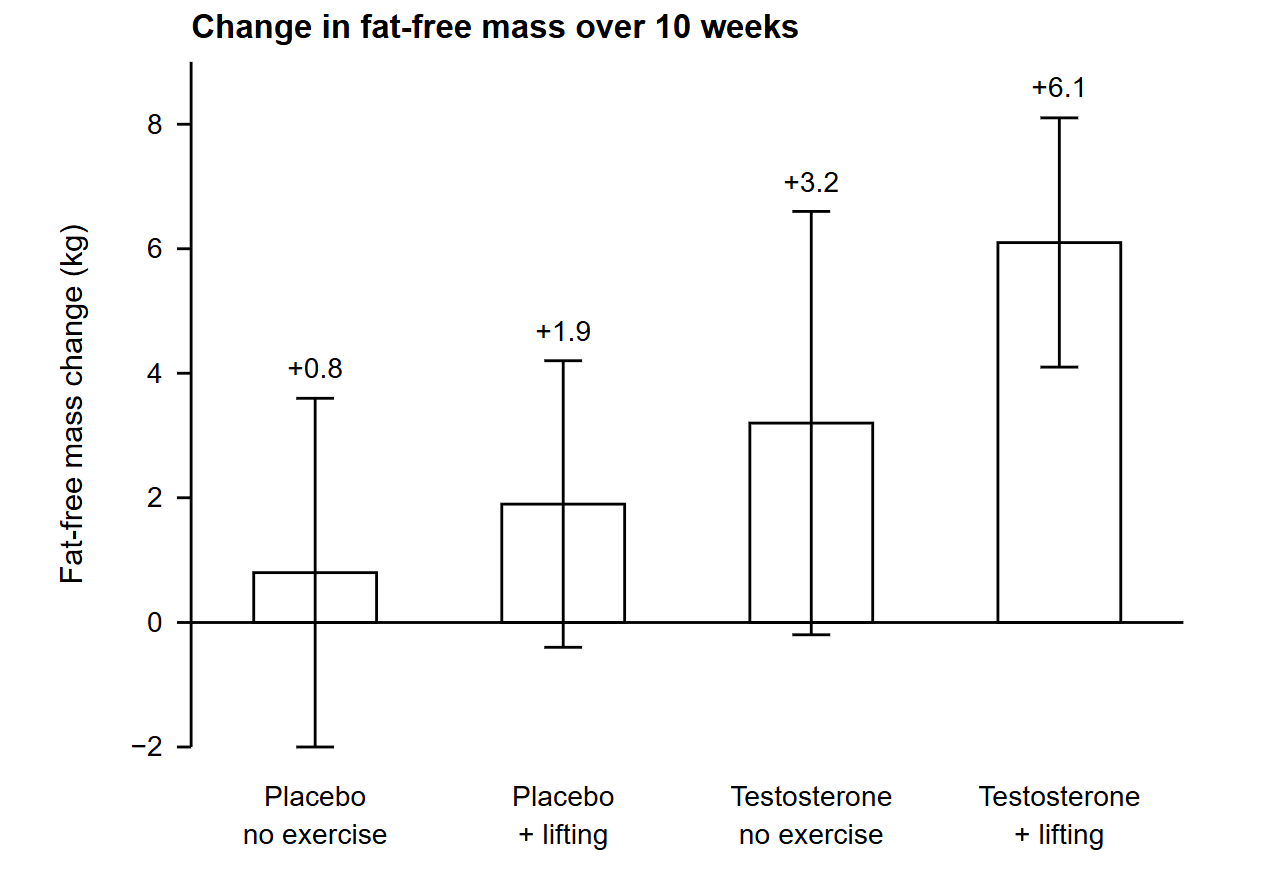
You can stop reading here if you want, and I will be happy knowing that you have seen this figure and can bring it to mind next time this claim starts circulating.
The rest of this article will be more ranting from me about the paper and some philosophising about lifting at the end.
First, more details on the paper. I’m going to talk in terms of frequentist statistics since that’s what the paper does, but yes I know all the issues around p-values. That’s the framing the authors use, so we’ll stick with it to at least highlight what the paper does and doesn’t show by it’s own methods.
The only result the authors claim is significant in terms of fat free mass is that testosterone plus training beats not training with or without steroids. This study is too underpowered to show that training and testosterone significantly beats training alone. This is a clearly true fact that the data is too small and noisy to conclude! Also, even within the no lifting group testosterone didn’t even beat placebo to significance in FFM gain.
You can go read the abstract to see them phrase their way around this issue (emphasis mine):
“The men assigned to testosterone and exercise had greater increases in fat-free mass (6.1±0.6 kg) and muscle size (triceps area, 501±104 mm2; quadriceps area, 1174±91 mm2) than those assigned to either no-exercise group.”
Onto my next point: lets imagine that this was a bigger study and all results were real. Testosterone alone didn’t make the subjects any stronger. Mean bench and squat 1 RM both went up more in the lifting without testosterone group than the testosterone alone group. Given this our conclusion should be that you get stronger lifting natty that sitting around on massive doses of testosterone (‘oh it wasn’t significant’ NEITHER WAS THE MASS GAIN EVERYONE WONT SHUT UP ABOUT!! IT’S NEARLY ALL JUST NOISE!!).
What are we doing here guys. “Its not how much you lift its how much you look like you can lift” is a meme. It’s a joke. You actually do want to be stronger. As beautifully expressed in No, Really, You Should Do Strength Training by Sasha Chapin:
You might think that you’re strong enough to do everything that your life requires. And, well, that’s probably true. But what you haven’t experienced is the feeling that your life is abundantly physically easy.
This was a revelation to me. Until I’d gained some muscle, I didn’t know that getting out of bed shouldn’t actually feel like much, physically, or that walking up a bunch of stairs shouldn’t tire you out, or that carrying groceries around shouldn’t be onerous. I felt cursed by the necessity of occupying space while shuffling around this mortal coil. And now I do not. Moreover, I no longer feel that I need some special justification for existing, because simply residing in the material is now a privilege.
Now my final point on the study itself before we jump into lifting philosophy: the people in this study have as much relevance to you with even a passing interest in fitness as if this was done on mice.
Again, lets imagine the study was bigger and the numbers held up. The natty lifter group doing 3x per week training and pretty basic dietary stuff in the oft shared figure put on an average of 1.9 kg lean mass in 10 weeks, added 25 kg to their squat and 10 kg to their bench!
This is your black pill!?!? 2kg of lean mass in 10 weeks? This is either 1) unbelievably good news for what can be achieved in a short period of time or 2) noise and an artefact of the detraining protocol or study setup in which case we can throw the rest of the study away (it’s 2).
If you see that fat free mass gain figure pop up and are determined to base your decisions on it, your take home shouldn’t be “it’s so over for being natty, testosterone beats training even if you don’t lift” it should be “holy shit I can gain 2 kg of lean mass in a summer? Let’s goooo!”. Maybe you can, maybe you can’t but I promise thinking that you can and actually trying to will leave you in a better place than not.
Now to the final point where I will wax lyrical about lifting: even if testosterone alone made you bigger and stronger than lifting alone you should still get under the bar. Even if you got the Captain America super soldier serum you should still get under the bar.
You should already know that exercise and specifically lifting is one of the greatest investments you can make in your mental health. This is well studied and consistently found to be true. There’s endorphins that make you feel nice and you sleep better and your joints feel nicer and your back stops hurting. Your body decays slower and can do more things for longer. Whether or not you take testosterone you should be lifting weights.
Picking something up that you couldn’t before is a transcendent experience. Literally, you have transcended your previous physical form in a real sense. Priors you had buried deep in your predictive processing about who you are and what you can do are obliterated as the weight moves.
Henry Rollins talks about this in Iron and the Soul. You should go read it.
It wasn’t until my late twenties that I learned that by working out I had given myself a great gift. I learned that nothing good comes without work and a certain amount of pain. When I finish a set that leaves me shaking, I know more about myself. When something gets bad, I know it can’t be as bad as that workout.
Here’s a video of me squatting 100 kg for 23 reps then falling to my knees and staring deep into my own soul in the mirror before collapsing onto the floor.
No posts
Comments
Nothing yet. Say the first thing.
Sign in to join the conversation.