
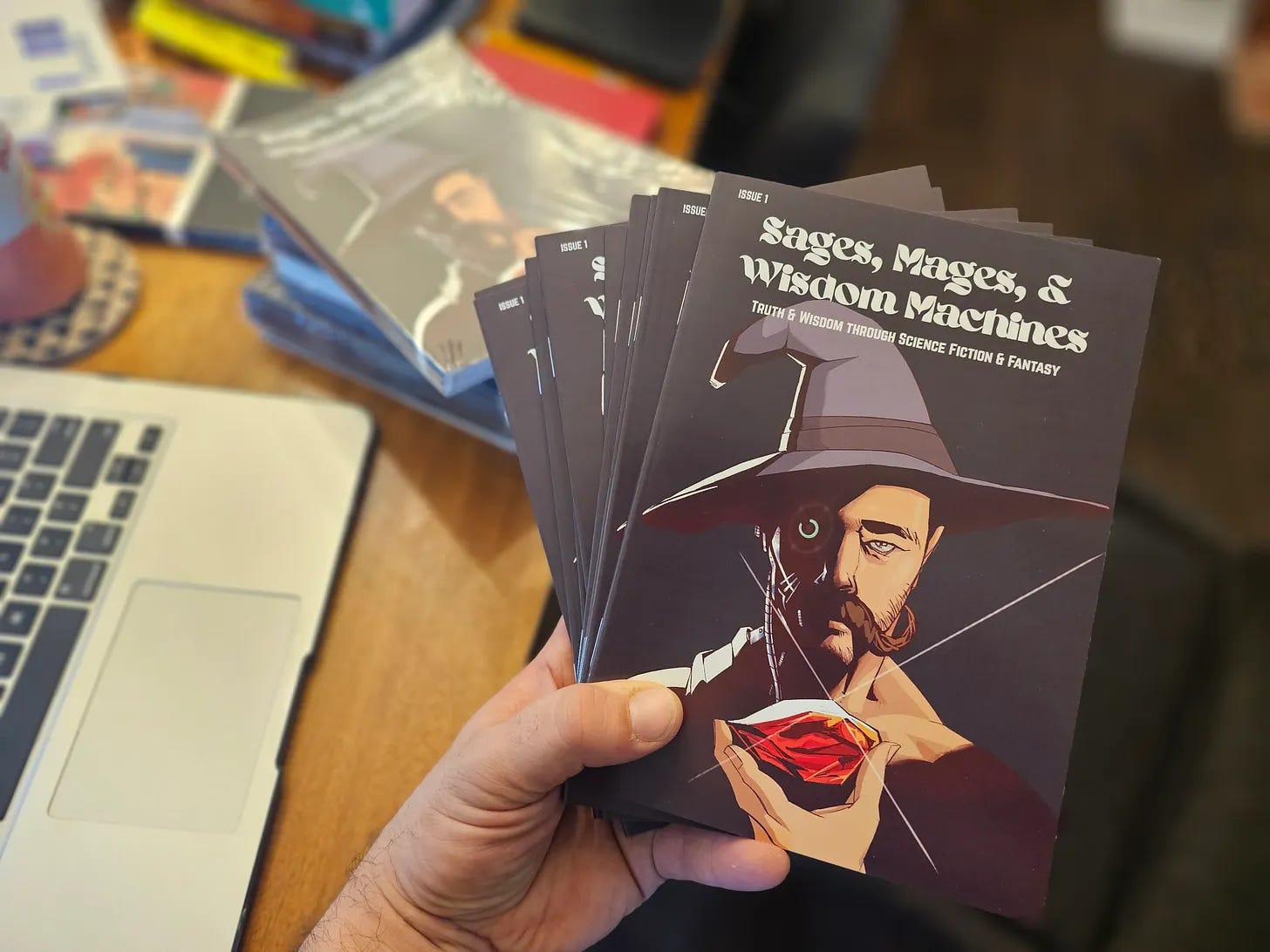
If you like philosophical fiction—especially science fiction and fantasy—then you’re going to love my philosophical SFF zine: Sages, Mages, & Wisdom Machines. I write short stories with philosophical themes in them and then I add companion essays at the end of each to help you find the Easter eggs therein and to help you understand and explore the philosophy and theology more deeply. I also write essays exploring themes in popular SFF stories, novels, and movies. And I include philosophical poems too! Grab yourself a copy from the button below:
Sages, Mages, & Wisdom Machines Zine
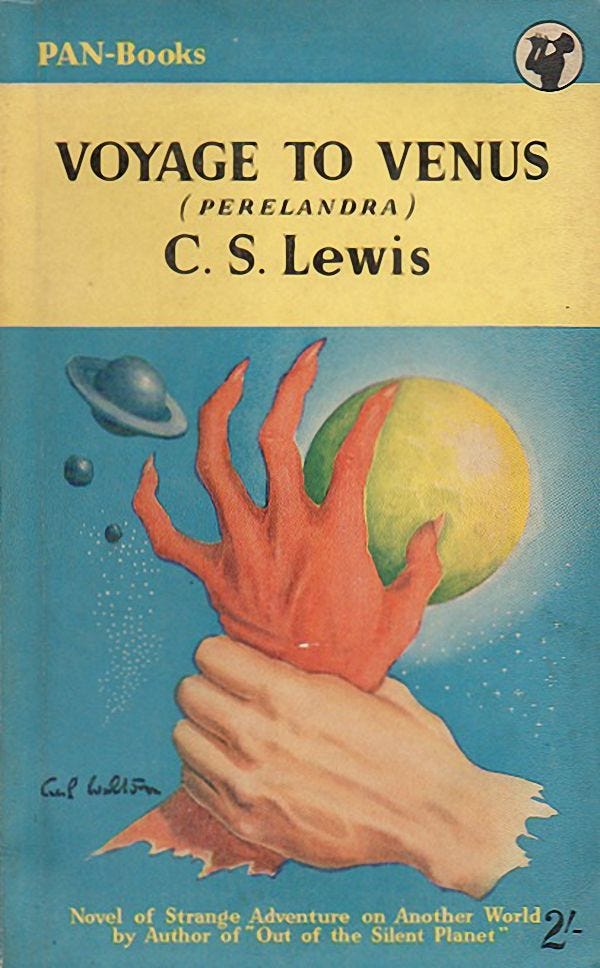
Money, in fact, would provide the means of saying encore in a voice that could not be disobeyed. pg.44
Welcome to the Parker’s Ponderings Book Club!
This is a philosophical & theological companion essay to C.S. Lewis’s Perelandra. It’s a very long post, partially because it’s a single essay on an entire book, and partially because Lewis put a ton of gems in the book and I have to comment on them so you can see how brilliant he was.
I will give you a taste of the essay, but the full essay, and my other Book Club companion essays like it, are for paid subscribers who help keep the lights on and support my independent scholarship. If you want to learn big ideas and think well about them, come join us for the Book Club and get access to lots and lots of other exclusive posts as well as access to the paid subscriber chat. I will overwhelm you with resources to learn, read, and think well!
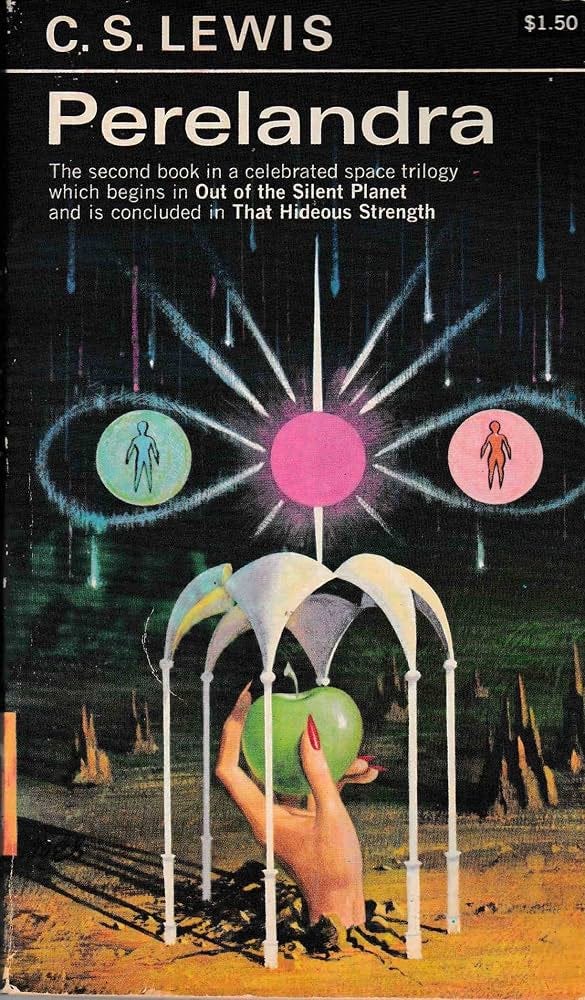
In this essay, I’m going to share lots of cool artwork for Perelandra, I will discuss Lewis’s cultural criticism present in the book, his philosophy, and especially his theology, including angelology, biblically accurate angels, demonology, evil, free will, and much more.
Plus at the bottom you can find my recorded Book Club Zoom discussion on Perelandra where I talk with one of my paid subscribers about the book in lots of detail for an hour (usually we have more subscribers on the Zoom calls but not this time).
Additionally, I am teaching a 6-week course on the Philosophy and Theology of C.S. Lewis starting July 11th!!! It’s accredited, so you can take it for college credit or you can audit the course—we have people signed up for both already!
Check out the course here:
Perelandra can be read alone without reading the prequel, Out of The Silent Planet, or the sequel, That Hideous Strength. It can, but it shouldn’t. Why? Because Lewis builds on the themes he started in OSP and continues them on through THS.
With that in mind, if you want to catch up on the story, read OSP and my 5 companion essays to it below:
Every science fiction story that deals with aliens should deal with the translation problem: how can we get species who don’t have a shared language to speak to one another?
There are lots of different ways to bridge the language barrier gap:
make a universal galactic language—usually this ‘galac’ reads a lot like English…
Have some sort of technology do the translating: Doctor Who’s Tardis does the translating for him and his companions. I’m using technology in my own novel to do the translation but I haven’t shared that in the serialization yet.
Use magic or a magic elixir like in Ant-Man: Quantum Mania or John Carter.
Or put a babel fish in someone’s ear like in The Hitch-Hiker’s Guide to the Galaxy
C.S. Lewis bridges the gap by making Elwin Ransom a philologist who can quickly learn the language of Malacandra, Mars, which turns out to be ‘Old Solar’ language anyways and allows him to talk not only with the martians but with the angels and Venusians or Perelandrans, the folks from Venus, as well.
So, Lewis already established that Ransom can speak to non-earthlings—no need to rehash that.
Additionally, we already had the wonderful description of space flight through the heavens in OSP—no need to rehash that either. Lewis puts Ransom to sleep—or a state of suspended animation—and uses an angel to fly him in a sort of translucent ice-like coffin through space. In his essay “On Science Fiction” he counts his shift from scientific space travel to supernatural space travel an advance, “I took a hero once to Mars in a space-ship, but when I knew better I had angels convey him to Venus.” (CSL Essay Collection, 457). So, if you want the space travel descriptions go back to OSP.
OSP has a ton of theology in it. It’s like a theological response to Plato’s Republic, a spiritual fulfillment of it. “Hey Plato may have been onto something but he needs to account for spiritual authority, not just political”.
Where OSP shines as a philosophical text, Perelandra shines in its theology and the third book, That Hideous Strength, shines in it’s cultural critique and eschatology (doctrine of last things). Though, each book has a healthy dose of philosophy, theology, and cultural criticism.
For instance, we can find cultural critic in Perelandra by way of Weston. Weston represents the Western Man—did Lewis do that on purpose? Probably. Weston starts as a philosophical Naturalist, that is, he doesn’t believe in spirts, souls, gods, immaterial things, non-physical entities. Only ‘nature’. He is a proponent of Scientism, a ‘scientific’ worldview that over-inflates the scientific method and prioritizes the empirical senses to its own detriment: “The only things we can know are those things we know through our 5 senses”—which, of course, is not something we can know through our 5 senses.
But Weston, like Western society, cannot be a Scientism-ist or philosophical Naturalist for very long. We are spiritual beings and we can’t help but think and talk about spiritual things. So Weston finds that he must admit of spirits and souls. He becomes a sort of pantheist/monist/maybe panpsychist? All is one, and the universe is one conscious being waking up. Lewis calls this view Emergent Evolution and you may have heard something like this on the popular level where someone says “we are the universe becoming aware of itself”.
Weston’s progression from scientism to a monistic (all is one) spiritualism represents Western society’s shift as well. It’s a bit prophetic but it seems to be cyclical. We saw the empiricism of Locke and Hume et al. in the 1700s, give way to Idealism(s) in the 1800s and early 1900s which then gave way to Logical Positivism which is something of empiricism’s revenge. I think Lewis saw
Comments
Nothing yet. Say the first thing.
Sign in to join the conversation.