
I’m a longstanding fan of the Texas-born filmmaker Richard Linklater. “Slacker” (1990) didn’t really resonate with me— or maybe I was just a touch too young. But as a late-stage Gen-Xer, I was, like almost everyone else in my age cohort, predictably swept up in the romance of “Before Sunrise” (1995). I mean, the all-night philosophical conversations. Nocturnal Vienna as the lushest of impressionistic backdrops. The still baby-faced, bright-eyed Ethan Hawke and Julie Delpy. What else could a teenager who spent hours reading the diaries of Anaïs Nin and was already plotting to move to Paris someday want from a film? I had crushes on both actors, of course.
Later, I was just as predictably heartbroken by “Before Midnight” (2013), the final film in what ended up being a trilogy. It deploys the same actors and characters to make a ruthless point about the passage of time, aging and the inevitable wear-and-tear that relationships go through as they submit to both forces. No spoilers here— just go see the films if you haven’t yet.
For me and many of my generation, Linklater’s trilogy acts as a temporal mirror, showing us how much we’ve aged, how our 20-something ideals of soulmates or fashioning new selves through travel abroad end up battered by the mundane pressures of work, raising children, and the yawning gap between our aspirations and what we’ve actually ended up doing. That's precisely the genius of these films, alongside the fact that much of the dialogue was improvised on the spot by Delpy and Hawke. Linklater likes to encourage that kind of spontaneity, which is no doubt part of the reason why we’re halfway convinced Jesse and Céline are nonfictional characters.
Later, after seeing “Boyhood” on the big screen in 2014, I was bowled over by how Linklater followed, and filmed, the same young actor over 12 years, yielding an uncannily naturalistic portrait of a child moving into gawky adolescence then into early adulthood. I remember thinking to myself at the time that Linklater had almost bested French filmmaker François Truffaut at his own creative gambit.
Truffaut had, famously, hired the child actor Jean-Pierre Léaud to star in his debut film, “Les 400 Coups” (The 400 Blows) (1959), about a child delinquent and his misadventures in working-class Paris. Léaud then went on to appear in several subsequent films as the same character, Antoine Doinel. Antoine had grown up, becoming a military drop-out, a dandy and a womanizer— and Truffaut ended up (at first unwittingly) constructing the same character over two decades.
His Antoine Doinel joints, alongside his friend Jean-Luc Godard’s debut film “A Bout de Souffle” (“Breathless”, 1960), were my gateway drugs to the Nouvelle Vague, or French “New Wave” cinema. While it’s hard to neatly define a movement whose founding members made very different films, let’s keep things simple. This was an informal movement led by a coterie of critics and artists, including Truffaut, Godard, Agnès Varda, Alain Resnais and others, who wanted to inject a sense of radical modernity, irreverence, realism and playful experimentation into a French cinema they considered stale and moribund. So they ended up directing films in order to manifest onscreen the sorts of things they imagined.
(Read my previous review of Varda’s brilliant documentary about her last Parisian neighborhood below):
Let’s circle back to Linklater. While I’d related “Boyhood” to the films of Truffaut and suspected that Linklater may have been inspired by the Antoine Doinel films in capturing the same actor and character over many years for his own film, I hadn’t realized what a student and devotee of French New Wave cinema he was.
Until now.
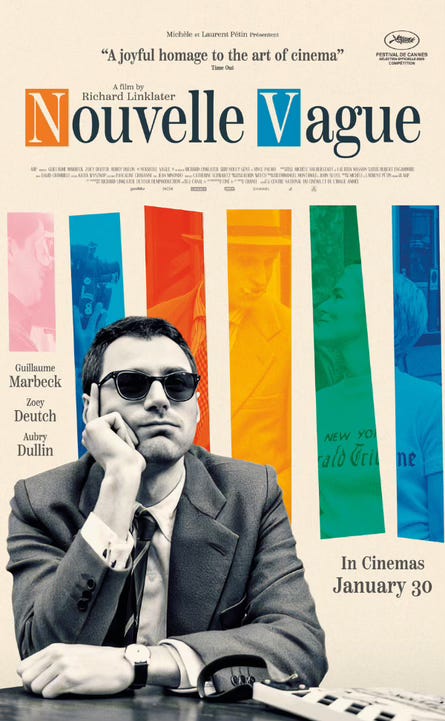
With “Nouvelle Vague”, Linklater has made a gleeful coming out as the sort of New Wave geek I’d encountered as a college student, and could never quite bring myself to be (though I secretly envied their too-cool-for-school personae). The sort of person who collects vintage back issues of Cahiers du Cinéma, the film- crit magazine where Truffaut, Godard, Claude Chabrol, Alain Resnais and other directors earned their chops as critics before jumping headfirst into directing.
The sort of person who wears dark Godard sunglasses, sixties-style Hats and suits à la Mad Men, or paints on eyeliner and grows black bangs to mimic the style of Godard’s muse and partner Anna Karina. The sort of person who knows the names of all the cameramen, production designers and makeup artists on Eric Rohmer’s most obscure film, and whose dorm room is studded with posters for Godard’s “Pierrot le Fou” and Varda’s “Cléo de 5 à 7”.
{Side note: judging from recent photos of Linklater I’ve perused online, he still cuts the figure of a scruffy, long-haired Texan progressive who spends a lot of time in Hollywood— no Godardish glasses or cigarettes in sight, so I’m being a bit glib here. Also, our living room currently features a poster of “Cléo de 5 à 7”}.
Again, I digress. I saw Linklater’s latest movie a couple of weeks ago on the big screen, and I’m so glad I made that choice. Streaming it at home wouldn’t have done it justice, nor accorded with the fact that “Nouvelle Vague” is partly a tribute to the sort of cinema-making that’s simply disappeared in the digital age.
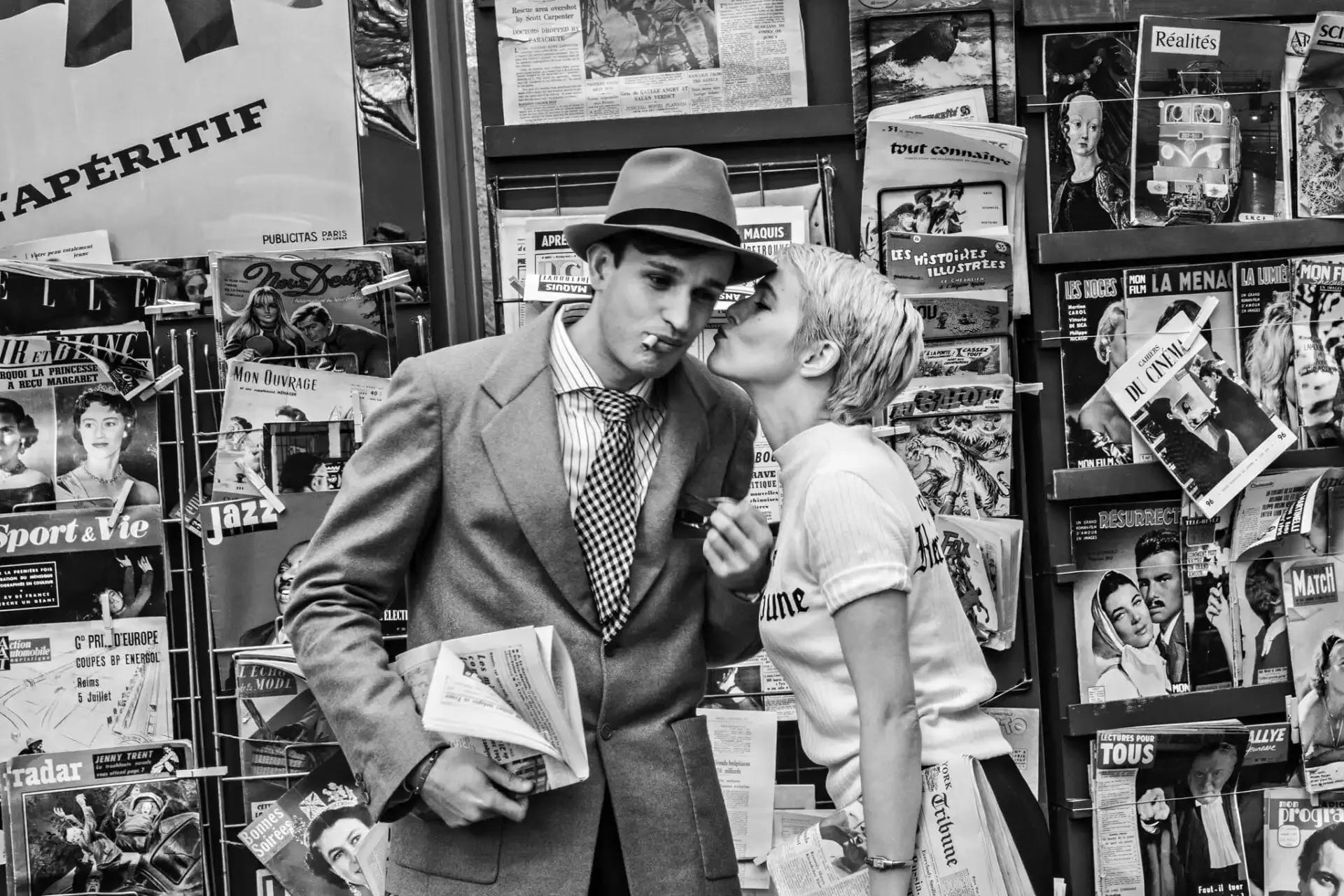
From the opening shots, it’s clear that every pain has been taken to reproduce the look and feel of late 1950s cinema, and specifically Godard’s sensually immediate, documentary-style techniques. Linklater shot the film in black-and-white, and on 35mm film— using a now rarely-used aspect ratio that narrows the image slightly and lends a more intimate feel. While it was mostly shot on digital, the analog vibes are intense: you can even see scratchy little cue marks, or “cigarette burns” appear at the corner of the screen, in a nostalgic nod to the reel change cues of yore.
Much to my relief, Linklater avoided the impulse to “Anglicize” things: the film is almost entirely in French, with a nearly all-French crew— one exception (aside from Linklater himself) being Zoey Deutch, who plays the American actress Jean Seberg and her “Breathless” character “Pah-tree-see-ah” (Patricia) to uncanny, gamine perfection.
I had to pinch myself a few times to remind myself that this was a film from an American director, because it was probably the Frenchest thing I’d seen in a long time— you could just feel it from the texture of the visuals, the pacing and spirit of the script, and the overall approach to filmmaking. “I wanted the best, most experienced French department heads we could find, and I feel so grateful to have worked with such a dedicated group. I think our sincere enthusiasm opened a lot of doors,”Linklater told Alex Kelly for Todum (Netflix).
The streets of Paris circa 1959, especially Montparnasse and an Avenue des Champs-Elysées that’s even more smog-choked than it is today, are lovingly and meticulously reproduced in the film. I have no idea how Linklater and cinematographer David Chambille filmed around the telltale clues of 21st century Paris, from wide bike lanes to vape shops, electric car charging stations and contemporary signage. Whether they used CGI (unlikely) or just cleverly staged their shots, the feeling of being immersed in Paris at the turn of the ‘60s is absolute. I guess it helps that certain areas, including Montparnasse, feature many streets, bistrots and shops that haven’t changed much at all since the late 1950s.
Linklater and Chambille also drew on an exceptionally rich cache of film documentation for Godard’s “Breathless”, including “ behind-the-scenes photography to camera reports, letters, memoirs, and interviews”. This allowed them to meticulously reproduce the sets and shooting conditions for the original film.
On to the plot (finally, you sigh!): A young, smartass film critic and wannabe director named Jean-Luc Godard is nursing an insecurity— he was supposed to have directed a feature film by the age of 25, and so far, he’s only put out a short. His friends and fellow critics Francois Truffaut and Claude Chabrol have already had well-received directorial debuts, and Truffaut is set to be lauded at Cannes for “Les 400 Coups”.
Goaded on by his chain-smoking friends, Godard (played by relative newcomer Guillaume Marbeck) heads to Cannes and pitches a producer to let him make a film based on a loose script he’d co-written with Truffaut years earlier. He’s greenlighted, but with a firm warning: it has to be entertaining— a straight-up true-crime and love story, based on a well-known “fait divers” (recent news story). Nothing too avant-garde.
A young boxer and petty criminal named Michel Poiccard (played by Jean-Paul Belmondo), misguided by his love for American gangster movies with Humphrey Bogart, steals a car in Marseille and is stopped by a cop on the way north to Paris. He impulsively shoots and kills the officer, and returns to Paris. There, he meets a young American student named Patricia Franchini (Seberg), who wants to be a reporter but for the time being hawks The International Herald Tribune on the streets of Paris, advertising the paper on her black-and-white tee. A quirky love affair, and predictable tragedy, ensues.
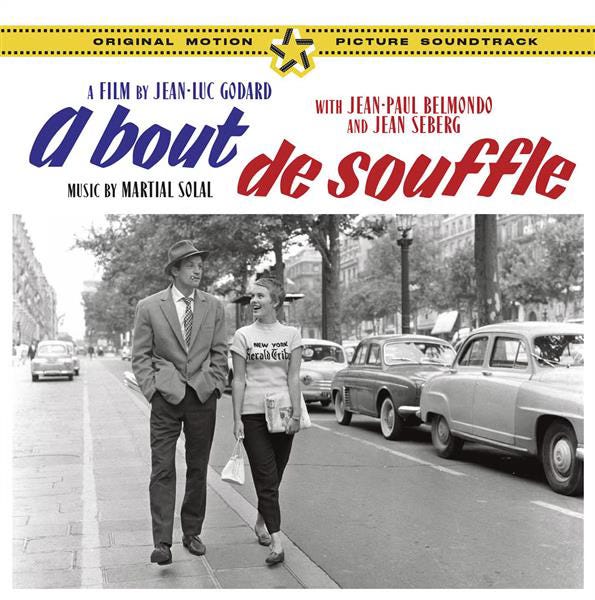
But while the story itself was at base full of familiar tropes and plot progressions, Godard’s take on it would not be predicatable— to the exasperation of his producer, actors and crew. From the beginning, the director embraces odd silences, plot holes, long, improvised scenes with little or no scripting, and renegade filming techniques that put both actors and camera crew on the spot, forcing them to work from pure instinct. He also only shoots as much as he feels like each day— and some days, that’s zero. The clock is ticking on his 20 days, and his producer is increasingly angered by the prospect that his investment will go up in smoke.
Linklater lovingly documents the making of “Breathless” as a 20-day, madcap experiment filled with moments of humor, exasperation, fortuitous moments and choices that end up— improbably— yielding a remarkable and completely original film once it emerges from the cutting room.
There’s plenty of humor here, including a scene that documents Godard’s (true-to-life) insistence that his main cameraman hide under a covered trolley and film scenes on the Champs-Elysees from a cleverly-cut hole. The fact that the film was shot with no sound and had to be dubbed in post-production also yielded amusing moments of confusion, and allowed the actors to chat about other things and even rant about their annoying director as they played the scene.
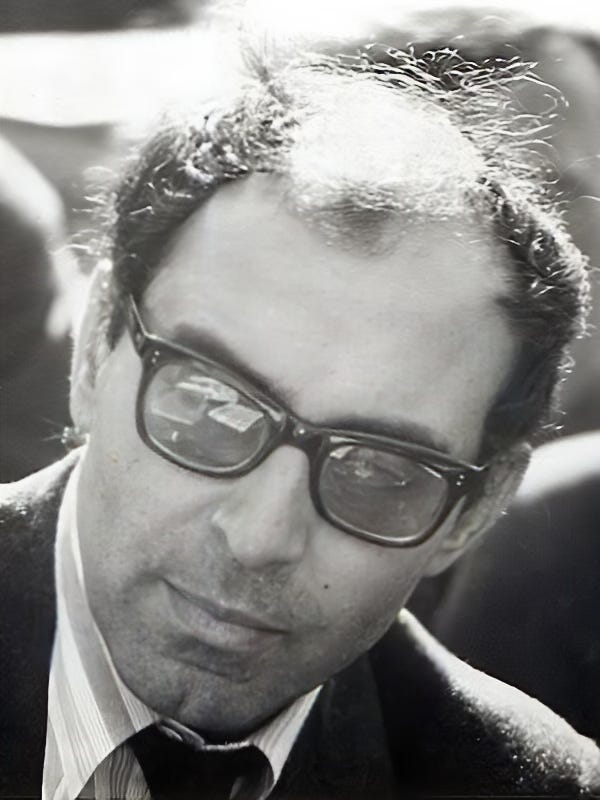
As Godard, Marbeck is dryly funny and charismatic, never once removing his dark glasses or extricating the cigarette from his mouth. He faithfully replicates the filmmaker’s Swiss-French accent and verbal tics, and delivers endless existential observations that poke gentle fun at Godard’s famous pretentiousness.
I did sort of yearn to see a less caricatural version of the director, about whom I know very little. Yet this wasn’t a biopic, nor would it have worked as one. It was a tribute to Godard’s wacky and brilliant filmmaking, so too much “backstory” or psychological probing would likely have felt misplaced.
As Seberg, Zoe Deutch masterfully embodied Seberg’s gamine physicality and charm, and the script highlights the acerbic wit behind the naive, heavily American-accented persona. Again, it might have been interesting to see something of Seberg’s vulnerability, which we glimpse in only a couple of short scenes— but perhaps that’s the task of a different film. You can read more on Seberg and her short, tragedy-strewn life in my portrait of eight American women who uprooted to Paris, then made history (at Paris Unlocked).
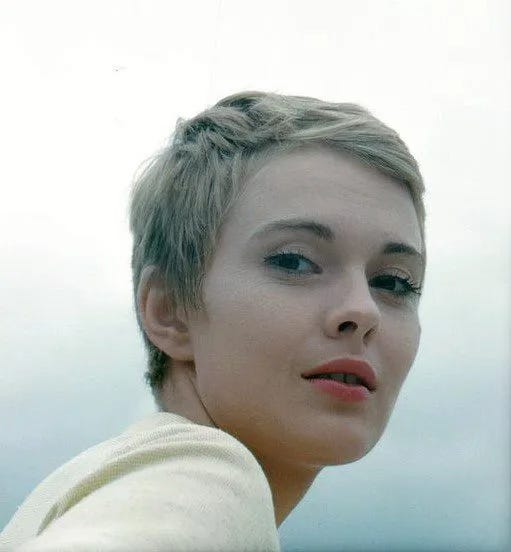
One of the things I both liked a lot about the film, but simultaneously found a bit infuriating from an audience perspective, is how Linklater periodically stops to highlight people who were important to the Nouvelle Vague movement — from critics to producers and cameramen, gaffes and editors— with brief close-ups and flashes of their names on the screen, without further explanation. Most of the time, we never see these people again over the course of the film.
On one level, I appreciated that this was his way of paying homage to the many, many people behind the making of a film or a genre. On another, it felt like a grating interruption that provided only superficial information— who are most of these people? Those curious enough can go look them up after the film ends, if their names are remembered at all. Godard would likely have appreciated the technique, as he was himself a fan of introducing irritations and breakages into his films, whether in the plot, through asynchronous sounds, or otherwise.
My overall take? Run to see this film on the big screen while you still can, o ye fans of la nouvelle vague. For those of you who haven’t yet seen “Breathless”, or who know little-to-nothing about the French New Wave, this isn’t going to be a very enjoyable film, aside from the sheer aesthetic experience. I suggest you watch, at minimum, Godard’s debut film before attempting “Nouvelle Vague”.
Taking the time to get to know a few other classics from the period would be even better. Truffaut’s “400 Coups”, Varda’s “Chloé de 5 à 7”, Rohmer’s “Claire’s Knee” and Alain Resnais’ “Hiroshima Mon Amour” are all ones I recommend. Peruse this handy list from BFI for more suggestions, and tips on where to stream.
Then again, as someone who weirdly enjoys being plunged into things and places I know nothing about, then working backward to fill in the blanks, perhaps it would be a fun ride to start with Linklater’s geeky tribute before gaining some knowledge of the original and its accompanying movement. If you attempt this, please let me know how it goes— I love these sorts of experiments.
Well, that’s about it for today’s ramblings, les ami/es. Come back next month for a March update from Paris by our Associate Editor Rachel Naismith, who will be offering all kinds of seasonal suggestions and talking about things on her radar (and tickling her palate) in the capital this spring.
Thanks so much for being part of this little community of readers. You make this sometimes-lonely endeavor more than worthwhile. And your ongoing support is so vital.
If you’re able to, please consider becoming a “Donor” subscriber or “Star Supporter”. For less than a cost of a couple of barista coffee drinks every month, you’ll get access to our ample archive of Paris and France-related features, opinion pieces, film & TV reviews, travel tips & in-depth itineraries— plus a free consultation with Courtney by email, to help you plan any future trips and offer personalized suggestions for your stay.
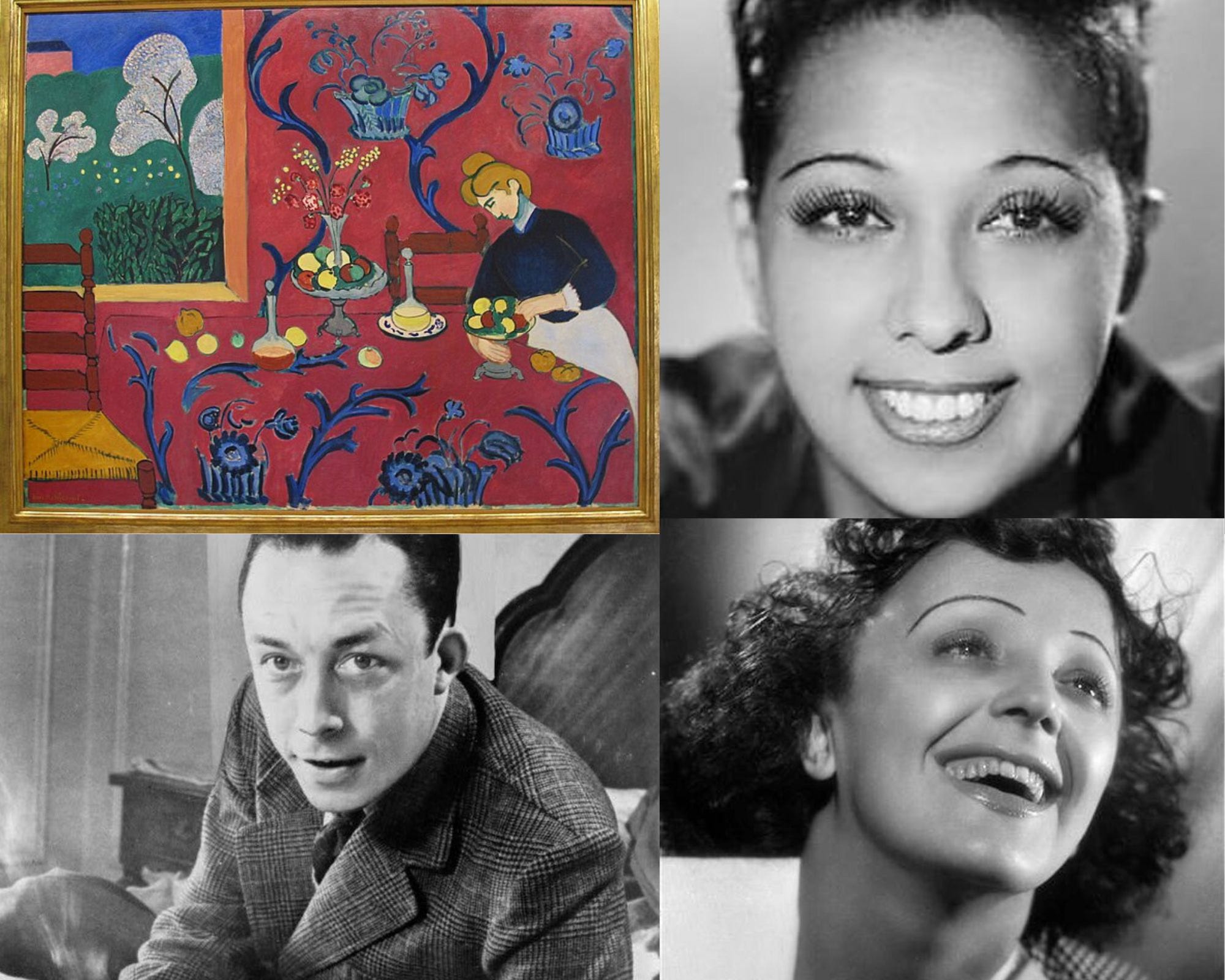
You’ll also be lending precious support to the development of my podcast project, which will explore French culture from various angles — history, food, cultural trends, the arts and literature — and hopefully be as addictive as it is informative. At the moment, I plan to drop a few first episodes for Season 1, exploring Great French Icons of the 20th Century, in early summer. The teaser image below offers some clues as to the extraordinary people featured in the series.
If you enjoy what you read here but would prefer to make a one-off contribution, you can always buy us a coffee (via Ko-fi). Whatever you can give is immensely appreciated, and will allow me to continue producing in-depth features, reviews, interviews, audio & video stories on French history, culture, art, food, news and more.
Please make sure to comment below if you’re hoping to see something in particular covered here, or at Paris Unlocked. You can also write to me here: editor@parisunlocked.com. I do my best to respond to all reader queries, comments and suggestions as soon as possible.
Comments
Nothing yet. Say the first thing.
Sign in to join the conversation.