
It’s time for another parenting deep dive! This week, I’m dissecting a facet of modern life that has tortured me for over a decade: navigating screen time. If you’re looking for an article to tell you that 17 minutes a day of TV is okay for pre-schoolers, but 24 minutes is bad, this is not the article. But if you want to feel more confident in the educated choices you make for your family around technology, you’re in the right place. This article is full of links to help you dive into the rich landscape of further reading, if you are so inclined, but my hope is that it will be worth your time as a free-standing summary of the key issues and research. Last time I wrote about screen time, I got almost no traction except a few deranged comments from an actual neo-Nazi— but my mother didn’t raise a quitter. Let’s dig in!

I’m very conscious that the dominant vibe of Substack’s parenting bestsellers is a laidback one. Parenting is hard enough and modern society makes it harder—but you’re doing great, mama! And though I would never call another adult ‘mama’, I mostly agree. Screen time, however, is a different kettle of fish. I’m going to argue that we are getting it badly wrong as a society, and we actually need a major re-think followed by radical change, even if that makes some people feel bad. More annoyingly, I’m going to argue that screen time for children is just the tip of the iceberg of a society-wide epidemic which urgently needs radical action. Sorry!
Before we get into it, perhaps I should share some of my Cool Mum™ credentials to assure Drunk Wisconsin et al that I’m not one of those universally feared neurotic mums who sit around worrying about everything. I’ve never really childproofed anything except the one cabinet that literally contains bleach, glue and an electric saw (coincidentally my favourite cabinet). I loved breastfeeding but had no qualms about my husband doing formula feeds when it meant I could sleep longer. I work outside the home and we use various childcare. No ‘content creator’ has ever conned me into buying some specific ‘educational’ toy. We have managed to travel widely as a family without worrying about discomfort or disruption to routine. I’m not saying this because all my choices are right, but simply to illustrate that I’m not a particularly jumpy person in general. But I am very jumpy about screen time.
Screen time is one of those things where the path of least resistance in modern culture (i.e. setting up a TV as the focal point of the family home and using smartphones and tablets freely around children) is woefully inadequate. And that’s a serious problem because our children’s relationship with technology is fundamental to their future mental and physical health, and the functioning of our societies at large. There is no way to Cool Mum™ your way out of this one. Getting a firm grip on screen time is about maintaining reasonably high standards for the social, emotional, cognitive and physical development of the generation that will inherit from us the management of a very complicated world. I would urge everyone to be less chill about it.
I know a lot of parents are overwhelmed, time-poor and genuinely cannot cope with being told that they’re doing yet another thing wrong. For that reason, and for that reason alone, growing in popularity is the narrative that we need to relax and just accept screens as a part of modern family life. Let me reiterate: it is not because screen time has been proven safe for small children (it has not). It is not because screen time actually makes households easier to run (screen-free families are doing just fine). It is only because the average parent spends so much of their life looking at a screen that they find the WHO recommendations for children unrealistic and get defensive about them. Of course, we’ve been here before with the ‘body positivity’ and ‘health at any size’ movements, except this time there won’t be an Ozempic to snap us out of the delusion. We either get this under control or things are going to get really bad.
One of the most touching things I’ve come across on Substack was Emily Phillips’s observation that motherhood is just about doing what you should have been doing all along. As a former ‘microwave-dinner-and-Netflix’ kinda girl, I’ve been really surprised at how much becoming a mum has motivated me to get my shit together, and how much more enjoyable my life has become as a result. Instead of seeing our children’s indisputably greater sensitivity to screens as a burden, we could re-conceptualise parenthood as the perfect opportunity to clean up our own relationship with screens for good. Our kids won’t be the only beneficiaries.
Why is there so much disagreement?
Many of us seem to be holding out for some solid data before really committing to a pathway on screen time. As ever, people love to argue that because experts disagree on the exact time limits and causality is hard to prove, maybe this is all a moral panic. Unless we get a study to back up all the ‘fear-mongering’, we can all relax! Except, of course, the study isn’t coming: there’s no useful control group, there are too many variables and most relevant data is self-reported, rendering it unreliable and impossible to compare across generations and cultures.
While my grandfather is unlikely to have self-reported ‘experiencing some anxiety’ about the impending Nazi invasion of Poland, today’s teenagers probably wouldn’t feel like their authentic selves if they didn’t report at least a little bit of anxiety! And yet there are some objective measures, like hospital admissions of minors for self-harm, that are showing us young people are increasingly mentally unwell. People are very quick to argue that rising anxiety is just a natural consequence of ‘late stage capitalism’ and ‘climate anxiety’. Even as someone who worries about climate change professionally and worries about late stage capitalism as a hobby, I am simply unwilling to accept that they make life much worse for the human psyche than the average day in 500 BC or 1935 CE. It’s the screens, stupid!
Looking at the real world, it is difficult to overstate how radically screens (among other factors) have transformed childhood. Until about yesterday, most of us spent our childhood helping around the house or roaming our neighbourhood with a gang of local friends (as always, Elena Bridgers digs all the way into our hunter-gatherer past to show this has always been the case —but most living adults around the world today, including me, enjoyed these free-roaming, outdoor childhoods as recently as 25 years ago). We were physically active, got into trouble for organising a ‘funeral’ for a fox carcass in a city park, had near-constant access to multi-age social interaction, and got an early taste of independence by being unsupervised most of the time from a young age. Being inside was a punishment.
Restless young children begging their parents for ‘more TV’ and lone preteens silently scrolling on their phones just… look wrong to me. They elicit the same feeling as a tiger frantically pacing a zoo enclosure. But if you asked those kids how they’re doing, they’d probably say they’re just fine. And if their parents already had a screen-based childhood in the 80s and 90s, they won’t be able to see the eeriness of it either. And what’s the ‘harm’, anyway? Lots of people with high screen time have successful careers and nice families. They’re not damaged in any way that shows up in socioeconomic or crime data—even if they can’t enjoy a book, they build their identity around shallow political in-groups and regularly choose reality TV over real life. Still, without cold hard data indisputably proving causality, conflicting narratives abound.
Fighting in one corner, we have the leading educators, psychologists and paediatricians who have a holistic understanding of children’s developmental needs, scrambling around for grants to support their difficult but necessary research. In the other corner, it’s the multibillion dollar industry whose sole purpose is to keep more people glued to screens for longer, in return for subscription and advertising revenue. This is not an equal fight and there’s no moral equivalence, but taking our children’s side is simple. The ask here is not for everyone to move to a hut in the mountains and live off-grid. It’s simply to put your smartphone away unless you really need it, read paper books and newspapers instead of scrolling, and physically de-center the TV from family life. That is enough to create an environment in which kids play independently and aren’t constantly begging their parents to watch another episode of Craig the Schizophrenic Bunny. But even this feels like a high bar for most families: and that is a huge issue.
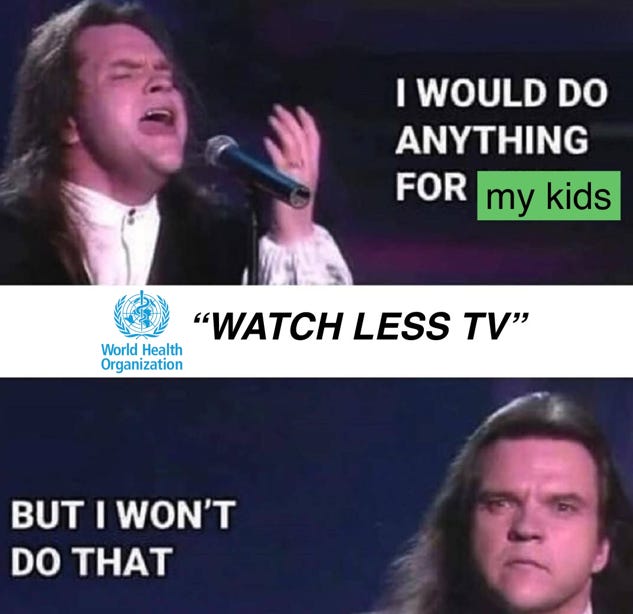
While I completely reject the idea that we should pretend-lower health standards because they’re hard to achieve, I do think we can learn from the obesity-epidemic-turned-body-positivity movement: the issues are primarily cultural and environmental. Telling screen-addicted parents who wind down in front of the TV after work and then doom scroll themselves to sleep to limit their child’s screen time to X minutes is like telling a yo-yo dieter with morbid obesity to ‘eat well and exercise’. We need targets, but we also need clear information and workable strategies. We have to really understand why it’s so hard for families to cut down screen time. We must tackle it from a cultural, societal and family-system perspective and propose effective lifestyle interventions that make life easier. But ultimately, as anyone who has ever lost weight will know, positive change always takes some resolve and hard work. Meaningfully reducing screen time is no different, but it is worth it.
The television and its victims
I always find it useful to be reminded of the sheer magnitude and range of impact of the screen-based world: the way our anatomy, cognition and relationships have shifted to accommodate screens, the way our entire society has grown around the screen like a vine around a tree.
Comments
Nothing yet. Say the first thing.
Sign in to join the conversation.