
Here’s quote for modern parenthood if I’ve every heard one:
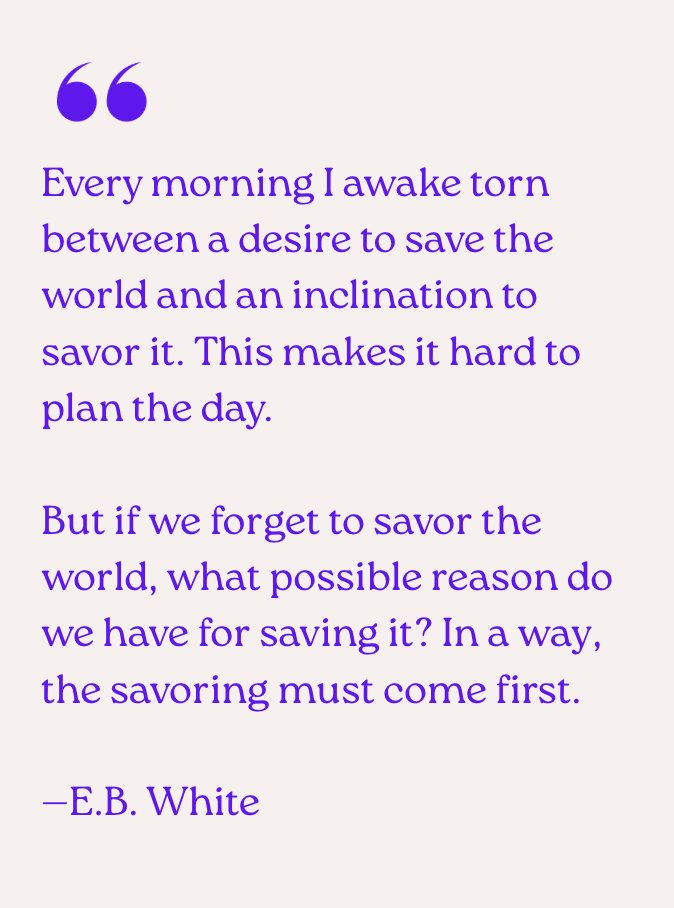
I arise in the morning torn between a desire to improve (or save) the world and a desire to enjoy (or savor) the world.
This makes it hard to plan the day.
― E. B. White
The other day, I made a list of “major events” since my oldest child was born in 2011 — just a quick-write of what immediately came to mind, no googling.
Sandy Hook Shooting, Hurricane Sandy, Boston Marathon Bombing, Brexit, Election of Trump, Hurricane Maria, #MeToo Movement, COVID Pandemic; George Floyd murder; January 6 Attack ; Russian invasion of Ukraine; October 7 and all the followed; Maui & LA Fires; ICE raids in Minneapolis (and other places); War with Iran; Rise of AI . . .
+An average of 600 mass shootings a year in the US (including Parkland, Uvalde, Pulse, Las Vegas Strip. . .
+All the news on mental health concerns, loneliness epidemics, climate crises, etc.
In aggregate, it’s a pretty heavy list and decidedly incomplete.
All this and more has been the backdrop of my parenting for the last 15 years.
There is a second half of E.B. White’s quote:
But if we forget to savor the world, what possible reason do we have for saving it?
In a way, the savoring must come first."
I believe that one of the best gifts parents can offer their kids is perspective. This is true in the micro — when kids get cut from a team and are convinced they will never feel better — and in the macro, when they are overwhelmed by all they see and hear in the world.
This is where I usually turn to Jamil Zaki, the director of the Stanford Social Neuroscience Lab and author of the book “Hope for Cynics: The Surprising Science of Human Goodness.”
In an interview, Zaki told me that when adults “focus kids on the negative – on the worst parts of life and the worst parts of humanity – we’re going to end up shrinking their world, making it harder for them to trust, and making it harder for them to explore, take risks, and form relationships.”
Zaki defines savoring as “noticing the good stuff as it happens.” Paying attention to that first bite of a favorite food. Pulling over to look at the rainbow. Noticing someone being kind or brave and pausing to feel that wonder and appreciation.
As Zaki told me, many of us get our news through the “shredder of social media.” Scary stories can feed our worst perceptions about what people are like and cause us to overestimate dangers. “Hope isn’t a matter of tuning out and burying our heads in the sand,” said Zaki. “Hope is a matter of paying closer attention and focusing more intently on what the world has to offer. Hope is a response to data.”
In fact, researchers have found that humans generally tend to underestimate human goodness. Studies find, in concrete ways, that people choose to help strangers they had never met. Zaki’s research has found that “most people value compassion over selfishness.” This matters. If our kids believe most people in the world don’t care about pressing issues or about helping others, hopelessness follows.
We are wired to remember the tough stuff — survival instinct and all that — so making a companion list of more hopeful world events in the last 15 years took a little more time. But the exercise was worth it, and it barely scratches the surface of “good news.”
We have new (or vastly improved) vaccines for RSV, Shingles, Dengue, COVID 19, and Malaria(!!!!) — mRNA vaccines may help prevent pancreatic cancer. AIDS-related deaths have been cut in half. Childhood mortality rates have hit an all-time low. Cancer survival rates are climbing. Mental health is taken more seriously. Global extreme poverty fell below 10% for the first time in history (but is still too high).
NASA’s Curiosity rover landed on Mars. The James Webb Telescope gives us breathtaking images of our universe. The Artemis crew gave us Moon Joy. Giant pandas are no longer endangered. Green turtles are in recovery. Alternative fuel is becoming more mainstream. The Ozone layer hole continues to shrink. Amazon deforestation has dropped sharply since 2023.
Malala won the Nobel Peace Prize. Young people took to the streets during Arab Spring, in Hungary, after Parkland, to push climate policy, etc. Global literacy rates are at 87%. More girls are in school in sub-Saharan Africa than ever before. Print books sales are up (and there’s been a massive resurgence of independent bookstores in the US since 2020). Community giving/support has flourished after nearly every major disaster. Neighbors still help neighbors — even neighbors who live in different countries.
So here’s that whole quote again. Because the answer is both/and.
No posts
Comments
Nothing yet. Say the first thing.
Sign in to join the conversation.