
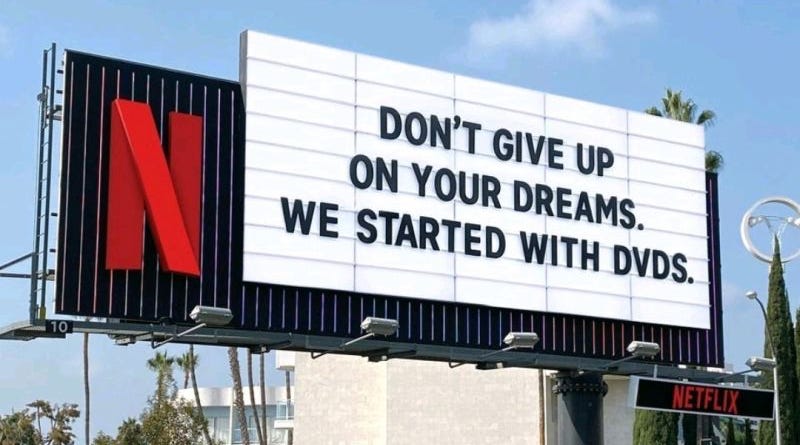
In 2021, Netflix put up a billboard in Hollywood that read:
DON’T GIVE UP ON YOUR DREAMS. WE STARTED WITH DVDs.
Take a moment and let that message sink in.
Three business models in just over a decade — DVDs, streaming, original production — each one a reinvention of what came before.
The billboard is neither defensive nor nostalgic. Just: we were that, now we're this. And the distance between the two is the whole story.
Most organizations can’t do that. Not because they lack the wit to write the billboard, but because they’re still in their own version of the DVD business and they know it. And yet they can’t bring themselves to let go.
Here’s the thing about a model whose time is running out: a slightly better version of it won’t save you. It won’t just fail to make a difference, it will distract you from taking the leaps you actually have to take.
I wrote this in Leaders Leap and I’ll keep writing and speaking about it until it stops being true. Which, sadly, and for so many organizations, doesn’t appear to be anytime soon.
The faster horse and the best blacksmith tend to get invoked separately. The faster horse as a cautionary tale about listening too literally to customers. The blacksmith as shorthand for obsolescence.
I want to talk about what happens when they show up together which, in my experience, can be quite often.
Henry Ford is credited with the line: “If I had asked people what they wanted, they would have said faster horses.” While Ford was reinventing transportation, the best blacksmith in town was thriving. Great reputation. Loyal customers. Refined craft.
Until he wasn’t.
Blockbuster wasn’t brought down by bad management. They ran a tight operation. Clean stores, a great selection, loyal customers: a model they spent years perfecting.
Netflix didn’t build a better video rental store. They made the video rental store irrelevant. Customers didn’t want a better way to drive to a store, find a movie, and pray they returned it on time. They wanted an evening of entertainment.
Airbnb didn’t build a better hotel. They rewired the entire supply side of where you sleep when you travel.
Uber didn’t improve the taxi. They rebuilt what it means to get from point A to point B.
In each case, the incumbents weren’t beaten at their own game, the game changed. And they kept playing the old one better as fewer and fewer people showed up to watch it.
That’s the blacksmith trap. Not failure, but excellence that became irrelevant or unseen. World-class execution of something the world was quietly leaving behind.
The other trap is subtler. And in my experience, more widespread.
When real change is coming — when customer desires are shifting, when a disruptive model is gaining traction somewhere out on the edges — the instinct of most organizations is to optimize what they already do. Listen harder to current customers, improve current products, and work tirelessly to close current gaps.
In Leaders Leap I call this infinite incrementalism. It feels like great management and it produces results you can defend in a board presentation.
And it almost always sends you down a road to nowhere.
Here’s the problem: customers can tell you what they want more of but they can’t tell you what they haven’t yet imagined. Ford’s customers wanted a faster horse because a car wasn’t in their frame of reference. Blockbuster’s customers wanted more titles and better late fees right up until they didn’t want any of it.
The faster-horse approach optimizes for the world as it is. Disruptive models solve for the world as it’s becoming.
Most legacy organizations never make that shift. Not for lack of talent or money but because the current model is still working well enough and the new one means cannibalizing what you’ve built, betting on an uncertain future, and accepting that your best customers today may not be the ones who matter most tomorrow.
That’s genuinely hard to do when the board is watching and the quarterly clock is ticking.
None of this happens in a vacuum. Organizations are run by people, and people are wired to defend what made them successful.
In Leaders Leap I call it “executive ego dysfunction.” Past success quietly reinforces how leaders read the present. The model that built the career becomes the model that gets defended. The instincts that were rewarded become the ones that get trusted, typically long past their sell-by date.
“The truth you believe and cling to makes you unavailable to hear anything new.”
- Pema Chodron
Clayton Christensen nailed the structural version of this in The Innovator’s Dilemma. Incumbents aren’t irrational. They’re doing exactly what good management looks like: listening to their best customers, protecting their most profitable lines, optimizing the core. The tragedy is that all of it is exactly wrong for a world in the middle of a fundamental shift.
The antidote is what Zen Buddhists call shoshin — beginner’s mind. Zero attachment to being right and a genuine willingness to ask whether what you’re defending is what actually wins the future.
This can be brutally hard to do, especially for people who’ve spent careers being rewarded for certainty.
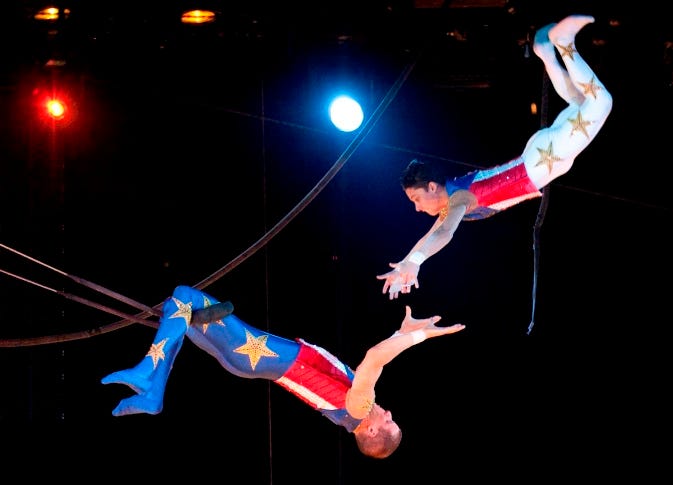
I’ve written before about the timid trapeze artist and Seth Godin’s observation that you can’t get to the next rope if you’re still holding on to this one. The trapeze piece is about the fear and psychology of letting go. This one is about what you’re letting go of: a model the world is walking away from, optimized to within an inch of its life, defended with everything you’ve got.
The best blacksmith never saw it coming. Not because he wasn’t paying attention or because he lacked skill, but because being world-class at something the world is leaving behind isn’t a competitive advantage, it’s a trap. A comfortable, well-crafted, thoroughly decorated trap.
Actually it’s two traps: the faster horse and the best blacksmith, showing up together more often than most leaders want to admit.
The question worth sitting with — genuinely, not just nodding at — is simple.
Are you getting better at the right thing or are you just getting better?
"Retail's Great Concentration" is accelerating. Just six retailers now capture the majority of industry growth, and the structural forces behind it aren't slowing down.
PLUS: Tapestry delivers strong earnings, Warby Parker shows profitable growth, and GameStop bids for eBay in what is likely the dumbest retail story of the year. Listen here or watch on our YouTube channel.
Book a 1:1 Advisory Call. I’m now on Intro.co for focused, high-impact sessions. Secure time here.
Bring Me to Your Next Event. I’ve delivered keynotes at industry conferences on six continents and spoken at corporate events, customer dinners, and book signings around the world. Reach out at events@sageberryconsulting.com.
Buy a book. Remarkable Retail is the best-selling, highest rated, retail strategy book of the past decade. Leaders Leap will help you navigate the choppy waters of disruption.
Comments
Nothing yet. Say the first thing.
Sign in to join the conversation.