
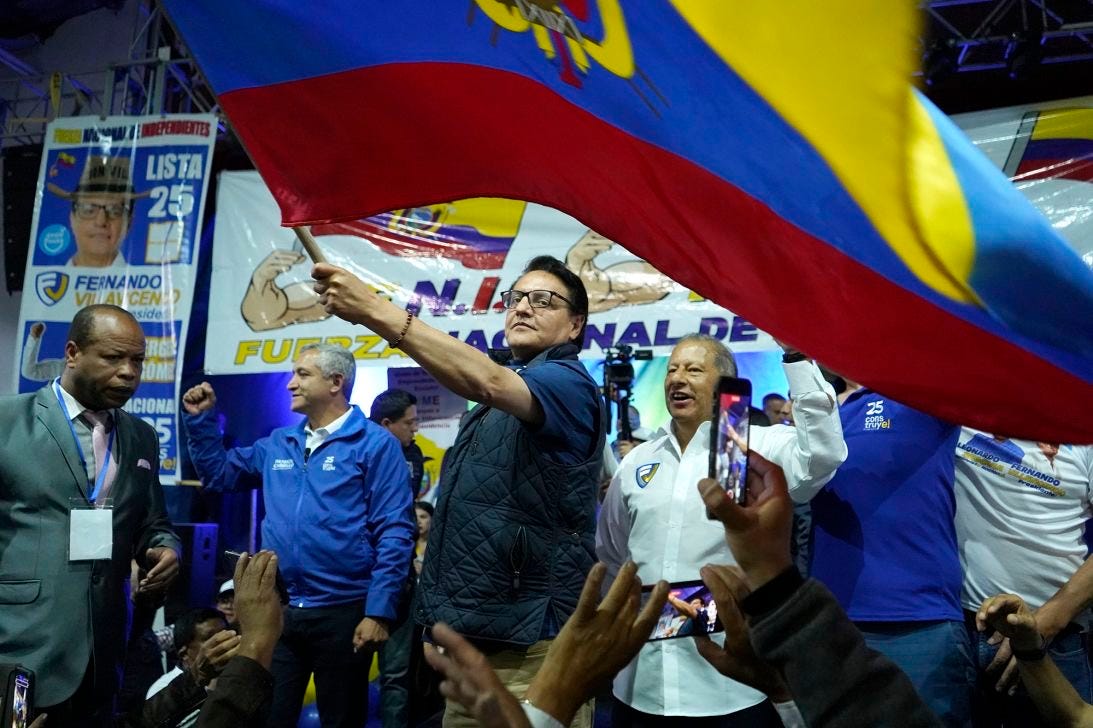
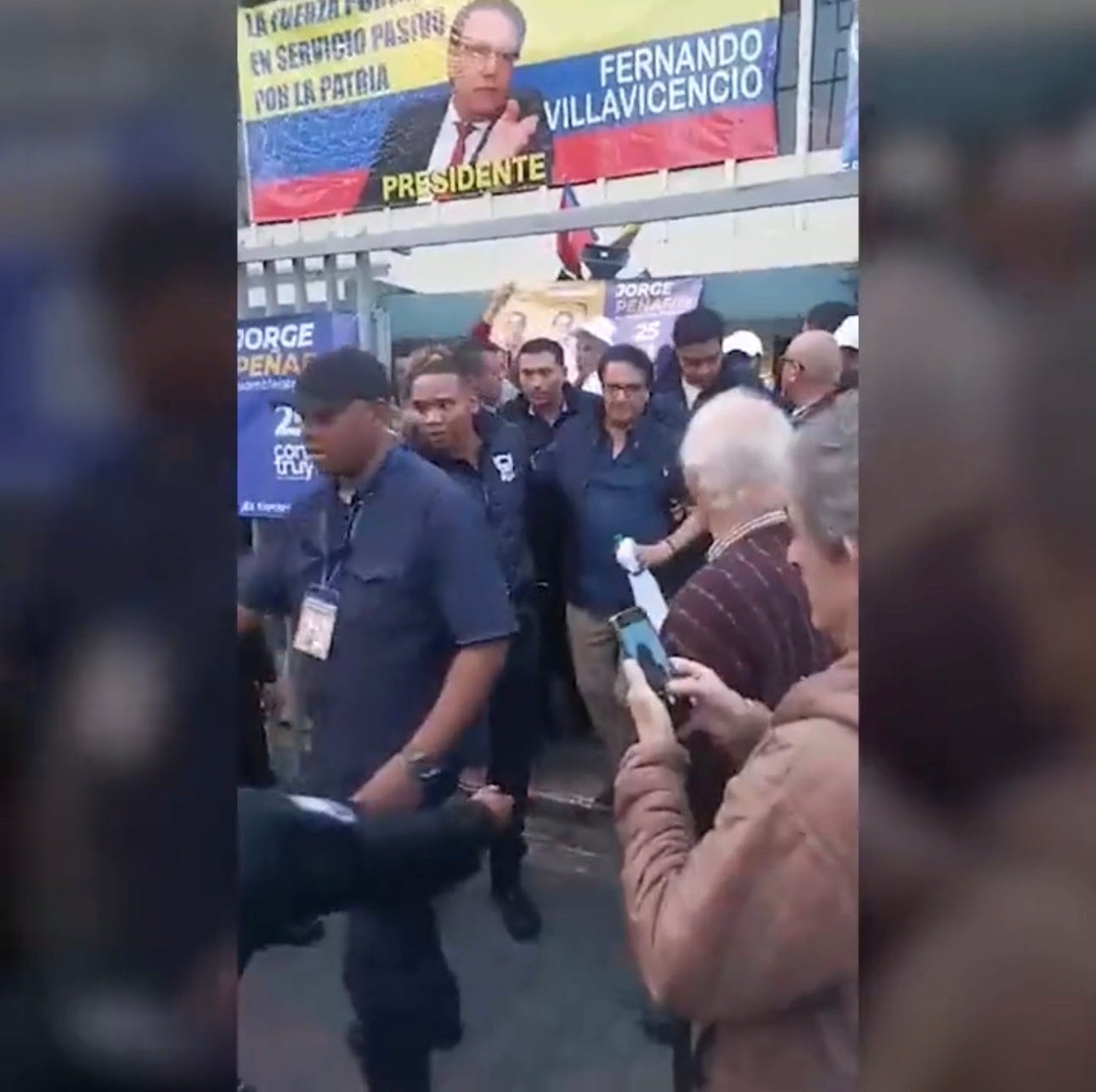
On 08/09/23, at the tail end of a geopolitical epoch that feels like a lifetime ago already, the Ecuadorian presidential candidate and anti-graft investigative journo Fernando Villavicencio was riddled with lead just as he was ushered through a scrum of supporters outside of a school in Northern Quito and into a loitering vehicle. To help conceptualize this for readers / viewers in the Burger Reich, the Villavicencio Hit is considered the most notorious, high-profile assassination in Ecuador’s modern history, something relatively on par with the JFK clipping, a level of political terrorism heretofore unseen in a country that had long been viewed as a not-particularly-homicidal oasis pacifico insulated away from the regional drug wars and factional violence that have so often rankled the countries of Caribbean Sudamerica and the Guiana Shield. Villavicencio’s death caused Correa, the figurehead-in-exile of Ecuadorian Socialism of the 21st Century, to inveigh against the incident, which he said confirmed Ecuador’s status as a “failed state”.
Even a superficial stab at an analysis of the Villavicencio Assassination inevitably collapses into a convoluted tale, such is the wilderness of mirrors that is Villavicencio’s biografía, the sprawling he-said-she-said of the unresolved conspiracy, the competing insinuations of culpability, and the fact that those bullets are like a fulcrum frozen in time upon which the recent history of Ecuador swings. Such is my burden to sally forth all the same.
Fernando Alcibíades Villavicencio Valencia was born in the provincia whose namesake is Ecuador’s tallest volcanic peak: Chimborazo. He was one of the founders of the indigenous, progressivist movement known as Pachakutik (its electoral arm -> CONIAE) which formed in 1995. The year following his entrée into politics, he was hired by Petroecuador, first as a comms officer before transitioning into a relatively brief career as a union steward and then the leader of the Federation of Oil Workers (Fetrapec), which ended with his dismissal by Pres. Jamil Mahuad’s administration in 1999 (more on him later). His severance was generous, possibly in a bid to keep him quiet over his irregular removal—Mahuad would be shown the door in an irregular fashion himself not long after.
Villavicencio set about building a career in the realm that would see him stake his claim to fame: investigative journalism. He wrote for Guayaquil’s paper of record El Universo and then eventually established his own, somewhat Intercept-esque local outlet that pays particular heed to public sector corruption in Ecuador and which employs a number of his family members. He made his reporting name as an outspoken, virulent critic of Ecuadorian governments, beginning with Mahuad’s successor Gustavo Noboa and culminating in his multiyear crusade against Rafael Correa, the nemesis with whom he locked horns most regularly.1
Speaking of which, while it can confuse things at this early hour, it’s critical for you to know that many among the Ecuadorian Left have long suspected Villavicencio was a pawn of the American government, with TeleSur accusing Fernando Villavicencio and his frequent collaborator Christian Zurita, his eventual replacement on the ballot, of being CIA operatives in a 2016 documentary. Villavicencio made snide remarks joking about his CIA and FBI relationships less than a year later. Leaked messages between America-friendly Prosecutor Diana Salazar, a Noboa ally, and a former Correa apparatchik named Ronny Aleaga have confirmed what was long suspected, though, with Salazar not only privately acknowledging that Villavicencio was an American informant but also revealing that she’d colluded to shitcoat Correa’s Revolucion Ciudadana party as the orchestrators of the assassination at the U.S.’s behest, signaling strongly that the Americans may have wanted Noboa in the presidential palace all along.
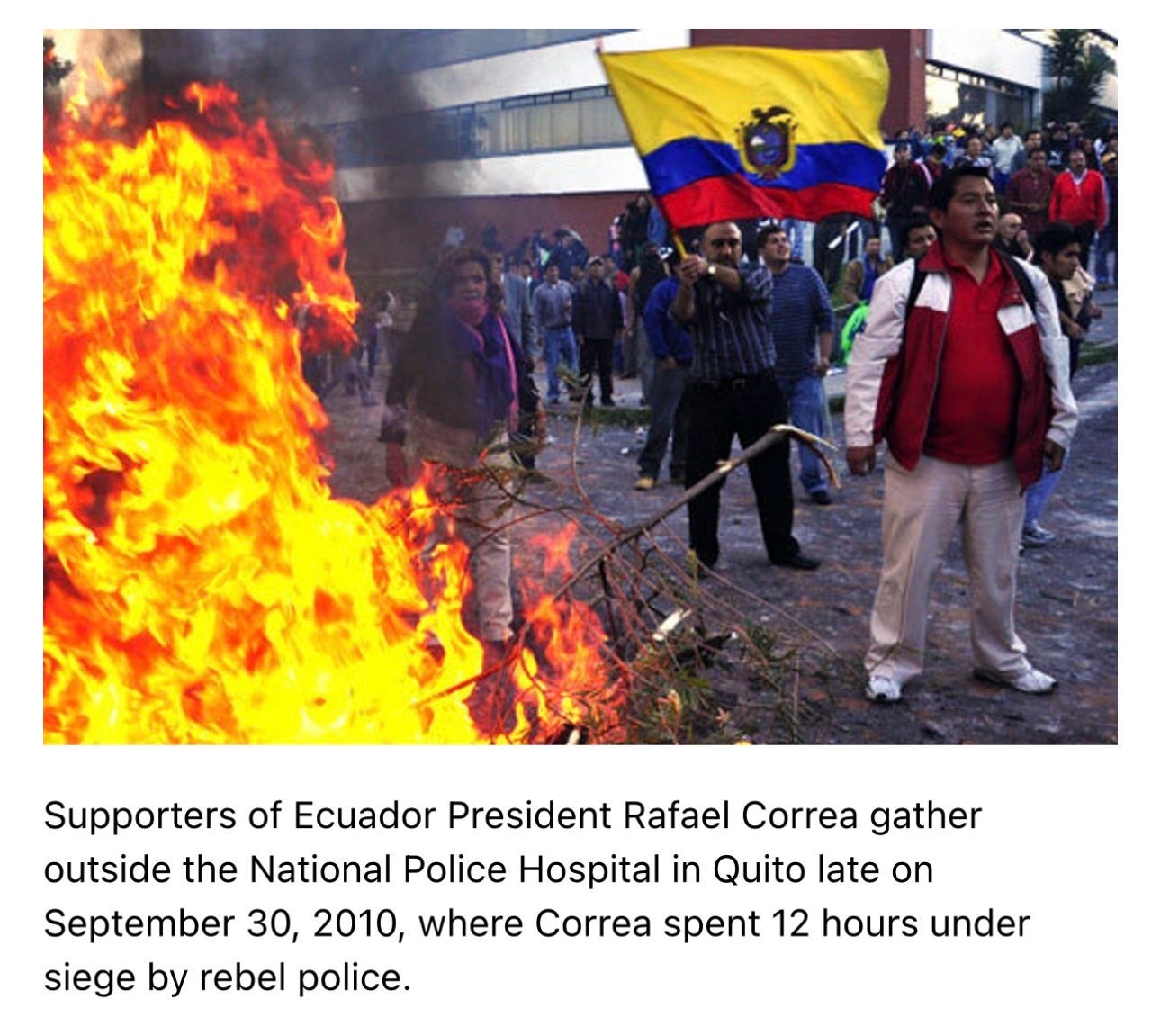
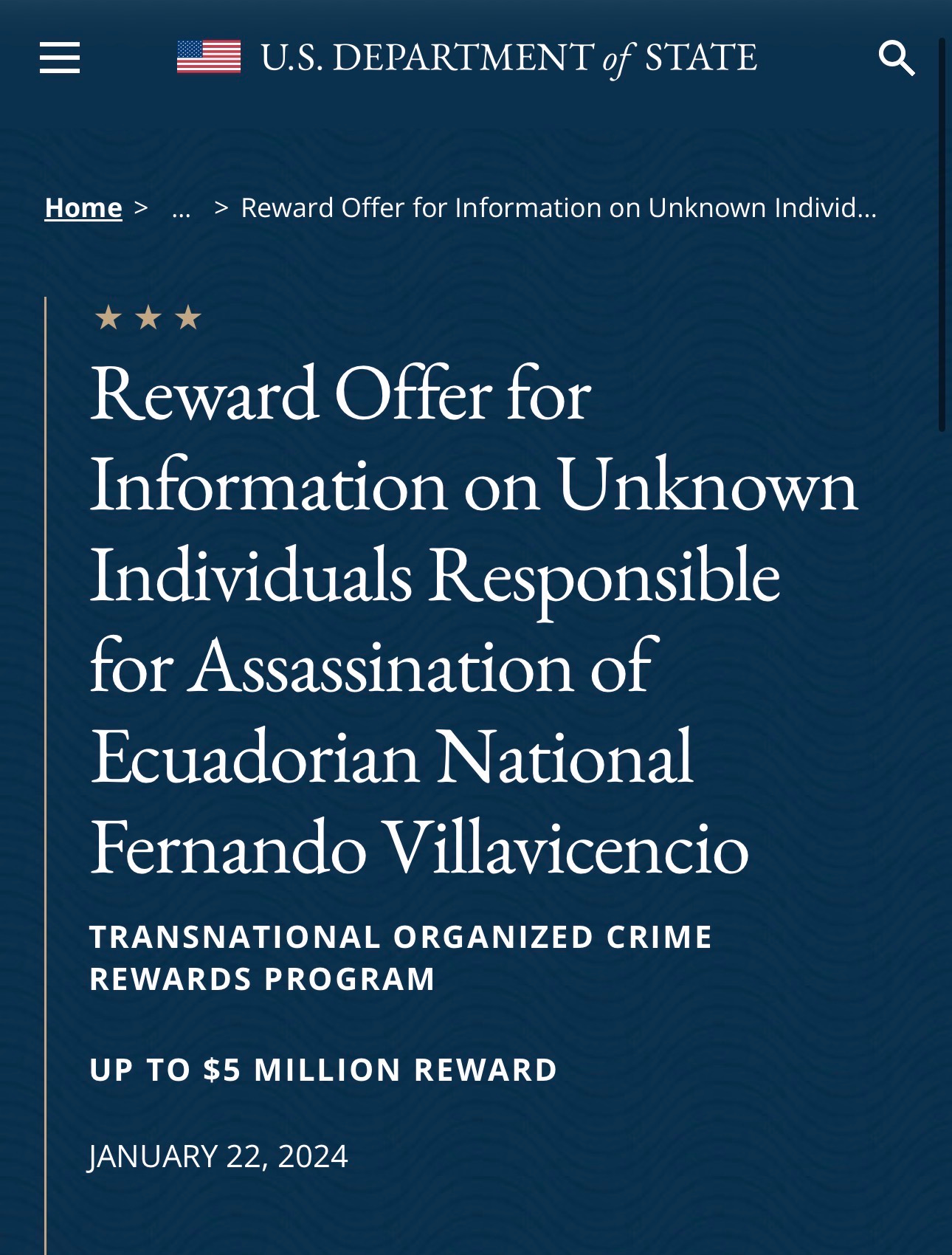
The notion that Villavicencio was an American asset is bolstered by the fact that he laid the dead and wounded of the Police Uprising of September 30th at the Correa admin’s feet, accusing them of murderous intent, when the DemSoc government’s line all along has been that it was a failed coup against them. After lodging these charges, Villavicencio departed for the States in hopes of gaining succor from the Inter-American Court of Human Rights and a precautionary ruling to stave off possible charges against him. When he returned to Ecuador, the standoff between him and the Correa government still wasn’t resolved, so he ended up evaporating into the Amazonian jungle, a fugitive from justice, where he remained until his warrant expired. The theory is also bolstered by the fact that three FBI Field Offices (Miami, NYC, Houston) were tasked with investigating his killing and the State Department issued a $5 million dollar reward for “information” on the “unknown individuals responsible”. Rarely does the US’s State Department & law enforcement invest their largesse in a search for posthumous answers unless they had a vested interest in the deceased.
In the latter years of his journalism / propaganda / psyop career, Villavicencio waded into the Julian Assange diplomatic impasse, a saga that Ecuador’s Correistas played a central role in by virtue of hosting Assange in their London Embassy for years. Villavicencio disclosed detailed security logs on the captive WikiLeaker and tried to drive the Correa government and Assange apart by seeding stories about an Italian surveillance company they’d allegedly enlisted to spy on their asylum guest. In December of 2018, he also served as a sketchy source and co-author of a Guardian piece that claimed Assange and former Trump campaign manager Paul Manafort had a sit-down in the Embassy, a claim that elicited a retort from WikiLeaks dubbing Villavicencio a “serial fabricator”. Epstein facilitator and trustee Richard Kahn emailed the Boss, Jeff the Financier, a link to the piece.
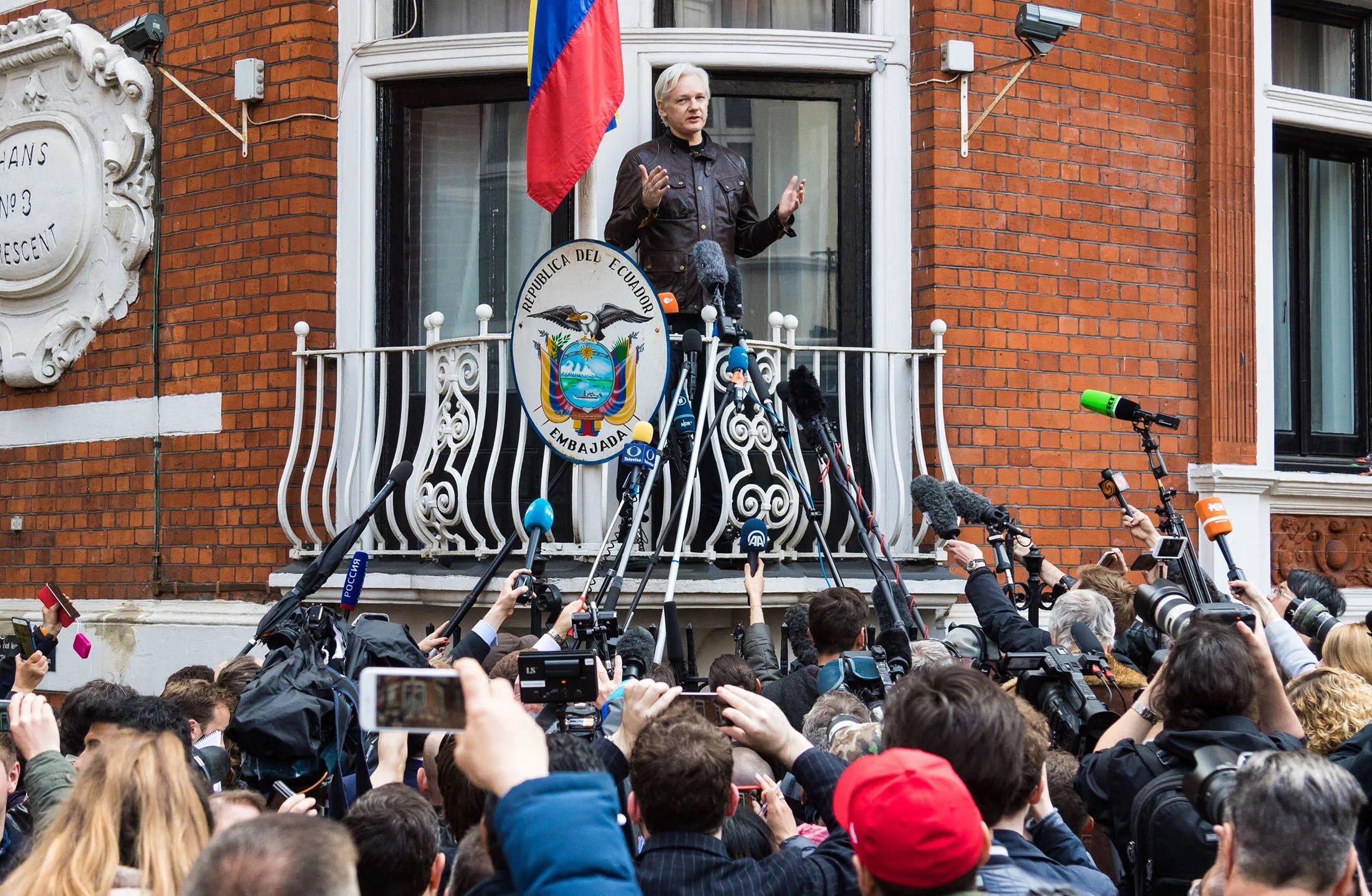
As we proceed, I believe we’ll elucidate dense sinews formed out of a Secret PsyWar of Information and Anti-Corruption “Transparency” that spans Ecuadorian history since dollarization and which has applied a shocking degree of influence over their domestic politics and foreign diplomacy. As with everything, it’s complicated. There’s an intriguing, somewhat internecine feud at play in this tale between, on the one hand, a classically liberal class of Ecuadorian reporters and muckrakers including ICIJ members and Fernando Villavicencio who inhabited the role of useful idiot for the American parastate by leveraging the Panama Papers and other tranches to shitcoat Ecuadorian socialism as a den of financial iniquity and bribery… 2 And on the other side, you had the Correa government and their long term Embassy subletter Julian Assange who accused the ICIJ of harboring biased political motives behind their scrutinizing of Correa-era state companies and of gatekeeping the documents from the public, an approach very much at odds with WikiLeaks’ MO and in keeping with that patronizing deference to intellectual authority and expertise that’s endemic to the petite bourgeois intelligentsia and which so often runs cover for limited hangouts. Assange specifically leveled the accusation that the Ecuadorian ICIJ team was being financed by the Americans because of the identity of one of their media partners.
An aspect that’s particularly fascinating about this, aside from the whole Assange episode being emblematic of Correismo’s newfound diplomatic combativeness towards the States, is that Epstein had an abiding interest in Assange, Wikileaks, Snowden, and the hacktivist citizen journalism and whistleblower milieu of the late Oughts and 2010s. 3
(See: End Notes in Pt. II for an incomplete chronology).
And with good reason. On July 18, 2019, while still-kicking Epstein supposedly languished in the MDC awaiting bail hearings, the International Consortium of Investigative Journalists (ICIJ) released an article showing that Epstein’s fortune linked back to a Bermuda-based shell company titled Liquid Funding Ltd. that he jointly owned with Bear Stearns, a shell that was reportedly a receptacle for the kinds of “mortgage-backed securities” and “collateralized loan obligations” that became synonymous with Steve Carrell’s most apoplectically repulsed facial expressions in The Big Short. The source for this revelation was the 2017 Paradise Papers that publicized the existence of 13.4 million confidential digital docs that contained evidence of tax evasion and offshore misfeasance by the bourgeoisie on every continent, the docs themselves appropriated—perhaps plundered through a cyberattack—from the offshore law firm Appleby, two corpo service providers, and biz registries in 19 tax havens.
Is it apparent yet why Epstein would keep tabs on Assange and the ICIJ? There are myriad reasons, not least that the hacktivist milieu were exhibiting a growing interest in the architecture of the leviathan offshore web of interlocking shells, trusts, and tax shelters that the Epstein Class stow their ill-gotten moolah in—put differently, one of Epstein’s primary livelihoods and areas of expertise was tax evasion and money laundering advice for the white collar / organized criminal. Unless such hacktivists could be corralled or bought off or until a time at which they’d been neutralized, they would pose an enduring threat to Epstein’s Empire, particularly in the climate post his ‘08 plea deal conviction (the general starting point of Epstein’s hiring of hackers for assistance with online search result suppression, Wikipedia back-end boobytrapping, downvoting, etc to cover his tracks).
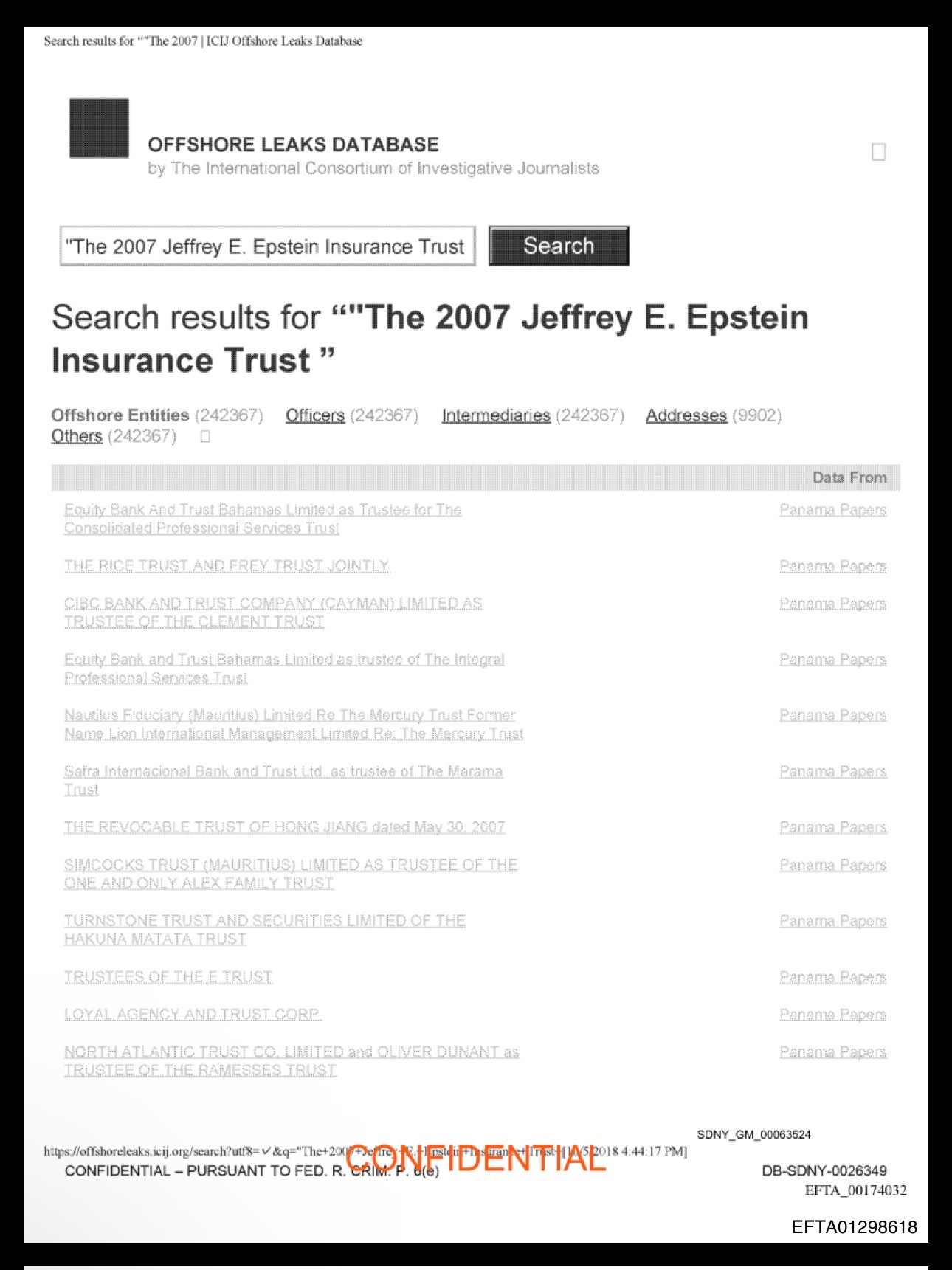
That the feds went searching for ICIJ hits stemming from the 2007 Jeffrey E. Epstein Insurance Trust—a tax-advantaged vehicle that allegedly held a $25 million life insurance policy the trustees were to dispense to the listed beneficiaries upon Epstein’s death—among numerous other front and shell companies in Oct. 2018 would have doubtlessly garnered Epstein’s concern.
Similar developments that would have been flagged by Epstein and his associates include the two sets of offshore-related document tranches given to WikiLeaks by a Swiss banker named Rudolf Elmer. The first occasion in 2008 saw the former Bank Julius Baer (JB) employee leak documents pertaining to the bank’s Cayman Islands offshore system, which caused a U.S. Judge to order a temporary shut down of WikiLeaks. The second occurred in 2011, with Elmer, Assange, and a representative of the Tax Justice Network holding a joint presser in London as the Swissman passed two computer discs laden with dirt on 2000+ elite, tax-evading clients spanning the globe to the WikiLeaks founder. For some reason, whether vetting concerns or fear of retaliation as the legal storm around WikiLeaks brewed, the details never reached the public, although they may have been grandfathered into a subsequent ICIJ leak without fanfare.
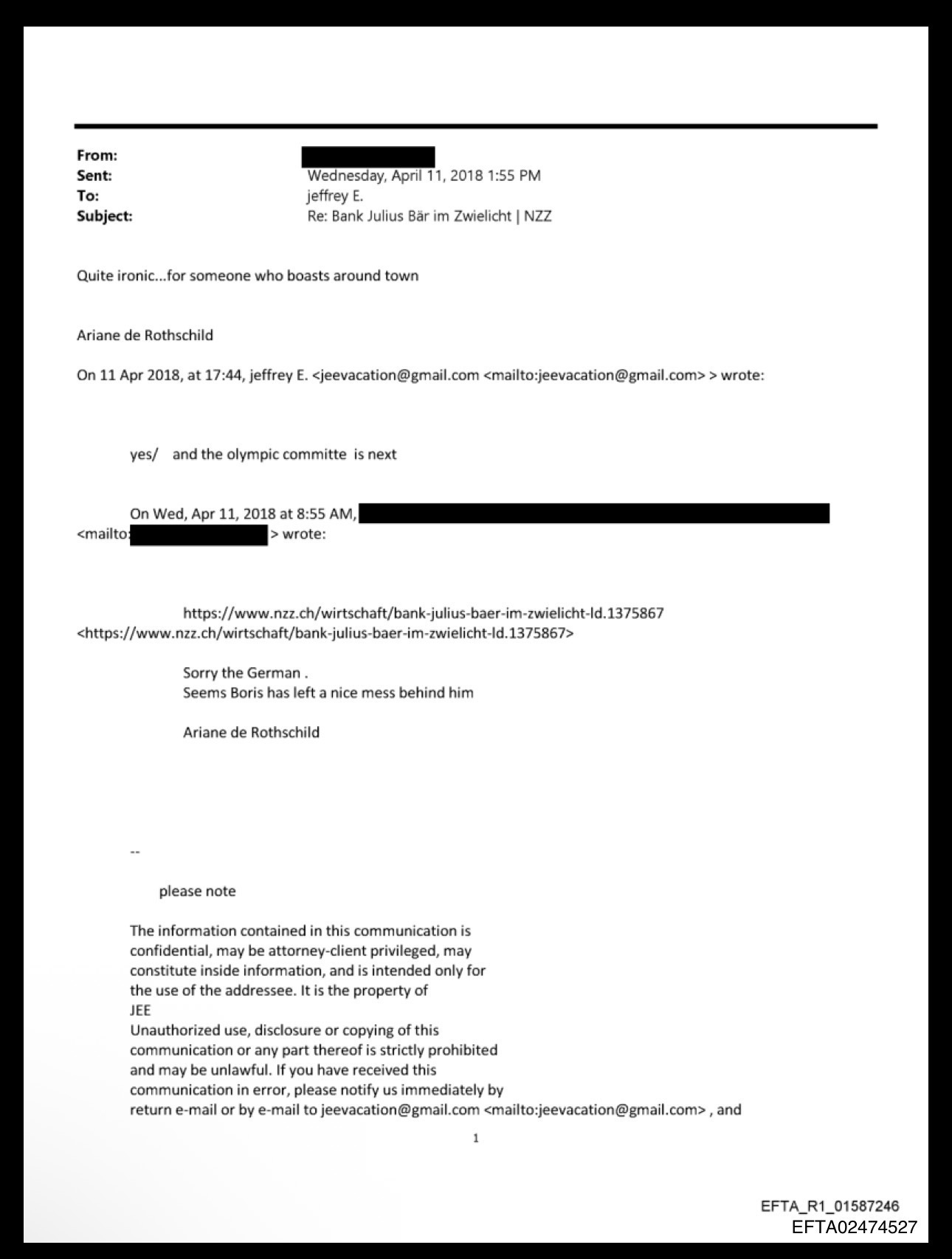
A cursory search in the Epstein Files quickly surfaces an email from Ariane de Rothschild to Epstein linking to a story in the German press about how Bank Julius Baer were scrutinized over their disregard for compliance when accepting Venezuelan PDSVA (state energy co.), FIFA-linked, and Russian clients—all regions or stories to which Epstein’s connected due to his emergent role as the go-to AmerIsraeli guy for infiltrating or attempting to recruit the ruling classes of “enemy states”, a niche inherited from his predecessor Robert Maxwell. Anyways, in the email, Ariane seems to scoff at Boris Collardi’s mismanagement of the massive Swiss financial institution, taking schadenfreude satisfaction. Her animus doubtlessly stemmed from the collapsed merger of JB and Edmond de Rothschild Group, a deal Epstein attempted to negotiate on her behalf. The paper trail seems to indicate Ehud Barak was party to this proposal, as well.
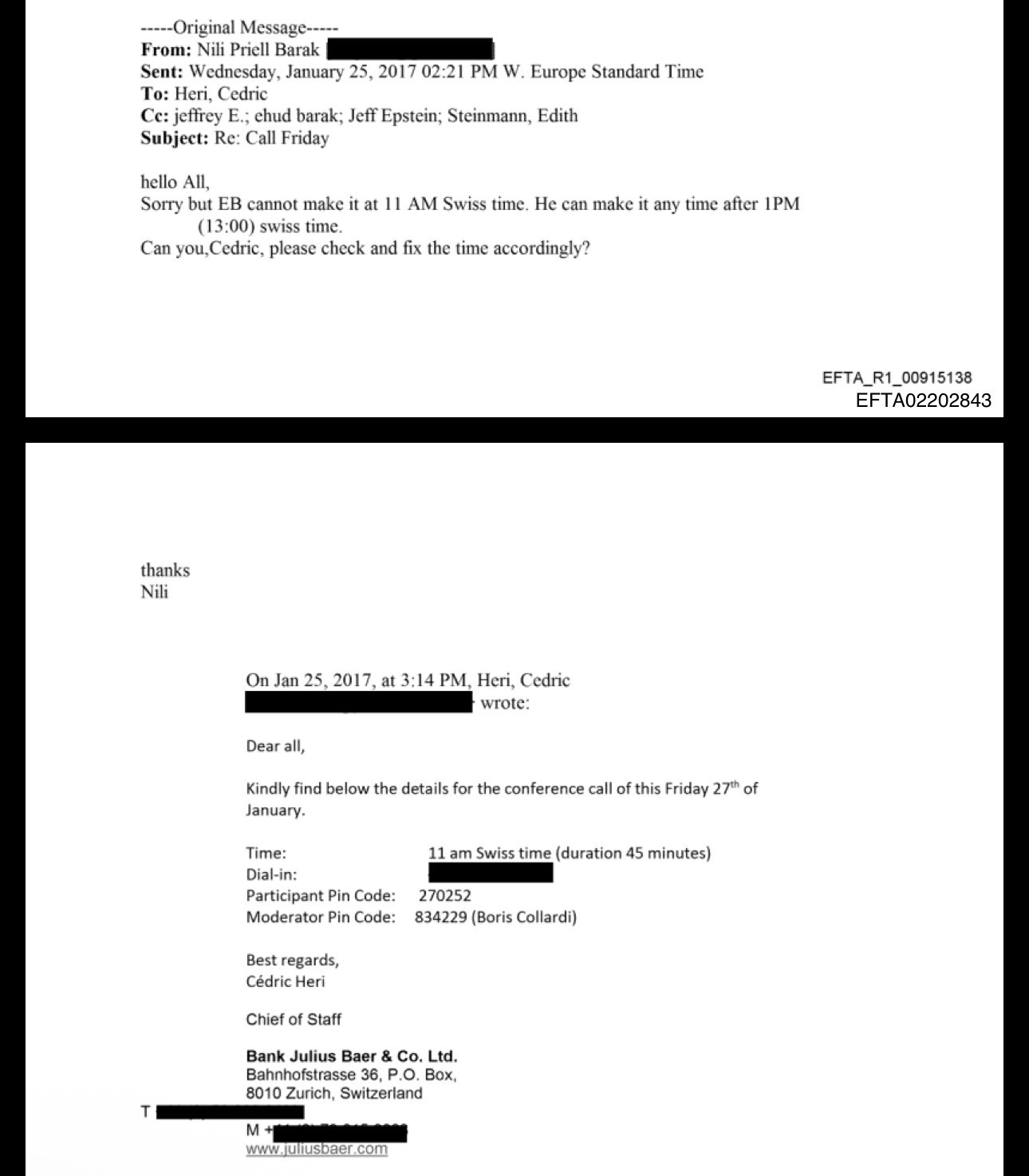
Epstein and Ariane may have begun to scheme about the possibility of a merger back when Bank Julius Baer announced they’d set aside $350 million to settle a Deferred Prosecution Agreement reached with the U.S. DOJ over their issuance of undeclared accounts to American clients that enabled them to evade taxes, another topic Epstein & Ariane discussed over email directly, which goes to show how some of these leaks had varied and sometimes unexpected knock-on effects (in a few instances, Epstein may have tried to exploit them). While there doesn’t appear to be incontrovertible proof that Elmer’s disclosure precipitated the DOJ case against Bank Julius Baer directly, it’s reasonable to assume it was one domino, at least, as he also relayed his incendiary folio of JB offshore deets to the IRS, a Senate Subcommittee, and Manhattan DA Robert Morgenthau’s investigatory team. Regardless of exactly how things fell out, it seems to the Epstein Class’s liking that mainly the Swiss bank ended up scrutinized & penalized and the clientele escaped unscathed on that occasion…
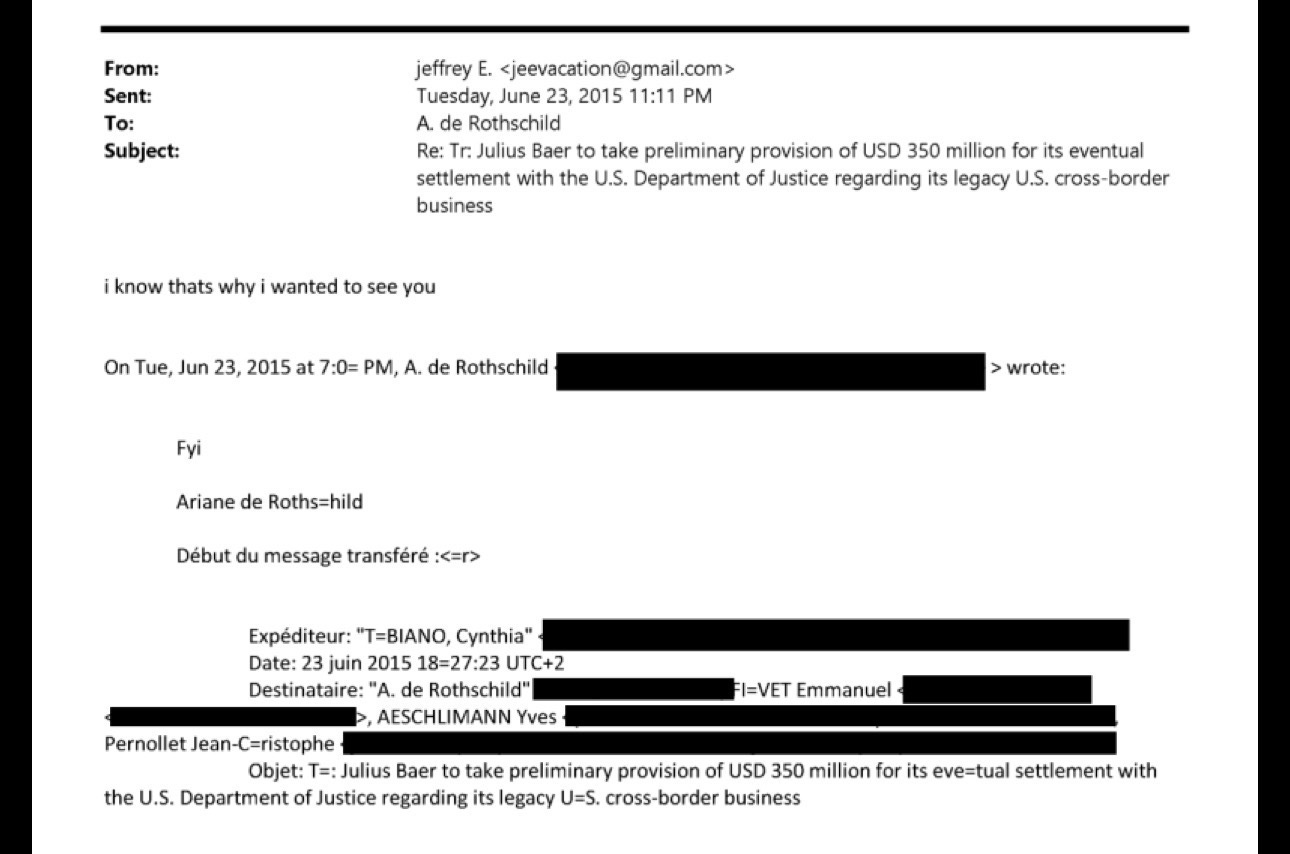
If you refer to the Epstein - Hacktivism Chronology in the End Notes, as is to be expected of the thorough and judicious reader, you’ll spy a pattern whereby Epstein and some of his closest associates pinged disclosures and news updates regarding WikiLeaks, Snowden, and the ICIJ back and forth. On the off chance you’re a notes-skipper, the condensed version of the “Most Instructive Hits” in the Files would go like this:
As early as 2009, CBS producer / technologist Dan Dubno reported on his meeting with Assange and ARPANET DoD web engineer Vint Cerf to Epstein. He described Assange as “paranoid” but a useful source of knowledge pertaining to “web-based whistleblowing” and governmental efforts to counter it
From there, we learn David Stern alerted Epstein of allegations against Prince Andrew that were disseminated by WikiLeaks (posing potential exposure of his op)
The son of Senegal’s president requested law firm recommendations for an office suitable for suing the hacktivist cell in 2010
As the chronology progresses, a string of communiques along these lines between Epstein and a bevy of bona fide spies and intelligence assets is assembled. Interactions with:
“real life Bond Girl” Nicole Junkermann
Obama WH counsel Kathy Ruemmler
alleged architect of the Saudi cyber surveillance program and possible Israeli asset (per one of the FBI’s Confidential Human Sources) Vincenzo Iozzo
French Foreign Affairs diplomat, Edmond de Rothschild Group employee, and Marine Le Pen adviser Olivier Colom
Steve Bannon
Etc.

Epstein instructed his personal anti-conspiracy psyoperator journo Edward Jay Epstein on how to subvert the popular narratives surrounding Snowden that portray him as a heroic figure
An employee of one of the Big Four spook-adjacent consulting firms named Ernst & Young sent Epstein info regarding a forthcoming ICIJ doc dump in advance

The general picture of how Epstein factors into the hacktivism goings-on is one in which he involves himself in crafting narratives about defector whistleblowers, solicits reports on hackers from his gargantuan informant network, keeps fellow spooks apprised of need-to-know developments, and furnishes implicated political elite with legal advice. Place this in the context of the recent revelation of Epstein’s possible hands-on role in convincing 4chan co-founder “moot” to keep the far-right /pol/ image board alive at a time when he was considering shuttering it in 2011, the same image board Boris Nikolic described to Epstein as possessing huge potential for “manipulation” and which went on to be the primary receptacle for alt right poasters’ speculations surrounding the Pizzagate ARG… A part-truth, part-fiction mythos (read: quintessential limhang) that mutated out of the Podesta Emails WikiLeaks and which monopolized the time of web sleuths for a few years, misdirecting their attention away from Epstein and Trump (the biggest beneficiary), despite the fact the evidence of their sex trafficking is even more concrete and voluminous.
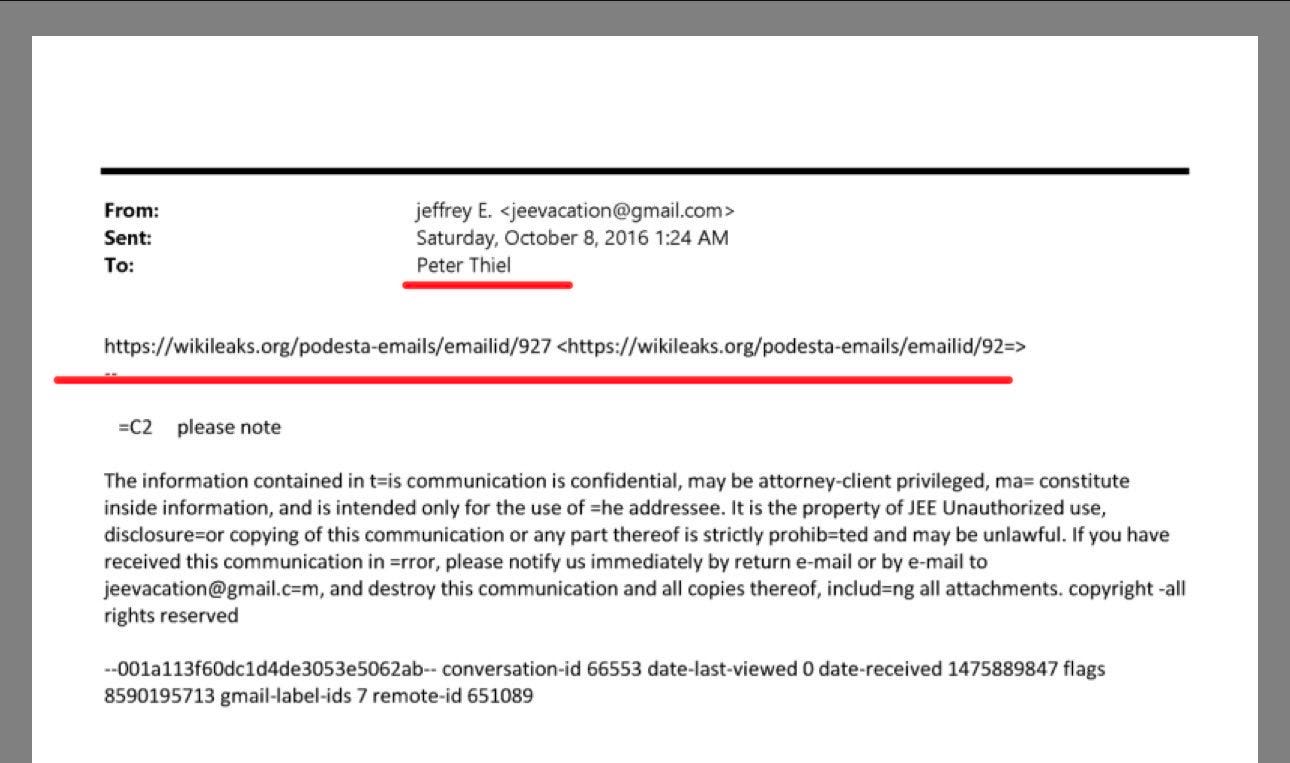
In Epstein’s own words sent in an epistle to Kahn, he verbalized the prospect that fake emails purporting to show the Clintons’ involvement in “really bad stuff” could be seeded by WikiLeaks via one of the last promised doc drops before the election. Coincidentally enough, Epstein also sent Peter Thiel, Trump’s first big billionaire-bettor-on-his-political-fortunes, a link to the Podesta emails right at this time in 2016. Perhaps that supremely untrustworthy federal informant Chuck Johnson’s assertion that Assange was being manipulated or handled by the Israelis to some degree can’t be dismissed entirely out of hand. It’s not impossible that WikiLeaks was occasionally making good on threats of COMINT blackmail, perhaps unintentionally, or were furnished with classified intel from ghost partners they didn’t even know were secretly Israeli.
We need to shelve the question of Assange’s Susness for another day 4, but I think we can at least concur that Epstein had more than a passing interest in this hacktivist subculture and the prospects it presented for psyops and that he harbored multiple motivations to meddle with these groups’ activities and/or even potentially weaponize them to shield himself or to deal damage against his enemies, thereby engendering a specific political outcome.
The Correa government’s intercession in the Assange and Snowden cases boils down to their role as a governmental intermediary representing WikiLeaks in diplomatic dealings (incurring some pretty significant geopolitical and trade consequences in the process) and the fact that they gave Assange asylum for 7 years in their UK Embassy despite considerable pressure from the conjoined imperialist WASP nest. To hone in on the connective tissue between these discoveries surrounding Epstein’s interest in the hacktivist milieu and the interplay between this mini era of offshore bank disclosure in Ecuador and its impacts on domestic politics, let me kinda preface the basic contours of the rest of the piece:
> Ecuador, a CIA proxy state for decades as of the late ‘90s, is deep in economic crisis
> the Clinton-era imperialist-apparatus taps Ecuador as a staging ground for Plan Colombia counterinsurgent ops 5
> Ecuador dollarizes under the leadership of a Dershowitz associate & pupil
> the Epstein Nexus turn Ecuador into a major hub of their Latin American sex trafficking ring through modeling competitions in the last couple years prior to Correa’s ascent
> Ecuadorians choose Pink Tide socialism
> WikiLeaks and the ICIJ start doing their thing
> Correa sets about combatting capital flight and offshore banking among the Ecuadorian elite, policies that help fund his social programs by increasing tax revenues, programs that position his government at the fore of this whistleblower movement against the transnational bourgeoisie’s slippery stinginess
> Epstein tracks this hacktivist milieu and involves himself to some degree (the exact extent or full nature is uncertain)
> the Correa gov grants Assange asylum
> Epstein associates and offshore structures get exposed by Panama, Paradise, Pandora, etc Papers
> Villavicencio serves as a source for various stories that cast doubt on the Ecuadorian Foreign Ministry’s intentions vis à vis Assange and allege that the Embassy hired a private firm to spy on him, clearly calibrated to drive a wedge between Assange and his hosts
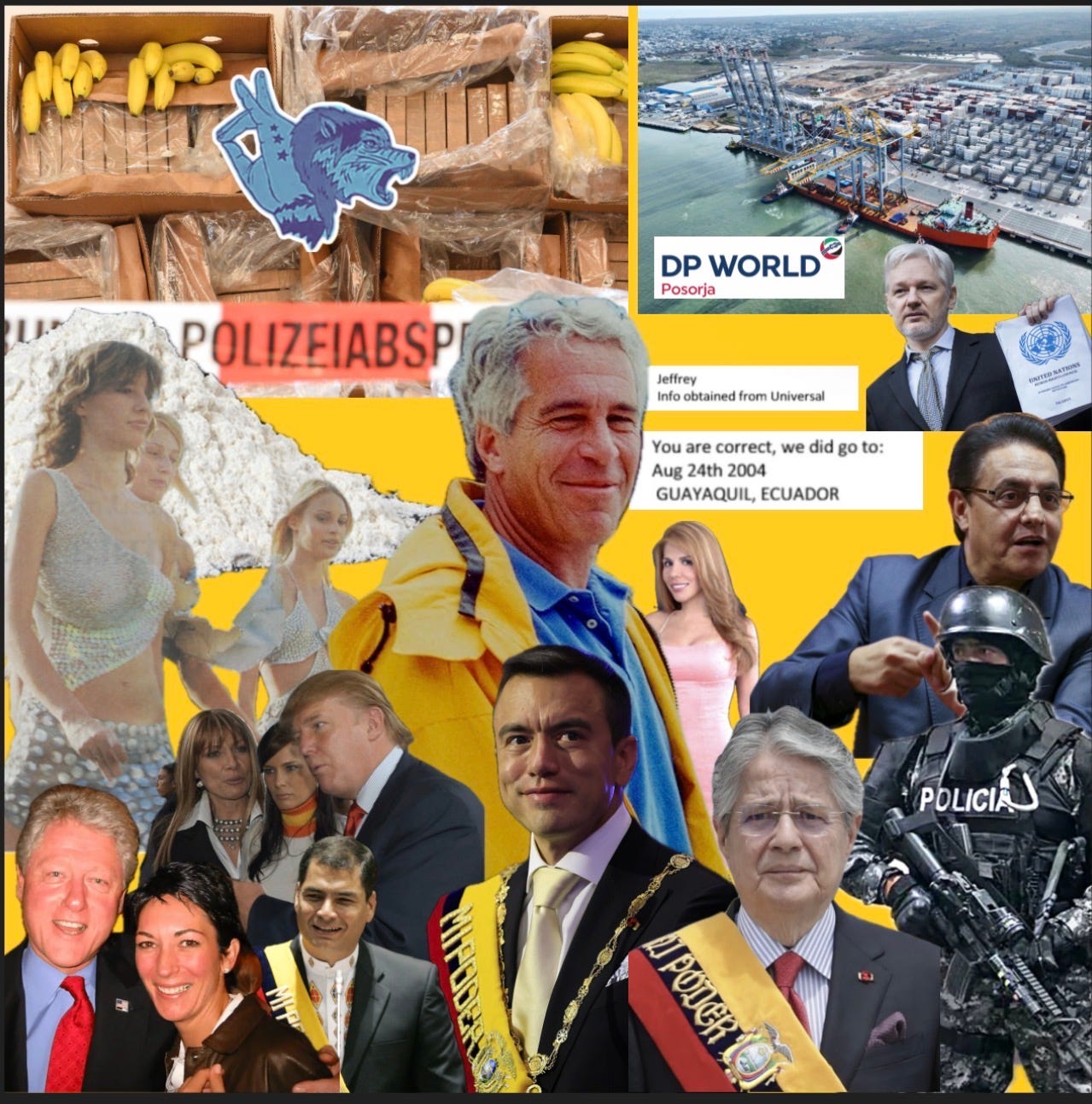
> DP World moves on a deep water port development project in Ecuador that may have once again been a backchannel means for projecting Epstein’s influence (see: most recent essay again)
> Villavicencio co-authors a speciously-corroborated Guardian hit piece claiming Manafort rendezvoused with Assange in the Embassy, one gossamer in the Russiagate web that Epstein described as an attempt to, paraphrasing, tie together Cambridge Analytica, the Russians, and Assange
> to this point, Epstein’s outsider perspective on what Villavicencio et al were undertaking strikes at the heart of the Yankee & Cowboy War of the 21st Century, waged between the PayPal-MAGA-Mafia Technofascists and the End of History Centrist Establishment—despite Genocide Joe’s rank culpability in the first post-10/7 stage of the genocide, the former is increasingly obviously the preferred choice for the Israelis… By extension, I think it’s possible that Villavicencio’s assassination was an outgrowth of this rift in the AmerIsraeli parastate and that a loyal asset of the neoliberal centrist faction was effectively torched to ensure PayPal-MAGA’s guy got into office. And as we’ll see, two potential angles to the clipping involve the narratives spun from his past head butting with Correa over Assange and the larger Offshore Info Wars and the degree to which Villavicencio also stuck his nose where it didn’t belong in the wider Epstein Class’s criminal ventures in Ecuador
> as Correa’s decade-long leadership comes to a close, the banking elite enlist a long-serving money grubber as political paladin in an effort to roll back the social safety net and anti-offshore reforms
> said candidate runs for the presidency on two occasions, winning the second time, and throughout, ICIJ disclosures set loose a snowballing shitstorm stemming from his offshore maneuvers
> this directly precipitates the election cycle that leads to Villavicencio’s assassination and the installation of Noboa, a Yung Trumpian strongman who’s rapidly become one of the Burger Reich’s closest allies in the region, along with Javier Milei, Nayib Bukele, etc.
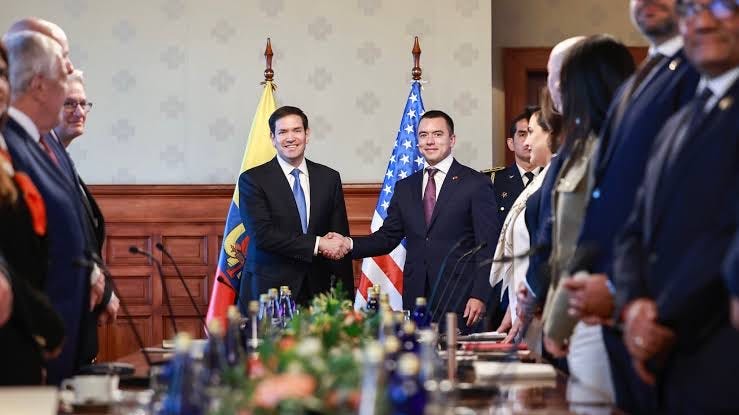
Correismo has watched its modest Pink Tide successes eroded further since Villavicencio’s death in Aug. 2023, as the eventual Miami-born winner Daniel Noboa endeavors to dismantle the remnants of Correa’s socialist policies and programs that saw poverty reduced by nearly 15%, billions in funds repatriated from abroad, taxes on the elite stratum increased to finance public health & education spending, unemployment reduced to 5.2%, and a newly confrontational stance adopted towards the soft imperialism of the World Bank & IMF and the more overt kind favored by the Estados Unidos. Noboa has worked in concert with the most reactionary and fascistic elements of the American ruling class to subordinate Ecuador as one of the Trump and Narco Rubio admin’s chosen bulwarks against Latin American socialism, deepening security coordination and joint human rights abuses as a pivotal partner in the sham war on narco-terrorism as manifested through the Shield of the Americas coalition and Operation Southern Spear.
The Villavicencio clipping left one of the alleged Colombian hitmen dead and security personnel, onlookers, and a legislative candidate injured in its wake. In the days preceding, Villavicencio had polled in second place behind the front runner Luisa González, a Rafael Correa loyalist who represented a left wing breakoff partido that defected from Correa’s old party PAIS Alliance over disagreements with his successor Lenin Moreno. Lumped together, they looked to be polling with the support of approximately 40% of the electorate in the crowded field. Villavicencio’s murder opened the door a crack for the right wing, bourgeois populist Daniel Noboa, a scion of one of Ecuador’s wealthiest banana export families, to come squeezing through, seizing upon the state of paranoia and unrest caused by the spate of gang violence and assassinations that pursued his neoliberal predecessor Guillermo Lasso’s decision to trigger “muerte cruzada”, sprinting into second place just in time to make the runoff as the Villavicencio clipping hung like an albatross around the DemSoc legacy candidate’s neck, causing her to sink in the polls.
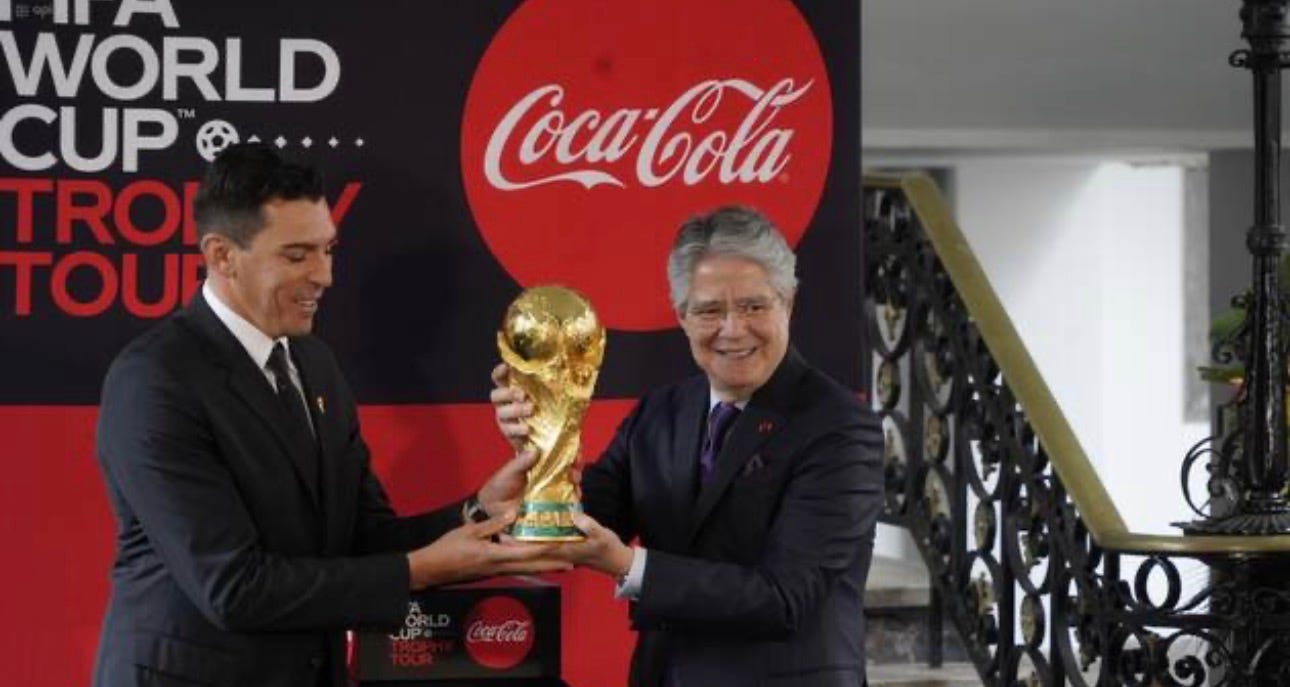
Besides his tenure as president, Lasso was once the head of Coca-Cola operations in Ecuador, effectively making him one of the CIA & Big Cola’s inside men, and he remains a major stakeholder behind Banco de Guayaquil. To legitimize my broad CoCIA-Cola brushstrokes, I’ll remind you that Adolfo Calero Portocarrero co-owned and managed a Coca-Cola bottling plant in Nicaragua before he hunkered down in the Honduran jungle with the CIA-armed Contras. A possible DEA agent and “private investigator” named Steve Van Cleave who was mixed up with Mitch WerBell and Lucien Conien for a time also bragged in Beltway circles that he’d conducted CIA business in Latin America under Coca-Cola cover. A Cuban CIA informant named Anselmo Alliegro reported to his handlers that Van Cleave ran a private intel firm for corporations called Intelligence Services Ltd. that was being contracted to infiltrate unions and communist movements in S. America and the Caribbean. Van Cleave’s obituary confirms that he worked for Coca-Cola as a security consultant abroad (have to save the rest of his CV for another day, as much as it pains me). And finally, back in the 1950s, the CIA and Coca-Cola funneled over $1 million USD into the Edward Lansdale-architected campaign to elect Defense Minister Ramon Magsaysay as President of the Philippines, a campaign that was spearheaded by agency fronts like the Nat’l Movement for Free Elections (rich) and which saw Lansdale pull the ol’ “spiked drink before a speech” trick against the incumbent Quirino (they’d later try to prank Castro in similar fashion, to no avail). Those are a few examples of why it’s reasonable to suspect Noboa’s predecessor Guillermo Lasso, this former Coca-Cola exec, is one of the CIA’s underlings.
Before that tangent, I’d mentioned something called muerte cruzada (trans. “mutual death”), a constitutional mechanism that’s supposed to serve as a check & balance by permitting a president to respond to impeachment proceedings by dissolving the National Assembly, which in turn initiates a national plebiscite on his mandate as presidential elections are duly held. Muerte cruzada is how Noboa even came to have a crack at the presidency in 2023, at least in the shortest order of operations.
Guillermo Lasso is the only president to have ever pushed this proverbial ‘nuclear option’ button, turning to the muerte cruzada as a last resort in the face of possible impeachment over allegations of embezzlement, offshoring, and tax avoidance. These allegations were first revealed through an investigation by the Argentine outlet Pagina12 during the 2017 election that traced a paper trail placing Lasso at the center of a sprawling web of 49 trusts and shell companies across Panama, the Cayman Islands, and Delaware. Additional research by the DC think tank the Center for Economic & Policy Research also uncovered that Lasso had planted tens of millions of dollars in over 140 condos and properties in Miami-Dade and Broward Counties as part of this tax avoidance strategy. 6 This earlier evidence of capital flight on Lasso’s part was then confirmed by the 2021 Pandora Papers. The humongous tranche of tax avoidance shell company and offshoring docs unveiled that Lasso rerouted assets to trusts registered in South Dakota in December 2017, which is damning, as it makes abundantly clear that he repeatedly attempted to circumvent Correa era measures and referendums that clamped down on capital flight. These measures included:
the Tax Equality Act, 2007 - granted Ecuador’s IRS the legal authority to keep a dynamic list of tax havens
the Ban on Offshore Bank Ownership, 2014 - rendered it illegal for Ecuadorian financial institutions to own sister banks or operate branches in offshore tax havens and dictated that they sell any foreign subsidiaries in violation
the Ethical Pact Referendum, 2017 - a national referendum that received overwhelming approval from the Ecuadorian electorate that stipulated that any candidate or public servant discovered to be holding funds or assets in tax havens be banned from office.
Lasso was an especially egregious case. As the executive president of Banco de Guayaquil (BG), he’d spent two decades assisting oligarchic clients in stowing their assets in offshore vehicles. Coming out of the Correa years, he was the Ecuadorian bourgeoisie’s chosen avatar to redirect the country back towards the free market heyday of the late ‘90s / early 2000s, a time of cavernous wealth inequality that culminated in the government’s decision to dollarize, precisely because he’d proven himself as an able steward of their class interests as a banker.
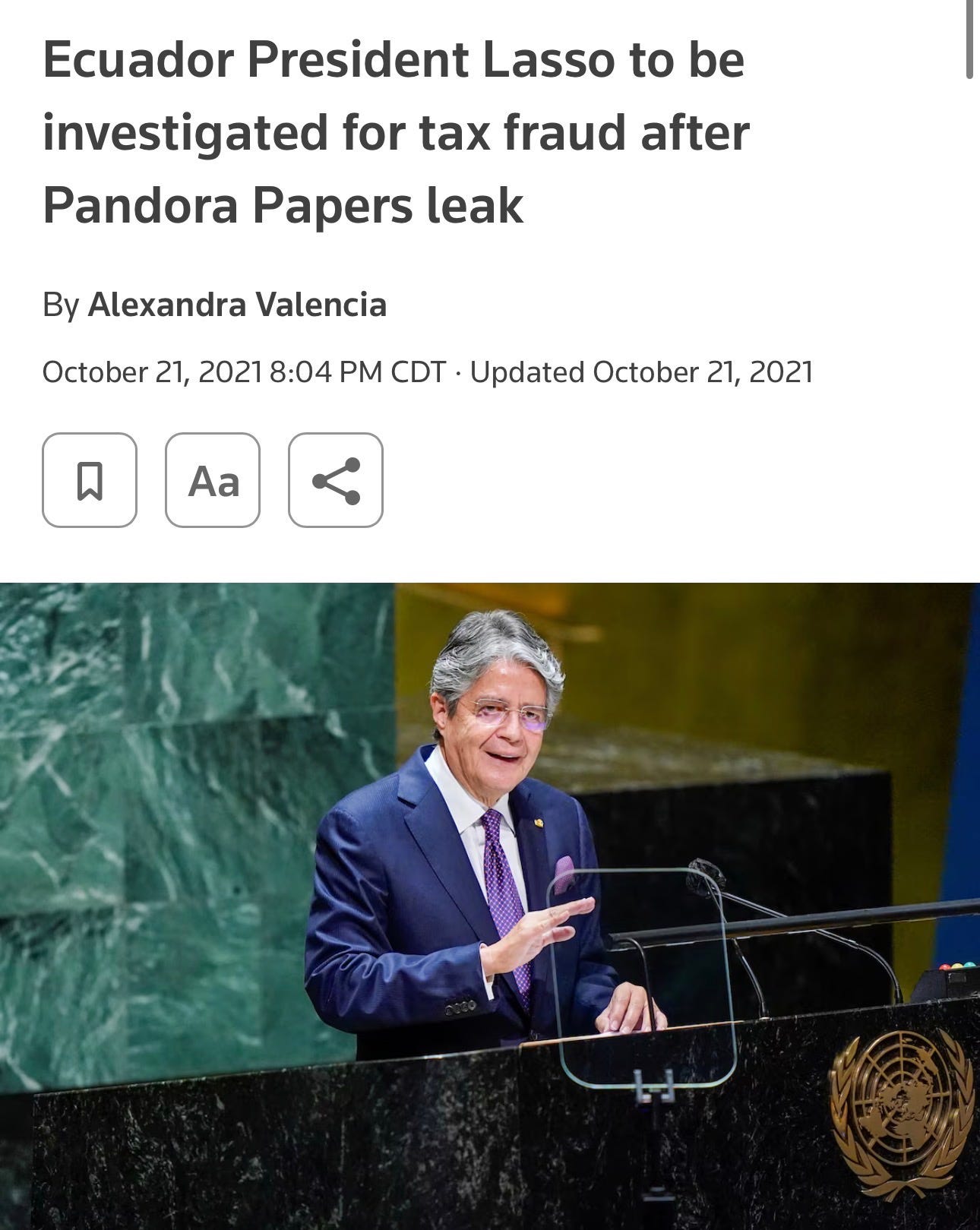
Lasso and BG preemptively ramped up capital flight in response to Correa’s election, as BG opened its offshore bank in Panama in 2007 (same year as Correa’s first inauguration), changed its name to Banisi four years later, and then sold the Panamanian tax haven to a holding company (Banisi Holding) registered under a law firm to disguise Lasso’s ownership in 2014 so as to evade the ban. According to reporting by The Hill, over 2/3rds of Banisi’s liabilities were out of country, despite Panamanian regulators authorizing it to keep offices, its web domain registry, and servers in Guayaquil.
We’re going to return to the Villavicencio contract killing, but in order to contextualize it properly, I need to introduce two other cases. You see, it wasn’t only the percolating revelations regarding Lasso’s offshoring, periodically brought back to the fore by various document leaks, that led to his downfall. In early 2023, La Posta ran an investigation that revealed that the President’s brother-in-law and two other associates had been operating an influence peddling bribery network. Its epicenter was the Public Enterprises Coordinating Company (EMCO EP), which was helmed by a former BG vice president named Hernán Lecaro who’d been appointed at Lasso’s in-law’s behest.
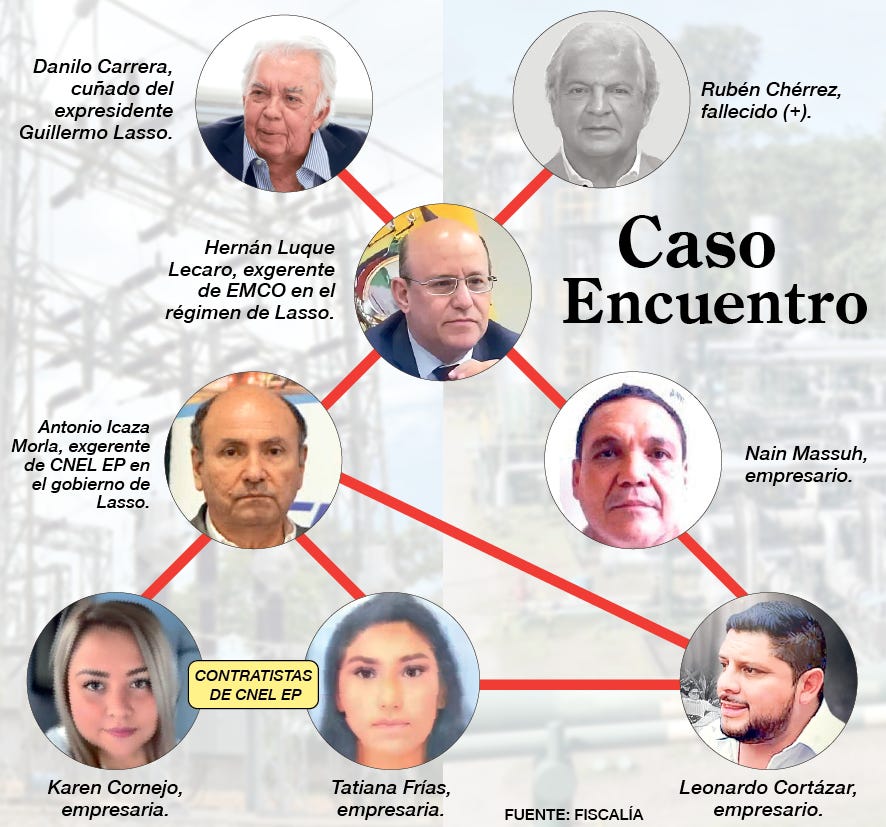
This triumvirate of Lasso loyalists who’d been given oversight of public-private partnerships effectively sold contracts with state-owned companies on the sly, requiring private companies to payout bribes to ensure payment. They also allegedly exerted influence over key institutions like the Customs Service & Ministry of Energy, similarly selling appointments. In this capacity, they allegedly helped conceal the Albanian Mafia’s interests as those of “big businessmen”, laundering their assets earned from arms, human, and drug trafficking in the country. The case first came to be known as “Gran Padrino” (The Great Godfather) before the name was changed to “Encuentro” (Encounter) by the Attorney General’s Office.
If I understand correctly, La Posta’s initial piece and the subsequent case hinged in large part on the whistleblowing of Leonardo Cortázar, who leaked audio exposing the scheme to the press. Ironically, Oversight Committee President Villavicencio had previously excoriated Cortázar as a corrupt “czar of the electricity sector”, deeming him a pawn of Correismo corruption as a part of his larger muckraking campaign against the DemSoc president. These allegations led to Cortázar’s brief arrest (seemingly the moment he turned informant) before he was released due to lack of evidence, after which he publicly confronted Villavicencio in Quito’s airport, haranguing him over the slander, which in turn led Villavicencio to avail himself of a magistrate for a restraining order.
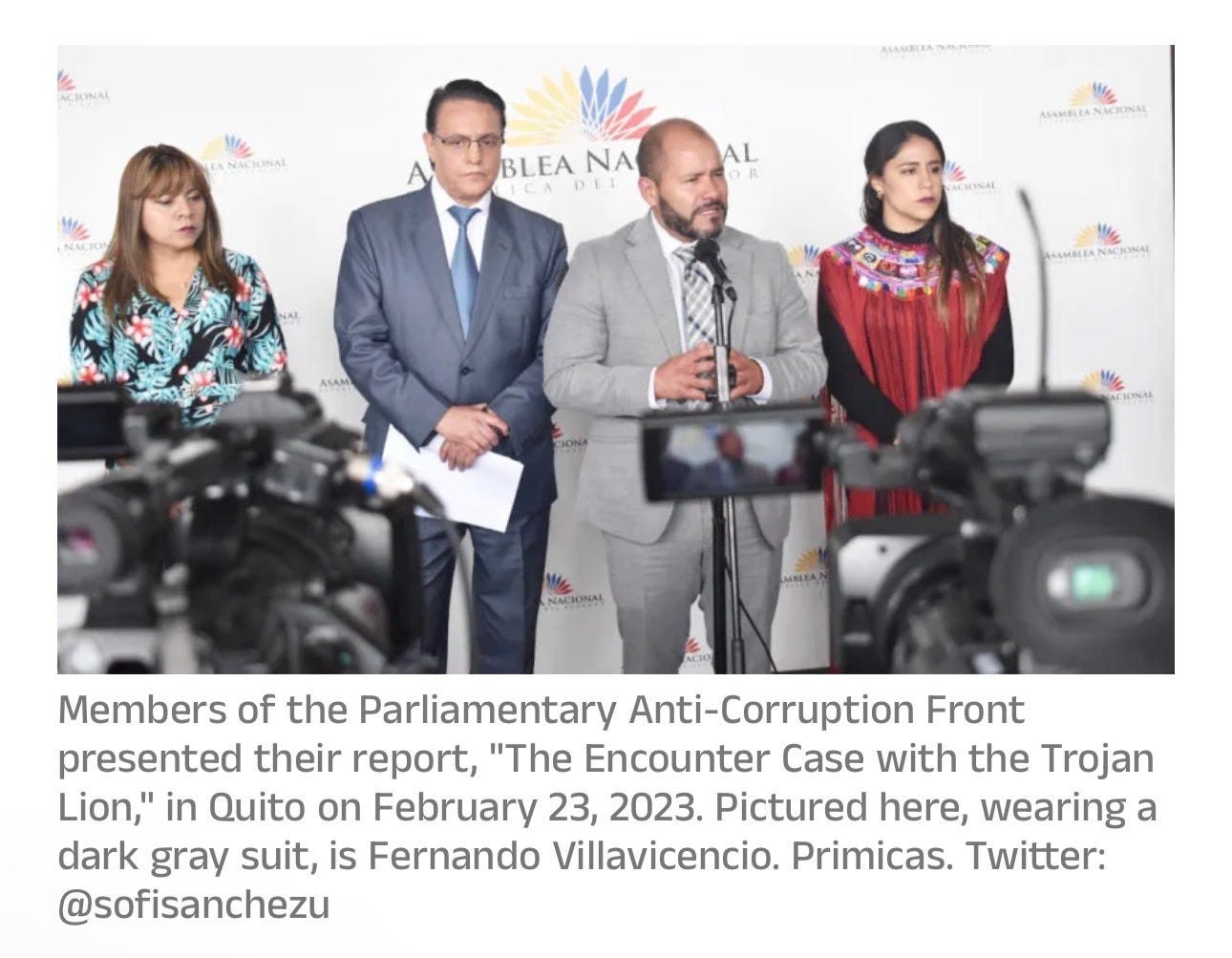
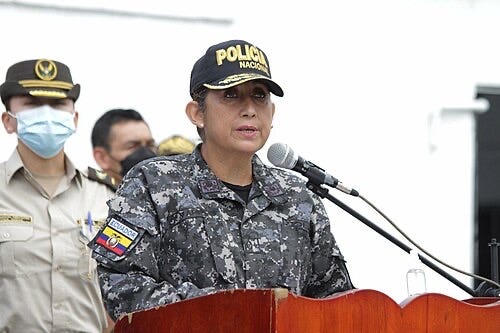
Villavicencio, who also led the Anti-Corruption Parliamentary Front, presented a parallel report on the Encuentro Case to the National Assembly’s Justice Committee on Feb. 23rd, 2023, alleging that President Lasso was aware of his brother-in-law Danilo Carrera Drouet’s influence peddling and Rubén Chérres Faggioni’s links to the Albanian Mafia’s drug trafficking and that there was a conspiracy of silence and coverup regarding these charges and an earlier investigation in Manta. In their 91 page report, Villavicencio and the Front dissected how the Albanian Mafia was operating on two coastal fronts: the port cities of Guayaquil and Manta. They alleged that Carrera and Faggioni frequently met with the Albanian Dritán Gijka in the Manta offices of Osakafish SA. The Front also alleged that the cocaine was moved through the ports under the omertà jurisdiction of the Los Choneros gang in Guayaquil with the added protection of La Madrina (trans. “the godmother”) aka Tannya Varela, the first female Commander General of the Policía Nacional del Ecuador (‘21-‘22) and whose turf once included Zone 8 - Guayaquil (‘18-‘19)..
The report led to a face-to-face between Villavicencio and Guillermo Lasso in the Palacio de Carondelet, the Ecuadorian equivalent of the White House, where it seems like some sort of arrangement was struck or Villavicencio was informed of Lasso’s decision to trigger muerte cruzada, as highly ironically, considering his reputation, the Anti-Corruption firebrand had previously cast one of the decisive votes that let Lasso off the impeachment hook over the crackdown on indigenous protests in 2022 and at a time when Lasso’s offshore tax evasion was already well documented, underscoring why the federal informant is not to be trusted, no matter much he’d self-identified as a “leftist” in the past.
This hypocrisy and double standard is laid bare by just a cursory comparison of the muckraker’s blurring of the lines between journalism and activism when Correa was in power, frequently requesting criminal charges against Correa apparatchiks with the Public Prosecutor’s Office based on his reporting and using hacked emails to report on alleged corruption at Ecopetrol, and the kid gloves with which he treated the neoliberal Lasso, sitting down with him in the luxe, gold-trimmed halls of Carondelet on January 31st, 2023, bringing the Front’s findings to Lasso directly before he went public, accompanied on the visit by the former director of the Center for Strategic Intelligence (CIES; Ecuador’s main intelligence agency) Galo Robalino.
Despite members of Lasso’s closest circle being implicated in the “Lion of Troy” investigation and in subsequent discoveries regarding the Albanian Mafia’s drug smuggling, and despite the fact that “banana and fish export companies” were alleged to be in cahoots with the operation (*cough* Noboa, who I’ll mention has dropped probes into Lasso officials and retained much of his government, effectively shielding him *cough*), Villavicencio once again framed the narco-tied “corruption structure” in the state’s public companies as the cartel remnants of the Correa and Lenin Moreno administrations, taking it easy on Lasso by describing his involvement as nothing more than a failure to “expel” the corrupt business unit managers contrary to being a silent partner.
Can you believe this guy, huh? Even though the “Leon de Troya” case was reportedly shelved because it was digging into the President’s brother-in-law’s confidante Ruben Cherres Faggioni, he once again tried to shitcoat Correismo (we’ll make the absurdity even more plain). Despite this, Villavicencio did accuse Policia Commander Tannya Varela of having unfairly scapegoated other police generals of drug ties to clear the way for her husband to be promoted, which illustrates the kinds of organized criminal enemies he may have acquired throughout this dangerous game, even if he was distorting the case for political reasons. First appointed by the RW wolf in sheep’s clothing Lenin Moreno before having her position ratified by Guillermo Lasso in May of 2021, Varela was forced to resign after the U.S. Embassy withdrew visas for a handful of police officials accused of being “narco-generals”. She’s also currently being prosecuted on precautionary charges of having leaked information related to the Lion of Troy case. 7
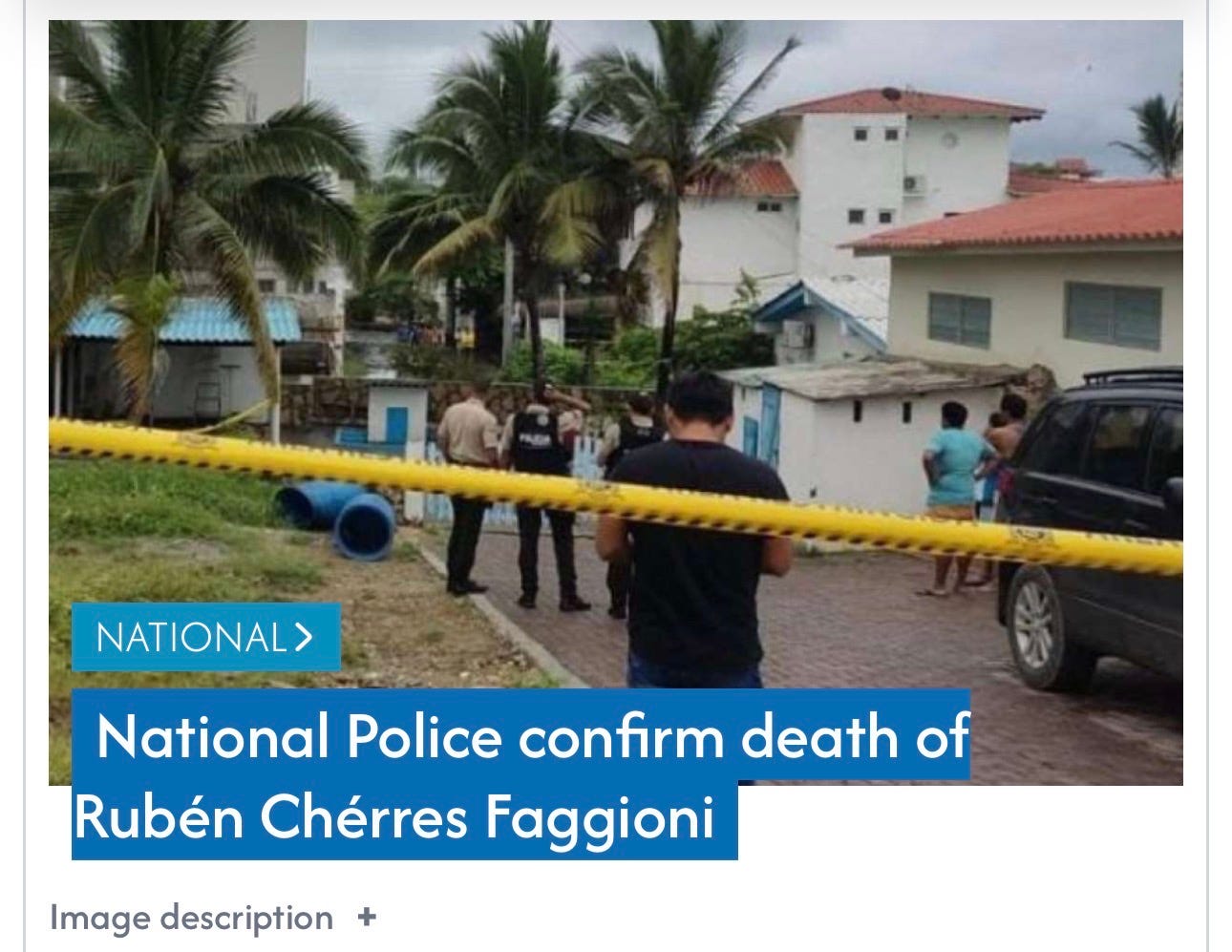
Before the exposed threads that appeared to tether Carrera, Lecaro, and Faggioni’s corruption to the Albanian Mob and their drug running could be sussed out further, the bodies of Faggioni, his girlfriend, and his security guards were discovered in his safe house in Punta Blanca on Mar. 31, 2023, where they’d reportedly been hiding out to avoid the Prosecutor Office’s warrants. The black and blue cadavers exhibited bullet holes and signs of torture. The following year, the Ecuadorian authorities declassified wiretappings and surveillance that purported to show the Albanians putting a hit out on Faggioni over failure to repay a debt that had climbed into the millions USD—I have my reservations and wonder whether this could also amount to the Noboa government and the surviving Lasso configuration covering tracks.
To put it simply, in the twilight years of Villavicencio’s abbreviated life, the muckraker became increasingly fixated on what he dubbed a “port mafia”, sticking his nose into all sorts of aspects of the container traffic where it didn’t belong and upsetting various stakeholders (and not just the democratic socialist Correista apparatchiks against whom the neoliberal type routinely crusaded). By the time his presidential campaign was in full swing and Villavicencio was weathering increasing calls for his head, he let loose the following in a TikTok diatribe published just over a month prior to his murder, seemingly emboldened by his growing political fame:
This is a message for the port mafia in my country. Yes, you, mafiosos who contaminate the export containers of this country, you who serve drug trafficking, who damage the history of this country, you polluters, your time is up.
This is an alternating angle that may hold some explanatory power for parsing the Villavicencio Hit, aside from the loosely described “Parastatal Feud Leads to U.S. Informant’s Sacrifice in Ecuadorian Killing of the King Fashion By Competing Intel-Crime Faction” take. Based on the little I’ve learned about Villavicencio—mind you, I’m no expert on him nor Ecuador—he strikes me as the kind of former Trotskyist who genuinely believes himself to be a principled idealist. While he’s obviously an unrepentant anticommunist who self-servingly worked with the agents of the imperial hegemon against Ecuadorian socialists, whether because it benefited his own vainglorious quest for power or because he imbibed the liberal pablum Kool-Aid that makes you trip balls and perceive socialism as “risky red authoritarianism”… Whatever the reason, he still smacks of the kind of high-falutin’ media type who possesses pretensions of being an “unbiased” enemy of all organized crime and graft, and while less enthusiastic about it when democratic socialists like Correa weren’t in power, duly harnessed his journalism and activism to take mafias to task and keep the political elite accountable to a lesser degree. It’s possible he was committed enough to “journalistic ethics” to render him disposable to his handlers. Put a pin in this character assessment as we return to the “port mafia”.
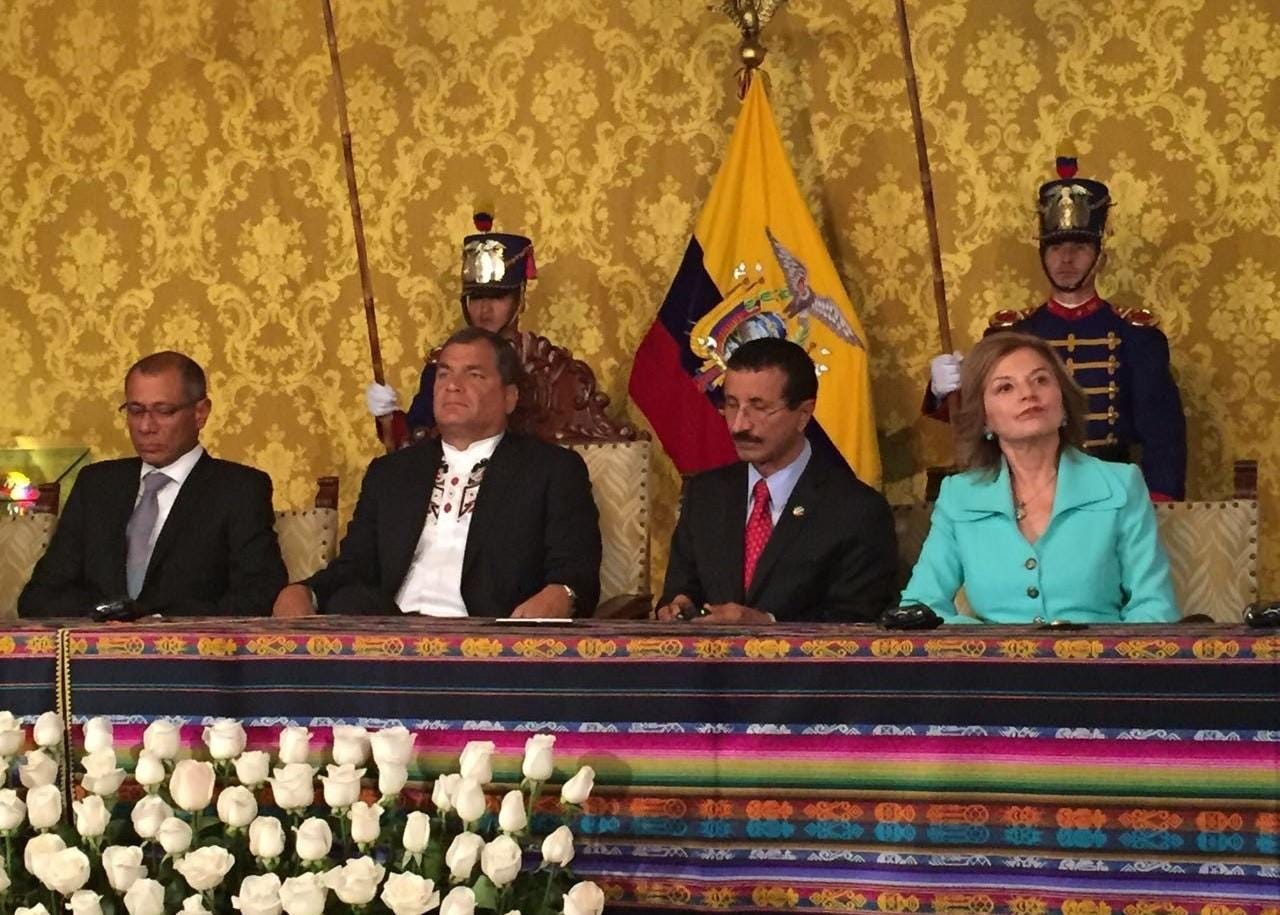
Sultan bin Sulayem offered Epstein a direct line to Ecuadorean president Rafael Correa if “he needs anything” in September 2013 prior to meeting with him for four hours in the resplendent Palacio de Carondelet, perched atop the Plaza Grande in Quito. The purpose of the visit was to explore a proposed co-investment deal between Ecuador and the Emirati shipping and logistics giant DP World, for which Sultan bin Sulayem was chief executive until his dismissal over the way his Epstein ties blew up in the public sphere.
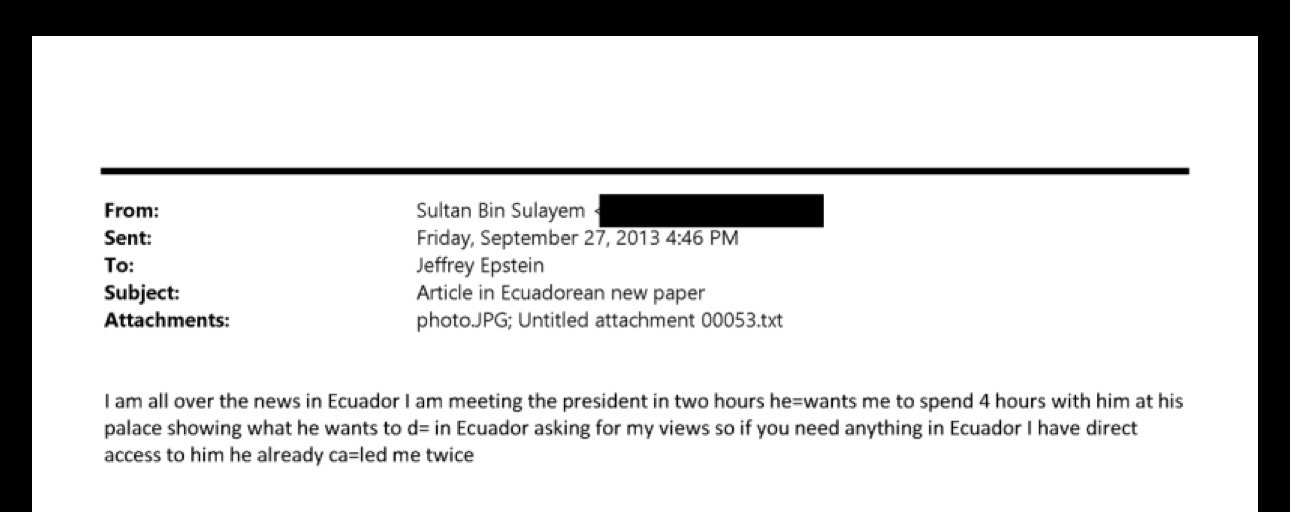
While I’m lacking some context as far as whether this was an offer Epstein solicited from Sultan or not and whether he’d opened doors for Sultan in Ecuador, having failed to pull all the communiques that may have bookended this one or the preceding logs due to the brokenness of the DOJ site, the critical questions regarding this development are:
Did Epstein utilize Sultan bin Sulayem as a back channel or infiltrator representing his own interests in this instance, as he also seemingly had during DP negotiations in Cuba, Venezuela, etc?
By extension, did DP World move on Ecuador as a part of the AmerIsraeli Epstein Network’s full-court press on Pink Tide and LatAm socialist countries during this period?
And did these DP World transit hubs moonlight as nodes linking the various Epstein Traffics?
Did they function as blackhole freeports beyond the watchful eyes of adversarial anticapitalist forces where Epstein and his cohort could move things—weapons, drugs, women, art work, artifacts, money, etc—without intrusion?
Cue once again: the Mega-Rich Light Bending Guy in his shipping container from Disco Elysium; the crate full of dead girls in The Wire S2; David Thewlis’s V. M. Varga sitting down in the box jacked to a semi truck parked in one of the Stussy Lots, cracking his knuckles before tapping away at the inner financial workings of their transnational corporate bleed out, takeover, and tax fraud syndicate on an array of monitors.
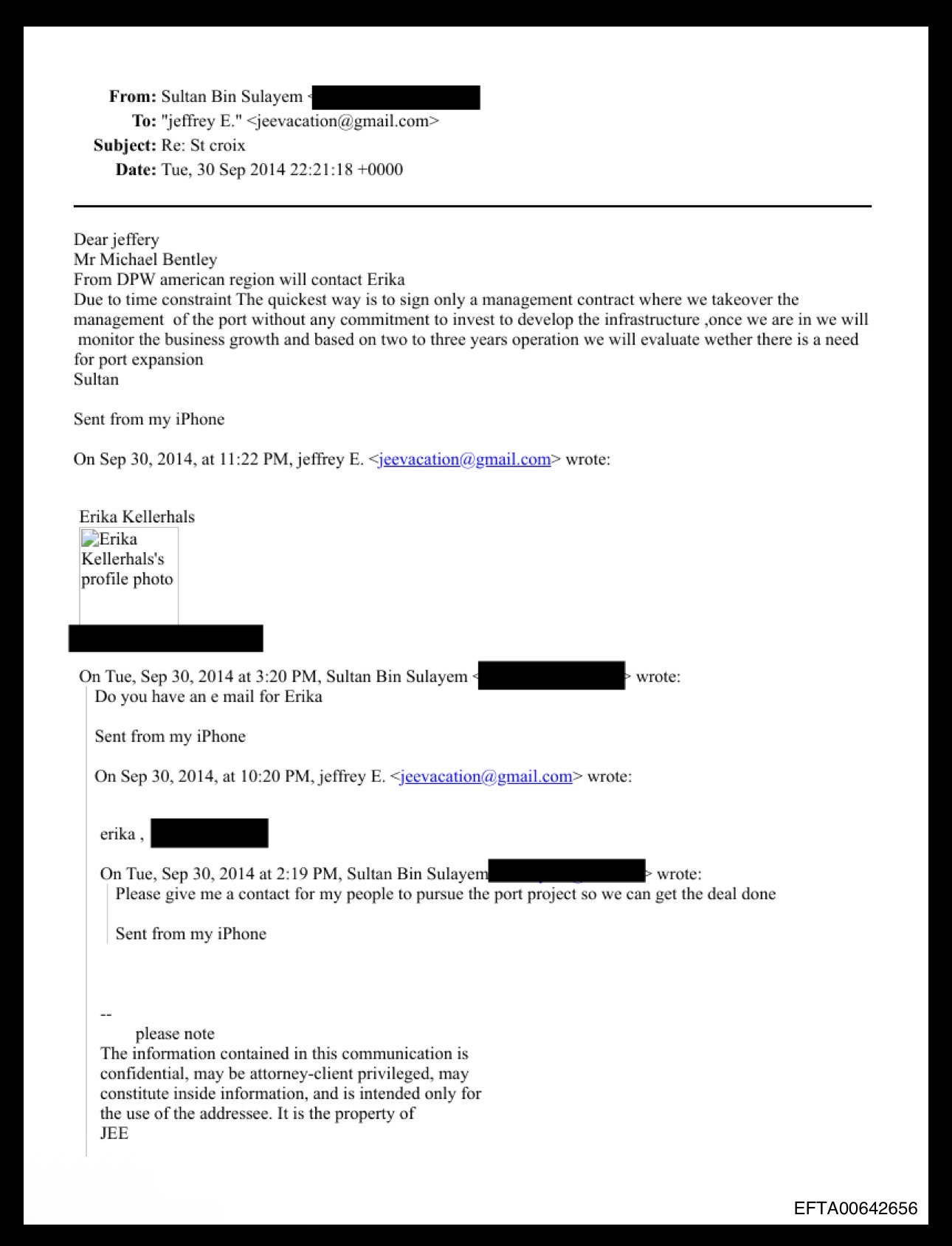
There’s an abiding pattern of Epstein helping to facilitate DP World’s expansion in Latin America and the Caribbean around this time. Aside from his negotiations with the Chavez admin after the Puerto Cabello expropriation in 2009 & his attempt to set them up in Cuba, Epstein and Sultan also discussed DP World taking over the U.S. Virgin Islands port in St. Croix in 2014. Epstein sent Sultan Erika Kellerhals’ contact info and Sultan mentioned in reply that Michael Andrew Bentley would take point in communiques. Bentley was also present when the port deal in Ecuador was struck as a representative of the contractor and he was listed among the original addressees on the email Sultan forwarded to Epstein regarding the VZ port’s expropriation by the Chavistas. Kellerhalls, meanwhile, was the non-signatory legal rep for the J. Epstein Virgin Islands Foundation.
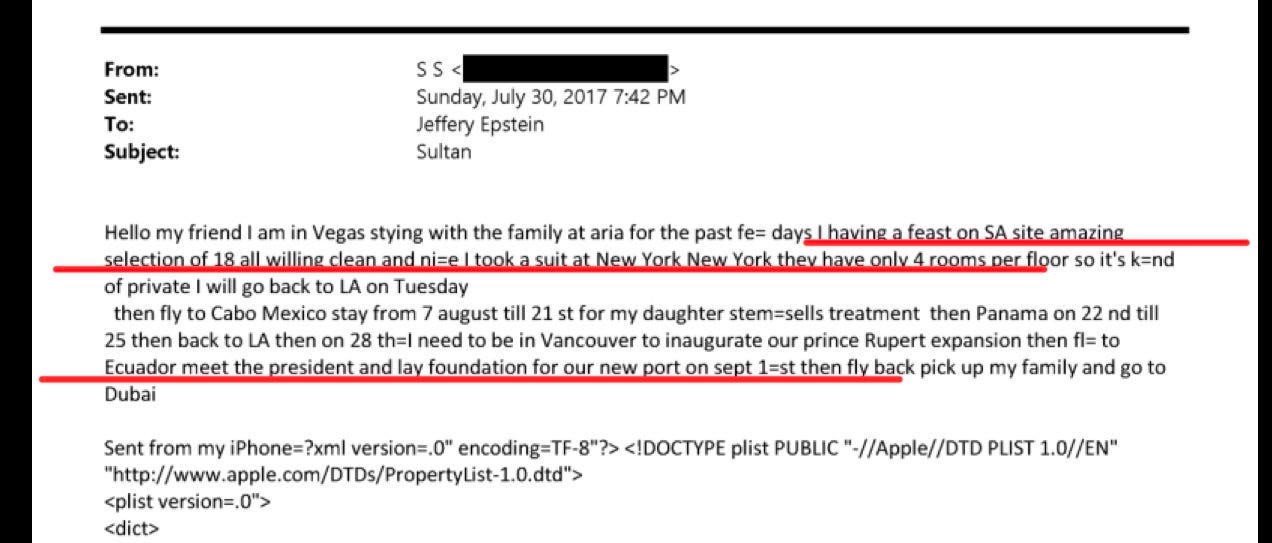
In 2017, Sultan emailed Epstein again, sharing his travel itinerary, including an upcoming visit to Ecuador to meet with the President and lay the foundation for DP World’s “new port”. 8 This is in reference to the Port of Posorja, the deep water container port that they installed in a fishing village where the Pacific Ocean spits its salty water into the mouth of the Guayas River approximately 50 miles downriver from Guayaquil as the crow flies. Posorja has recently ranked as the top port in Latin America for the second consecutive year as “a leading gateway for Ecuadorian trade and critical connection point to international markets”. The massive harbor development also received a $50 million USD loan from the Republique Francaise and Proparco in 2018 to help finance its construction.
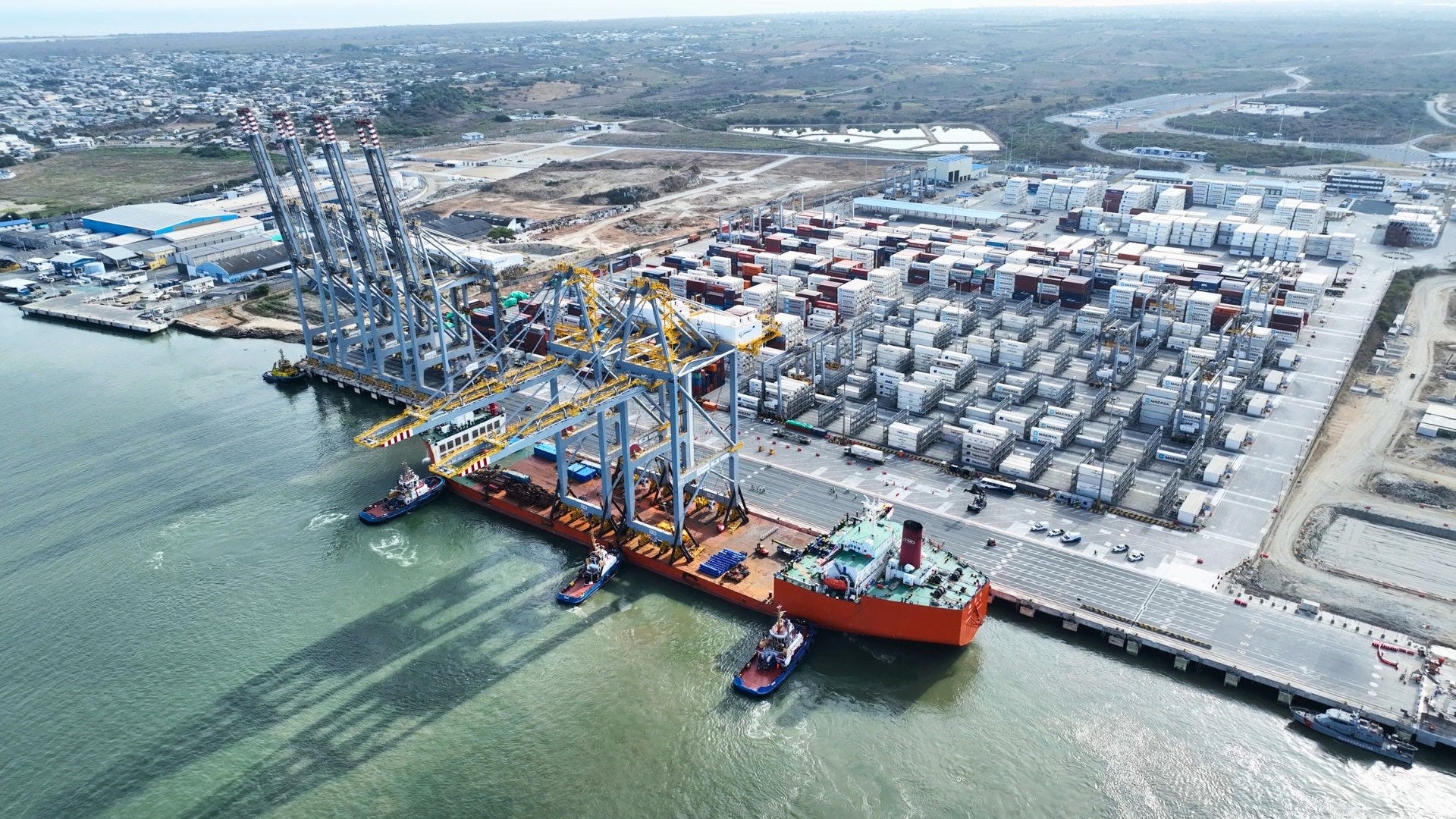
And here’s where things begin to get really spicy. Citing research by the Organized Crime and Corruption Reporting Project (OCCRP), despite the proverbial panopticon of security cams, biometric controls at gates, and cargo scanners, the Port of Posorja has rapidly emerged as one of the “leading launchpads for cocaine”, with 15.4 tons intercepted in the district in 2024 and with homicides having increased 13-fold since the port’s opening. In Rotterdam and Antwerp, Posorja ranked as the top “loading port” based on volume of seized coke shipments, surpassing the OG point of embarkation in the city upriver, with German law enforcement also noting an increase. The sleepy fishing village now sees 2-3 street side assassinations PER WEEK.
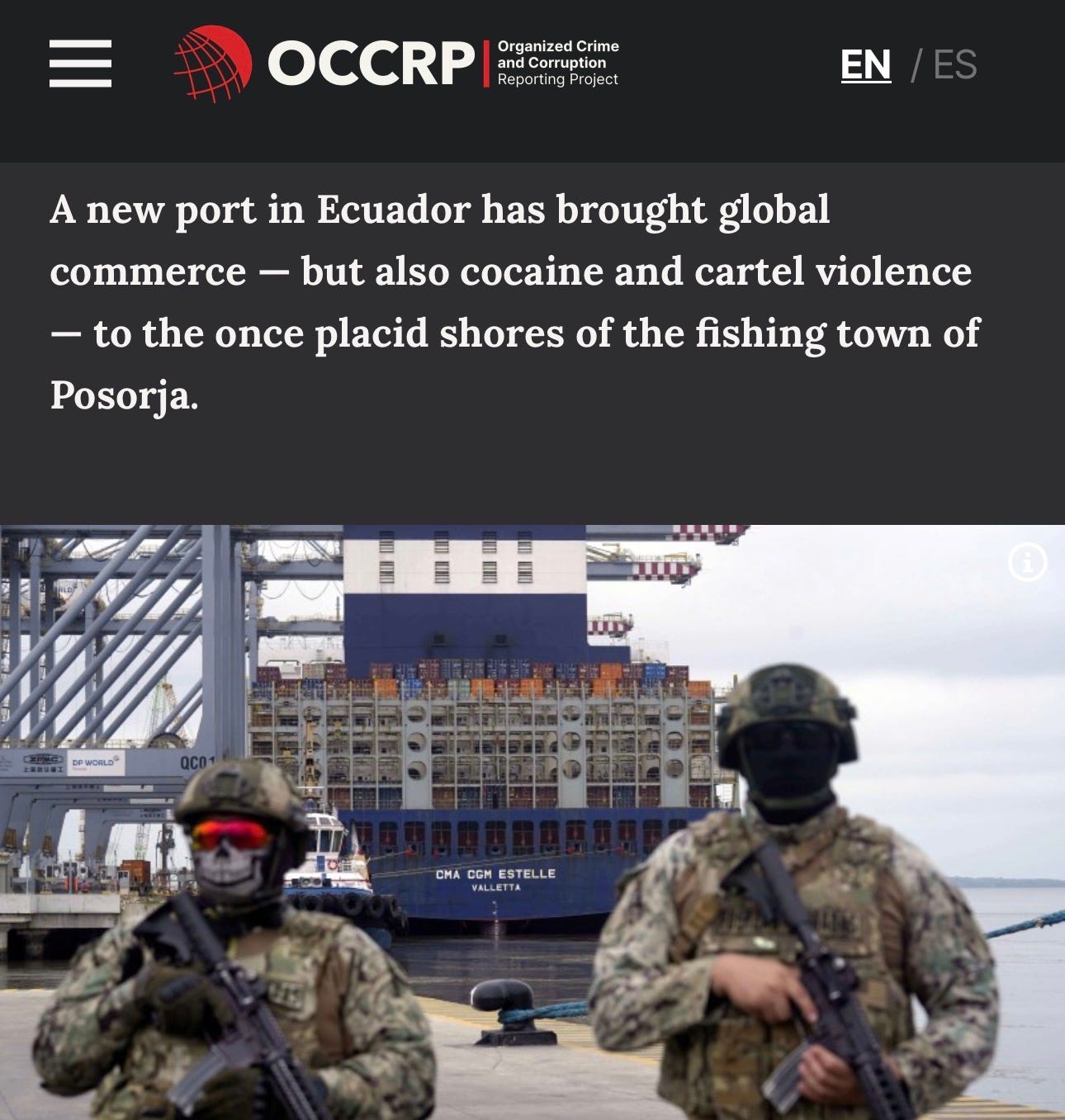
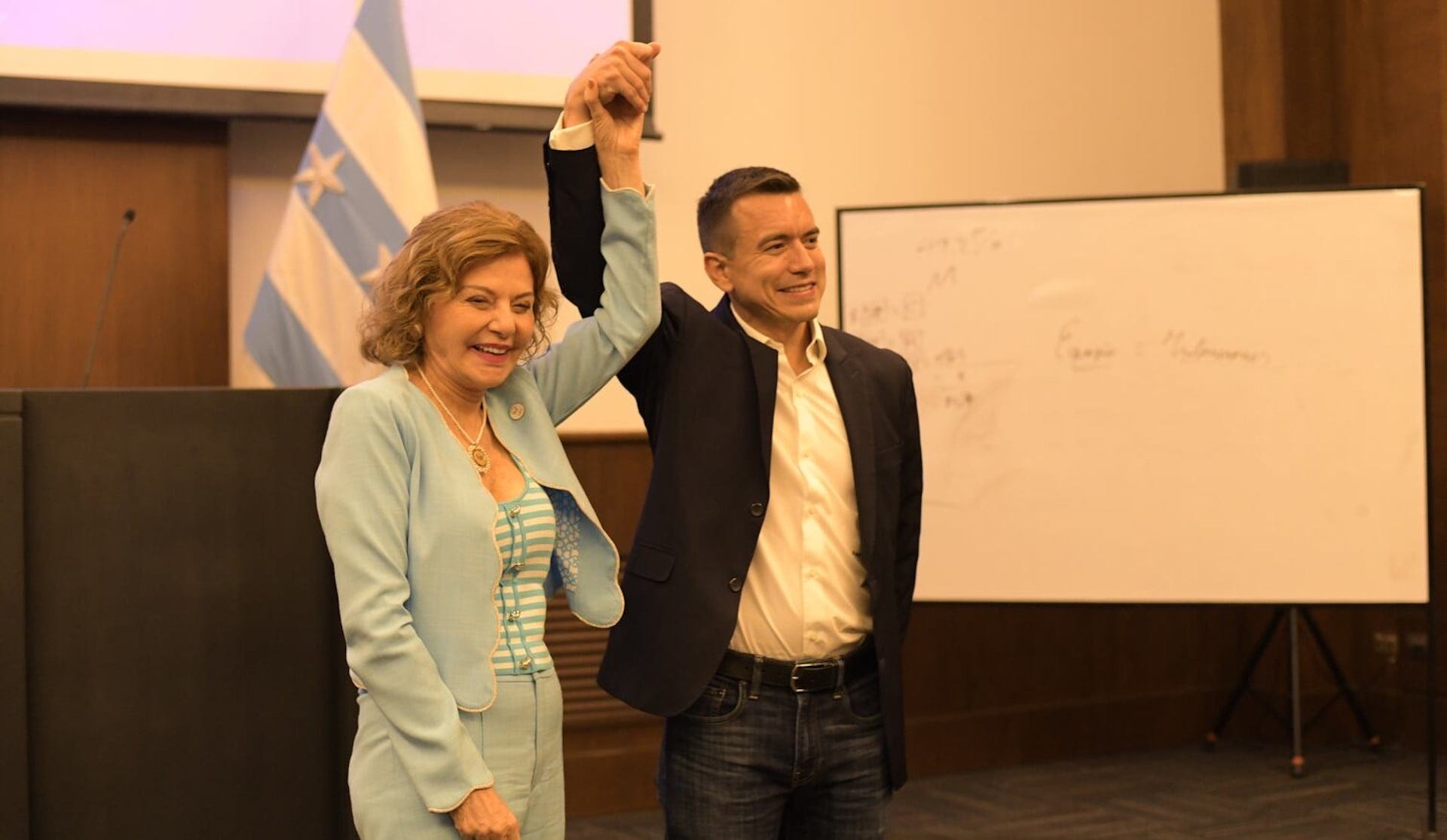
This $1.2 billion port project—one of the largest foreign investments in Ecuador’s history with DP World receiving a 50 year concession in exchange for building the logistics hub—wasn’t just a deal struck between Correa, the government’s Ministers of Transport & Public Works & Foreign Trade, and Sultan bin Sulayem and Mohamed Sharaf of DP. Nope. There were also two private sector companies on the Ecuadorian side heavily involved in the negotiations that partnered with the Dubai-based company led by one of Epstein’s closest friends. One of these companies is Nobis Grupo (or Consorcio), which formed a joint venture with the Emiratis called DP World Posorja SA, holds a 22% minority stake in the enterprise, contributed millions to Phase 1 of the development (funding the acquisition of coastal land and the dredging of the access channel & terminal’s berth), and served as a strategic partner with the necessary regulatory experience to keep the development on track. The chairwoman of Nobis Group is none other than Daniel Noboa’s aunt, Isabel Noboa Pontón de Loor. 9
You’re probably wondering what in god’s name this has to do with Epstein specifically… I’m getting there, scout’s honor. Before I do, I should probably explain the impetus for this article, though. A couple days ago, Camila Lourdes Galarza ran a story on Drop Site News examining the extrajudicial assassination of Alexandra Bravo as she exited a cafe in Manta, one of the two port cities that Villavicencio claimed were dens of Albanian iniquity and which are now recognized as the most efficient transit points in the region for bulk shipments of cocaine. A sicario swerved into view astride a black motorbike and fired at the prosecutor, striking dead both her and her sister who valiantly tried to shield her with her body, diving in between the spray of bullets and the prosecutor. Per Galarza, this makes Bravo the 26th member of Ecuador’s justice system to have been murdered since 2020. Although such retaliation is becoming more the norm than the exception, as bleak as that may be, this incident is particularly notable as Bravo was investigating the Fiorella, Negra Francisca, and Don Maca cases, the recent American drone strikes on civilian fishing vessels, with two crews reporting they were subsequently abducted and tortured by an American patrol boat, apparently bearing striation marks and gashes on their legs and feet.
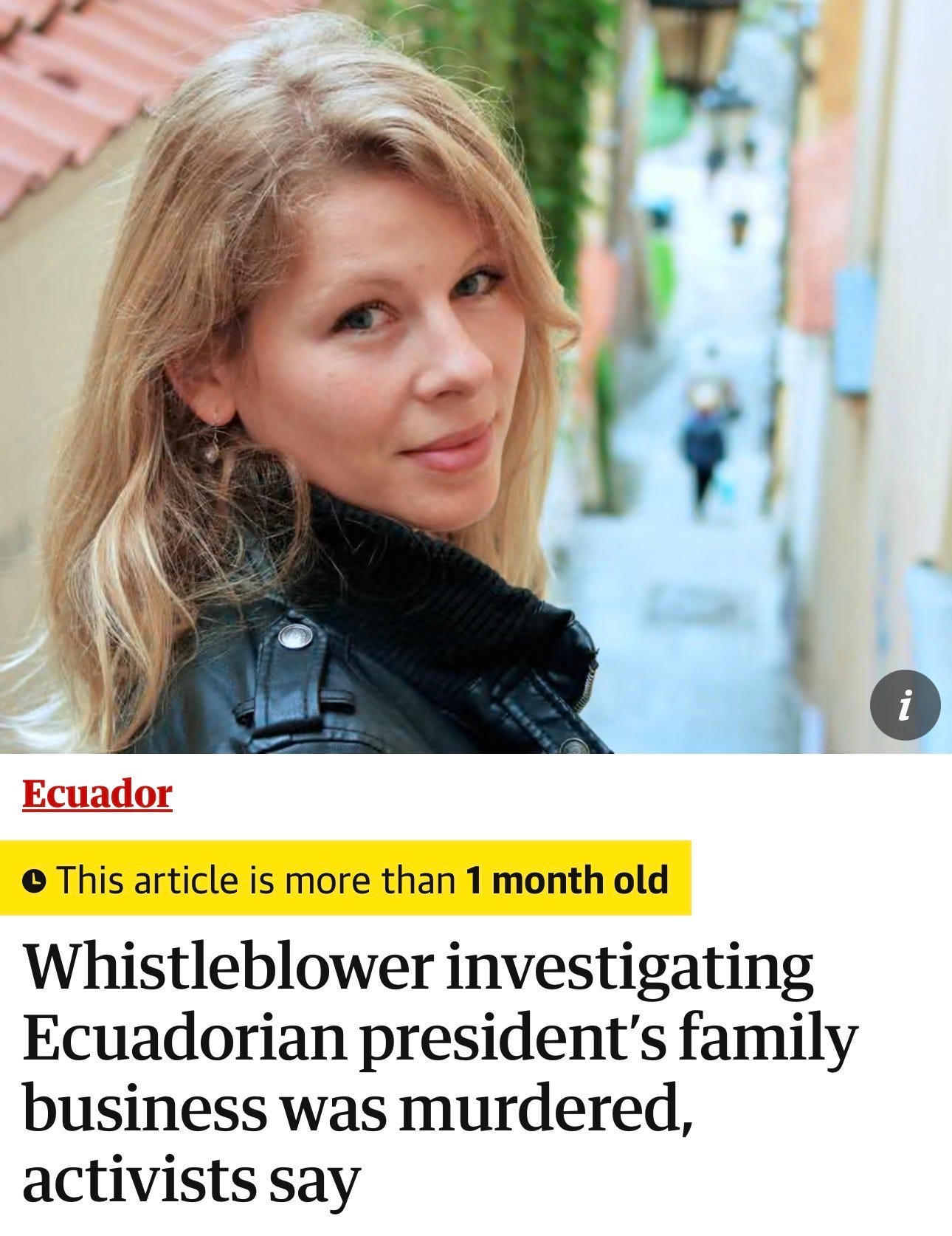
The Bravo Hit arrived on the back of the highly suspicious suiciding of Polish anti-corruption and environmental activist Monika Silva Koniuszek, whose body was also found with a noose around its neck earlier in June, lying on the floor of her home in the touristy seaside community of Montañita. Post-mortem and crime scene findings cast serious doubt on the government’s handwave-y claims of suicide, as it was discerned that she’d suffered blunt force trauma to the back of the head and there was blood on the walls. Making the official cause of death seem even more threadbare, Silva repeatedly attempted to alert her social media to the thinly veiled threats against her life, claiming that her efforts to expose Noboa Trading’s links to international narcotics had placed her in the crosshairs. She preemptively laid her coffin before the head of state.
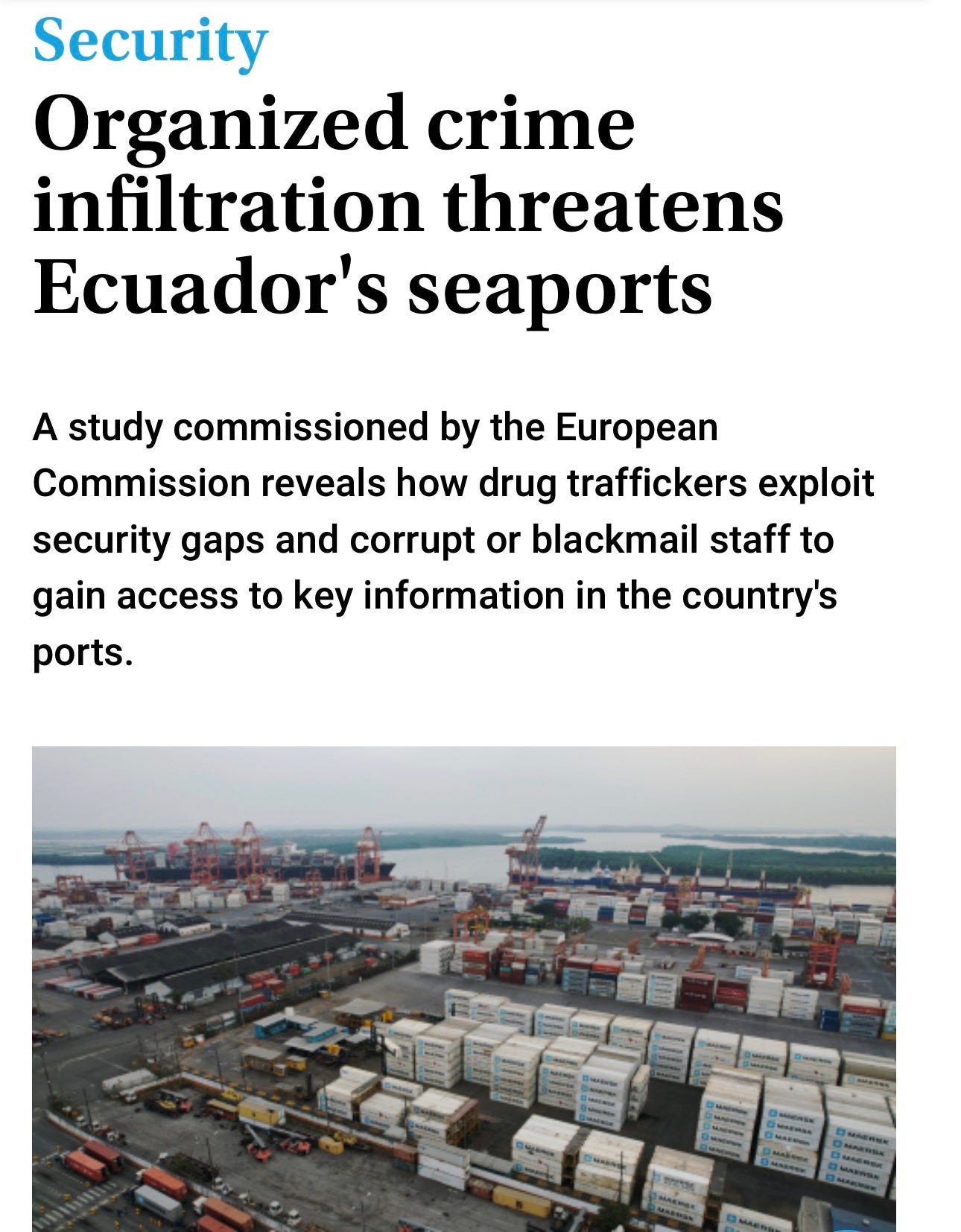
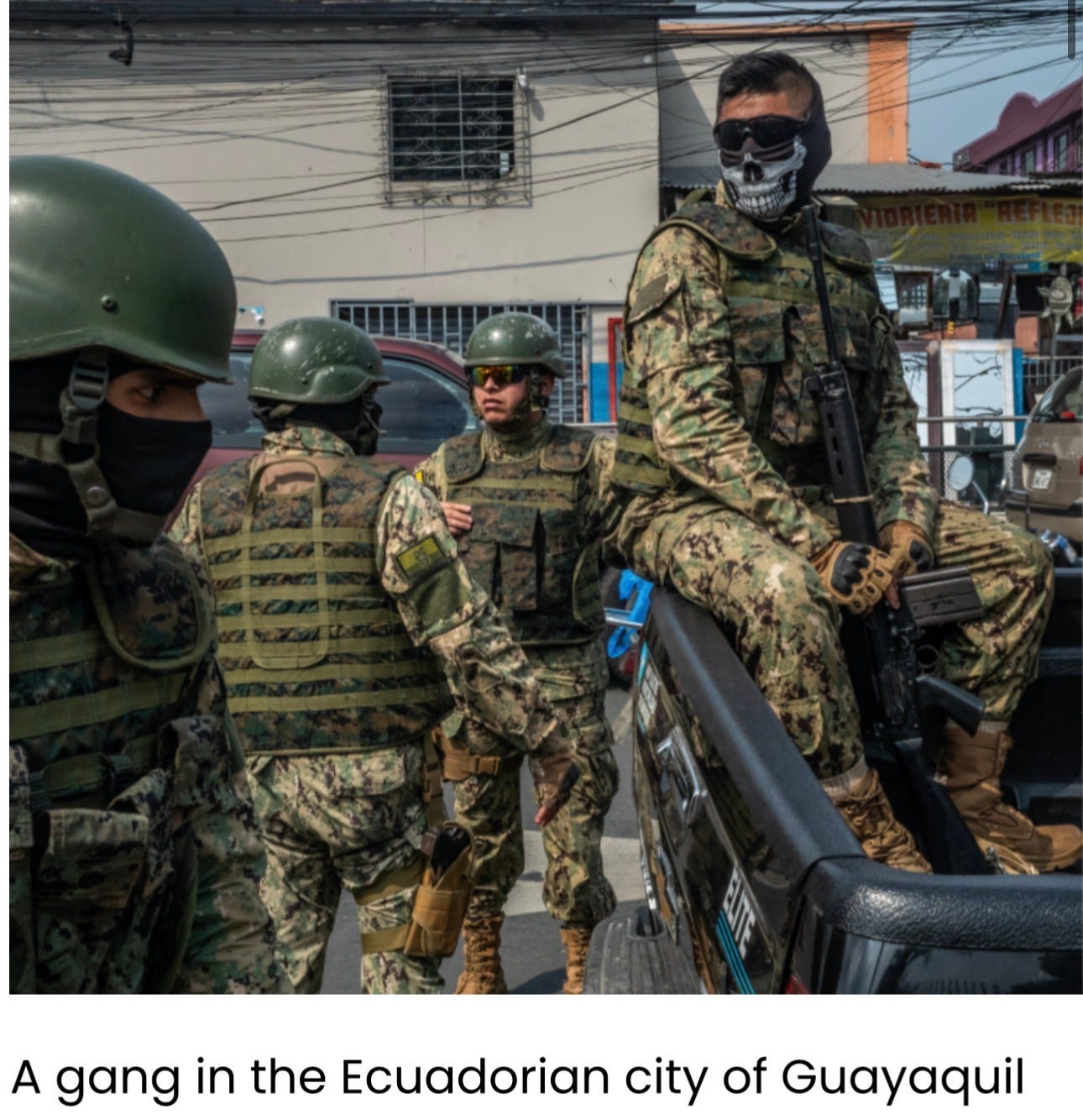
The arch irony of the butchery of Noboa’s tenure is that, much like Villavicencio who was knocked off the board, the foetal politician self-styled as a steel-gloved anti-drug crusader who’d help bring Ecuadorian organized crime and their foreign partners to heel. Despite all the draconian crackdowns, increased militarization, and rampant human rights abuses… Despite the golden retriever-esque cooperation with the Burger Reich’s military and the unilateral strikes against Amazonian dairy farms and fishing vessels… Despite what has effectively amounted to a secret war, the motivations of which are clearly imperialist, criminal, and underhanded… Noboa’s worst efforts culminated in Ecuador’s bloodiest 6 months on record and they’ve come no closer to stemming the flow of cocaine passing through their ports, as over 70% of Colombian and Peruvian powder continues to be exported through Ecuador before shipping for markets further afield. In short, taking Noboa’s stated goals at face value, it’s been a chastening defeat. Knowing what I know about the historical interplay between American imperialism, drug trafficking, and anticommunist purges, though, I suspect that the whole prohibition through the barrel of a gun shtick is no more than a facade and that Operation Southern Spear and Noboa’s drug policy are as much about controlling and monopolizing the drug trade as they are convenient covers for political violence and the displacement of peasantry from arable or exploitable land. Even the DEA and Pentagon’s own analysts have conceded that the “deadly boat strikes” have failed to curb the drug supply at all.
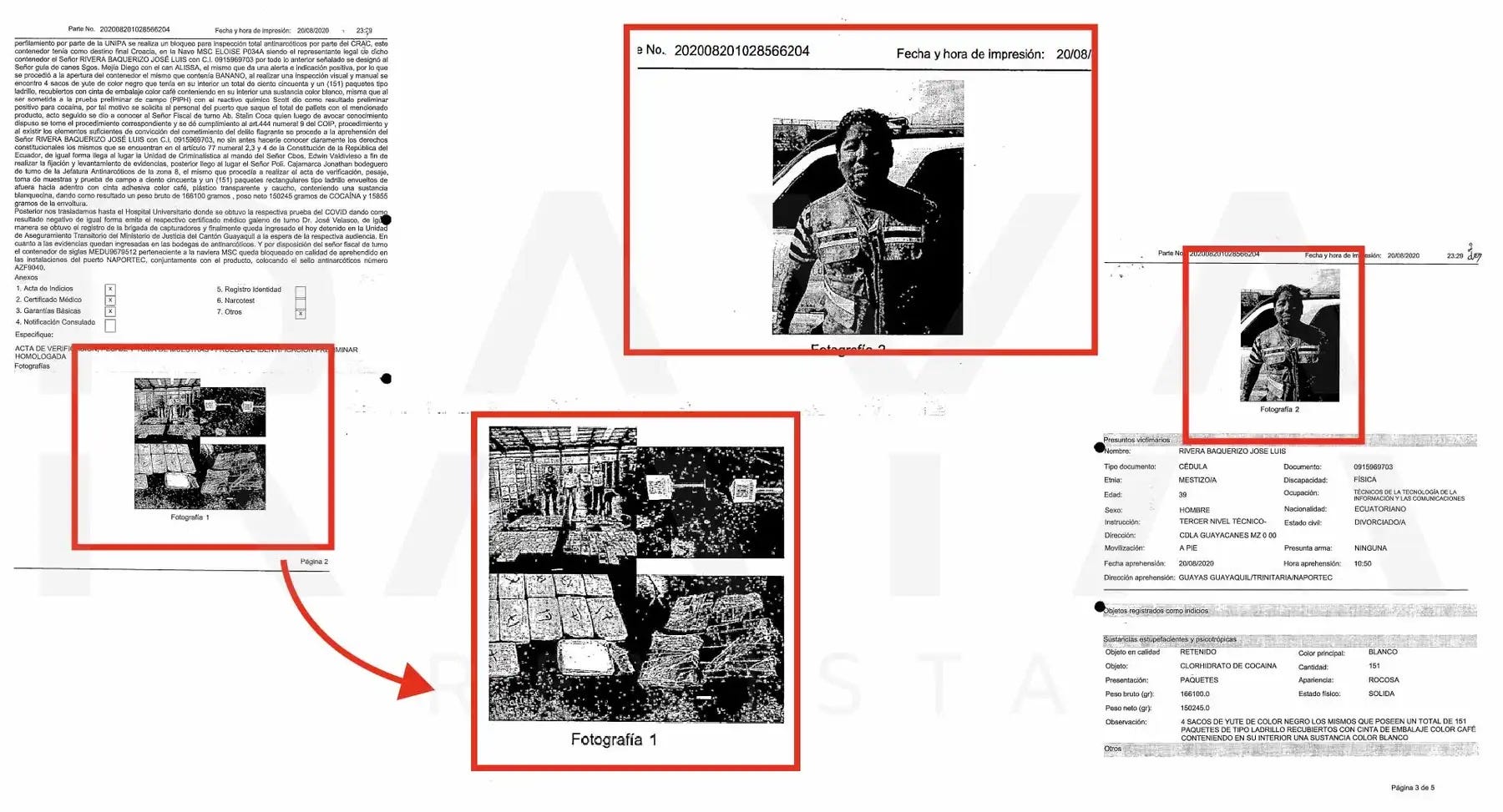
To this point, there’s considerable evidence that the Noboa Dynasty are actually their own crime family outfit and that Daniel Noboa is wielding his newfound political power to shield their fishscale export operation from consequences. Between 2020 and 2024, 3 separate banana shipments containing hundreds upon hundreds of kilos of cocaine were ferreted out by the National Police’s Port and Airport Intelligence Unit at the Naportec Port in Guayaquil—bricks wrapped in brown packing tape in black jute bags stacked atop the banana boxes in one instance, another time stowed in a refrigerated unit, and once behind a false wall in the shipping container. On all three occasions, Noboa Trading Company’s employee José Luis Rivera Baquerizo, whose responsibilities include anti-narcotics checks, was arrested and then released thanks to the intercession of the Noboa family lawyer Edgar José Lama Von Buchwald. In the early ‘20s, he was an advisor to then-Assemblyman Daniel Noboa and has since been appointed as Ecuador’s Minister of Health, underlining the degree to which the family’s cresting political power has been hijacked to grease the wheels of their transnational traffic.
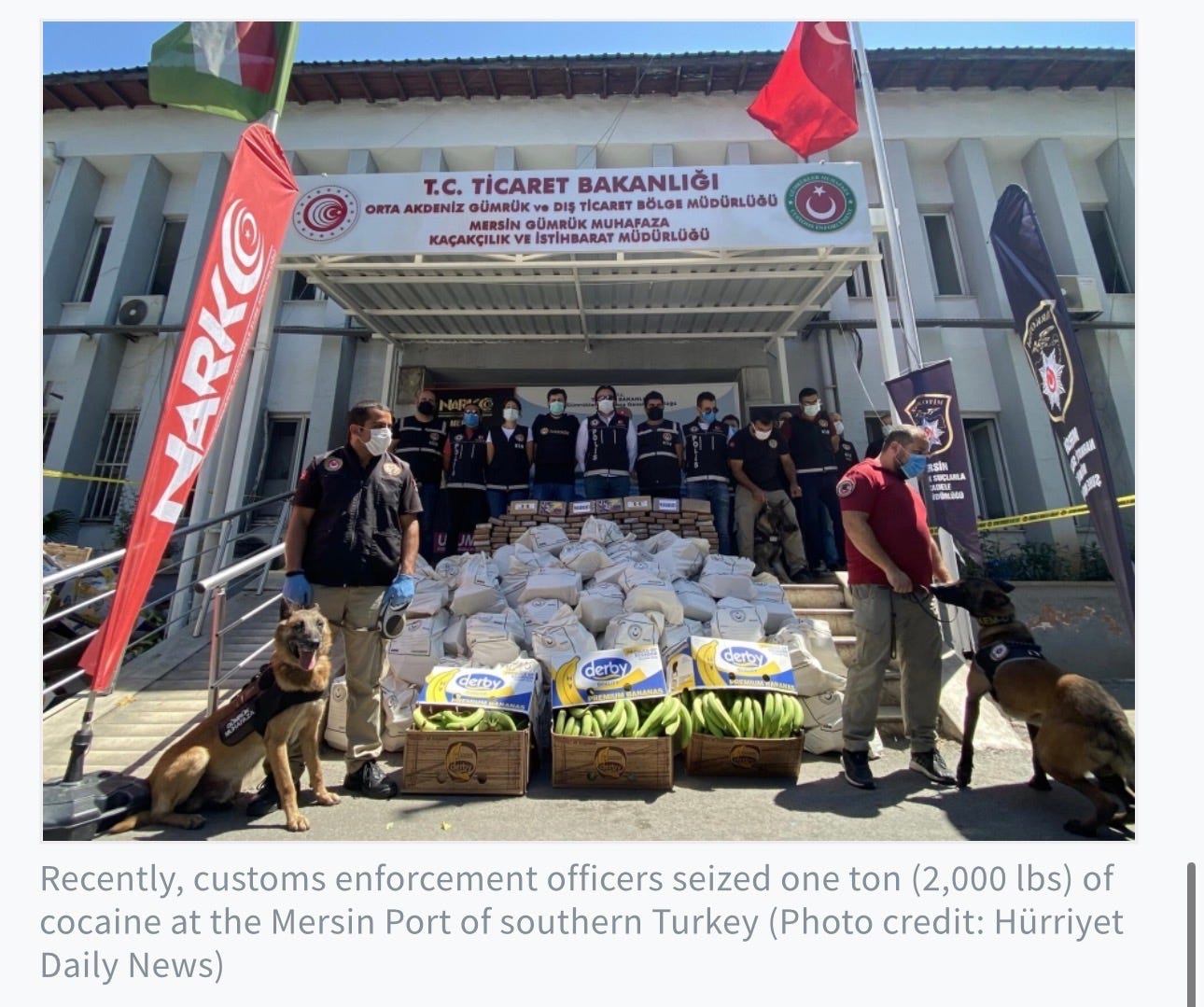
Furthermore, the likelihood that Daniel Noboa, his cousin, and the patriarch are in the dark regarding the nose candy finding its way into their cargo is very remote indeed, as the Noboa Group own a vertical monopoly of the Ecuadorian banana industry, stretching from the crop’s cultivation at the plantaciones de frutales they own to the company that manufactures the boxes to the frigates that carry the containers that are part of the Noboa Group (Ecuadorian Line) to the individual brands under which their bananas are sold abroad, such as Banana Bonita, registered under a Bahamian holding company called Fruit Shippers Ltd that once again links back to the Noboa’s. The last shipment that was flagged at Naportec was in 2024 (during Noboa’s presidency) and contained another 76 kilos. And it’s not only the 3 shipments that were detected by the policia in Ecuador: 600 kilos were discovered in Banana Bonita freight in Mersin, Turkey (said co. serves markets in Serbia, Germany, and Morocco) and a recent European Commission report claimed that 57% of banana cargo that departs Guayaquil arrives in Antwerp with cocaine aboard.
The depressing irony of these developments and the increasing entwinement of the State and the Narcos is that this is precisely how the AmerIsraelis and the West want it. When Correa first took office, Ecuador’s murder rate was 15.9 deaths per 100k residents. By the end of his last term, the rate had fallen to 5.8, one of the lowest homicide rates in all of Latin America. The Correa admin’s law and order successes are attributed to an assortment of reforms & policies:
the doubling of social spending first & foremost, with poverty reduced by approx. 40% and inequality by 16%
the purging of police and the replacement of corrupt or comprador officers with new cadet classes that grew the force by 40%
increase of salaries for the rank-and-file
increased focus on neighborhood policing & community outreach
the adoption of a 911 emergency response system & video surveillance
the rehabilitation & reintegration of the Latin Kings, Ñetas, & Masters of the Street, gangs not subordinated to the Mexican cartels
decriminalization of the possession of small quantities of drugs
Since 2017 and over the span of his neoliberal and right-wing successors’ Lenin Moreno, Lasso, and Noboa’s terms, homicides have suffered an eightfold increase from that 5.8 per 100k to a whopping 45 per 100k. How was this tragedy written? Well, by the DemSoc revolución’s betrayal by the unfittingly named Lenin Moreno, who tore up his promises of continuity and enacted an austerity program under the supervision of the IMF in 2019 in return for a line of credit, laying off thousands of public employees, slashing the budget by 30% and shuttering programs and ministries (including some of the novel security-related ones implemented by Correa), a rolling back of “Socialism of the 21st Century” in favor of free marketization & “democracy” that elicited the applause of the Trump and Biden regimes.
Exacerbated by COVID, poverty and unemployment roared back like never before, with quarantine flowing into a massive subsection of the workforce’s absorption into the informal economy, which in turn has contributed to the rise in drug trafficking, all of it congealing with the AmerIsraeli-enforced austerity and War on Drugs’ policies to create a perfect storm. To be overly reductive, the AmerIsraelis have coerced or incentivized the Ecuadorian ruling class into undoing the Correa government’s social expenditures, driving wealth disparity back up and re-stratifying Ecuadorian society, worsening material conditions for the majority of Ecuadorians, which is like pouring fertilizer on crime and drug dealing, in turn using the flood of violence as pretext for security coordination and permanent military presence. In short, the rolling back of Correismo is a return to the vastly unequal and impoverished Ecuador of the late ‘90s and early 2000s and it’s no accident that said time period of economic crisis and dollarization was precisely when the Epstein Nexus moved in and made Ecuador the centerpiece of their Latin American sex traffic, which we’ll examine in this essay’s concluding section.
With these points against Noboa’s narco-presidency on the board, let’s now return to DP World’s Posorja, Sultan bin Sulayem, and his Aunt Isabel Noboa, one of the industrial developments that’s perhaps best analogized as a Stage 3 tumor of cancerous bourgeois criminality. Having recently passed its 5 Year mark, the Port of Posorja has solidified its hold on the prestige that comes with being Ecuador’s busiest terminal, having processed the most trade volume and incorporated three new services for the Danish transport giant Maersk in 2024 that underline its criticality to global supply chains. 10
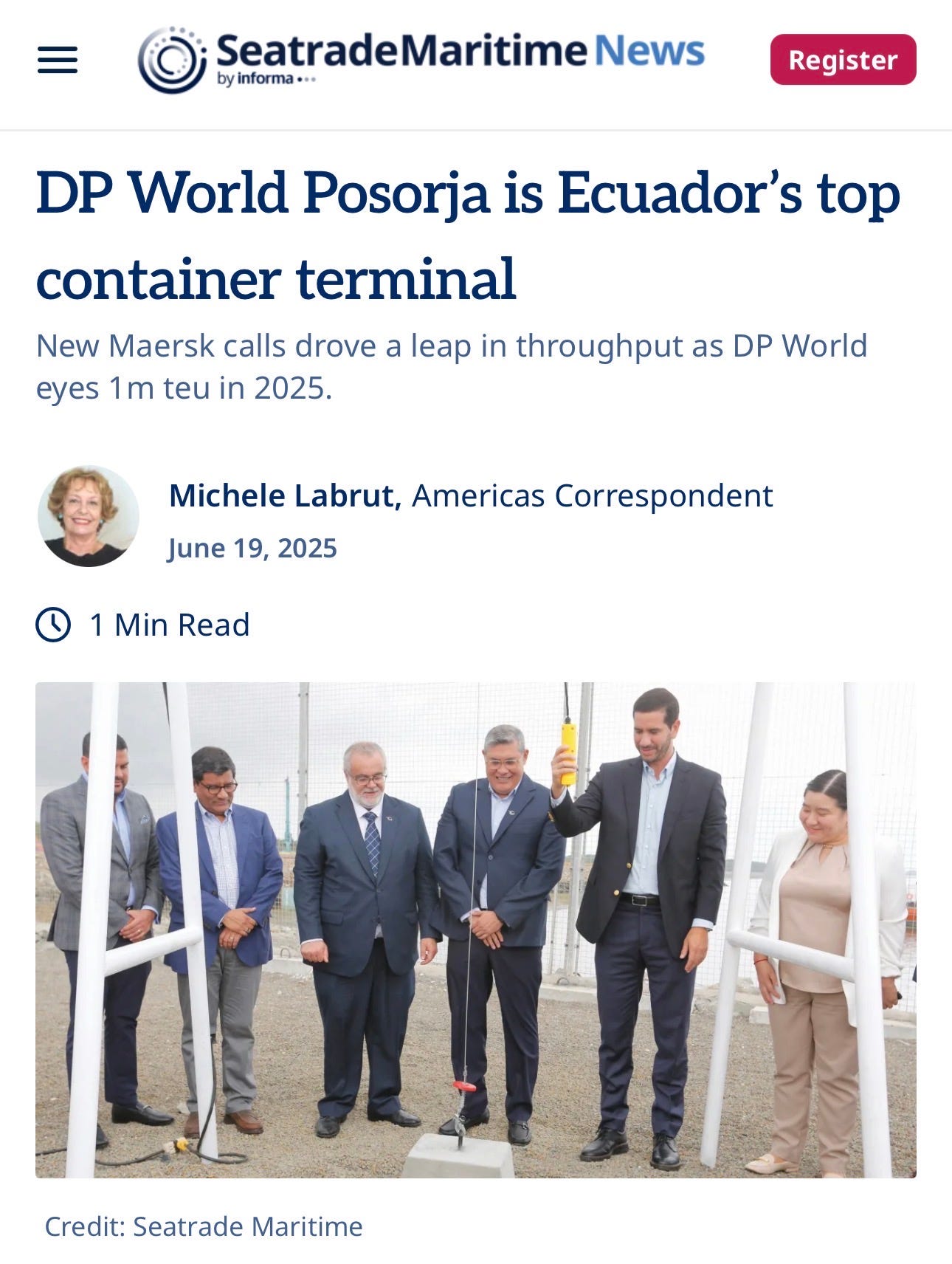
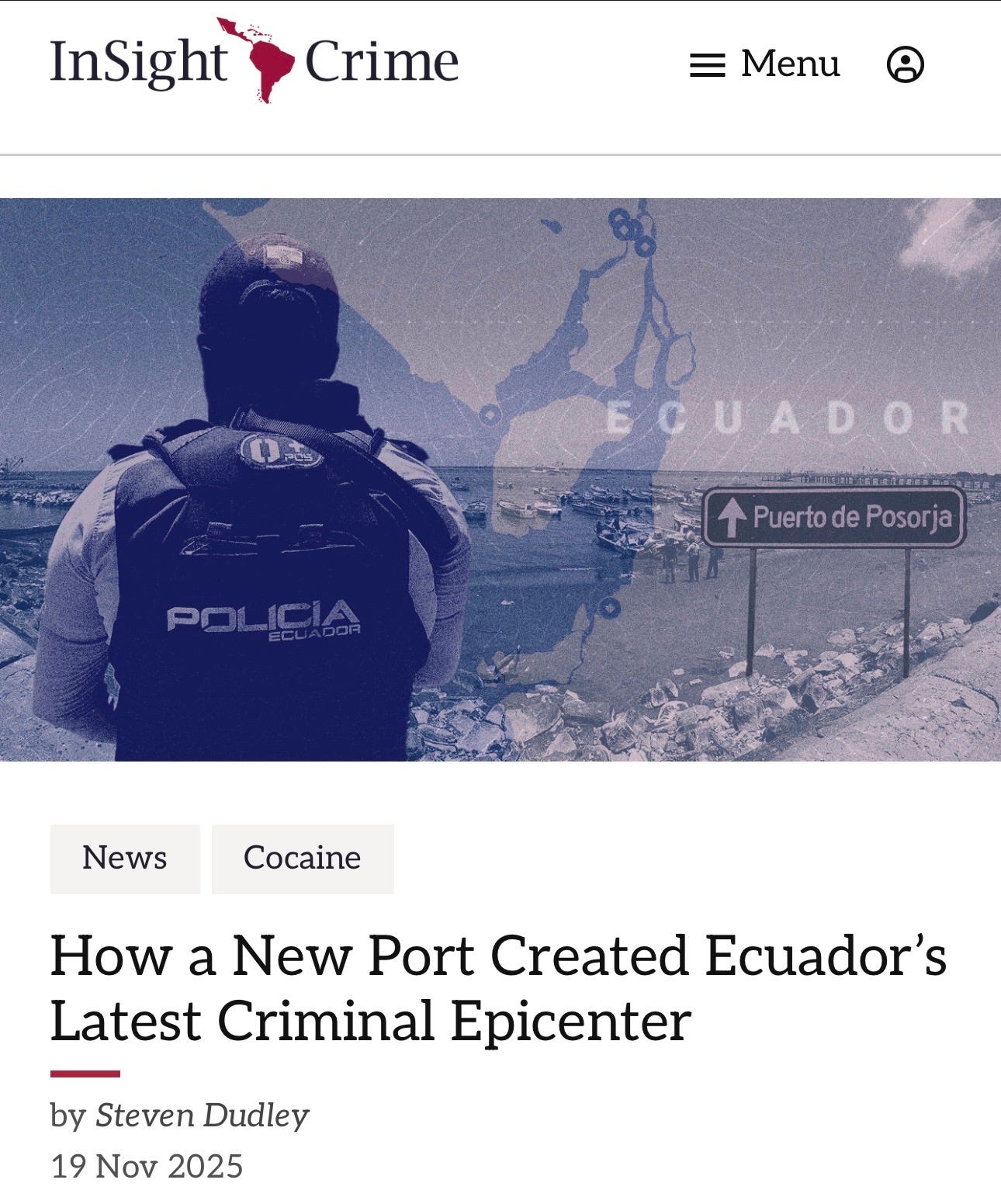
The stakeholder salivation-inducing profitability and trade volume has been accompanied by ever-rising tides of blow and violence, as we’re seeing. According to an InSight Crime report, since the ribbon-cutting of DP World’s deep water port (which can handle post-Panamax ships, some of the largest cargo freighters), the Los Choneros gang, which is the armed wing of the Sinaloa Cartel in Ecuador, and a splinter group called Los Lobos, have been waging a war the epicenter of which is Posorja and another coastal town called General Villamil Playas that’s approximately 16 miles due west. In 2019 when the Port was opened, the two fishing villages had suffered only 4 cumulative murders that year—by 2023, there was a record 155 between them, rising to quadruple the national average. According to InSight, Posorja is a Los Lobos stronghold. You’ll see how intriguing this is in a moment.
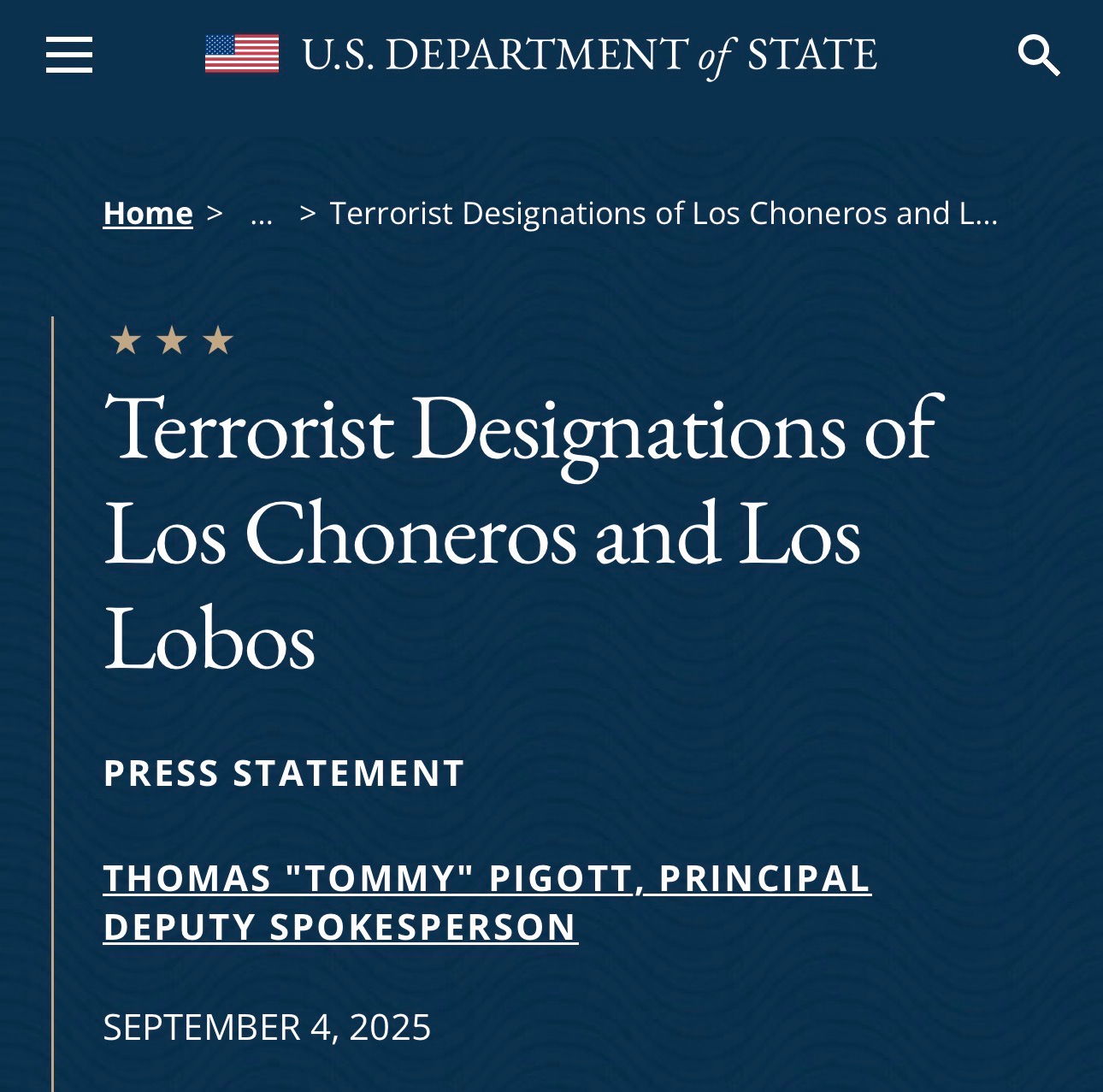
The Noboa and Trump admins have declared war on both criminal organizations, designating them foreign terrorist groups and targets of this newfangled War on Drugs they’re spurring on, but if you’ve learned anything at this point, nothing is as it appears. As Los Choneros and Los Lobos gun each other down in the cafes and billiard halls of the once-peaceful coastal communities and vie for a monopoly on Posorja’s container smuggle, we’re seeing more and more of the powder volume rerouted from Guayaquil to DP World’s facility, with the 15 tons seized in 2024 showing a 300% growth.
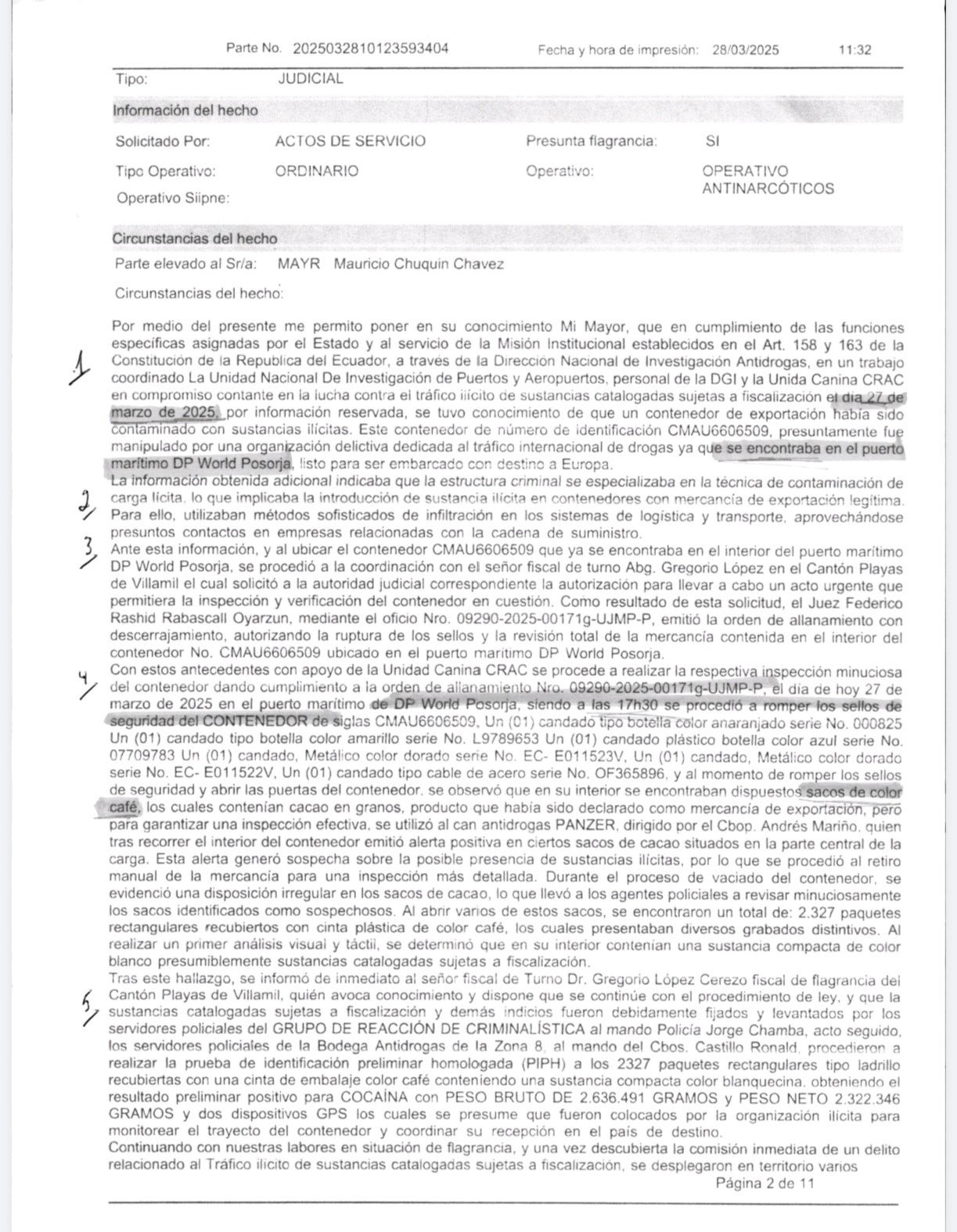
The booming banana, cargo, and cocaine trade has led to further investment and infrastructural expansion by the Noboa administration, with the President attending in-person the groundbreaking of the Posorja Multi-Purpose Terminal Expansion Project undertaken in conjunction with the China Harbour Engineering Company. The Posorja Boom has also led to further contemporaneous additions to the folios of evidence showing the Noboa Family’s implication in the cocaine traffic: most recently, the Blasti Case. TeleSur reported earlier this year that Ecuadorian authorities seized 2.6 tons of cocaine in a shipping container owned by the shipping & warehousing company Blasti S.A. at the Port of Posorja. The Blasti firm’s corporate architecture and leadership overlaps significantly with the Noboa Conglomerate, with the company managed by a Chilean who holds executive roles with Noboa Trading and Noboa S.A. and with Blasti’s shareholder entities linking back to various Noboa family members. Quote:
Among them is Isabel Noboa Pontón, the president’s aunt, who is listed as a shareholder of Petromar Esmeraldas S.A., Materbanano S.A. and Empacadora del Litoral Empacar S.A. Other individuals identified as shareholders in the innermost layers include Isidro Romero Noboa, Melissa Romero Noboa, Casandra Sicre Noboa and Nastassia Sicre Noboa.
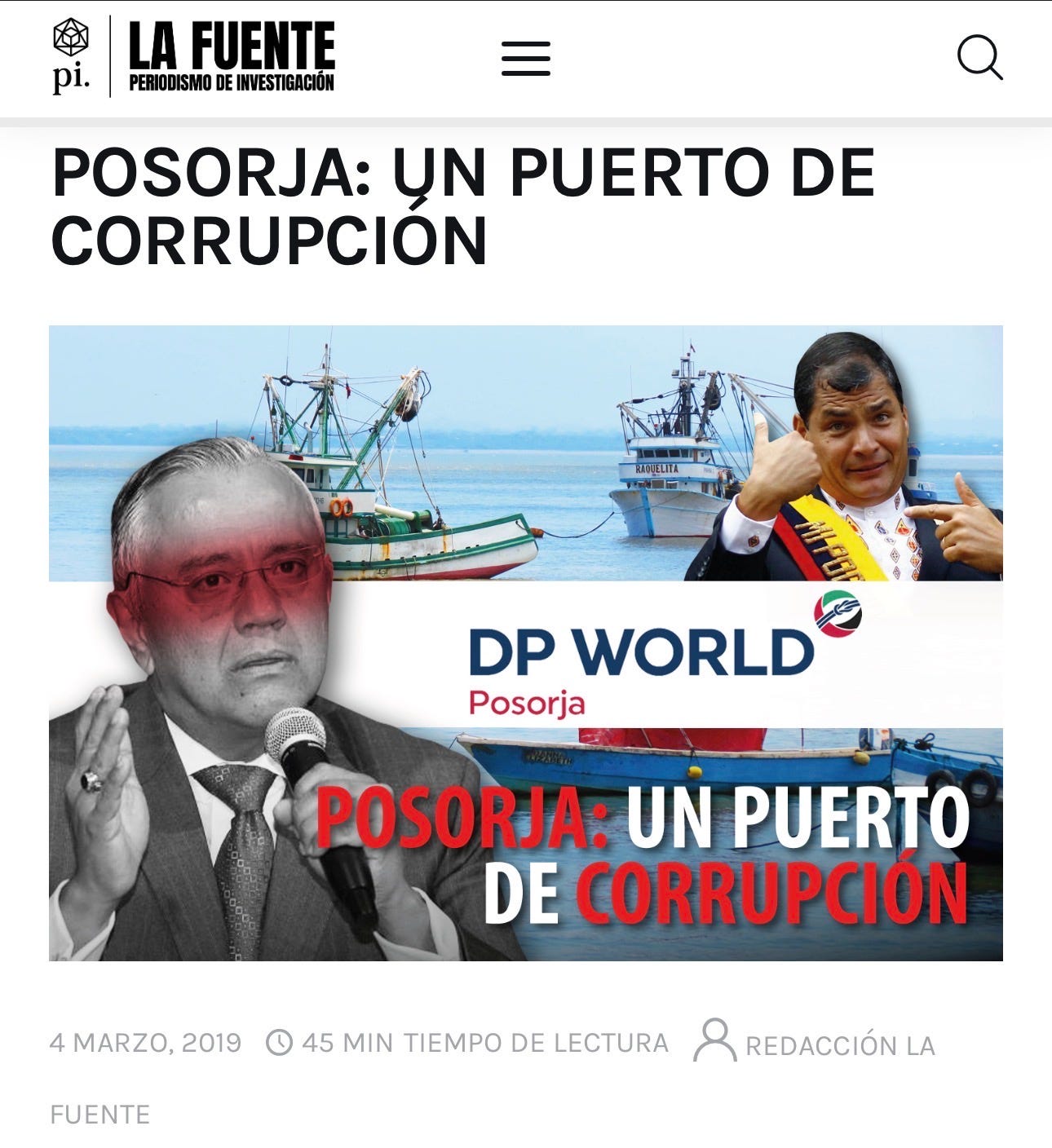
Returning to the Villavicencio Hit, it seems like another angle to the murder could be that Villavicencio upset the Noboa’s by publishing massive “exposes” of supposed irregularities in the Posorja concession process. For example, this article pertaining to accusations of influence peddling by Correa, embezzlement, the absence of an international bidding process on the Posorja installation (failing to secure a deal most favorable for the Ecuadorian people), and the awarding of an unfair percentage of cargo traffic gross revenue to DP World, with Ecuador only receiving a paltry 5%, which Villavicencio published in his online outlet The Source: Investigative Journalism on March 4th, 2019 (even if he portrayed the socialistas as mostly culpable). Here’s another expose from June 13th, 2019 in which his outlet aired the State Comptroller’s claim that the Port of Posorja project had caused “serious harm to the State” by reducing the Treasury by hundreds of millions.
On March 24, 2022, just over a year prior to his assassination, Villavicencio tweeted out evidence from the Arroz Verde case (trans. green rice) that shows lawyer Alexis Mera was employed by DP World and Isabel Noboa’s Nobis Grupo at the same time that he served as Correa’s Legal Secretary. Mera was jailed over an alleged bribery network in the Correa government in the Green Rice case as the Empire Struck Back against the Ecuadorian DemSocs through lawfare, convicting Correa in absentia over $7.3 million in “bribes” that were supposedly funneled to his partido Alliance PAIS. Arroz Verde was spearheaded by none other than Fernando Villavicencio and his substitute candidate replacement Christian Zurita, of course, tying in with the larger Odebrecht “disclosures” and the deep state’s counter-hacktivist leaks, yet another example of his enduring vendetta against Correismo that made him so attractive to the gringos.
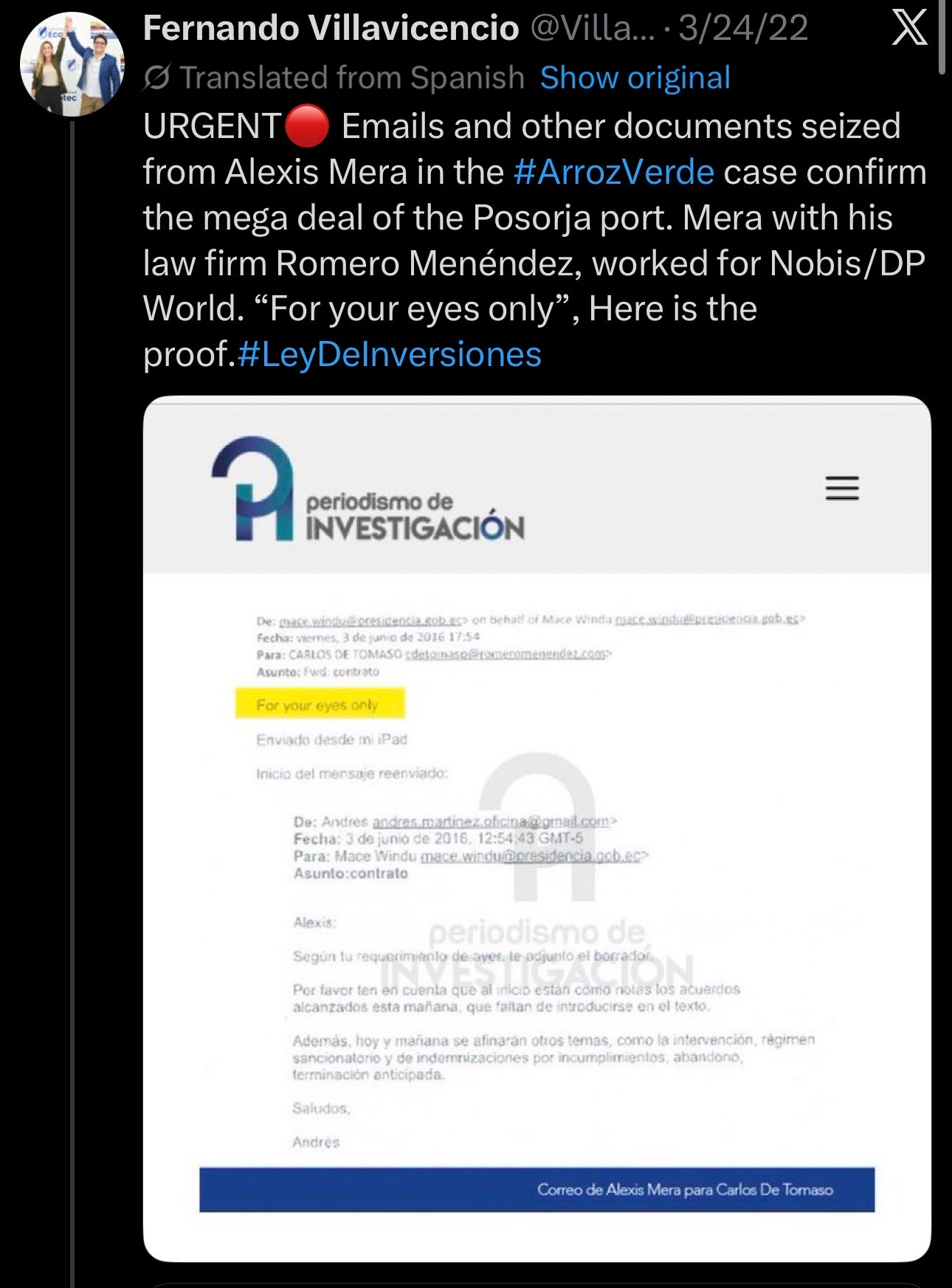
The March 24th tweet was culled from an earlier exposé of Villavicencio’s titled “For Your Eyes Only” that tagged off the Arroz Verde Case to make the argument that there was significant conflict of interest, illegality, and insider dealing involved in the Port of Posorja mega-deal and concession-awarding process. You’ll see why his digging around these topics could be problematic for the most powerful family in the country. Quote:
The reviewed documents show that Alexis Mera played both sides of the field: he used the power of the Legal Secretariat to benefit DP World and the Nobis Group, while his law firm Romero Menéndez advised the contractor and received economic resources, configuring an evident conflict of interest, influence peddling and possible bribery.
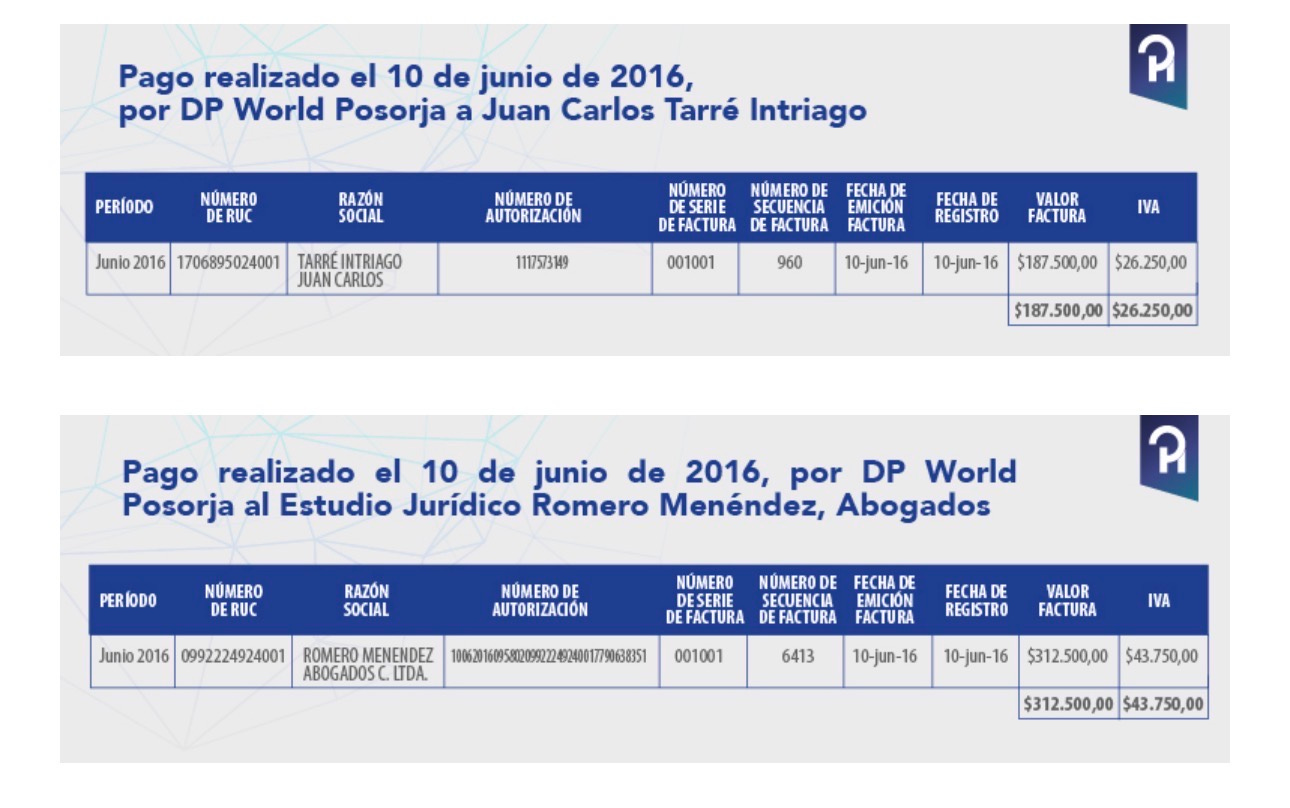
Villavicencio goes on to provide invoice evidence of two payments to Mera’s law firm Romero Menéndez (he’s a partner) amounting to $500k that was received from DP World and Grupo Nobis’s joint company. With all of this in mind, I feel like the smoke begins to clear somewhat regarding the Villavicencio Assassination and the machinations behind his murder. Let me expand on the official narrative and the coverup that helps us to cut through the murkiness.
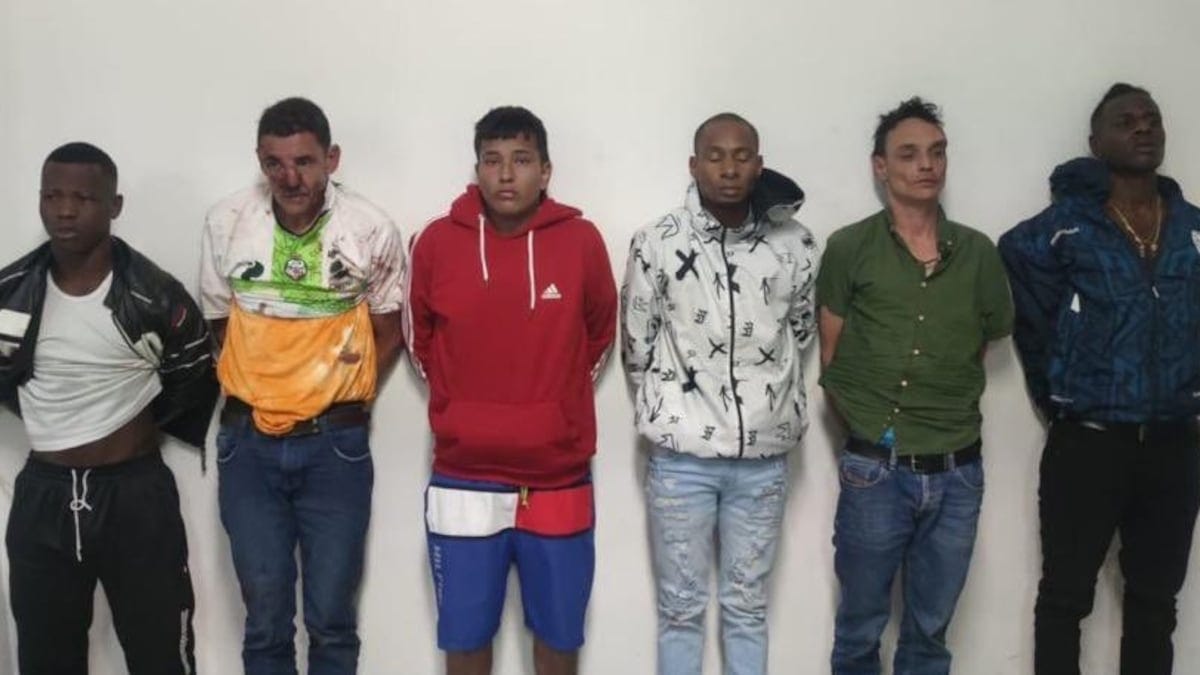
I already mentioned how one gunman was fatally downed at the scene during the shootout, a Colombian national alias Ito. In the hours following, 6 more Colombian hit men suspects were swept up, firearms and grenades supposedly found on their persons. Like one of those deep event curiosities, the six had all been arrested a month earlier on other charges including drug trafficking, were duly released on bail, and then had warrants issued for their arrest TWO HOURS before the clipping because they’d failed to check in with the policia as stipulated. HOW CONVENIENT. What kind of brain dead hit men would go take out a presidential candidate at the exact time they were supposed to report to their parole officer unless it was an operation that had specifically been designed for them to be captured?!
Now for another component of the official narrative… Remember how we said that recent reporting from InSight Crime maintains that Los Lobos, this splinter faction of Los Choneros, has turned the Port of Posorja into their personal turf? Well, you’ll be shocked when I tell you that the day after the attack, a group of masked and tatted individuals recorded a threatening video message claiming responsibility for the FV Hit like some dour rework of a scene from Terror in Resonance. They said they were Los Lobos, the gang that Narco Rubio recently designated a foreign terrorist organization and which the State Department alleges tethers together the Jalisco New Generation cartel, European Mafia, and dissident remnants of FARC (Revolutionary Armed Forces of Colombia), which we explicated in great detail in the last episode was the target of a political genocide architected by Rafi Eitan and partly perpetuated by Clinton with Epstein & Maxwell’s assistance in the previous essay.
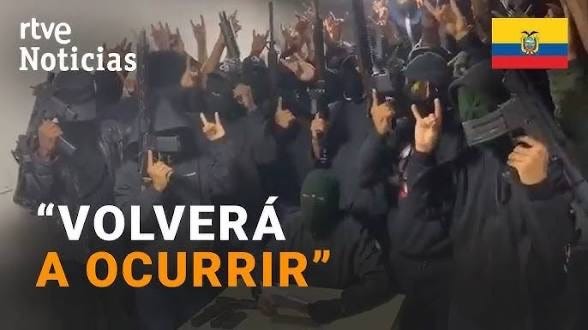
Only problem is that NGOs immediately cast doubt on the recording’s authenticity and the (likely IRL and non-AI generated or central cast) Los Lobos promptly released a second recording that disavowed the video and denied all of its claims. Convoluted, as I said. Prior to his death, Villavicencio had spoken publicly about how the leader of Los Choneros had threatened to have him offed, actually, albeit he was collecting enemies like Pokémon. More significantly, his widow accused “the State” (meaning Lasso government) of full responsibility, partly because he was under its protection and she maintained the security had been lacking, although it’s quite possible she was insinuating something else. His hermana echoed these claims.
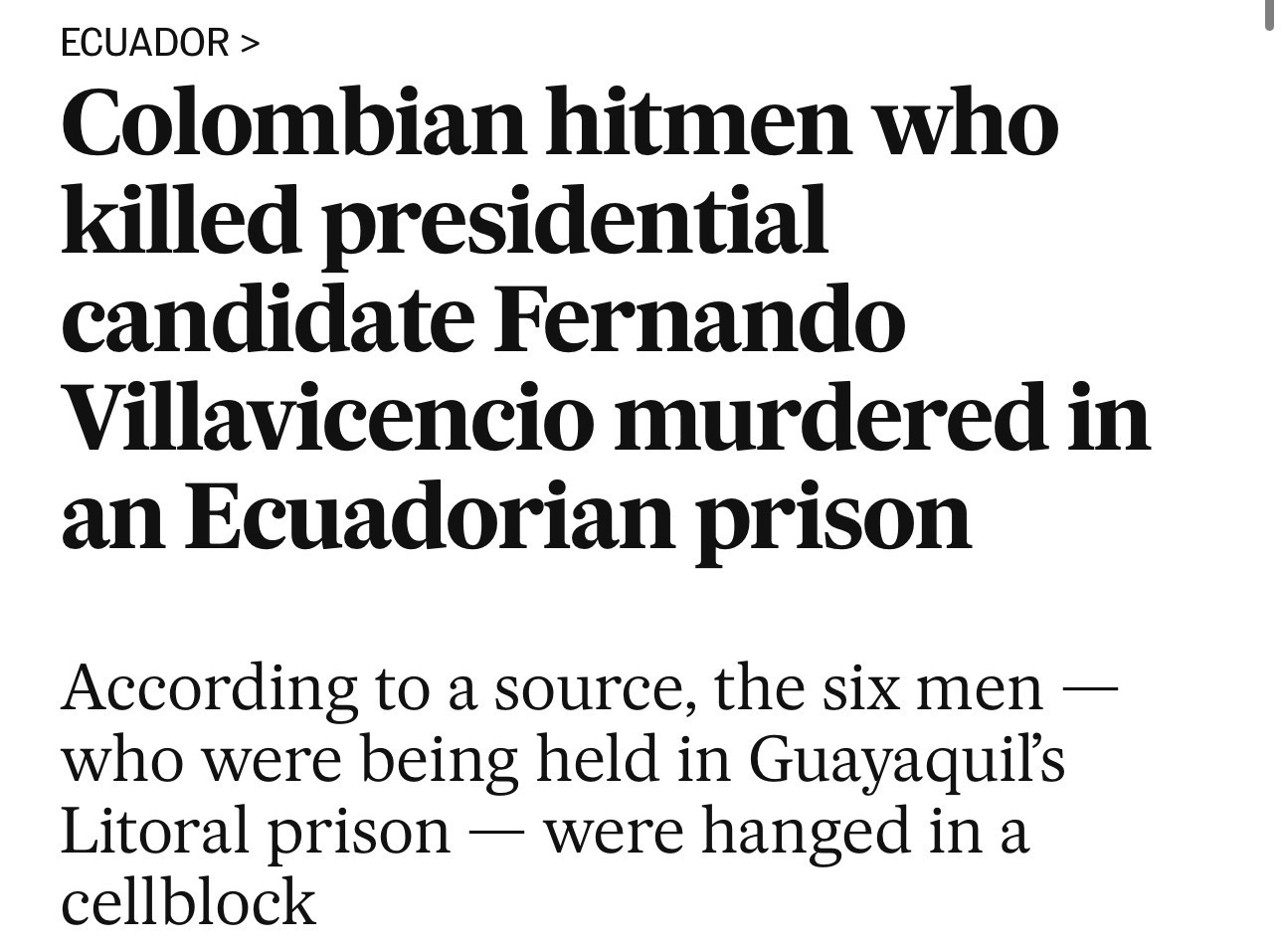
The surviving Colombian hit squad who’d been placed in pretrial detention in Litoral Penitentiary in Guayaquil were soon survivors no more: one week before Ecuador would head to the polls, their cadavers were discovered hung in Cell Block 7, a different block from the one they’d initially been assigned and then another they’d been transferred to 5 days prior. Lasso was in New York at the time and told the press he would be promptly heading home to meet with his Security Cabinet. The clearly contracted clean up operation of the supposed wet workers may have doubled as a convenient excuse to get rid of the National Police Chief and the head of the penitentiary institute in advance of Noboa taking office, another Police Uprising Purges reprisal by the Right. Perhaps. From his life in exile, Rafael Correa leveled the charge that the suspects’ murders confirmed the Lasso government was responsible for the assassination and the admin had been fully permeated by organized crime. Showing some degree of residual Pink Tide solidarity, Gustavo Petro has also echoed Correa’s assessment publicly at various points, implying that the Noboa and Lasso administrations are the ultimate masterminds of the scheme.
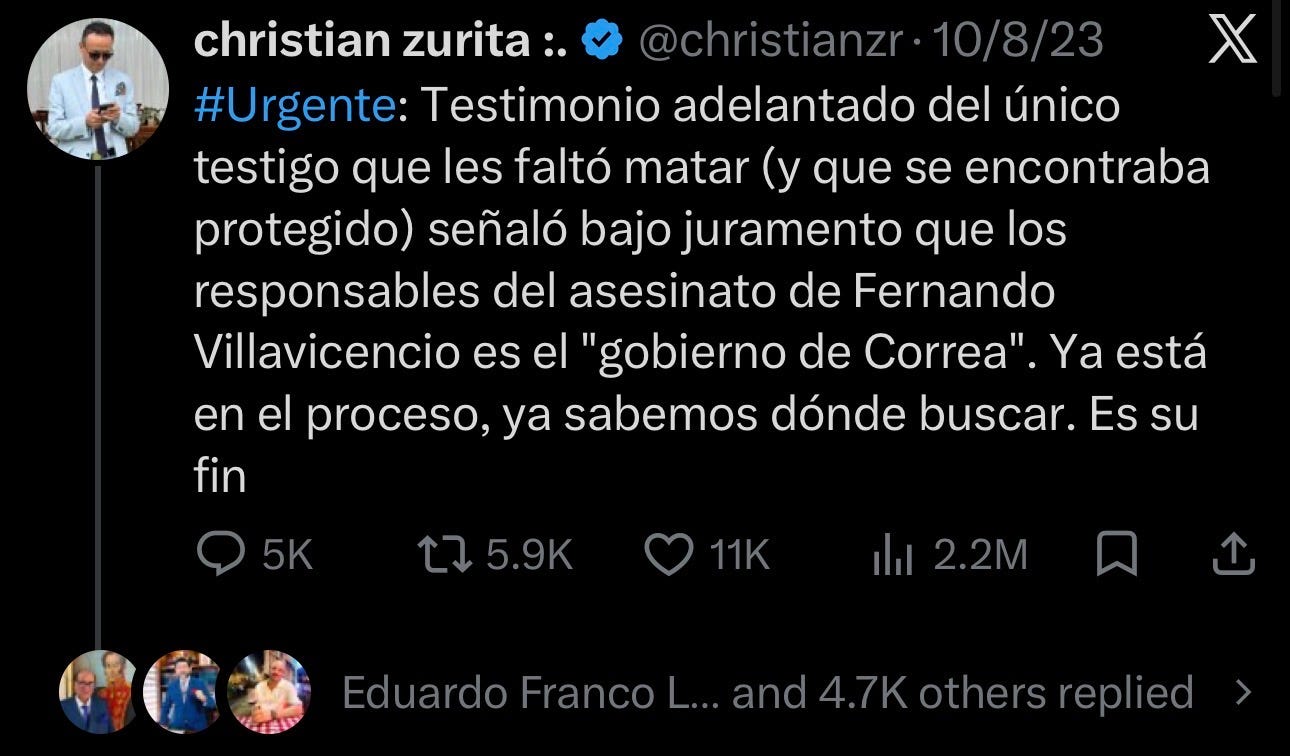
One individual’s role that we haven’t really unpacked yet in all of this also happens to be supremely suspicious. Christian Zurita, Villavicencio’s trusted colleague, tweeted on Oct. 9th, 2023 that “preliminary testimony” from the “only witness they failed to kill” stated under oath that Correa and his lackeys had ordered the clipping. The source of Zurita’s incendiary claim was reportedly a leak from the U.S. pawn Attorney General Diana Salazar and Villavicencio’s widow Veronica Sarauz also jumped on the bandwagon during a presser, placing the accusatory crosshairs on Correa as the election ramped up towards the runoff. In an official narrative that’s already littered with holes like a Swiss bank, there are two issues with the shitcoating that Correa orchestrated things from abroad that stand out. Doesn’t matter much because the damage was already done by Zurita and Sarauz’s statements, causing Luisa Gonzalez to falter in the polls, ultimately losing to Noboa under the cloud of suspicions, BUT—
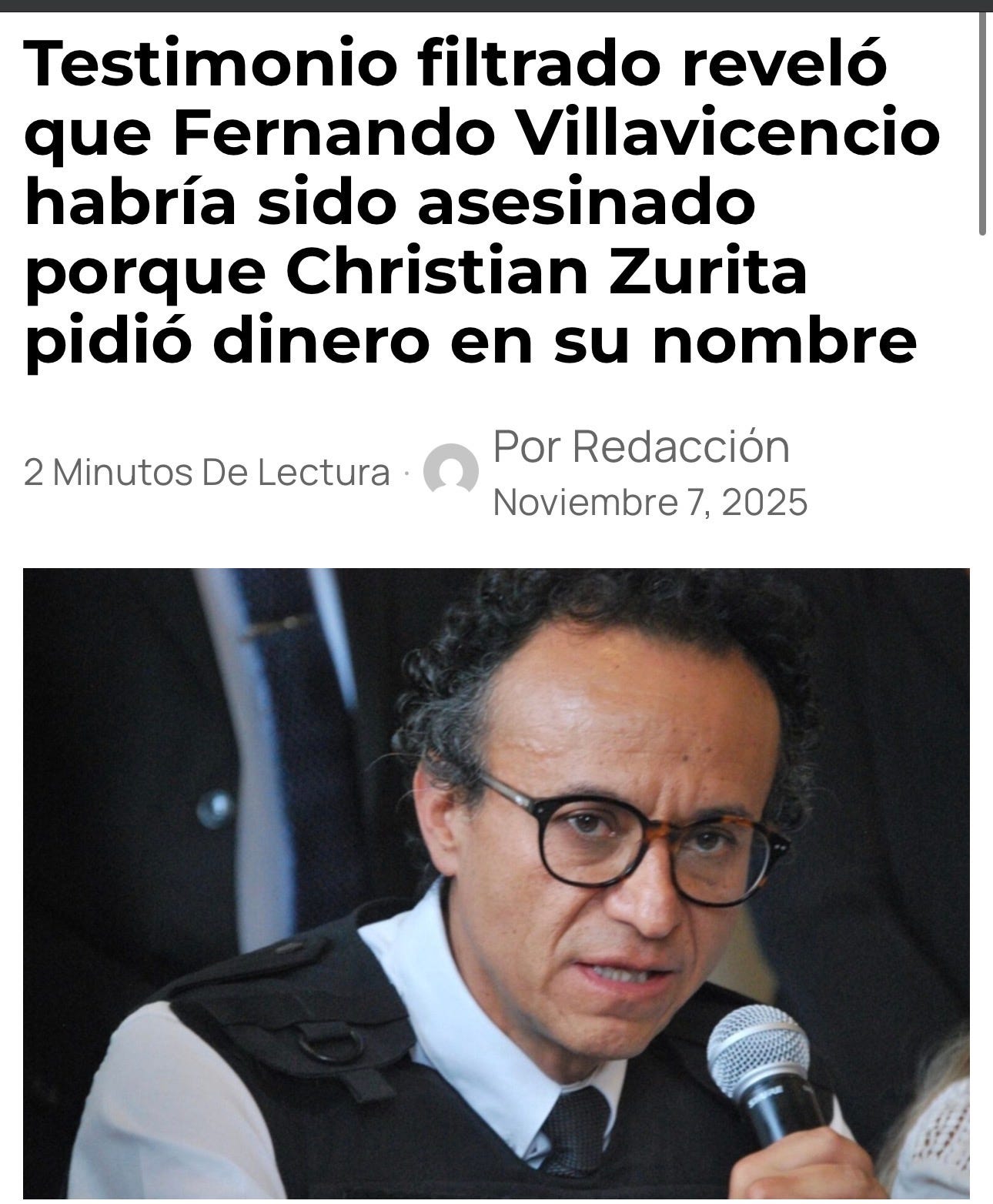
In November of last year, testimony was leaked from a witness who claimed to have shared a cell with the money launderer and drug financier Leandro Norero (a fascinating character due to his old timey escape arts), and said witness alleged that Zurita had approached the gangster and solicited a $200,000 bribe in return for not publishing explosive information about his criminality. As the story goes, Norero actually paid the hefty catch-and-kill fee, but Zurita’s buddy Villavicencio proceeded running the incendiary report anyways and Norero therefore ordered his assassination. Again, how convenient that this 34 or possibly 36 year old from Guayaquil who once faked his death by having his lawyer claim he was felled by Covid to avoid extradition to Peru and who is allegedly a part of the criminal underworld formed of the allied Los Lobos and Chone Killers groups (Lobos again, the framed) would be the original source of the contract… And how convenient that he, much like the Colombian hitmen reportedly hired, was killed in a riot at the Latacunga Prison in Cotopaxi in 2022, a full year before the Fernando Villavicencio Magnicide (as they call it) was carried out!
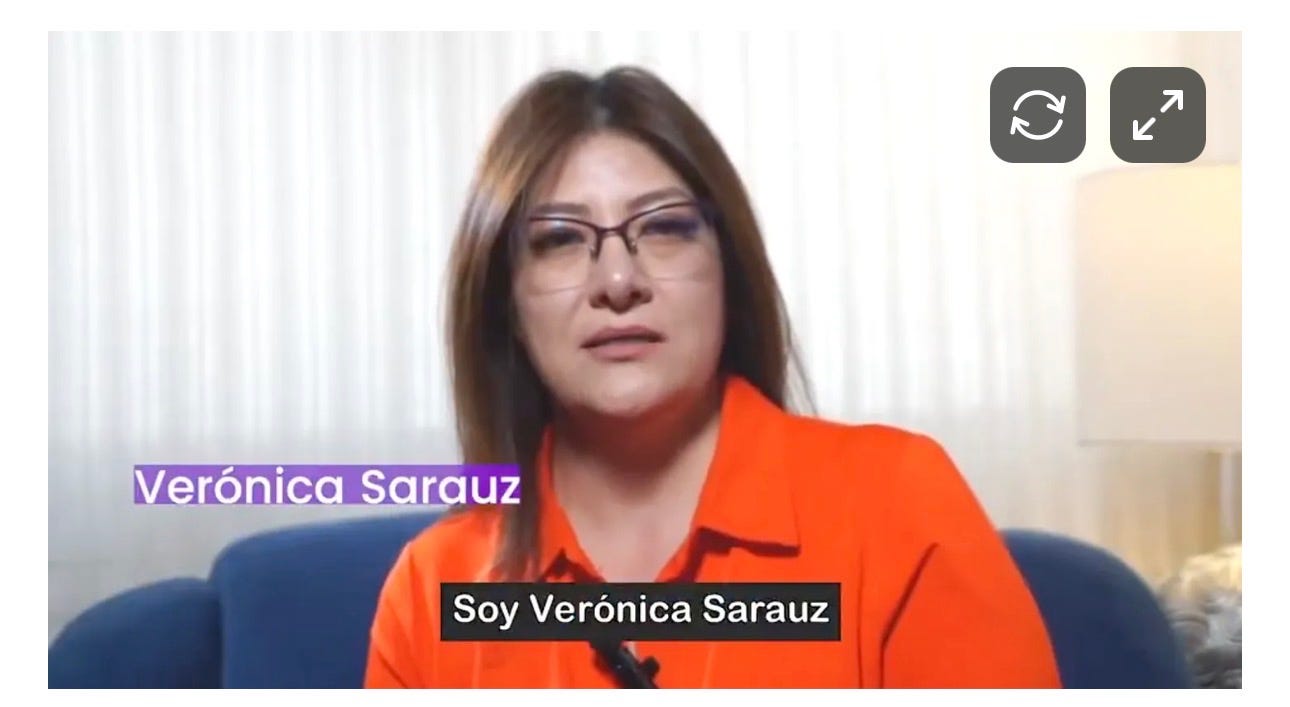
The other big hole that makes the state’s opportunistic bloodcoating of their socialist enemies blatant would be the fact that Villavicencio’s wife 11 reemerged in the lead up to the Spring 2025 runoff in which Noboa was up for re-election against Luisa González once again and released a video that rocked the race as she retracted her previous allegations and reversed course entirely. The widow Veronica publicly accused Noboa and Diana Salazar of pressuring her to point the finger at Correa so as to nuke González and the Revolución Ciudadana’s lead, despite the total dearth of credible evidence to support the allegations, saying, “It was all false… They vilely deceived me”. The incendiary claim from one of the initial disseminators of the Correa shitcoat wasn’t enough to prevent Noboa’s continuation, sadly, another tragic case of too little too late.
Zooming out to conclude this section, I think we can all agree that Villavicencio was a Sacrificial Lamb stuck to a pike at the Altar of Marketization and Anticommunism and the biggest uncertainty is what interests made up the cabal that ordered his killing.
(Pt. II will follow shortly. You can read it immediately by visiting the ParaPower Mapping Patreon. Muchas gracias.)
No posts
Comments
Nothing yet. Say the first thing.
Sign in to join the conversation.