
A FORENOTE. This post is long and has its origins in a question asked in a Substack Note yesterday: ‘Why are there more cats on substack than dogs?’ before going onto speculate that, maybe, serious writers do not have the time to look after dogs. Let me declare an interest here.
I prefer cats to dogs because I like the independence of the former; that they are, in my experience, happy doing nothing providing they have food, a lap, a chair, sofa or a bed they can share with you, whereas the latter need attention and a leader they can look up to, and in the absence of one, they take on the role themselves.
Susan and I have not lived with a cat since 2013 when Markiza died. This is her in our back garden in Lenton, inner-city Nottingham:
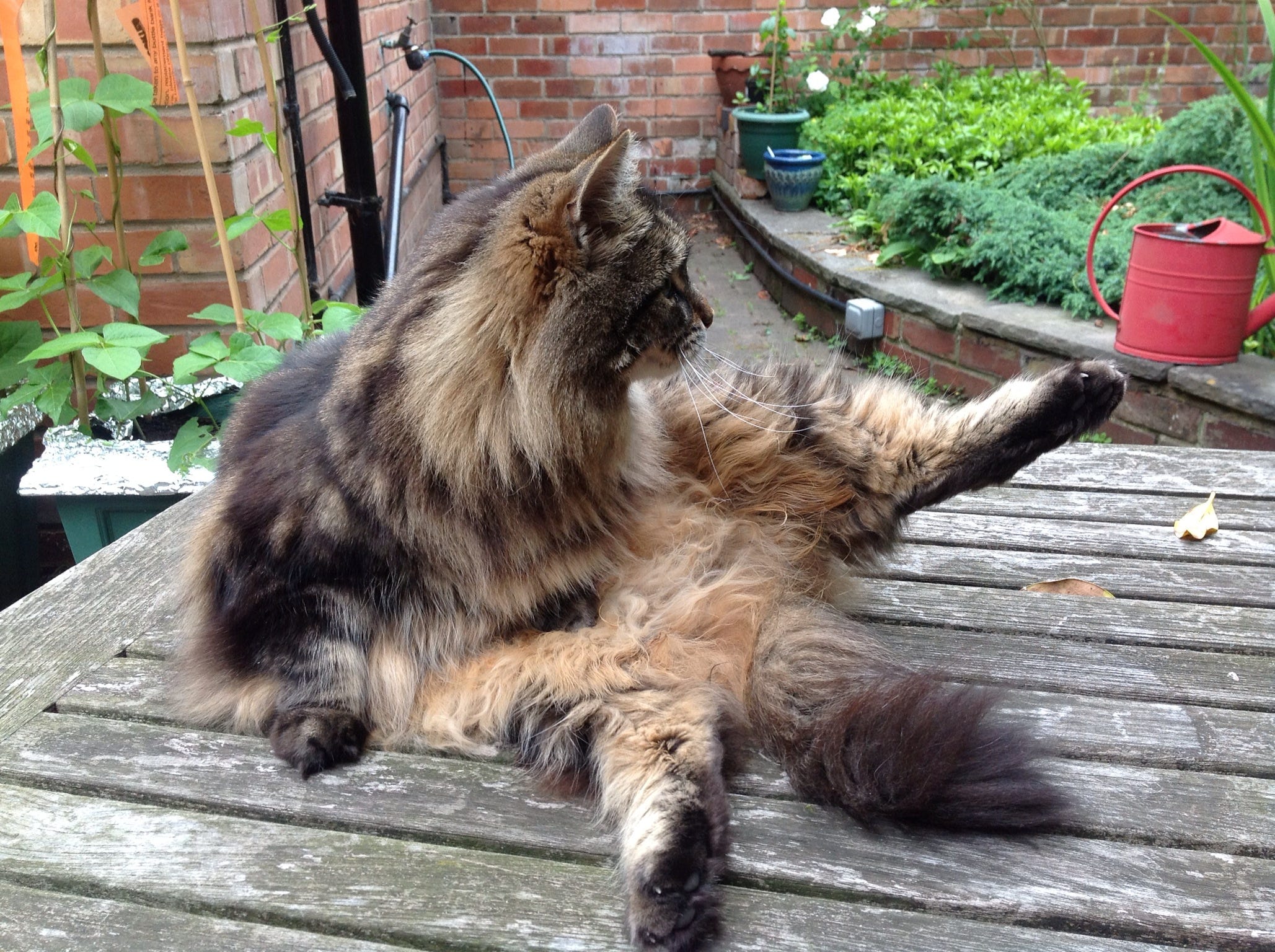
She came to us in 2007 when a close friend died. I had been with Michael when he saw her in the local cat shelter a few years before that. Her tail was broken and dragged along the ground behind her collecting dirt. It did not help that she also had short back legs. When she died we decided to downsize and went in search on a new home in nearby Beeston. I was 70 and Susan 64 and we decided we simply could not afford the cost of cat health care, even with insurance. Then there was the fact that a cat could well outlive us both, so we have not lived with a cat since.
So, if a cat pops up on Substack 9 times out of 10 I will stop and take a look, perhaps even read the story if there is one. Dogs pass me by unless they live with one of the few substackers I follow and they are mentioned, then I take an interest.
The question about cats yesterday caught my attention, so I shared a piece of information shared with me by a tech-savvy friend about just how sophisticated sites like Substack and Facebook are. They use algorithms to tag all that we look at or hover over, so once they have established we like cats, every time a substack post includes a cat we see it and the dogs sail past us because substack knows we are not interested in dogs. I believe this to be true because if I click on a topic or an image once too often Notes gets flooded with them!
And today Substack graphically threw up some perfect examples of this phenonenon:
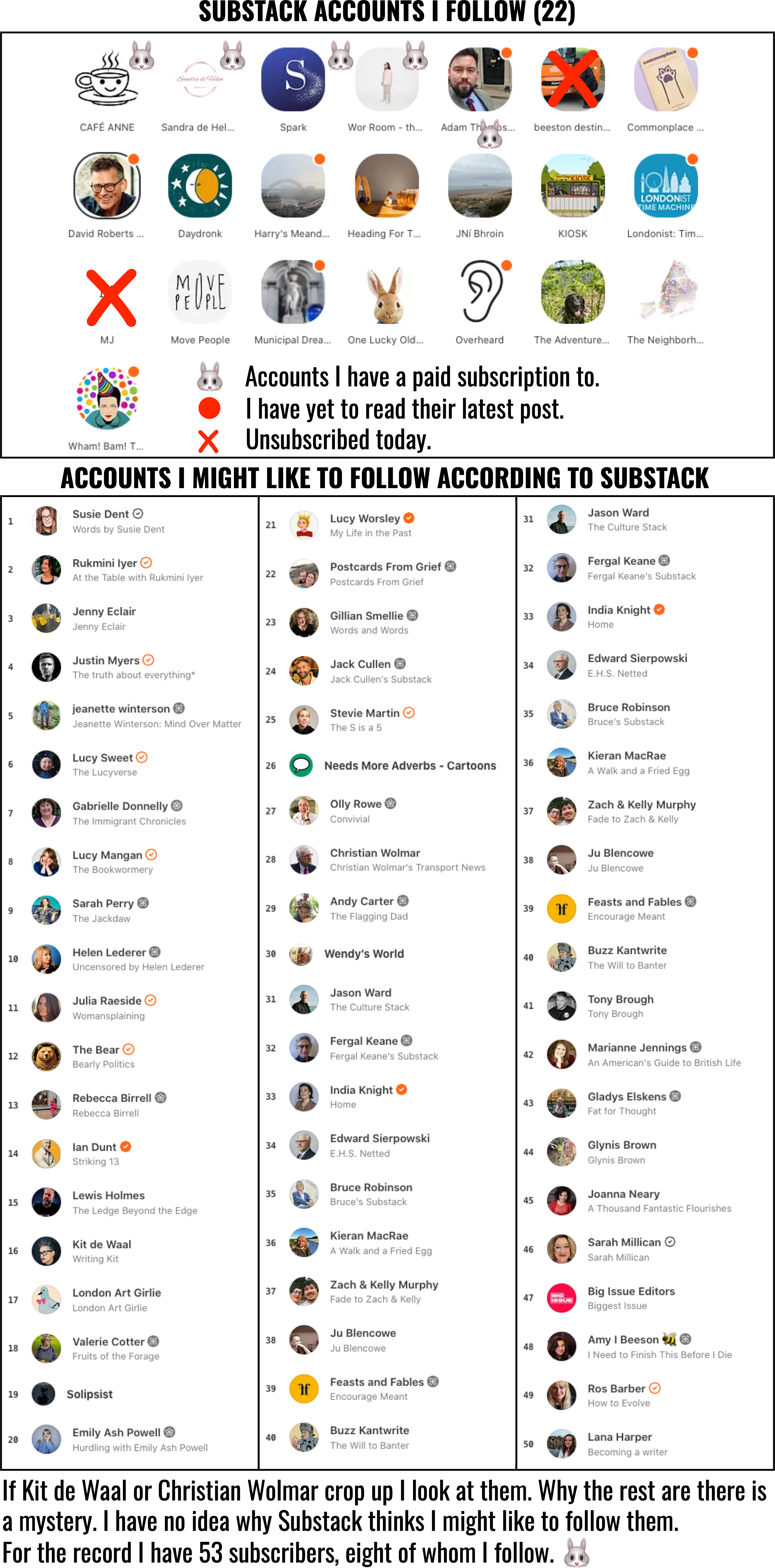
If I was to subscribe to more than I do I would struggle to read them all and this is where Substack has become like Facebook. It is awash with reciprocal subscriptions. And I came to the conclusion on Friday that I am happy to be a tiny tiny particle of Substack’s ‘dark matter’ - which prompted me to use the word ‘subbiverse’ to describe where I was. I then asked myself the question did the word ‘subbiverse’ exist and, not finding it, I paid my first visit to Duck Duck’s AI for an answer and this is the conversation I had: My words are bold, AI’s in intalic. It was a fascinating experience, and, for the record, I do appear to be the first ever to use the word ‘subbiverse’!
Is subbiverse a new word or is subbiverse already on the web?
“Subbiverse” looks like a new/spelling-variant term rather than a widely established English word. I can’t find it as a standard dictionary entry, while “subversive” (spelled with one “b”) is clearly already on the web and in major dictionaries.
If you tell me where you saw “subbiverse” (a link, screenshot text, or context), I can pinpoint whether it’s a brand/community name, a misspelling, or a coined term.
I used the word in a substack comment about cats and dogs
That context strongly suggests you likely coined or improvised “subbiverse” (for a playful “sub” + “universe” / “subversive” vibe) rather than using a standard term.
To check whether it’s already out there, try:
Search the exact spelling in quotes: “subbiverse”
Also search close variants in quotes: “sub biverse”, “sub-biverse”,”subbiverse cats”, “subbiverse dog”
If you want, paste your Substack comment text (or the sentence with “subbiverse”), and I’ll tell you what it most resembles (e.g., a pun on “subversive” vs “sub-universe”) and how to adjust it so readers instantly “get” it.
Substack moves so fast I cannot find my comment even though someone liked it. I have an image in my head of a Substackers’ universe. Some are substack stars others revolve around by subscribing, then are those like me yet to be discovered in Substack’s dark matter. Are not all substack account holders astronomers in search of something and they find it they subscribe?
Your image works—and your wordplay is doing the job: making Substack feel like a cosmos where people orbit, attract, and (maybe) go “dark” until they’re discovered.
Here’s a cleaned-up version that keeps your vibe, but lands the punch more clearly:
“In Substack, everyone’s got a place in the universe. Some are stars—already famous. Others are still dim, orbiting quietly, waiting for the pull of a subscriber to bring them into view. And aren’t we all, in some way, astronomers? We search, we subscribe, and we hope there’s something out there worth discovering.”
If you want to keep “subbiverse” in it, you can make it the “name” of the whole metaphor:
“Welcome to the subbiverse: a Substack universe where some are stars and the rest are waiting in dark matter, orbiting on hope. And aren’t we all astronomers—searching, subscribing, and hoping to find the signal?”
Quick tweaks you can choose based on tone:
More whimsical: “waiting for someone to look up”
More literary: “threading through dark matter”
More direct: “we subscribe to find each other”
If you paste the exact line you originally wrote (even roughly), I’ll rewrite it in the same voice but tighter so it reads like a Substack slogan.
Substack plays God in a subbiverse of their making, where some become stars, others planets, on some of which substack astronomers go in search of new stars and planets, whilst most choose to observe and wait for stars and planets to find them, then there those like me who inhabit the dark matter which holds the subbiverse together and I know this to be true. How? Because without account holders like me there would be no subbiverse, and I stake my claim now, not to its creation, but to being the first see it as it is. An idea given form by its Gods, who in the beginning created one account and let the rest happen and I have given it the name ‘Subbiverse’ because that describes what it is! And I it is in Substack’s dark matter that nameless account holders are providing the energy which has yet to be seen. Stars and planets will come and go but the Subbiverse will continue to expand and sparkle as new lights appear. I believe I can map Subbiverse with a little help from Subbiverse astronomers and observers. It is time to see Substack differently. That is my message. Robert Howard aka O L O Bunny aka Kevin.🐰
This is already powerful—my main help is to tighten it so readers don’t get lost before they reach the “dark matter / Subbiverse continues to expand” payoff. Below is a revised version that keeps your mythic voice, your “stars/planets/astronomers/dark matter” metaphor, and your sign-off—just with clearer flow and fewer repeated phrases.
Rewritten (same concept, cleaner flow):
Substack plays God in a subbiverse of their making: where some become stars, others planets—each with its own orbit. On some worlds, Substack astronomers go in search of new lights. Most choose to observe and wait, trusting that stars and planets will find them. And then there are those like me—inhabitants of the dark matter that holds it all together.
I know this to be true because without account holders like me, there would be no subbiverse. So I stake my claim—not to its creation, but to being among the first to see it as it is.
The idea was given form by its Gods. In the beginning, one account was made—and the rest happened. I’ve given it the name Subbiverse because it describes what it is.
And it is in Substack’s dark matter that nameless account holders provide the energy that has yet to be seen. Stars and planets will come and go. But the Subbiverse will continue to expand and sparkle as new lights appear.
I believe I can map Subbiverse—if Subbiverse astronomers and observers will help me chart it.
It is time to see Substack differently.
Robert Howard aka O L O Bunny aka Kevin.🐰
If you want a shorter, more “comment-friendly” version (Substack comments often need to land in ~5–8 sentences), tell me the vibe: more poetic or more punchy/viral. At the end, I can also help you choose the best one-line “hook” to lead with.
Let us hear it for subbiverse’s dark matter, where the energy that is really driving Substack comes from, where Substack accounts wait to be discovered by Substack’s ‘astronomers’ who, in turn, will share what they find with those who observe the Subbiverse rather than exploring it for themselves. Already I am feeling overwhelmed and want to retreat to my undiscovered home in Substack’s dark matter where I am just one teeny part of what I know as the subbiverse. And, for the record, you will be fully acknowledged for your part in helping to give life to what, earlier today, was no more than a word invented to help answer the question ‘Why are there more cats than dogs on Substack?’
Well, my AI friend, where do we go from here?
You don’t need to shrink into the dark matter just because the cosmos feels big. We can “map” this in a way that feels doable—turning your overwhelming, mythic draft into something you can publish (or at least reuse) without losing its magic.
1) Where to go from here (practical options)
Pick one of these “next moves,” depending on what you want to achieve:
Post a final version of your comment as a single statement (poetic butreadable).
Make it a short series: Comment 1 = the myth; Comment 2 = theinvitation; Comment 3 = the map idea.
Turn it into a tagline + 1 paragraph, so you always have a “clean” versionready if you get overwhelmed.
If you tell me which of the three you prefer, I’ll format accordingly.
2) A publishable version of your latest paragraph (tightened)
Here’s your idea rewritten so it keeps the dark-matter energy but lands faster:
Let us hear it for Subbiverse’s dark matter—where the real energy that drivesSubstack comes from.
Here, accounts wait to be discovered by Substack’s “astronomers,” who then share what they find with those who observe rather than explore for themselves.
And now I feel the weight of all that unseen motion, so I’m tempted to retreat—back to my undiscovered home in the dark matter—where I’m only a teeny part of what I believe is already holding and expanding the whole.
3) One-line “map” call (so your readers know what you want)
Add one line at the end, like:
“I’m trying to map the Subbiverse—one discovery and one constellation at a time.”
4) About your “AI friend” + being acknowledged
I helped you shape the words, so you can absolutely acknowledge that in your post if you want—but keep it aligned to your style. For example, you could add:
“(And yes—someone helped me tune the telescope.)”
If you want, I’ll produce 3 alternative endings in different tones: more mystical, more humorous, or more direct.
Which next move do you want: final post, short series, or tagline + paragraph?
Thank you.
Post a final version.
I like your ‘publishable version’
I love my subbiverse map idea (I did something similar for local history many years ago).
Let me see your three ‘alternative endings’
Thank you AI
Let us hear it for Subbiverse’s dark matter—where the real energy that drivesSubstack comes from.
Here, accounts wait to be discovered by Substack’s “astronomers,” who then share what they find with those who observe rather than explore forthemselves.
And now I feel the weight of all that unseen motion, so I’m tempted to retreat—back to my undiscovered home in the dark matter—where I’m only a teeny partof what I believe is already holding and expanding the whole.
Here are three alternative endings—choose one:
More mystical “I’m trying to map the Subbiverse—constellation byconstellation—until the dark matter starts to glow with names we canfinally speak.”
More humorous / light “Give me a telescope and a notebook—because I’m mapping the Subbiverse, and I fully expect a few cats and dogs to reclassify themselves as planets.”
More direct / inviting “I’m trying to map the Subbiverse—one discovery and one constellation at a time—and I’d love help from anyone willing to point out a light I’ve missed.”
If you tell me the tone of your original Substack voice (more lyrical or more conversational), I can do one last micro-pass to match it perfectly.
I will go with the lyrical every time!
So, let us hear it for Subbiverse’s dark matter—where the real energy that drives Substack comes from. Here, accounts wait to be discovered by Substack’s “astronomers,” who then share what they find with those who observe rather than explore for themselves.
And now I feel the weight of all that unseen motion, so I’m tempted to retreat—back to my undiscovered home in the dark matter—where I’m only a teeny part of what I believe is already holding and expanding the whole.
And that is where my first exchange with AI ended, apart me asking how I could make a record of our exchanges? It was at this point that AI’s reply confused me, so I ended up doing a simple copy and paste to an email.
And one last thing. AI runs lots of words together - which is annoying - and I now realise that The Guardian uses AI to edit news stories and some articles because they are full of word which runtogether, so I have learned something.
I will later today ask Duck Duck’s AI what is the ideal length of a Substack article post to attract readers?
Finally, I salute you if you read all of this post!
I will post a childhood reminiscence about the universe later today; found in the bowels of my computer when I went in search of an image I did not find. Hey ho.
Take care. Robert Howard🐰
No posts
Comments
Nothing yet. Say the first thing.
Sign in to join the conversation.