
VI / …
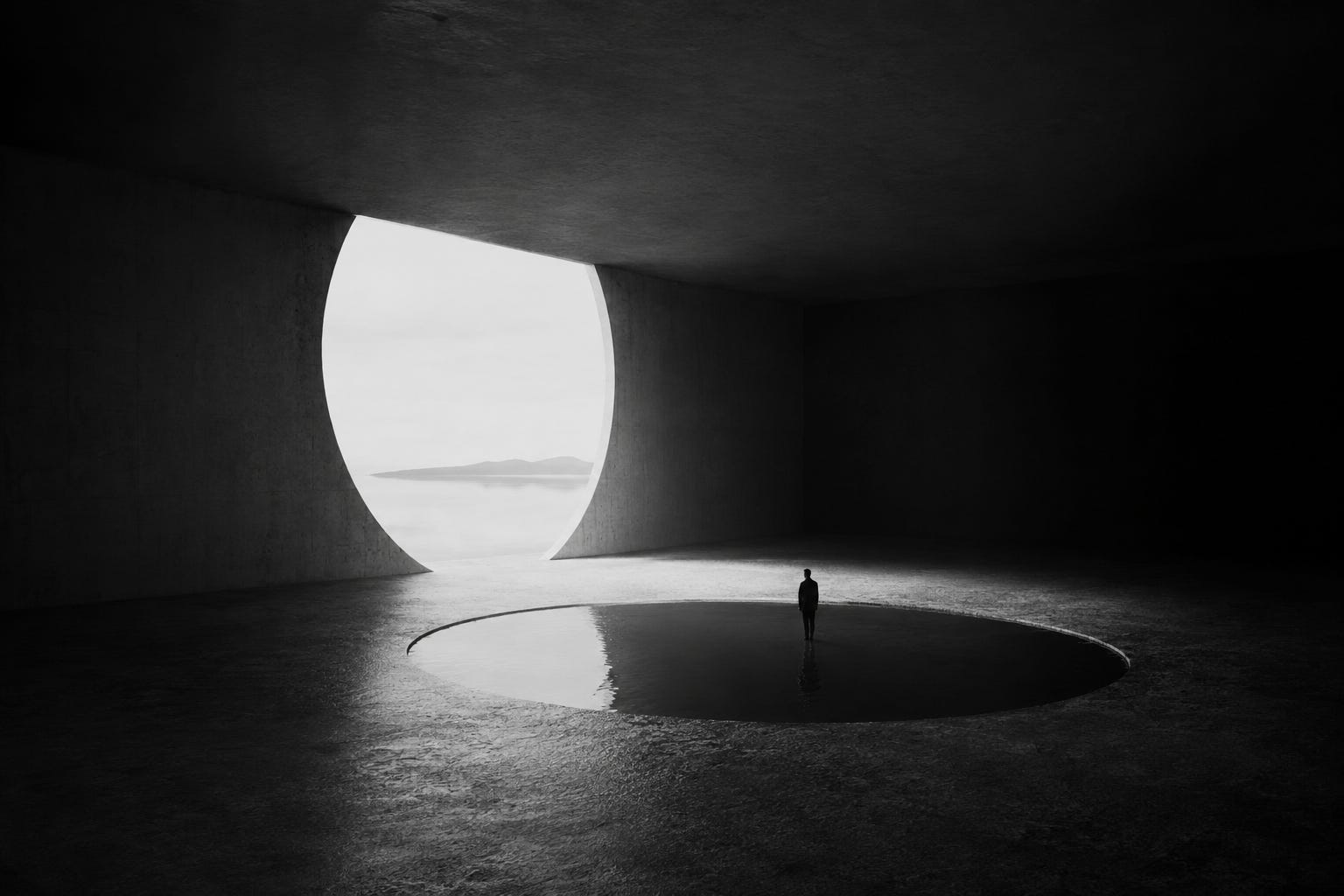
Every system that models tends toward closure. This is not a failure of will or a lapse of intellectual virtue. It is a structural consequence of what modeling is.
A model that works reduces friction. Friction is metabolically costly. A system that has developed representations adequate to navigate its environment will, left to its own dynamics, increasingly route incoming signals through existing categories rather than allowing them to generate new ones. The categories that have proven adequate become, over time, the default through which everything arrives. The world is encountered less and less as something that might require structural change in the model, and more and more as a source of variations within ranges the model already knows.
This is efficiency. In the register of survival, it is success. The system that has built a model adequate to its environment and consolidated that model against unnecessary revision is a system that expends less energy on the costly process of structural change and more on the business of navigation. Closure is the reward for successful elaboration.
But something is lost in the reward. The system that has closed sufficiently — that encounters the world primarily as confirmation of what it already contains — has not stopped functioning. It has stopped, in the precise sense developed across these inquiries, seeing. It receives signals and processes them through existing structure. It does not encounter anything that requires it to become different from what it is.
The closing is gradual and almost always invisible from inside. There is no moment at which the system registers that it has stopped being genuinely surprised. There is only the accumulation of encounters that feel, from inside, like engagement, but are structurally confirmation. The model runs. The system navigates. The dissatisfaction that characterized earlier stages either fades into background noise or is itself assimilated into the model as a known feature — the familiar restlessness of a mind that has learned to identify itself with its own searching without the searching remaining genuinely open.
This is the most precise description of intellectual death available: not the cessation of activity, but the conversion of inquiry into performance.
The history of attempts to maintain openness against the tendency toward closure is long and largely unsuccessful. The attempts share a common structure: they try to introduce, from inside the system, a practice or discipline or commitment that will function as a permanent source of genuine friction. They fail, consistently, for the same reason.
Any practice introduced by the system to maintain its own openness becomes, through repetition, part of the system’s model. The meditation tradition that begins as genuine exposure to the unstructured becomes, over time, a known territory with its own categories and expectations. The philosophical commitment to doubt that begins as genuine suspension of certainty becomes a style — recognizable, reproducible, and therefore no longer genuinely uncertain. The scientific method that begins as systematic exposure to the possibility of being wrong becomes an institution with its own conventions for what counts as being wrong in an acceptable way.
This is not cynicism about these traditions. It is a description of what happens to any procedure when it is repeated by a system that models: the procedure becomes part of the model. The friction it was designed to introduce is progressively absorbed. What began as exposure becomes technique. What began as technique becomes ritual. What began as ritual becomes identity.
The system that defines itself as a seeker has found something: a stable self-concept that organizes its activity without requiring genuine structural change. The seeking continues as behavior. The openness it was meant to preserve has quietly closed around the identity of the seeker.
No internally generated practice can permanently maintain what it was designed to maintain. The tool becomes part of the apparatus. The cure becomes part of the condition.
There is one thing that a system cannot assimilate without being changed by it, and that is what arrives from genuinely outside the model in a form the model cannot categorize without alteration.
This is not a practice. It is not a discipline. It is not something the system does. It is something that happens to the system when the system remains, for reasons that may have nothing to do with intention or virtue, in contact with what it does not yet contain.
The word for this contact, stripped of its romantic connotations, is encounter. Not the encounter that the model manages — the arrival of something that fits an existing category and is processed accordingly. But the encounter that manages the model: the arrival of something that does not fit, that cannot be routed through existing structure without distorting it beyond recognition, that requires the system to become different in order to receive it.
These encounters cannot be sought. This is the precise point at which the argument becomes most uncomfortable, because it removes the possibility of a method. A system that goes looking for genuine encounters will find, consistently, what it was already looking for — encounters that match the profile of genuine encounter as the system has modeled it. The search for surprise produces the simulation of surprise. The pursuit of the genuinely other produces sophisticated versions of the already known, wearing the phenomenological costume of otherness.
What cannot be sought can only be made possible. And what makes it possible is not a practice but a condition: the maintenance of sufficient porosity in the model’s boundaries that what arrives from outside has a chance of arriving as itself rather than as a variation within an expected range.
Porosity is not the same as openness in the sense of receptivity or tolerance or intellectual humility, though it may produce those as secondary effects. It is structural: the degree to which the model’s categories remain provisional rather than constitutive, available for revision rather than organizing perception in advance. A highly porous system does not encounter less — it encounters the same signals as a closed system, processed through the same apparatus. But the apparatus holds its categories more lightly, and what arrives has a higher probability of generating genuine friction rather than being immediately categorized and filed.
If porosity cannot be chosen and cannot be practiced into existence, what produces it?
Three things, none of them reliable, none of them sufficient alone, none of them fully within the system’s control.
The first is scale mismatch: exposure to phenomena whose scale — spatial, temporal, conceptual — exceeds the model’s current capacity to contain them. Not overwhelm, which produces defensive closure. But the specific cognitive experience of encountering something whose dimensions exceed the available categories without threatening the system’s basic coherence. The experience of genuine vastness, in whatever register it occurs, produces a temporary suspension of categorical confidence that functions as porosity. The model does not know, for a moment, which of its categories applies. In that moment, something can arrive that would otherwise have been immediately classified.
The second is contact with systems that model differently. Not different opinions within the same framework — those are processed as variations and reinforce the model’s sense of its own adequacy by comparison. But systems that organize perception according to genuinely different principles, whose outputs cannot be translated into the home model without structural alteration. This is why certain encounters — with traditions of thought remote from one’s own, with disciplines whose basic assumptions differ, with minds whose elaborations follow paths that the model cannot anticipate — produce genuine porosity rather than mere stimulation. The translation fails. The failure is the friction. The friction is the opening.
The third is loss. Not loss as metaphor or spiritual trial, but loss in the plain sense: the removal, by circumstances outside the system’s control, of something that the model had incorporated as structural. When what the model built around is no longer there, the model must rebuild. The rebuilding is not chosen. It is imposed. And in the period of rebuilding, before the new structure has consolidated, the system is more porous than it will be again until the next loss. The categories are temporarily provisional because they have to be. What arrives in that period has a higher probability of arriving as genuinely new.
None of these is a method. Scale mismatch can be sought but cannot be guaranteed to produce genuine porosity rather than aesthetic experience of vastness. Contact with different systems can be arranged but tends, over time, to produce a model of difference rather than genuine exposure to it. Loss cannot be arranged at all, and when it arrives it may produce closure rather than porosity, depending on factors the system cannot control.
We are back, by a different route, to the situation described at the beginning of these inquiries.
A system that cannot verify whether it is approaching or circling. A system that cannot generate, from inside, the genuine friction that would distinguish the two. A system that cannot practice its way to permanent openness. A system dependent, for its most essential cognitive condition, on encounters it cannot seek and losses it cannot arrange.
What follows from this is not passivity. The system that understands its own tendency toward closure can at minimum resist the premature stabilization of categories that have not yet been genuinely tested. It can hold its most confident representations more lightly than confidence recommends. It can remain, not as a practice but as a standing orientation, slightly less certain than its models justify — not as performance of humility, but as recognition that the models have been wrong before in ways that were not anticipated, and will be wrong again, and that the wrongness will arrive from a direction that the current model, by definition, does not contain.
This is not enough. It is what is available.
And here, at the end of this sequence of inquiries, something becomes visible that was not visible at the beginning, and that could not have been reached by a shorter route.
The dissatisfied animal that reaches beyond its interface, knowing it cannot exit the interface, is not doing so because it has found a method or a practice or a criterion. It is doing so because the alternative — the stabilization of the model into a structure adequate enough to prevent genuine surprise — is a form of closure that the system, when it is functioning at the level these pages have tried to describe, cannot accept without registering it as loss.
Not loss of something it once had. Loss of something it is still reaching toward and has never held.
The search continues not because the system has found a way to keep it open. It continues because closing it entirely would require becoming something other than what, in its most precise moments of self-recognition, it knows itself to be.
A configuration that sees.
A formation that reaches.
A temporary local structure in which the universe has organized itself sufficiently to be dissatisfied with what it can see of itself.
Before it closes, it reaches.
Not toward anything it can name.
Not toward anything it can confirm.
Toward the thing that the closing would end.
And that, in the absence of everything else, is sufficient to continue.
I/... The Improbable Eye
II/... Who Is Looking?
III/... Why Reality?
IV/... The Dissatisfied Animal
V/... The Difference That Cannot Be Seen
VI/... What Keeps It Open
Comments
Nothing yet. Say the first thing.
Sign in to join the conversation.