
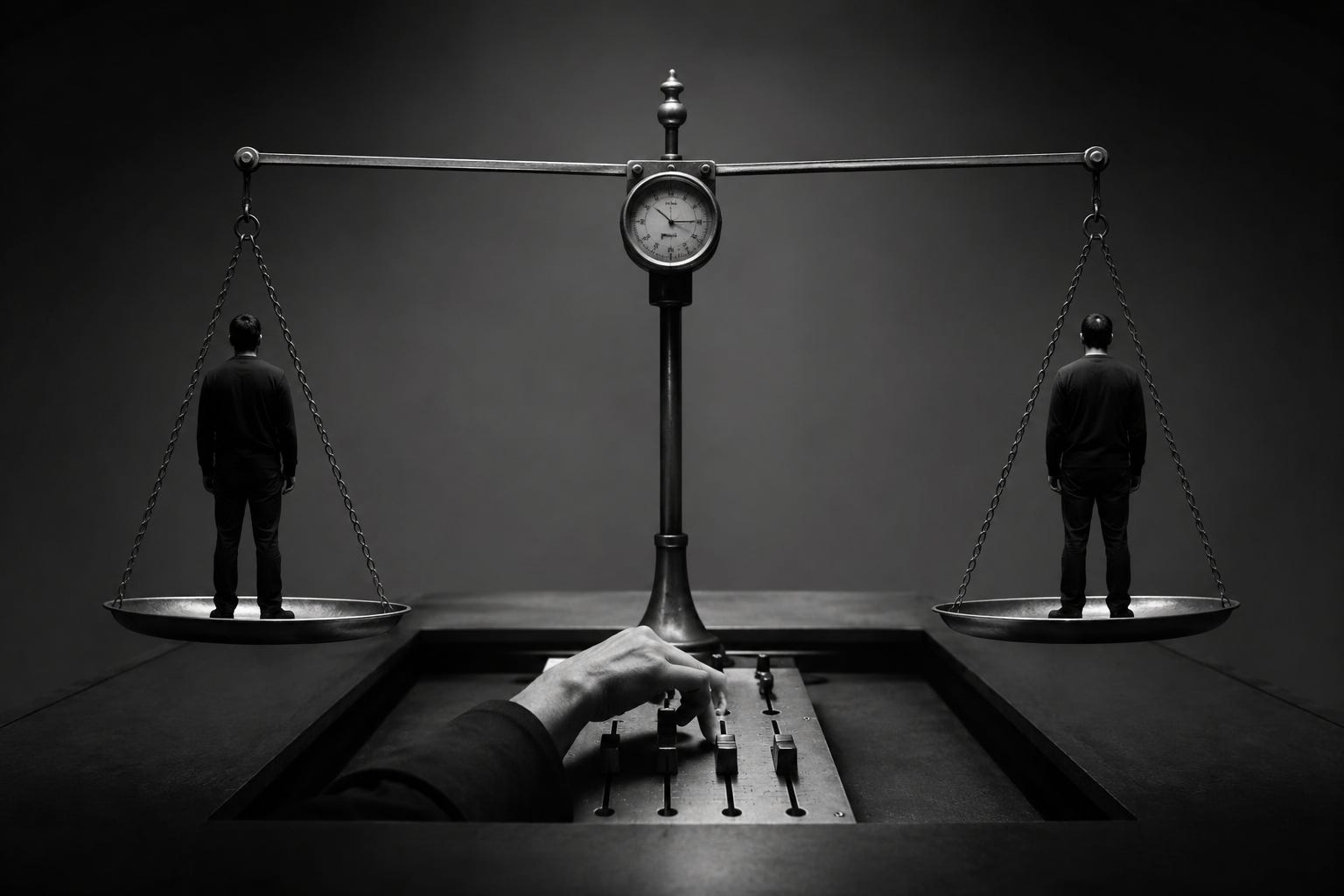
Somewhere in a database there is a number attached to your name, and it is treated as a fact about you. Lenders read it as your reliability with money, a trait you are taken to carry the way you carry a height or a blood type, present before anyone looked. The number is supposed to describe that trait. Its authority rests entirely on the assumption that the trait comes first and the number comes after.
The number does not sit still once it exists. A high score brings offers of credit at low rates: borrowing is cheap, repayment is manageable, the account stays current, and the record of staying current raises the score. A low score brings the reverse. Credit is offered sparingly and priced high, when it is offered at all, so the same obligation is heavier to carry and more likely to slip, and each slip lowers the score again. Two people of identical habits, sorted once into the high band and the low band, will over time become genuinely different payers, because the terms they were handed differed, and the terms came from the score. The reliability the number claims to find, it has a hand in giving out.
There is a real fact underneath, and it should not be waved away. People do repay or fail to repay, the behaviour is recorded, and the record is not invented. The score is not a fiction laid over nothing. The behaviour it records, though, is not formed in a place sealed off from the measurement. Whether an obligation is repaid depends on its size and its rate, and those were set by the score before any of the behaviour happened. The referent is real and it is also partly downstream of the instrument that claims only to observe it. The measurement and the measured do not come fully apart, and how far they fail to come apart is the entire question.
The shape appears wherever a number governs access to the thing it grades. A measurement can sit at any point along a line. At one end it only reports: a thermometer reads a fever and changes nothing about the fever. At the other end it mostly arranges its own confirmation, as the grade goes out, the world reorganises around the grade, and what returns is the grade’s own consequence wearing the face of evidence. Most of the numbers we live inside sit between the ends. The question to put to any of them is how much of what it reports it has made, and the answer fixes its place on the line.
Once the shape is visible in the score it is visible elsewhere. A seller’s star rating decides who clicks, which decides who sells, which decides who survives to be rated again. A school’s rank draws the students and the money that go on to produce the results the rank will later report. In each case a token that presents itself as the readout of an independent reality is also among the forces shaping that reality, and the form of the number hides how much of that reality it had a hand in making.
The arrangement does not fall on everyone the same way. It compounds in both directions, easing the path of those it has placed high and steepening it for those it has placed low, and then it presents the outcome as something each person earned. The part the number produced is read back as desert. This is how a device that allocates keeps the appearance of a device that merely records, and it is why the people the number weighs on most heavily are the ones least placed to contest the reading.
The score was doing two things at once and showing only one of them. It read the borrower, and it set the conditions under which the borrower could be read. To ask whether the score is correct is to assume the borrower stands finished on the far side of it, waiting to be described. For the part the score helped produce, no one stands finished on the far side. There is the number, the conditions it handed down, and a person becoming, under those conditions, more or less the kind of payer the number had already announced.
Comments
Nothing yet. Say the first thing.
Sign in to join the conversation.