

The Gulf has decided that the commodity after oil is compute, and it is buying that future almost entirely from American companies.
The United Arab Emirates and Saudi Arabia are pouring sovereign wealth into data centers, equity stakes in frontier labs, and the most advanced chips that Nvidia and AMD will sell, with Qatar a step behind and writing large checks of its own.
The strategy is coherent and it is fast. The catch lives in the fine print of nearly every deal, which is a quiet agreement to keep Chinese technology out and to build on a stack that Washington can inspect.
That bargain is the organizing fact of Middle Eastern AI strategy. Each Gulf state wants to be a third center of gravity in artificial intelligence, separate from the United States and China, hosting enough compute to serve roughly half the planet within a short network hop.
None of them can get there without American silicon, and American silicon now comes with conditions. So the region has chosen sides while pretending, when convenient, that it has not.
The capital is staggering and it is concentrated. Saudi Arabia’s Public Investment Fund manages around a trillion dollars, with its own 2024 report putting assets near $940 billion and the tracker Global SWF estimating closer to $1.15 trillion. Abu Dhabi is larger still.
Its three principal funds, ADIA, Mubadala, and ADQ, hold roughly $1.7 trillion between them, and by Global SWF’s count the UAE’s largest state institutions together control close to $2.5 trillion. Only a portion of that is aimed at technology, though the portion is large and rising, and it sits on top of the separate trillion dollar frameworks each state has signed with Washington.
Money at that scale does not wait for venture rounds or congressional appropriations. It moves when a crown prince decides it should.
Each country has stood up a national champion to spend it. The UAE works through G42, the Abu Dhabi technology group, and through MGX, an investment fund launched in 2024 by G42 and Mubadala.
Both orbit Sheikh Tahnoon bin Zayed Al Nahyan, the country’s national security adviser and the brother of its president, which tells you the file sits at the top of the state.
Saudi Arabia created HUMAIN in May 2025, a PIF company chaired by Crown Prince Mohammed bin Salman and run by the former telecom executive Tareq Amin. Their mandate is to build the entire stack from data centers to Arabic language models. Qatar moves more quietly through its sovereign fund and a homegrown model called Fanar.
Geography does the rest. The Gulf offers three things that crowded Western markets cannot supply at once. There is empty land, and a lot of it. There is energy that is cheap and abundant, with gas and solar today and nuclear arriving, which matters when a single campus can draw as much power as several mid sized cities.
And there is patient state capital that treats a data center as national infrastructure rather than a quarterly bet. Stargate UAE, the flagship, is designed to run on a blend of nuclear, solar, and gas precisely because the math of gigawatt scale compute is, before anything else, a math of electricity.
The ambition is not only to host other people’s models. All three are building sovereign systems tuned to Arabic rather than bolted onto English first ones.
The UAE’s Technology Innovation Institute ships the Falcon family, and its Falcon H1 Arabic models have topped the open Arabic leaderboard, beating larger systems from Saudi Arabia, Qatar, and even some Chinese and American labs on Arabic benchmarks.
Saudi Arabia has ALLaM through HUMAIN. Qatar has Fanar. The point of these models is leverage, since a country that can train its own systems is a country that can negotiate over the chips for everyone else’s.
The clearest way to read the region is to follow the contracts. They form a web with Gulf capital on one side, two national champions in the middle, and the American technology stack on the other. The headline projects are large enough that they have rearranged the global data center industry around them.
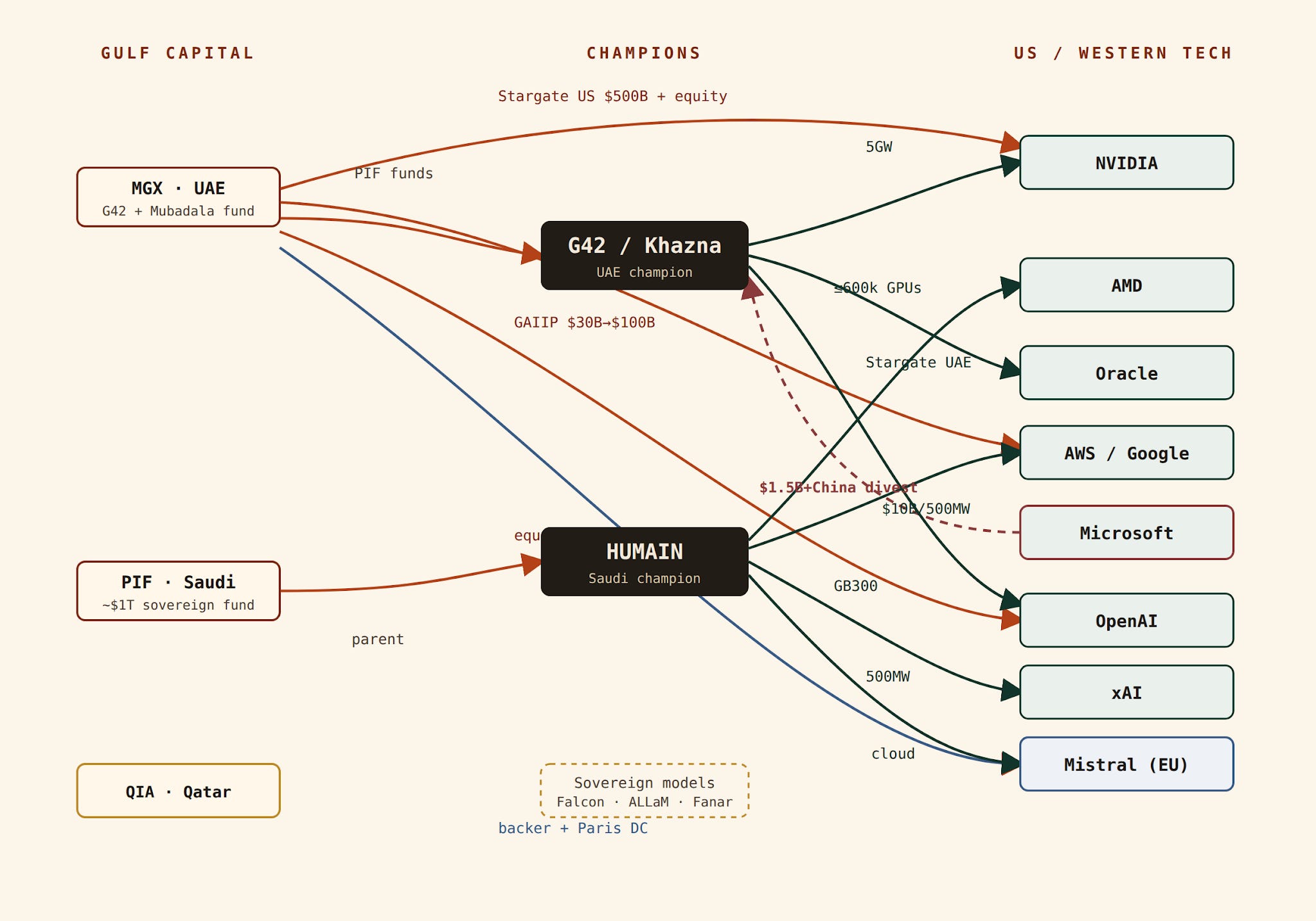
Stargate UAE is the centerpiece. Announced during President Trump’s Gulf tour in May 2025, it is a five gigawatt campus in Abu Dhabi, the largest AI build anywhere outside the United States, spanning ten square miles and capable of housing on the order of two and a half million GPUs at full size.
G42, through its data center arm Khazna, is constructing it. OpenAI and Oracle operate it. Nvidia supplies Grace Blackwell GB300 systems, Cisco the networking, and SoftBank rounds out the consortium.
The first one gigawatt cluster anchors the site, with an initial two hundred megawatts due in 2026. Sam Altman has called it the first milestone of OpenAI’s plan to build infrastructure for allied countries, which is a polite way of saying the model layer and the host country are now bound together.
MGX is the capital arm of the same ambition. It took a stake in OpenAI and joined the United States Stargate venture alongside OpenAI, SoftBank, and Oracle, a project carrying a five hundred billion dollar headline. With Microsoft and BlackRock it set up an infrastructure fund that started near thirty billion and aims toward one hundred billion. It has also put money into xAI, Databricks, and Europe’s Mistral.
It has put money into…
Comments
Nothing yet. Say the first thing.
Sign in to join the conversation.