
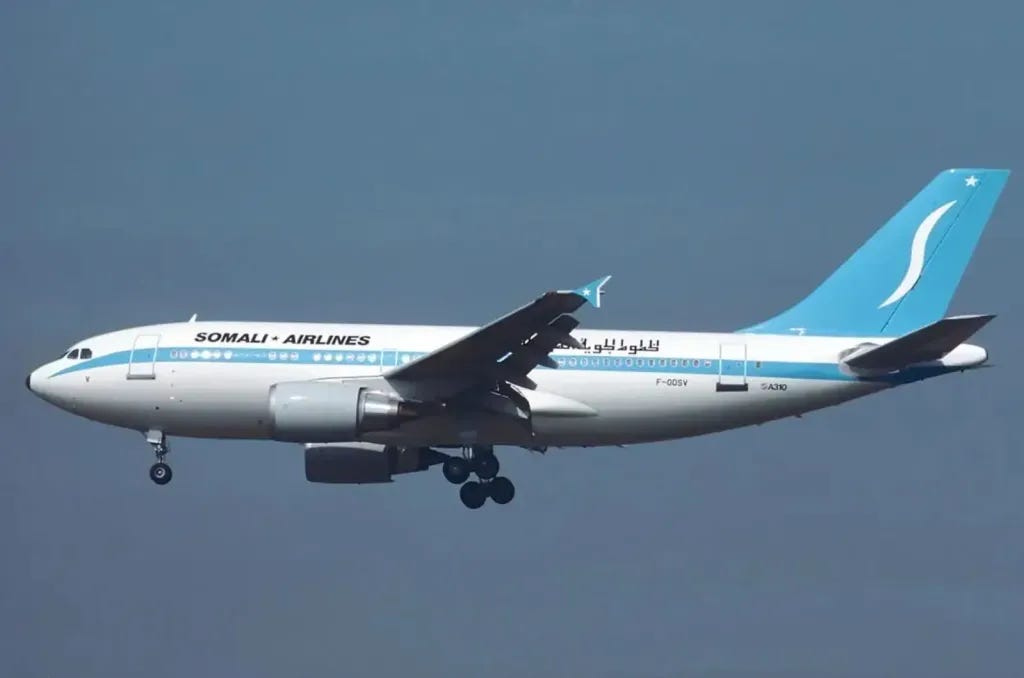
After more than three decades grounded by war and political upheaval, Somali Airlines is reportedly preparing to return to the skies, giving Somalia one of its clearest symbols yet of its efforts to rebuild the country’s place in regional and international aviation.
The government says the national carrier is expected to resume operations next month, marking a major turnaround for an airline whose services collapsed in 1991 after the overthrow of President Siad Barre plunged Somalia into prolonged civil conflict.
The airline, previously known as White Star, once connected Somalia through domestic and international routes. Its disappearance was not simply the loss of a commercial business. It reflected the wider collapse of state institutions and infrastructure that followed decades of instability.
Now, the government is attempting to reverse part of that decline.
Transport Minister Mohamed Farah said authorities have acquired two Airbus A320 aircraft as the starting point for the airline’s revival. The fleet is expected to grow, with the government planning to add at least two or three more aircraft as Somali Airlines expands its network.
The ambition is significant because two aircraft alone cannot establish a competitive national carrier. The government’s broader challenge will be turning the symbolic return of Somali Airlines into a commercially sustainable operation capable of competing with established regional and international airlines.
Farah, however, believes the importance of the project extends beyond aviation economics.
“This is not simply about acquiring two new Airbus A320 aircraft; it is a powerful symbol of the journey our country has undertaken through resilience, rebuilding and restoring national pride,” he said.
That message is particularly important in Somalia, where rebuilding state capacity has taken place alongside efforts to restore basic infrastructure and reconnect the country with international systems.
A functioning national airline could have practical benefits. Somalia has a large population living abroad, and the government expects the carrier to make travel between the country and the diaspora easier. More direct connections could also support businesses, families and traders who regularly move between Somalia and other countries.
Tourism, although still constrained by Somalia’s security challenges and limited infrastructure, could eventually benefit from improved air links as well.
The airline’s return also comes on the heels of broader efforts to rebuild Somalia’s aviation sector. In 2018, the country regained full control of its airspace after years of management by the United Nations aviation system through the International Civil Aviation Organization.
That development was an important marker of restored state authority. The construction and expansion of airport infrastructure represents another part of the same process.
President Hassan Sheikh Mohamud recently inaugurated a new airport in Mogadishu’s Haawaay area, a facility expected to reduce pressure on Aden Adde International Airport while providing the capital with another airport designed to meet international standards.
Taken together, the developments point to a government trying to build an aviation system that is not dependent on a single airport or entirely reliant on foreign carriers.
But reviving Somali Airlines will require more than aircraft and airport facilities. The airline will need experienced management, strong maintenance and safety systems, reliable scheduling, competitive fares and commercially viable routes. It will also have to navigate competition from carriers that already serve important African, Middle Eastern and Asian markets.
The choice of the Airbus A320 is nevertheless notable. The aircraft is widely used on short- and medium-haul routes and could give the revived airline flexibility as it develops connections across Africa and into the Middle East.
The project’s significance to Somalia therefore lies in what it represents as much as where the aircraft fly.
A national carrier once disappeared because the state itself was collapsing. Its planned return suggests a different trajectory: a country seeking to rebuild institutions, reconnect its people and reclaim infrastructure that was lost during years of conflict.
If Somali Airlines can move beyond symbolism and establish a disciplined, competitive business, its revival could become one of the more visible signs of Somalia’s gradual reintegration into the global economy.
The first flights will therefore carry more than passengers. They will also carry the expectations of a country attempting to turn recovery into something tangible.
No posts
Comments
Nothing yet. Say the first thing.
Sign in to join the conversation.