
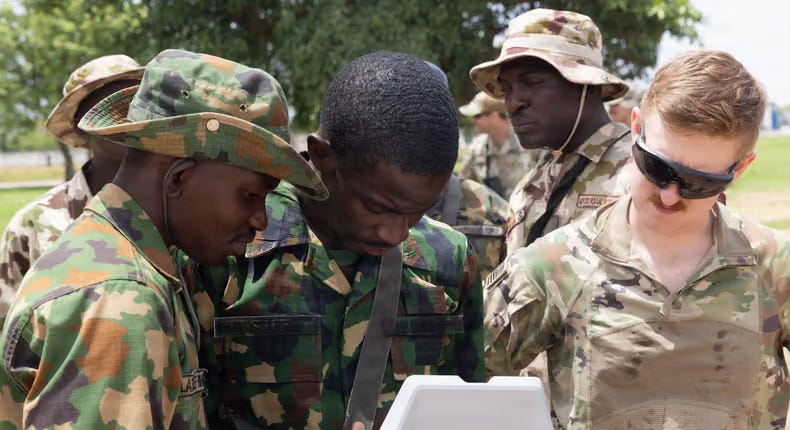
The United States is taking its security partnership with Nigeria into a more specialized phase, with American military personnel training Nigerian forces to operate unmanned aerial systems as the US seeks to strengthen one of its most important security relationships in Africa.
The latest training at Operating Location Bauchi focused on members of the Nigerian Air Force Special Forces Regiment and offered practical instruction in the operation of small unmanned aircraft, according to a report by Business Insider Africa. The exercise may have involved only a small group of Nigerian personnel, but its wider significance is considerably larger. It reflects a shift from traditional military cooperation towards technology-driven intelligence, surveillance and battlefield support.
US Army Sgt. Mark Murphy, an intelligence analyst assigned to the 13th Combat Sustainment Support Battalion, led the UAS session. About 10 Nigerian personnel first received roughly 45 minutes of classroom instruction before moving into hands-on exercises. After being introduced to the aircraft and its controls, the Nigerian troops were able to operate the system themselves.
The emphasis was not simply on flying a drone. Murphy also explained how information gathered through unmanned aircraft can be incorporated into military operations. That distinction matters because the real military value of UAS technology lies in what commanders can do with the intelligence collected, rather than the aircraft itself.
Nigeria could find that capability increasingly important in a conflict environment where armed groups operate across difficult terrain and often rely on mobility, concealment and surprise. Small unmanned systems can provide forces with an additional layer of situational awareness without immediately exposing personnel to the risks associated with reconnaissance on the ground.
The training is also part of a much broader American effort to expand African military familiarity with drones and counter-drone technology. During African Lion 26 in May, service members from four countries participated in an inaugural drone academics program in Morocco covering small unmanned aircraft systems and counter-UAS capabilities. Nigeria’s participation placed the Bauchi training within a wider regional push to develop expertise in a technology that is rapidly becoming central to modern warfare.
The timing is particularly significant. The US has already increased its operational involvement in Nigeria’s fight against Islamist militants. In March, Washington deployed MQ-9 Reaper drones and around 200 American troops to Nigeria, giving the United States a more direct role in intelligence and training activities.
That cooperation has since moved beyond surveillance and exercises. In May, US Africa Command said it conducted operations against ISIS targets in northeastern Nigeria in coordination with the Nigerian government, including strikes on May 16 and May 17. AFRICOM said the first operation killed a senior ISIS figure.
The combination of American intelligence assets, specialized training and Nigerian ground capabilities points towards a more integrated security relationship. Rather than simply providing equipment or conducting occasional exercises, Washington is helping Nigerian forces develop the skills needed to use modern battlefield technologies and incorporate the resulting intelligence into operations.
Nigeria also has a strategic reason to welcome the deeper engagement. Its military faces a complex security landscape involving ISIS-linked militants, Boko Haram remnants and other armed groups. The sheer size and geography of the country make intelligence gathering a persistent challenge. Greater access to unmanned systems could help Nigerian forces monitor remote areas, identify militant movements and improve the planning of operations.
But the expansion of US military involvement also raises questions about Nigeria’s long-term dependence on external intelligence and technology. Advanced systems are only as effective as the institutions, personnel and command structures supporting them. Sustaining the capability will require continuous training, maintenance, intelligence analysis and clear operational coordination.
The Bauchi program therefore represents more than another bilateral military exercise. It is evidence of a relationship evolving around the realities of modern conflict, where drones, intelligence and precision operations increasingly shape how wars are fought.
The United States views Nigeria as a strategically important partner in West Africa. Nigeria, meanwhile, gains access to specialized expertise and technology at a time when its security challenges are becoming increasingly complex.
The direction is clear: US-Nigeria military cooperation is moving deeper into the technological and operational space, and unmanned systems are emerging as one of the most important components of that partnership.
No posts
Comments
Nothing yet. Say the first thing.
Sign in to join the conversation.