
Portugal’s Golden Visa has been one of the most popular residency-by-investment programs in Europe for over a decade.
But the landscape has shifted.
The real estate route is gone and the wait for citizenship recently doubled. Yet many are still opting in, contrary to what most people expected.
Why?
Because despite the reforms, this remains a strong program for a lot of people. When you compare Portugal to the other options in Europe (or even the rest of the world), the Golden Visa is still one of, if not the strongest on the table.
On top of that, there’s a route into Portugal’s Golden Visa that most people don’t know exists. The disbursement is half what the main path costs. There are zero overheads. And it still builds toward an EU passport with an average stay of seven days a year.
Before we go any further, a note: we operate in Portugal too, but our goal has always been to offer multiple products across jurisdictions, and we don’t address any of this with bias around one specific program. If anything, my bias tends to be conservative on Portugal specifically, because I know the market and its trade-offs in detail.
Here’s the full breakdown.

The first reform, in October 2023, is the one most people remember. Buy an apartment in Lisbon and get residency. That path is gone, along with the capital transfer route it went out with.
The second reform, Lei Orgânica 1 of 2026, in force since May 19th, is the more recent one. Naturalization went from five to ten years. For EU nationals and citizens of Portuguese-speaking countries (CPLP), it’s now seven.
For anyone who applied before the law changed, the situation is still procedurally uncertain. The implementing regulations are expected around mid-August, and my read is that protection will land for pre-reform applicants either through the regulations themselves or through the courts. But nothing on that is confirmed yet, so I’m not going to overpromise.
For anyone entering the program now, though, it’s clean: the new regime applies, ten years to citizenship, seven for CPLP nationals.
The number is seven. As in seven days a year.
That’s the average physical presence Portugal asks from you to hold the residency. And these are the same seven days that count toward the minimum stay requirements for permanent residency and, eventually, citizenship.
Every other Golden Visa program in Europe splits those two things apart. The residency is passive but the naturalization is not. Greece asks zero days a year to keep the permit. But if you want Greek citizenship, Greece wants 183 days a year for seven years. Italy’s Investor Visa has the same structural split along with Malta too. Residency passive, citizenship earned by moving your life over.
Portugal doesn’t split them. Seven days to hold and then seven days toward the whole timeline.
The reform doubled the number of years but it did not touch this mechanism. And the mechanism itself only applies for the first five years: after year five, once you qualify for permanent residency, the 7-day requirement drops away. So the actual total is closer to 35 days over five years, not 70 across the full ten. Set that next to the days Greece asks for its own citizenship, and you can see why Portugal is still, by a considerable margin, the low-friction path to a European passport.
At year five, once you have permanent residency, you have the right to live and work permanently in Portugal and you no longer need to hold the investment. So even if you never take the passport, you’ve locked in permanent EU residency after five years with minimal presence. Citizenship at year ten is an optional upside, upon fulfilling requirements, not necessarily the entire premise.
Five paths are still available under Portugal’s Golden Visa, and they suit different profiles.
Investment fund. €500,000 into a regulated fund with at least 60% of assets invested in Portuguese companies (real estate is expressly excluded as the object of those investments). Your capital is preserved in theory, but you carry fund risk. This is the most popular path right now because people like the idea of getting the money back plus a return. You’re also paying twice the ticket and taking on market exposure to get there.
R&D and company capitalization. In the €200,000 to €250,000 range. Legitimate paths, less commonly used, more structuring involved.
Job creation. Ten positions, no fixed capital requirement. Available and workable, but a different kind of commitment and not the path most international applicants take.
And finally, the one that most people miss…
Cultural heritage donation. €250,000 to an approved heritage or artistic project. Or €200,000 if the project sits in a low-density area. Non-refundable. You do not get the money back.
The donation route is the one almost nobody talks about, and it’s the one I think is the most compelling entry point today.
Here’s why: no fund to track, no property to manage, no exit strategy to plan, no ongoing overheads at all. One transfer, and you’re in the system.
The donation goes to projects certified by GEPAC, the body under the Portuguese Ministry of Culture that oversees this: battlefield archaeology, museum conservation, heritage restoration. You’re funding something that would otherwise decay, and the residency is what Portugal gives you back for it.
The capital is gone. The donation is non-refundable. So your options look like: €250,000 gone with certainty, or €500,000 at risk in a fund. Both are legitimate answers, they’re just answers to different questions. If capital preservation is your first priority, this route is the wrong product.
If you’re moving to Europe anyway, you may be overpaying. Live in Europe on an ordinary residence permit for the required period and you can get to a similar place for less money. The donation route is specifically for the person who wants a European position without relocating their life to hold it: optionality.
The clock starts when the card is physically issued. Not when you file, not when the application is approved. When the residence card lands in your hand. Portuguese processing has historically run long, and that gap between filing and card issuance is now your problem: every month of delay is a month that doesn’t count toward the ten-year timeline. That’s the single biggest reason to move early rather than late.
Nothing here is effortless. Investment-residency programs in Europe are never entirely passive, even the donation route. There’s paperwork to file, documentation to gather, and a trip to Portugal for biometrics. If you’re expecting to wire the money and be done, this isn’t that. These are serious programs that always require a certain degree of dedication.
Italy. The Investor Visa starts at €250,000 into an innovative startup. Processing was historically faster, though it’s slowing as demand surges. But the key difference: Italy requires you to actually live there for continuous legal residency. Similar ten-year timeline on paper, fundamentally different commitment on the ground.
Greece. The Golden Visa is still running, but the amounts are higher, starting at €400,000 or €800,000 depending on the area for real estate. There are startup routes that bring the number down, though they carry job-creation constraints. Renovation projects can sit around the €250,000 level but require you to complete the renovation before applying. Citizenship takes seven years and requires you to physically live there. And the Greek language test is considered one of the less friendly to foreigners, because of a different alphabet.
There are other routes (Malta, Cyprus, Hungary), each with its own trade-offs. But the punchline is simple. If you want a path to citizenship without relocating to a specific country, Portugal is the answer. If you want to actually move to a European country and build your life there, one of the others might fit better.
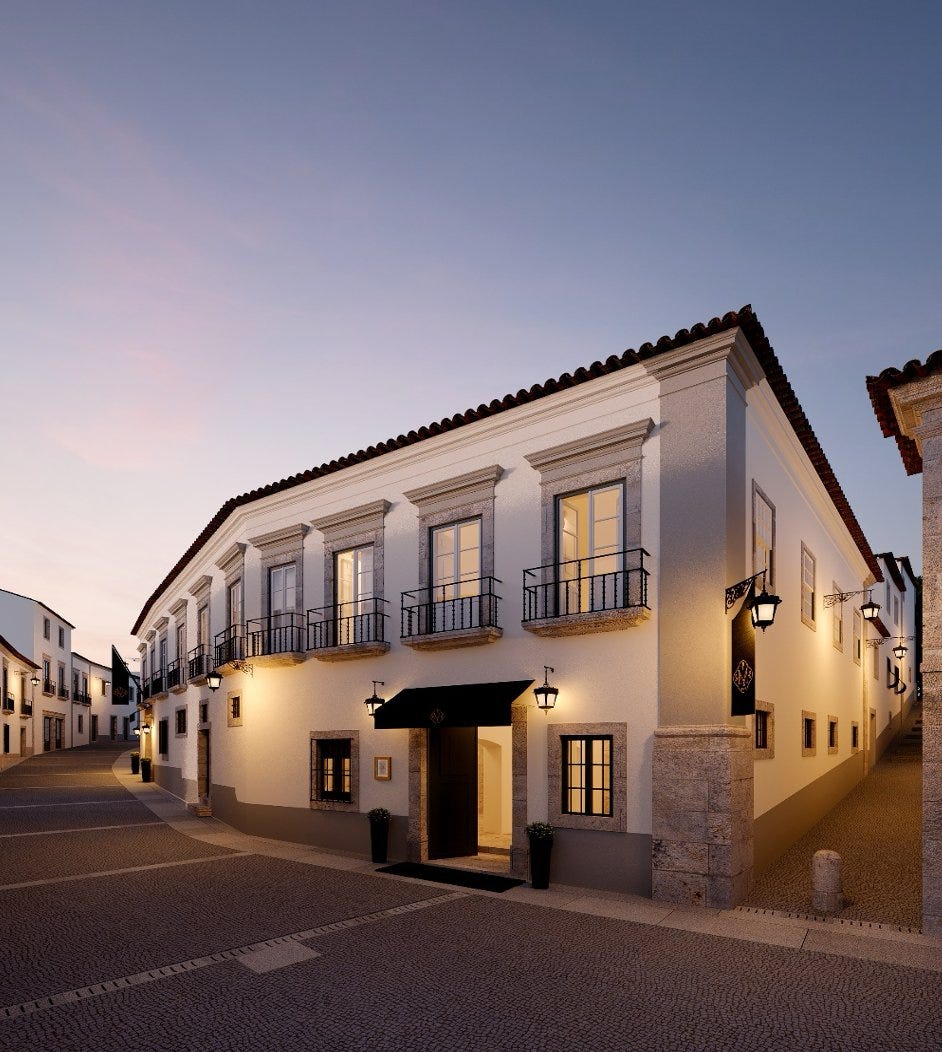
We’re currently helping a local foundation on a project in Évora, a city in the Alentejo region of Portugal that’s been a UNESCO World Heritage Site since 1986 and one of the most historically significant cities in the country. The project is the restoration of a Casa Nobre in Évora’s historic centre. The building was established by the Calça and Pina family in the sixteenth century and was registered as a National Monument in 2024.
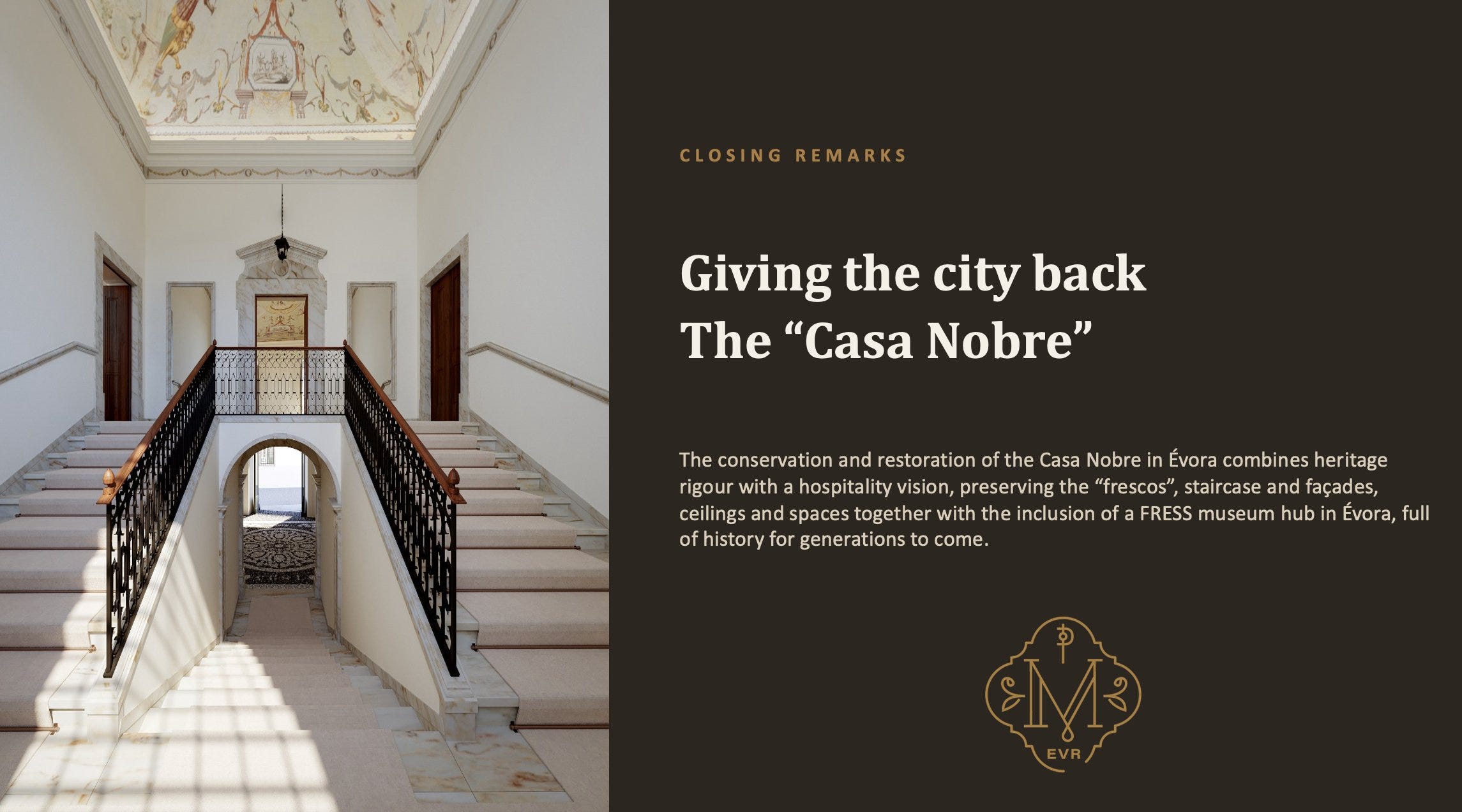
Inside is a mix of art and archaeology. Sixteenth-century frescoes across the noble rooms with allegorical scenes and mythological medallions, a monumental staircase in wrought-iron and marble, heraldic carvings on the façade. Beneath the ground floor, an active dig keeps turning up medieval walls that predate the house itself.
Decades of neglect left the building in serious condition, but the decorative heritage survived.
The restoration is led by FRESS, the Fundação Ricardo do Espírito Santo Silva, one of Portugal’s oldest foundations. Founded in 1953, FRESS is the country’s national reference for decorative arts conservation. They operate a museum-school of decorative arts in Lisbon, which I’d highly recommend visiting if you’re ever there.
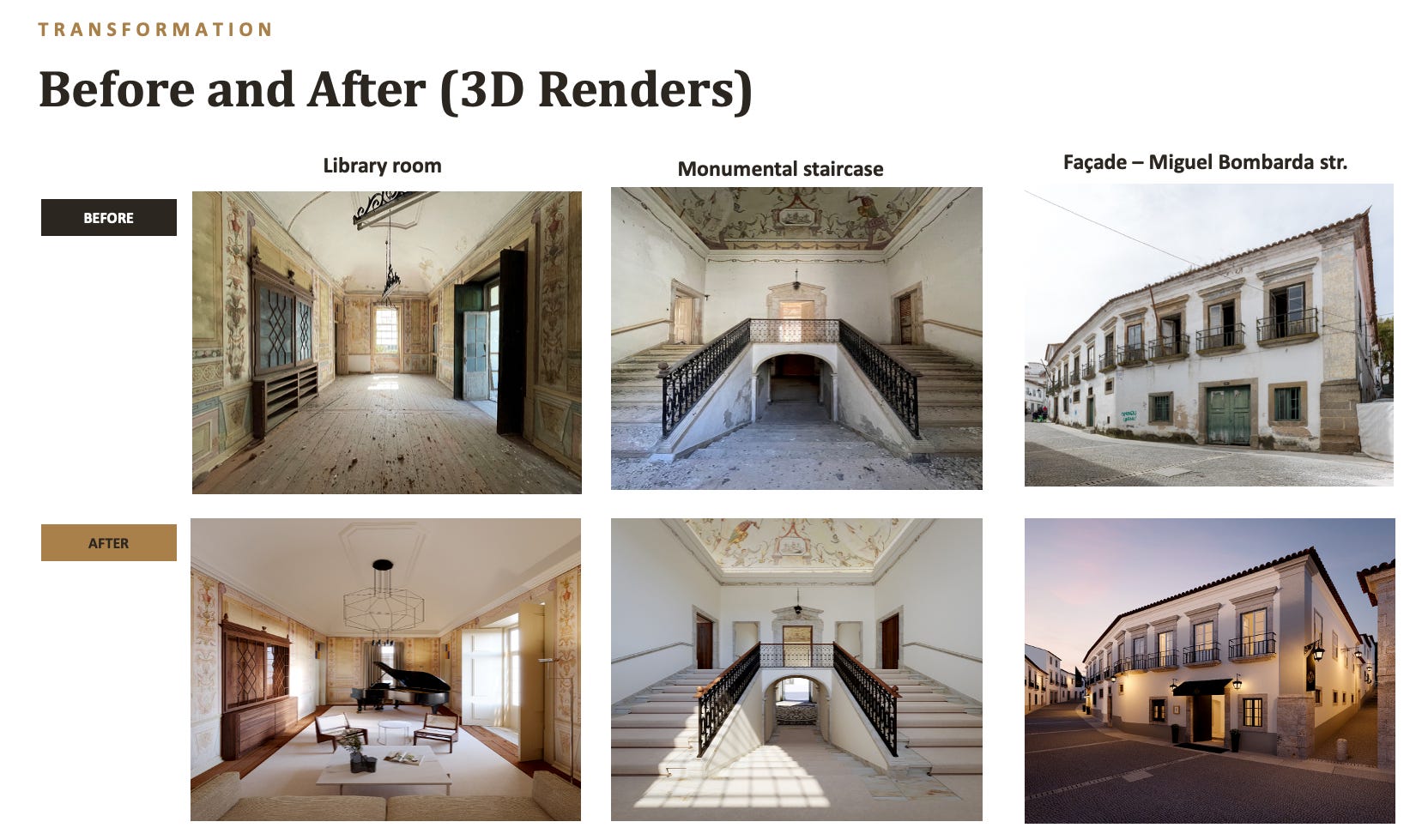
When it’s complete, part of the Casa Nobre becomes a museum of decorative arts, with the rest a functioning hospitality venue. Five centuries of heritage preserved and open to the public, inside a UNESCO city.
For this project, 5 spots remain out of 50 under the cultural donation route. Because Évora qualifies as a low-density area, the donation amount is €200,000, not €250,000. That’s the lowest-threshold way into Portugal’s Golden Visa still available.
5 spots left out of 50 on Casa Nobre. There are pros and cons on this route. If you’re interested, book a consultation with the Bitizenship team. We’ll share more, walk you through your situation, and connect you with the lawyers who handle the process.
Book a consultation call here.

What I keep coming back to with these programs is that you’re not really buying a visa here. You’re buying optionality while it’s still on the shelf.
Most people assume the door stays open and the program they’re looking at today will still be there when they’re ready. Across Europe, over the last three years, that has not been how it has worked. The families I work with who are in the strongest position aren’t the ones who picked the single best country. They’re the ones who built a structure with residency in one jurisdiction, citizenship on the way in another, and assets distributed across both before the window got smaller.
Portugal’s donation route is one piece of that structure, not the whole thing.
But for someone who wants a European position, doesn’t want to relocate full-time, and is comfortable with a non-refundable contribution, it is the most compelling entry point into Europe right now.
If you missed the recent pieces on the rest of Europe and Italian side of the picture…
For Americans:
For those interested in Italy:
Reply and tell me if Portugal is on your radar, or which part of this surprised you. I read every message.
And if you enjoyed this, click the ❤️ button and restack.
Stay free,
Ale
Writing from Lisbon
Comments
Nothing yet. Say the first thing.
Sign in to join the conversation.