
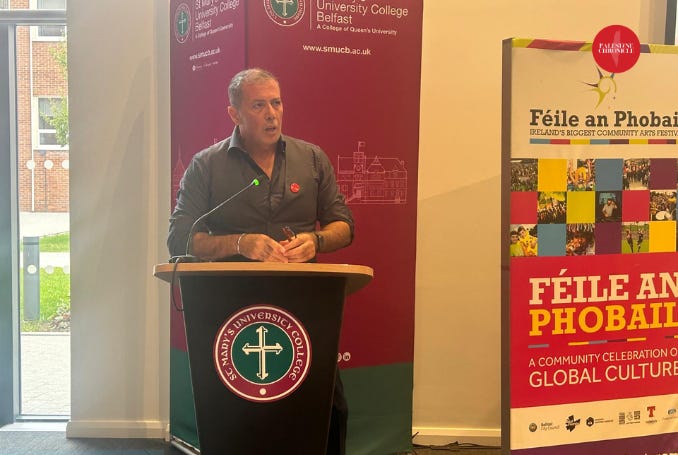
In Belfast, Ramzy Baroud explored Palestinian memory, resistance and narrative sovereignty, arguing that storytelling remains essential to survival and liberation.
Baroud described storytelling and memory as essential tools of Palestinian survival and resistance.
He challenged histories that portray Palestinians as passive subjects rather than historical actors.
He presented sumud and resistance as part of a long Palestinian historical continuum.
Baroud linked his family’s losses in Gaza to the struggle against historical erasure.
He called for solidarity rooted in Palestinian history, agency and the right to resist.
Speaking in Belfast on Palestine Day, on August 6, Palestinian author and journalist Dr. Ramzy Baroud delivered a deeply personal examination of memory, colonialism, resistance and the struggle over who possesses the authority to write history.
The keynote address and presentation of his latest book, Before the Flood: A Gaza Family Memoir Across Three Generations of Colonial Invasion, moved between Palestinian history, Baroud’s childhood in a Gaza refugee camp, the destruction of his ancestral village of Beit Daras, the ongoing Israeli genocide in Gaza, and the killing of members of his own family.
But Baroud’s central argument extended beyond the story of one Palestinian family. Palestinian history, he argued, cannot be understood through the political and military milestones established by colonial powers, nor can Palestinians be reduced to victims appearing only when they enter Western archives, diplomatic documents or news reports.
For Baroud, Belfast itself provided a particularly meaningful place from which to make that argument.
“I believe that, to stand in Belfast, is to stand in a city whose very walls speak,” he began. “It is a place that understands with profound historical clarity, that stories are never merely words. They are battlegrounds.”
Drawing a connection between Irish and Palestinian experiences of colonialism, Baroud said Ireland understood “the weight of carrying an unbroken identity through centuries” and the importance of memory when sovereignty itself is denied.
“It is precisely within this shared geography of struggle, from the streets of Belfast to the refugee camps of Gaza, and I was born and raised in a refugee camp in Gaza, that we must confront the central question of our work,” he said.
“Why do we write books? Why do we insist on telling our stories, even when the dominant media machinery seems willfully blind or worse? When imperial institutions have already constructed a narrative, designed to render us invisible,” Baroud added.
For Palestinians, Baroud argued, such questions cannot be reduced to literary or intellectual debates. They concern the very survival of a people whose history has repeatedly been subjected to political and physical erasure.
“These are not academic questions. They are urgent, existential,” he said. “These are questions of fundamental survival. Not merely physical survival, but survival as a people, possessing a living memory, an unbroken historical continuity, and a collective dignity that refuses to be erased to a footnote in someone else’s empire. Someone else’s history.”
Baroud traced his understanding of this relationship between memory and survival to his childhood in Gaza, where Palestine existed not only as geography but as an inherited landscape of stories.
“We tell stories because memory is our primary defense,” he said. “I grew up in a household in Gaza where stories about the village we had never seen, about the homeland we had never lived in, were told almost daily.”
That transmission of memory, he explained, allowed successive generations born in exile and refugee camps to remain connected to a history from which colonial displacement sought to sever them.
“We write so that our children and the generations that follow can trace the unbroken thread of who we are. Even as that thread is violently stretched across exile, displacement, walling, and more,” Baroud explained.
This understanding lies at the heart of Before the Flood, in which Baroud uses his own family history to challenge conventional historiography.
“In Before the Flood, my latest book, I set out to challenge how history itself is defined, weaponized and consumed,” he told the audience.
History, Baroud argued, cannot simply be understood as a chronological sequence of battles, agreements and decisions made by political elites. “History is the sum of feelings, the culmination of ideas, the evolution of collective consciousness, identities, and relationships. And the subtle changes occurring in societies over the course of time.”
The distinction, he said, is crucial because an official history built exclusively around political events can erase whole communities simply by excluding them from the record. “If history is reduced to official political events alone, then an entire population can be erased simply by omitting them from the official record.”
The ongoing genocide in Gaza has given this question a devastatingly literal meaning.
“You noticed in Gaza, throughout the genocide, quite often, you would hear about this number of families have been erased on the fisher brackets, meaning that the entire genealogy, the entire bloodline, or the whole plan, has been taken out completely,” Baroud said.
“That’s what it means to take someone entirely out of the official record, meaning that there is nobody left to even tell the story, or to remind us of that family, that entire clan actually existed,” he added.
Against such erasure, collective memory assumes an entirely different historical function. “But if history is understood as something lived, carried in collective memory, oral traditions, and everyday consciousness, then it becomes indestructible.”
Baroud recalled that his first encounter with history from below did not occur in universities or academic texts.
“When I grew up in the refugee town of Gaza, I learned that this long before I read academic texts,” he said. “I encountered what Antonio Granchi called the organic intellectual, not in university halls, but in the muddy alleys of the refugee camp.”
His parents and the people surrounding him, he continued, possessed an intellectual and historical consciousness that existed independently of formal academic recognition.
“My parents were organic intellectuals. As were countless men and women around us. They possess immense intellectual capacity, and a profound historical consciousness, even if society did not grant them that formal title of intellect,” Baroud said.
Palestinian history consequently survived through stories, family memories and oral traditions. “Our history, therefore, lives in stories. Told and retold, sometimes in fragments, sometimes in whispers, oftentimes in defiance.”
The reference to whispers, Baroud explained, was literal. “Our history teachers, fearing that the soldiers could be snooping around our elementary school, would have one of the kids look out to make sure that it was safe, and they would whisper our history to us in school.”
This history also survives through the memory of villages destroyed during the Nakba and through families who continue to preserve their names and genealogies.
“It lives in the way a grandmother remembers a village that no longer exists, describing its orchards, its markets, its daily rhythm of life as if it were still standing,” Baroud said. “It lives in the preservation of the village names and family genealogies asked down across generations.”
Such memories, he argued, should not be treated as supplementary material to the supposedly authoritative colonial archive. “This oral tradition, this history from below, is not a secondary source. It is our primary counter archive.”
The battle over historical memory, Baroud continued, remains central to contemporary representations of Palestine.
He pointed to the dominant political and media treatment of October 7, 2023, which frequently presented the date as though Palestinian history had suddenly begun that morning.
“This is why when the events of October 7 took place, notice how many politicians, most politicians in the West, and mainstream media, and others, acted as if October 7 was the very start of the events that our action was discussing,” he said.
“Nothing else had happened prior to that. No British colonialism over Palestine, no Nakba, no Naksa, no Intifada, no massacres, no refugee camps, no settlements, no settlers, no violence. Everything was great until October 7 took place,” he added.
For Baroud, this compression of Palestinian history is part of a much older struggle over who has the authority to determine where history begins and whose experiences are allowed to become part of the historical record.
“This is why, for colonized societies, reclaiming memory becomes an intellectual and political act of resistance,” he said. “It restores authority to the lived experiences of communities whose voices were systematically excluded.”
He pointed to former Israeli Prime Minister Golda Meir’s notorious assertion that there was “no such thing as Palestinians” as an expression of this colonial logic: denying the existence of a people in order to facilitate their displacement and erasure.
Baroud recalled experiencing this denial in an extraordinarily literal way while living in Gaza, when the document issued to him by the Israeli military administration listed his nationality as “undefined.”
“All of us were ‘undefined,’ as far as Israel was concerned. As if we did not exist,” he said.
He recalled the bewilderment of immigration officials when he presented the document while traveling abroad.
“And I’m standing there, a descendant of a nation and a people that go back in history for thousands of years: undefined,” Baroud said. “That’s how Israel wants to see us, and that’s what we refuse to accept.”
This denial of Palestinian historical existence, Baroud argued, has also shaped the way Palestinians are represented in Western political discourse and mainstream media.
“Within dominant Western media narratives, Palestinians are permitted to exist only within a dehumanizing binary: either as terrorists, whose actions must be perpetually suppressed, or as helpless victims, deserving only of pity and conditional humanitarian aid,” he said.
The second representation may appear more sympathetic, he said, but it still deprives Palestinians of something fundamental: political agency. “The reality of our suffering is undeniable, but this reduction to pure victimhood strips us of the single most crucial element of our existence: our agency.”
For Baroud, reclaiming Palestinian history therefore also means rejecting the idea that Palestinians exist merely as objects upon whom history acts. As he would later tell the audience during the discussion, “We’re not victims of history. We are not a footnote in history. We are not a byproduct of someone else’s history. We are history.”
This idea forms the foundation of Before the Flood, in which Baroud tells the history of his own family not as an isolated memoir, but as a window into a much longer Palestinian historical continuum.
That history begins in Beit Daras, his family’s ancestral village, which was ethnically cleansed and destroyed in 1948.
Reading from the book, Baroud described his family’s final departure: “When Ibrahim and his wife took their children and fled Beit Daras for the last time, it was enveloped in smoke, gunfire, explosions, and the screams of dying villagers.”
Like countless Palestinians during the Nakba, the family initially believed their displacement would be temporary. But as neighboring villages fell to advancing Zionist militias, they were forced south toward Gaza. “After a few days’ journey, the family arrived at Shujaiya. The old Gaza neighborhood overflowed with desperate refugees seeking food and shelter.”
Baroud paused after reading the passage to underline its contemporary resonance. “This did not happen after October 2023. This happened around May and June of 1948. The same story, the same history.”
Beit Daras, he stressed, was not simply a place that appeared in history at the moment of its destruction. “Beit Daras was not an abstract place. It was a living community shaped by centuries of history, agriculture and culture.”
Understanding that continuity, he argued, challenges representations of Palestinians as a population produced by a modern geopolitical dispute. Instead, Palestinians belong to “a deep historical trajectory, rooted in their ancestral soil.”
Baroud connected this historical continuity to the Palestinian concept of sumud, commonly translated as steadfastness.
But that translation, he argued, does not fully capture the concept.
“Sumud is often translated simply as steadfastness, but the word carries a far deeper, multidimensional meaning,” he said. “It is not passive endurance. It is not sitting quietly while waiting to be saved. Sumud is an active, strategic insistence on presence.”
He pointed to the extraordinary return of displaced Palestinians from southern Gaza to the devastated north during the first ceasefire as one of the clearest contemporary expressions of sumud.
Hundreds of thousands returned despite knowing that their homes and neighborhoods had been destroyed and that basic services were virtually nonexistent.
“They would rather go back to areas that have been completely destroyed,” Baroud said. They would rather remain beside their destroyed homes, he explained, than accept permanent displacement elsewhere. For Baroud, this was sumud in its most immediate form: “functional, raw and real.”
“It is the conscious decision to remain rooted in that land despite overwhelming forces designed to render us absent,” he said. “By remaining present, Palestinians actively interrupt the colonial logic that requires our non-existence.”
Gaza and the Historical Continuum of Resistance
The same historical framework, Baroud argued, is necessary to understand resistance in Gaza. Palestinian resistance cannot be reduced to Hamas, nor can it be explained through one ideology or one historical moment.
“Gaza’s resistance throughout history has been linked to Palestinians themselves, not to the specific heroic figures we encounter now and then,” he said.
Its continuity, he added, is evident precisely because Palestinian collective resilience is not confined to “any specific period, mode of thinking, or religious belief.”
Baroud situated contemporary resistance within Gaza’s much longer history of confronting foreign invasions, from ancient armies to the Crusaders, Napoleon’s campaign, British colonialism and, eventually, Israeli occupation.
The persistence of that resistance is particularly striking, he noted, because Gaza’s geography offers little natural protection.
“Gaza is a flat, small coastal area,” he said, historically vulnerable to forces attacking from the sea, the desert and surrounding territory.
Over centuries, its inhabitants adapted their methods of defense to changing forms of warfare. But military techniques alone, Baroud argued, cannot explain Gaza’s ability to resist successive invasions. “An ingredient far more precious is required for resistance to matter: the human spirit.”
At this point, Baroud’s historical argument became deeply personal.
“Beyond academic concepts and structural analysis, there is something far more immediate, personal and painful that drives this work,” he said. “We tell stories because we must survive.”
During the ongoing genocide, Baroud said, more than 100 members of his immediate and extended family have been killed. “They were not distant names. They were not statistics. They were human beings whose lives were intimately tied to my own: children, teachers, doctors, mothers, and my beloved sister.”
His sister, Dr. Soma Baroud, was killed by the Israeli army on October 9, 2024, while returning from a hospital.
Reading from Before the Flood, Baroud recalled the impact of her killing. “After days of mourning, it dawned on me that Soma, in her beauty, cleverness, wisdom, patience and, yes, courage and sacrifice, represented all the Somas of our history, including the history yet to be written.”
Her story, he said, encapsulated the reason Palestinian memory must survive even when entire families and bloodlines are being physically destroyed.
“When whole generations are subjected to military slaughter, when entire bloodlines are wiped from the civil registry, what remains?” Baroud asked. “Meaning remains. The story persists, carried forward by those who survive.”
Even amid Gaza’s destruction, Baroud noted, children continue to be born in tents and among the rubble, many carrying the names of relatives killed during the genocide.
“This is not merely a gesture of mourning,” he said. “It is an assertion of historical continuity.”
For Palestinians, history is therefore not something confined to archives.
“History is not a closed book resting on a shelf. It is a living presence,” Baroud said. “It is carried in our names, woven into the intricate patterns of tatreez, our embroidery, spoken in our dialects, preserved in our food, and sustained in our daily refusal to surrender our dignity.”
This, he said, is ultimately why Palestinians must tell their own stories. “We do not write to beg for recognition from those who oppress us. We do not write to sanitize our struggle for Western sensibilities.”
“We write to practice narrative sovereignty. We write to remember. We write to resist. We write to survive. But above all, we write to assert that we exist. Not as abstractions, not as passive victims, and not as footnotes in someone else’s history, but as a people with our own narrative, our own deep historical continuity, and our own unbroken presence in this world.”
(The Palestine Chronicle)
Comments
Nothing yet. Say the first thing.
Sign in to join the conversation.