
There’s an unusual attachment-detachment mindset required of most working artists—unless they want to become their best collectors. Many painters describe a strong emotional involvement with a painting while the paint is wet, spending hours of mental horsepower bringing it to maturity. Then the piece dries and goes to a gallery, hopefully to find a “forever home.” Most painters never know where their paintings end up, and whether the owners selected them as décor to match the sofa or chose them for a deeper reason. Then again, some painters operate their own galleries or participate in plein air festivals to actually meet the people who buy their paintings. But once a painting leaves the studio, it’s usually the equivalent of a closed adoption.
That’s why the Washington Post clipping below is one of painter Donald Jurney’s treasures. The article shows the actress Alexandra Wentworth posing in front of her Donald Jurney landscape painting. The photo caption says: “For Alexandra Wentworth, a cherished painting helps define the home she shares with husband George Stephanopoulos and their two daughters.”
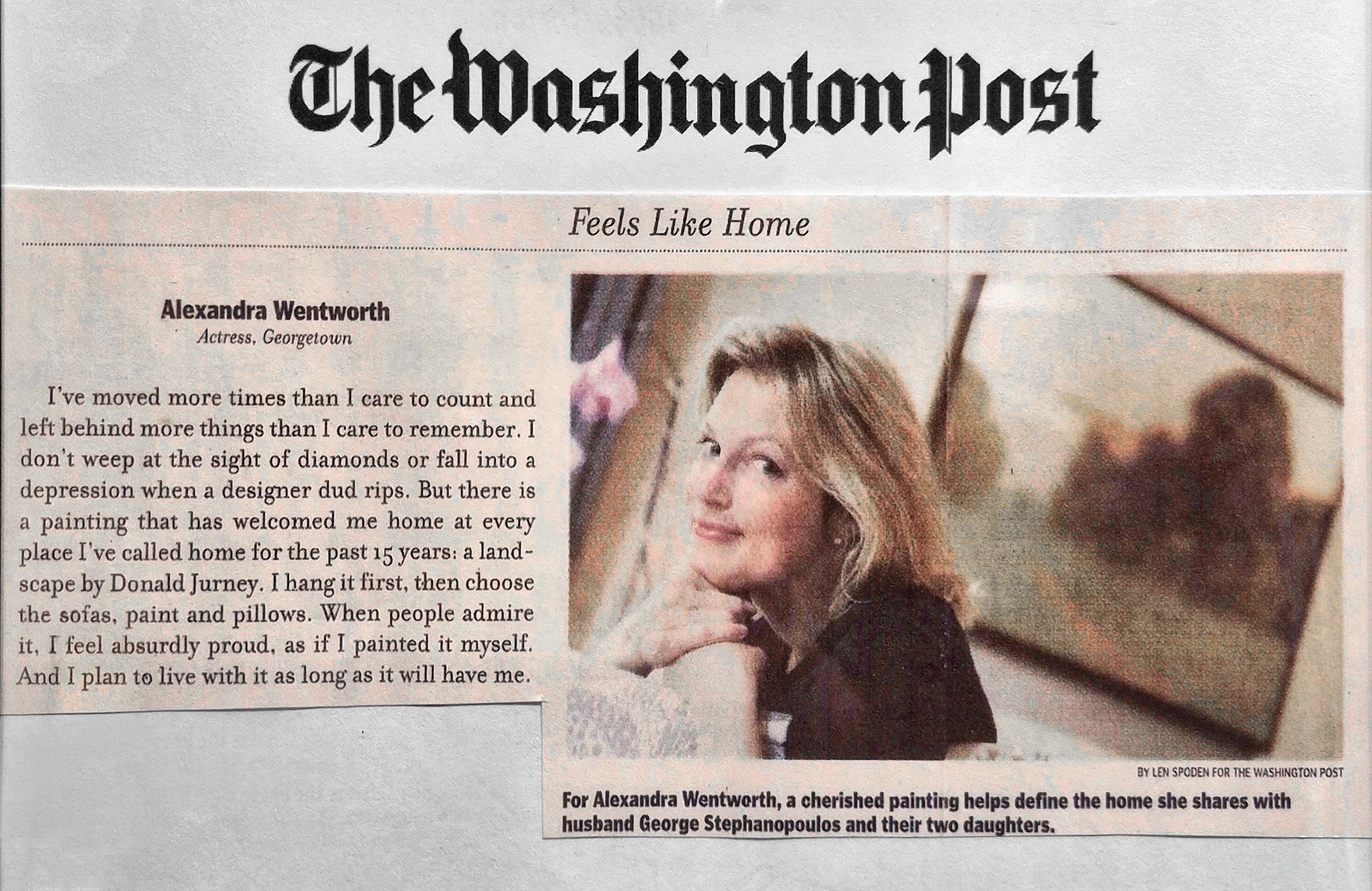
About the painting, she wrote: “I’ve moved more times than I care to count and left behind more things than I care to remember. I don’t weep at the sight of diamonds or fall into a depression when a designer dud rips. But there is a painting that has welcomed me home at every place I’ve called home for the past 15 years: a landscape by Donald Jurney. I hang it first, then choose the sofas, paint and pillows. When people admire it, I feel absurdly proud, as if I painted it myself. And I plan to live with it as long as it will have me.”
I’d say that’s one of the best compliments a painter could receive. Donald says that a stranger mailed the clipping to him after going to considerable effort to track him down. He was grateful to receive it and touched to discover that one of his paintings brought such meaning and delight to its owner.
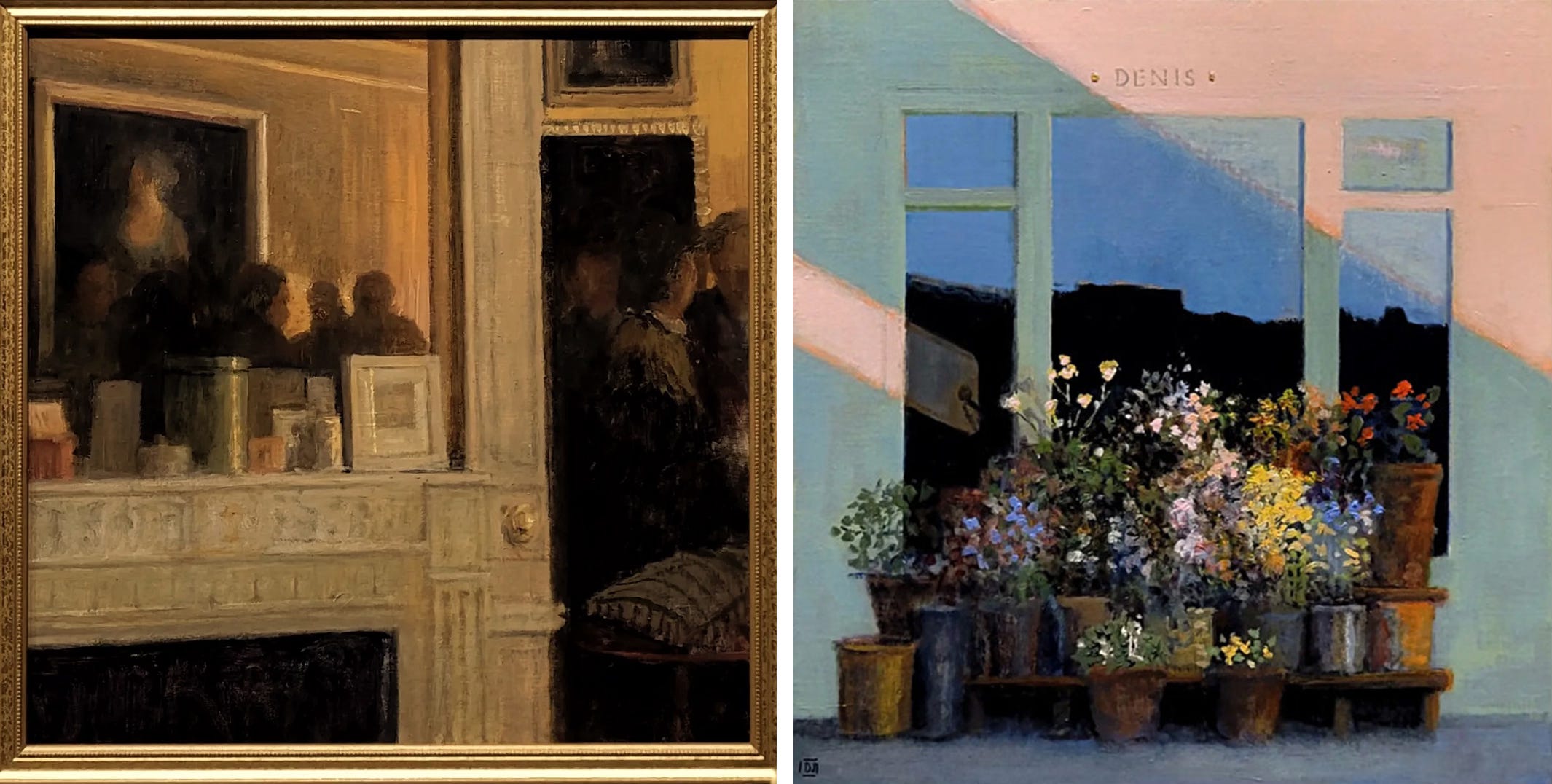
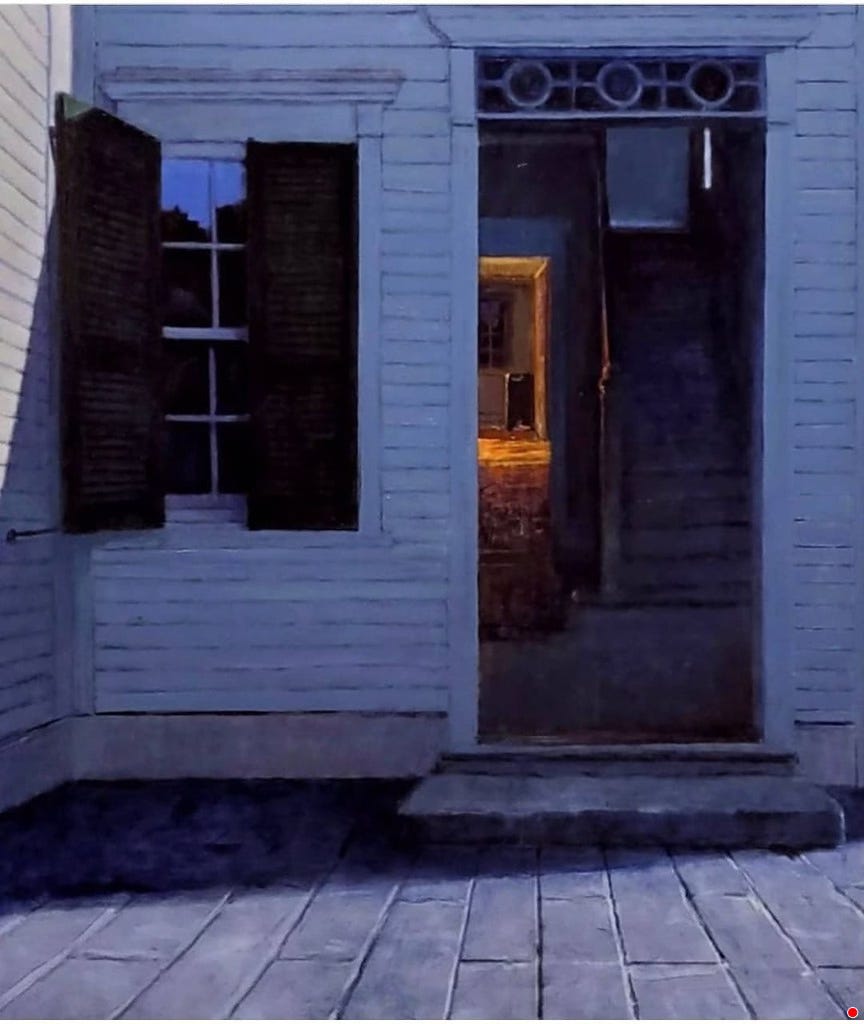
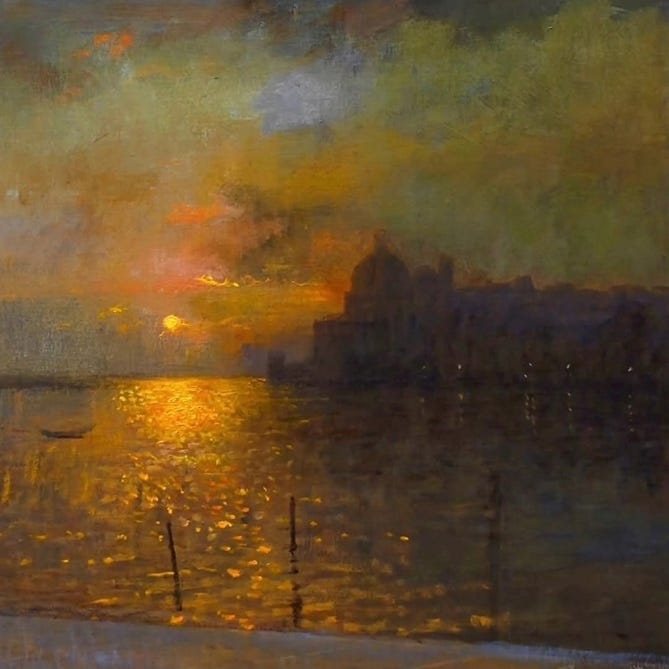
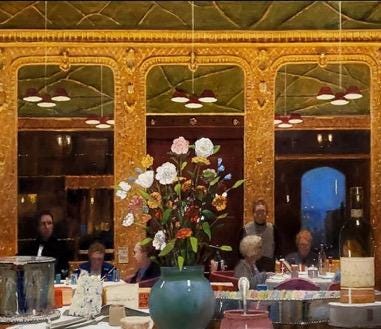
I wasn’t surprised by the actress’s testimonial. Donald’s paintings have emotional magnetism. Many times this spring while walking in downtown Rockport, MA, I’d stop to admire one of Donald’s paintings in the window at Folly Cove Fine Art. Seeking out more of his work, I visited his Instagram and website and enjoyed his beautiful scenes of museum galleries, drawing rooms with windows looking out at Parisian rooftops, and European cityscapes. Each painting had intriguing lighting: a sunlight-splashed wall or floor, the view through a window or doorway to an illuminated landscape, or glinting objects in an otherwise dark room. The subjects had a somewhat vintage and European feel. I later learned that Donald invented all the scenes.
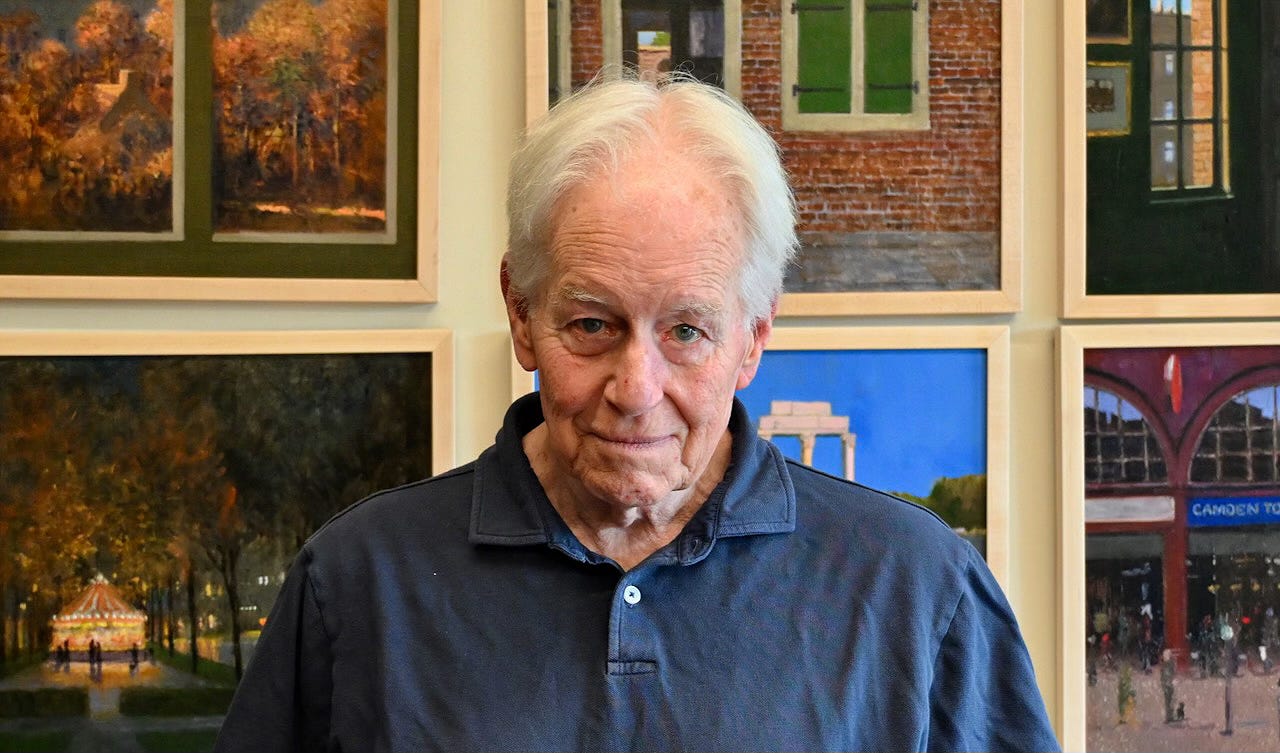
Subsequently, the Staff Photographer and I visited Donald’s spacious Amesbury studio in a former mill building in late May 2026, just as he was finishing a series of 52 paintings to send off to the Quidley & Company gallery on Nantucket for an opening on August 14th. I enjoyed meeting Donald and appreciated his wry sense of humor and direct answers to my questions.
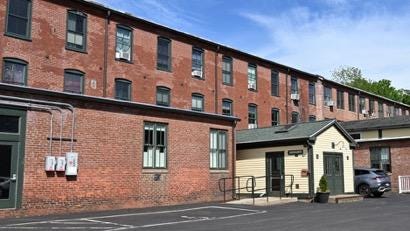
His studio within the Cedar Street Studios building includes a foyer-like entrance, a sizable painting space, and a third room where Donald stores completed paintings. As you’d expect at a converted mill building, the wood floors carry about a hundred years of wear and creak nicely.
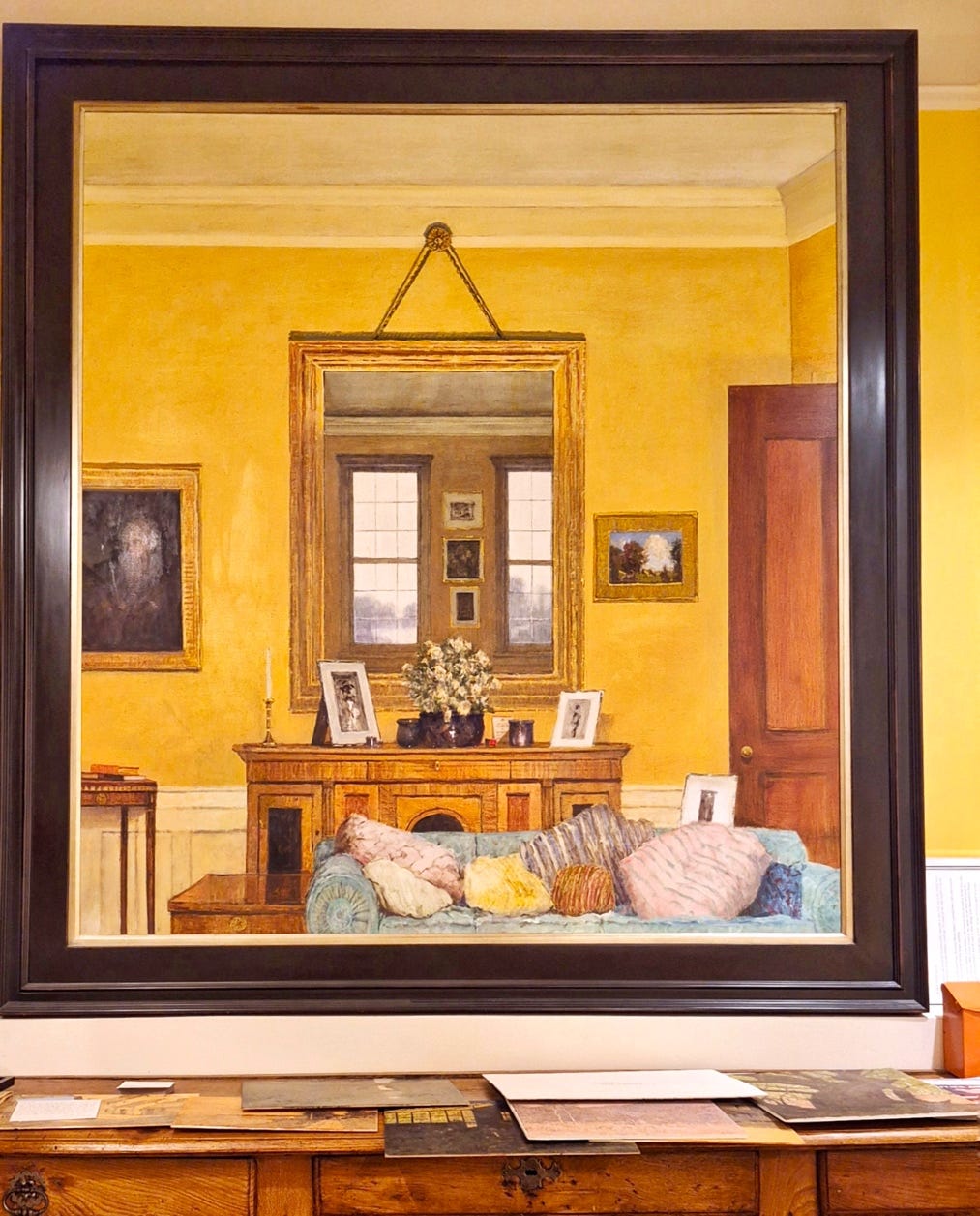
Upon entering the studio, you’ll see the large painting shown below. Like many items in the studio, it comes with a story. Donald says his framer delivered a sizable frame—large enough for a 60” x 54” canvas—and bigger than what Donald was expecting. The framer wasn’t excited to take the wrong-sized frame back, so Donald kept it and painted the partly invented interior, taking cues from a small sketch he made in 1984 of a drawing room on the Isle of Skye:
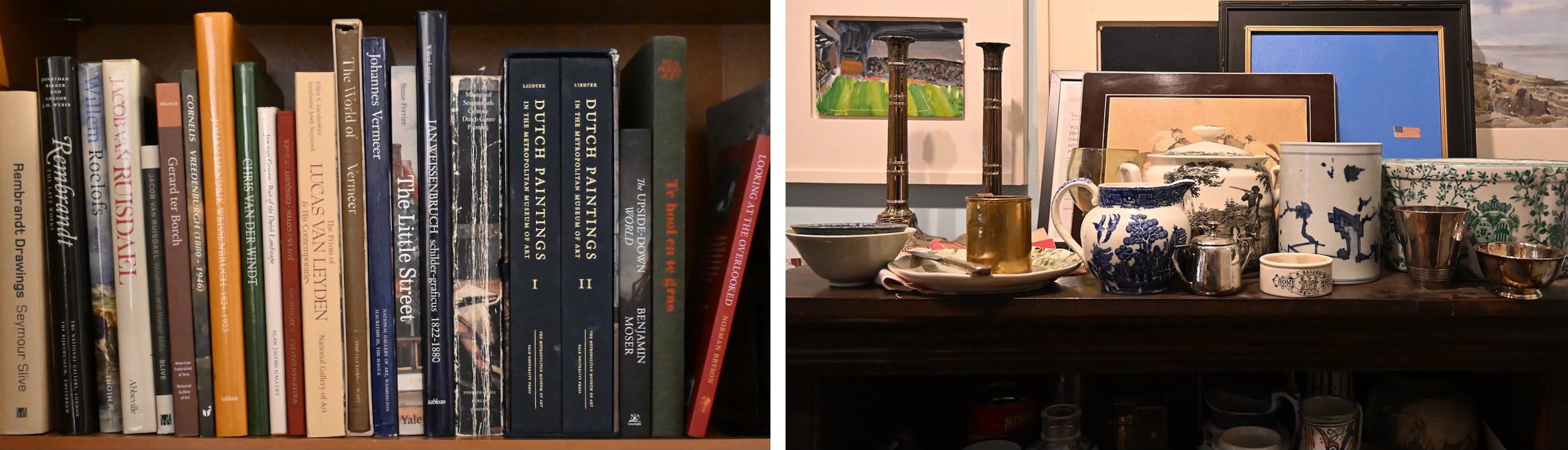
Like many of Donald’s paintings, the studio is perfectly dense with objects of interest: paintings by him and others, plus glassware, pottery, photographs, books, and ephemera.
Every year I send two big paintings to Quidley on Nantucket. This year, Chris [Quidley] said, “What about Ireland?” I’ve painted a lot in Ireland, so it’s reasonably easy for me to summon Ireland.
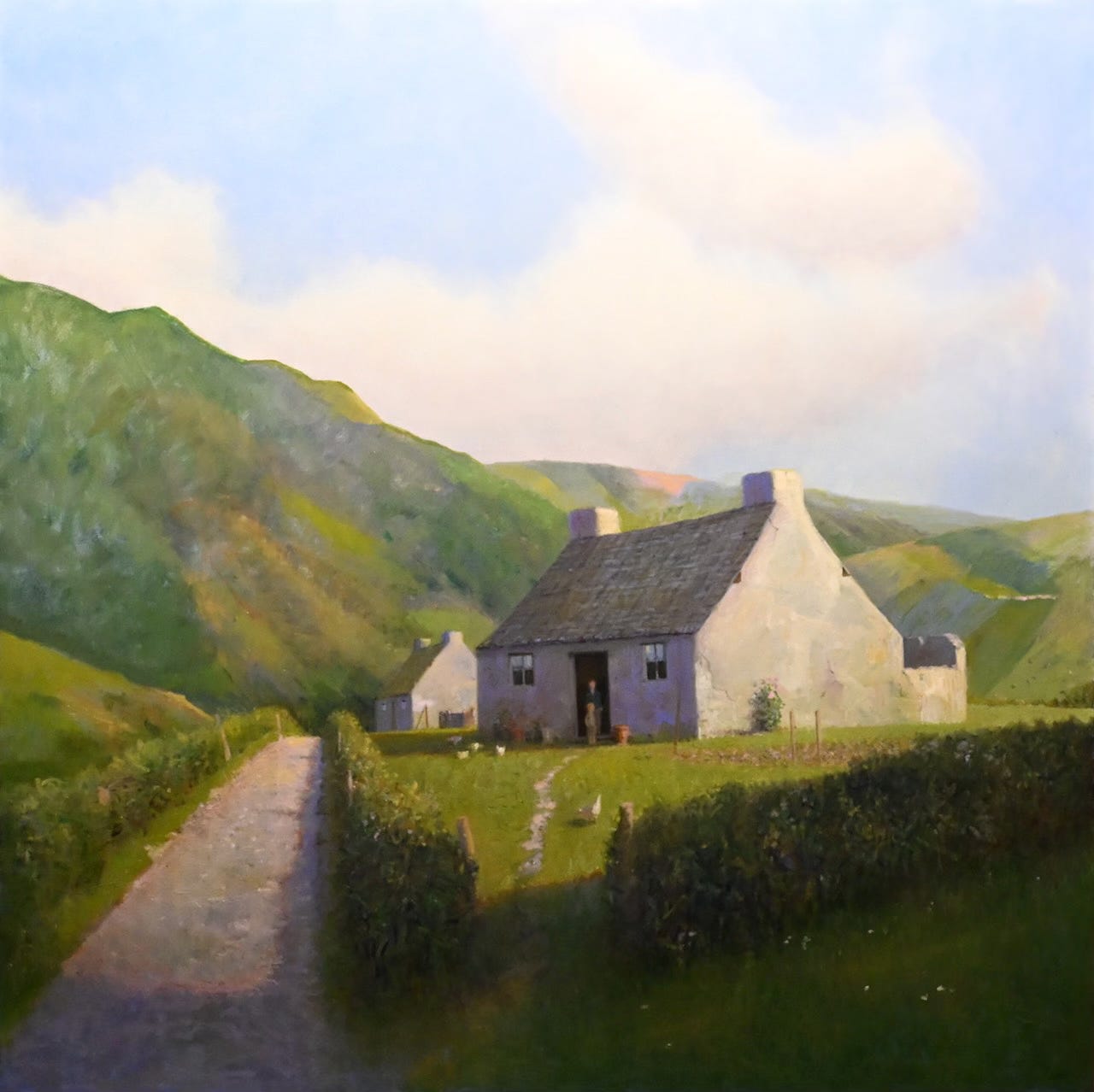
This painting is not a real place, and 95% of the smaller paintings on the other studio wall are not of real places. I paint out of my head nowadays. I’ve traveled a great deal; last year, I was in Europe, I think, five separate times. Most of my recent paintings are based on places where I’ve been.
Often, I will cover a panel, if it’s one of the small 16” x 16” ones, with raw umber mixed with Liquin [fast-drying medium]. While it’s still wet, I use a Q-tip to draw into it and take off some paint so the white part comes through. The Q-tip removes the paint in a way that a brush could not. I also like the Japanese Q-tips because they are pointier.
I use Q-tips to draw the lights and then I add darks. At a certain stage, it catches my imagination, and I think, “Well, if that’s a whatever, then next to that whatever, there should be another whatever.” And then I’m on my way. [As he’s talking, he covers a panel with a raw umber and Liquin mixture and begins drawing with a pointy Q-tip. He says he’s going to draw a room, and instantly, there’s a window with light streaming through it and onto the floor. He roughly sketches in some surrounding details before wiping the demonstration panel clean.]
It’s all about light.
[He adds wryly:] If there wasn’t any light, I couldn’t see it.
I know that it’s likely to be a city scene or an interior or whatever. It’s a very peculiar way to work. I know that. But painting this way is second nature to me now and I don’t think about it.
No. I don’t paint from images because I would find myself too scrupulous in copying them. When I paint out of my head, I only include the things that I want to put in. Historically, I painted from drawings that I made in France. I would go there twice a year and make many drawings to use to create large paintings. I would paint reasonably carefully from them, but there’s not a lot of information in the drawings.
Because the drawings don’t have a lot of values in them, I can decide what type of light and mood I want to create. They could equally become sunlight, moonlight, or even overcast scenes.
Drawing out-of-doors is a must, and not just for landscape painters. As the poet Donald Hall wrote, “Well, of course, I said, it won’t all be gin and bananas.” It’s equally true working en plein air: changing light, unexpected wind, and the dreaded rain. But never lose courage!
Here’s a snippet from the journal I kept on one of my France drawing trips:
“Hotel des Artistes, Gargilesse-Dampierre, Indre, 17 May 95. The weather, starting out today, did not promise well. The hotel, which is perched on the side of a ravine, at the bottom of which is the river Creuse, doesn’t offer enough view of the sky to judge a whole day’s weather prospects. But the leaden aspect it did offer was not comforting. The wet pavement outside announced that it had recently rained and the ominous sky said it would again. But up, up, out of the gorge I went, up to the highlands, to Cluis, to Neuvy-Saint-Sèpulchre, and on toward Nohant and the Indre, back to George Sand’s Vallée Noire.”
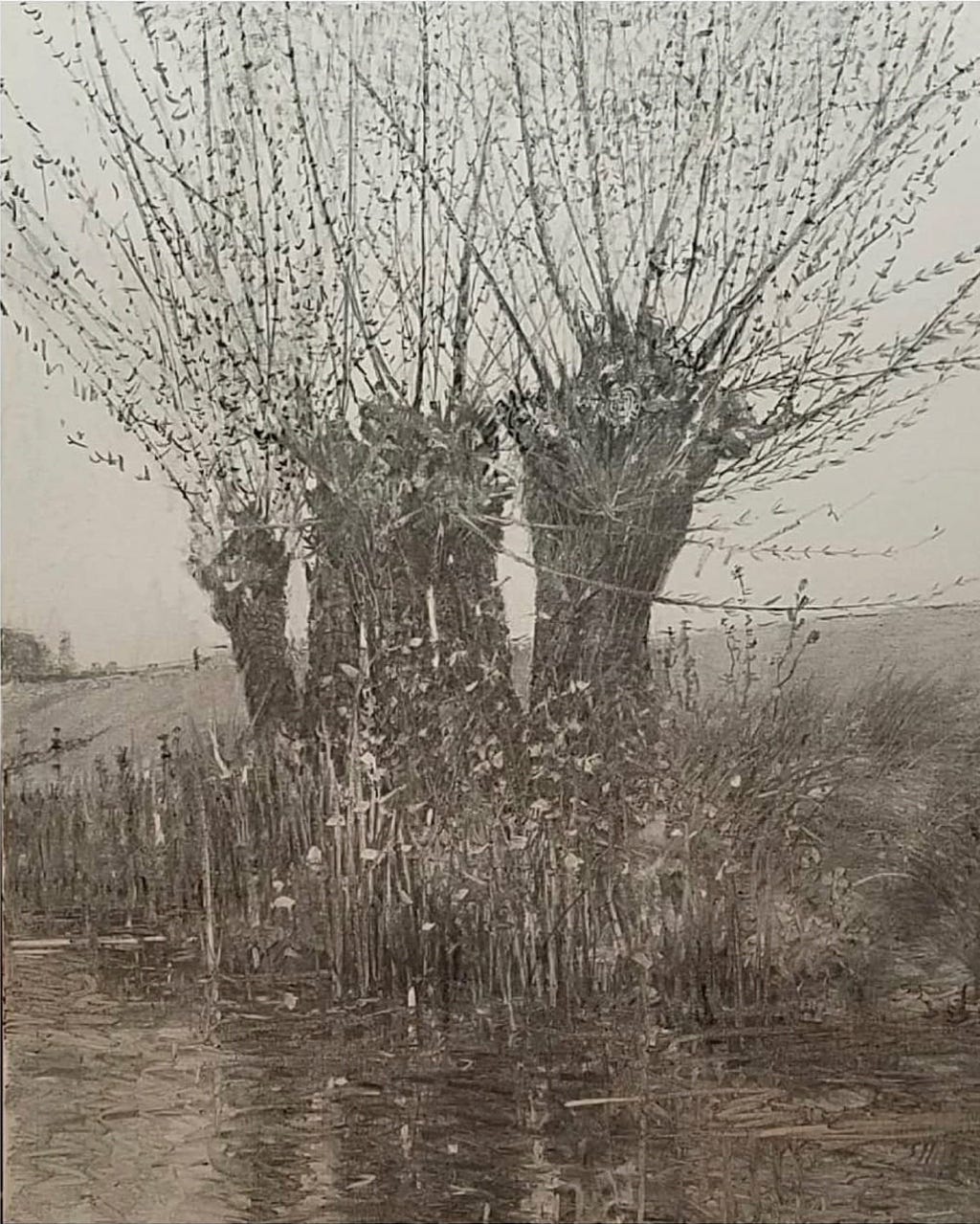
Well, it’s funny. I’m taking information in on some level of which I’m not necessarily aware. I painted a number of Dublin pubs that didn’t depict real places. But I wasn’t taking mental notes in a pub and saying, “Oh, I have to remember how that tap looks.”
When I taught this approach in a class, some students said, “What? I can’t use a photograph? And there’s no still life set up!” I said, “Nope, it’s all in here.” [Donald taps his head].
I asked them to create a painting of their childhood bedroom. They’ve got all the information in there [points to his head again], and they just need to figure out a way to access it. They did quite well with it. It’s fun watching people get in touch with stuff they haven’t thought about in a very long time. I could charge a therapist’s rate for it. [He smiles, again wryly].
I expect this is going to be in your new series about “crazy painters I have met!” [We both laugh. Come to think of it, that’s not a bad idea for a series. Let me know if you have suggestions for people to include.]
No, because that’s just too much for me to cover with raw umber. I probably drew it in with a combination of ultramarine and burnt umber, which I can moderate to go either cool on the blue side or warm on the brown side.
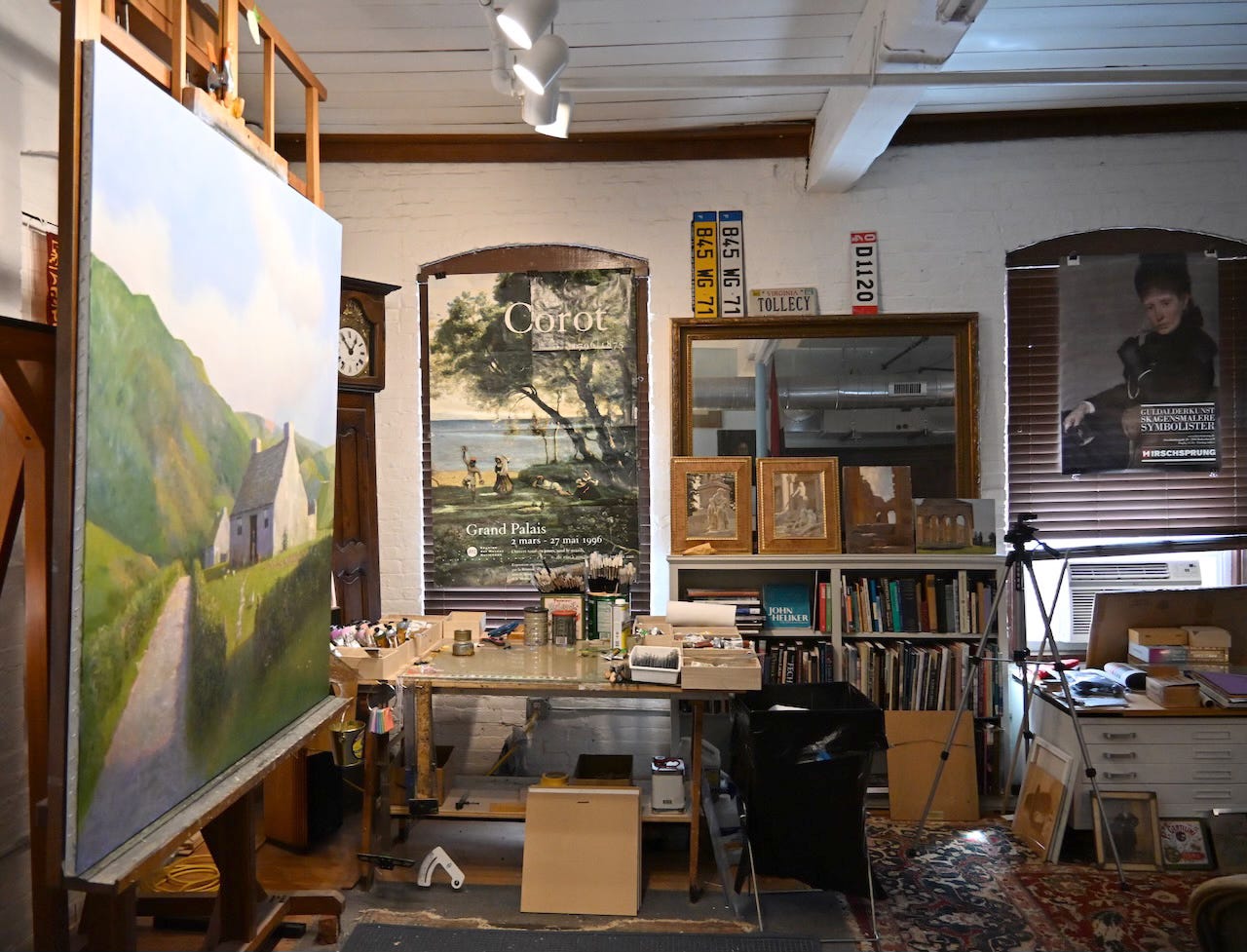
I never have a full picture of any of them in my head. As I’m painting, I ask, “What does this need here?” Then I pursue it. I don’t keep everything I add, and I make changes. At the very end of this painting, I thought to myself, “I think that needs some chickens.”
Degas famously said, “A painting is never finished, it is only abandoned.”
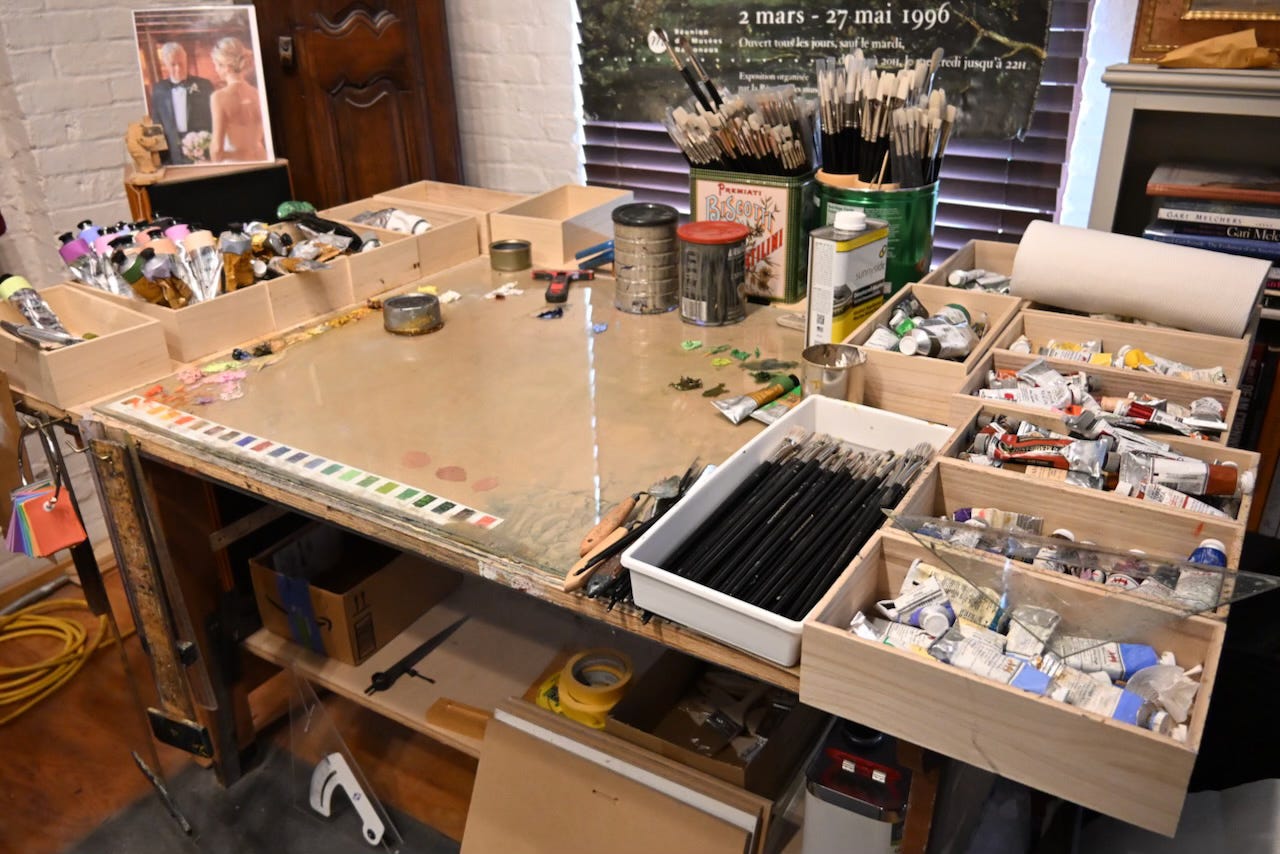
I come here to paint almost every day. If I’m not traveling, or if my wife, Ginny, hasn’t figured out something I need to do, then I’m here. I’m here long days, often 10 hours or more. Essentially, I’m working all the time.
Although I work a great deal, I love it. Some of the time it’s just work. Maybe there’s an area in a painting that has to be blue. Well, that’s just work, right? But most of it, certainly more than half of it, is creative.
I concentrate very hard when I’m painting. That degree of concentration means that it’s both exhausting but also effective because I really go there.
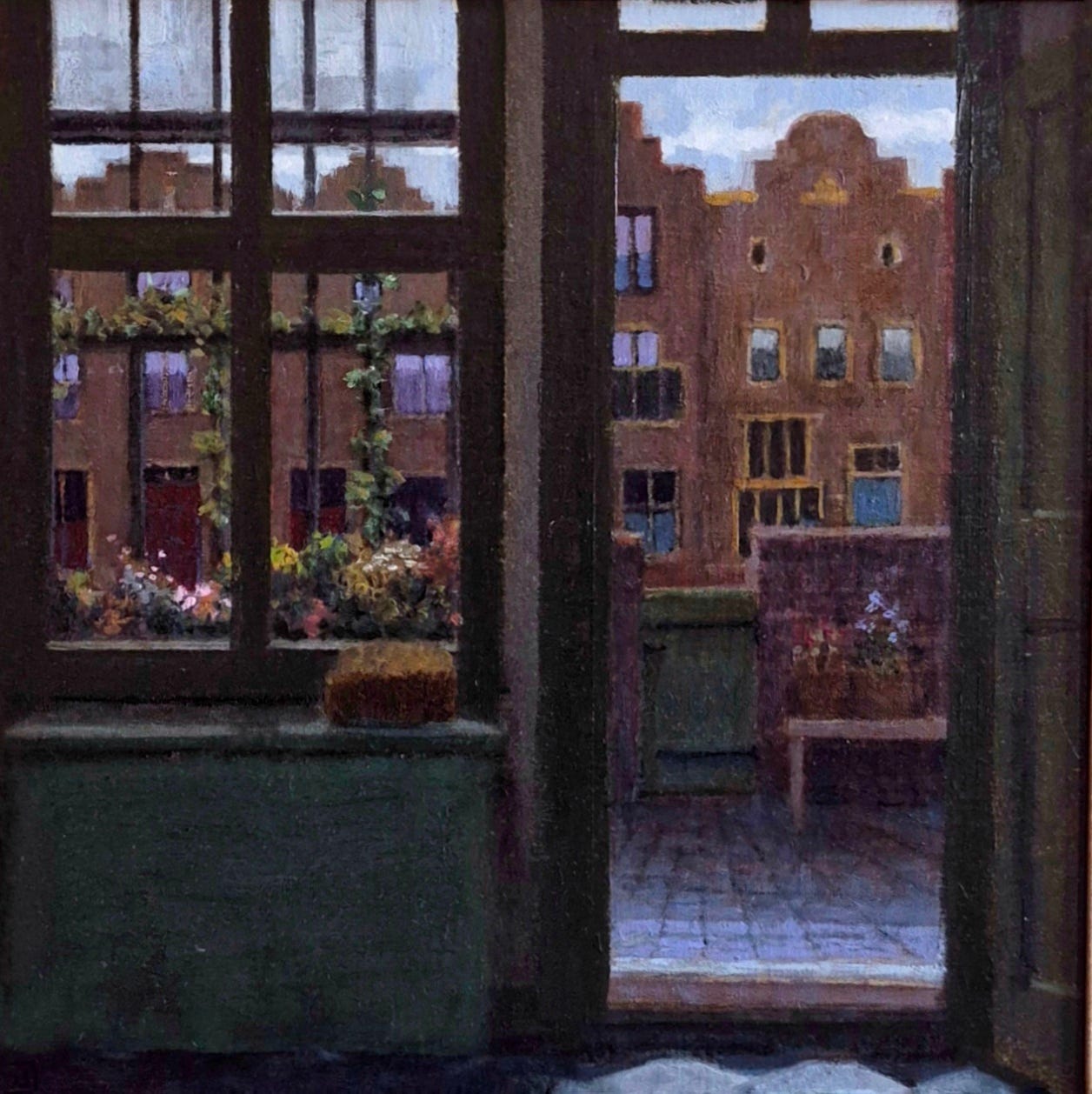
That’s less apparent to me than it may be to you. Of those in there [he motions to a wall in his studio with 52 16” x 16” paintings soon to go to a gallery] I guess a few of them are tighter.
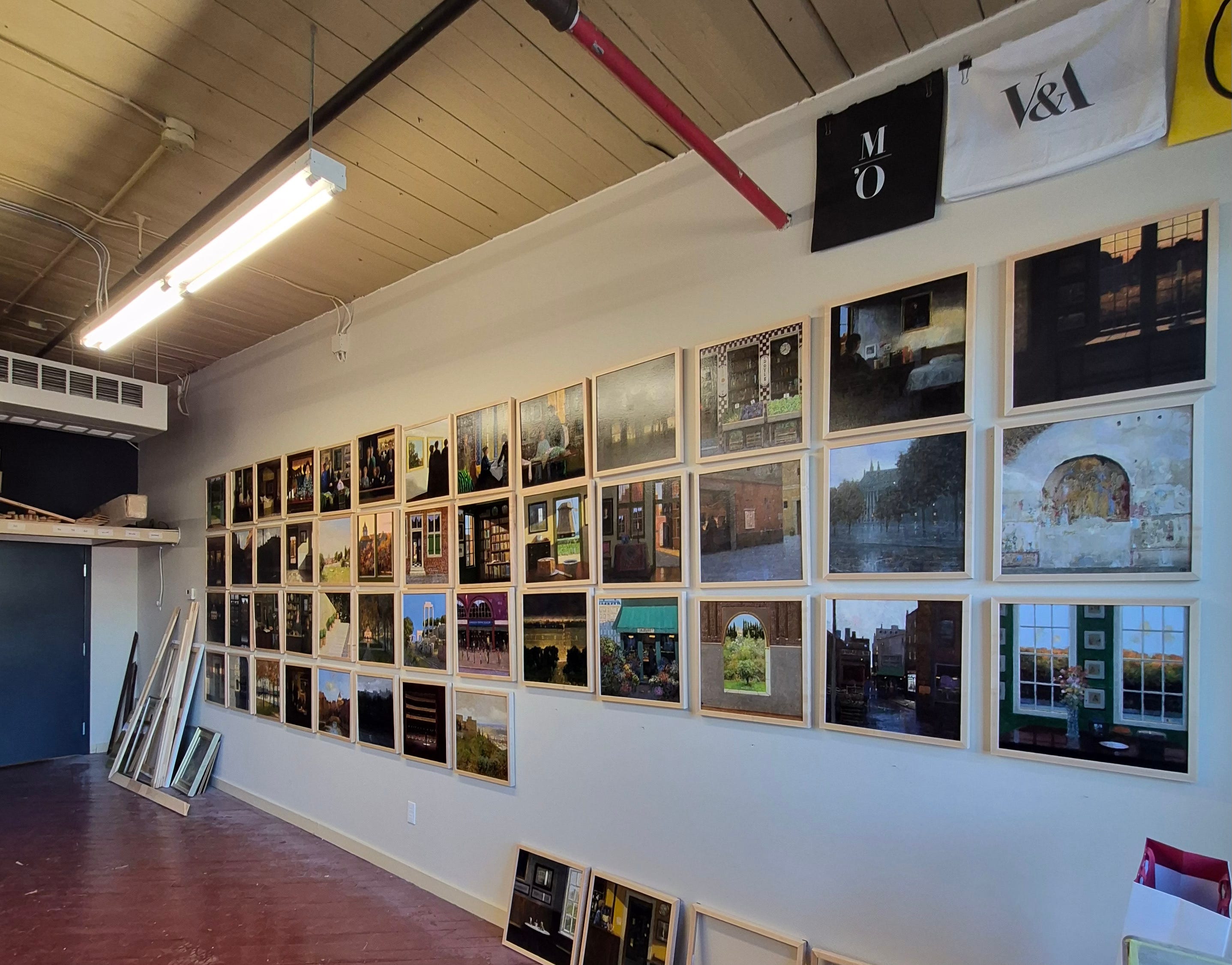
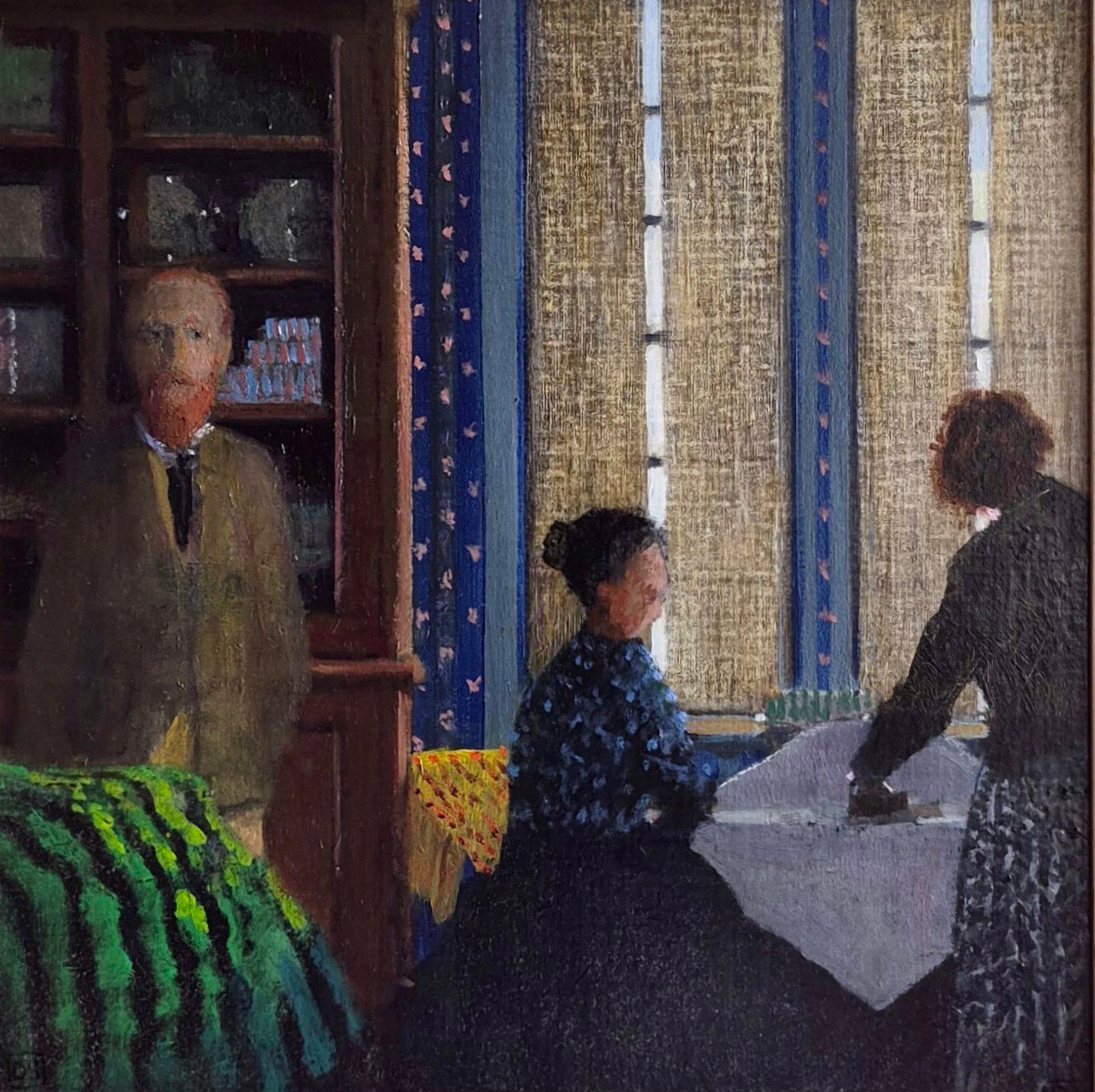
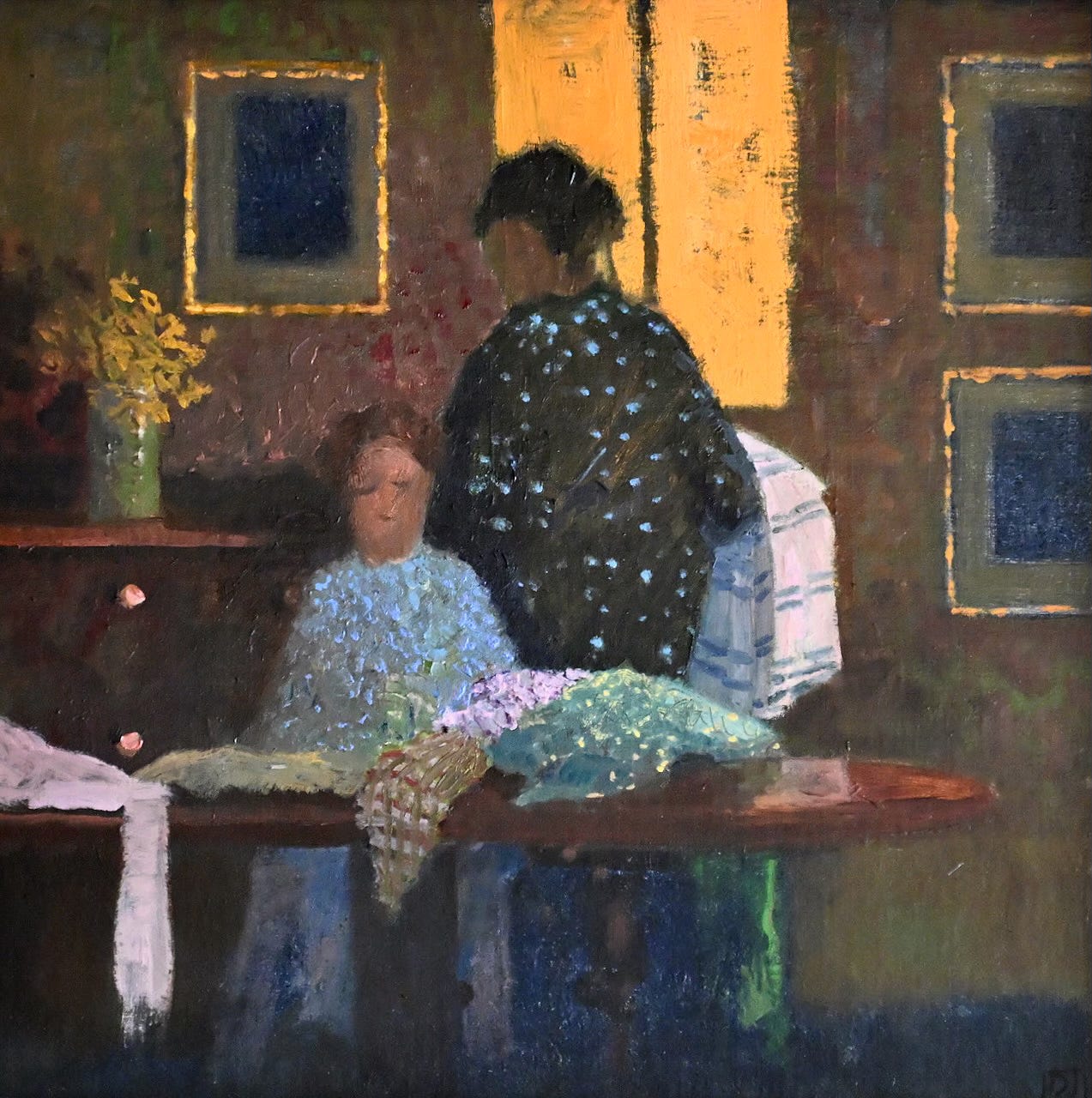
There are four or five that came about as a consequence of seeing a Vuillard exhibition in New York a couple of months ago. Those paintings are perhaps looser, in the sense that they’re slightly out of my comfort zone, which was also fun.
I’m a tremendous Vuillard fan. He was willing to break all kinds of rules. I think, “Oh, no, you can’t do that. That person with the flowered dress cannot almost disappear into the wallpaper!”
Vuillard’s mother was a seamstress, and she employed seamstresses in her apartment in Paris. From the time he was very young, Vuillard was surrounded by all sorts of patterns. He was obviously absorbing all of it.
Many of his paintings are of women in spaces surrounded by lots and lots of fabric. I did my version by including lots of patterns, but the paintings don’t look remotely like his. I did put Vuillard in one of them.
Tell me about your Doorway to the Golden Age painting.
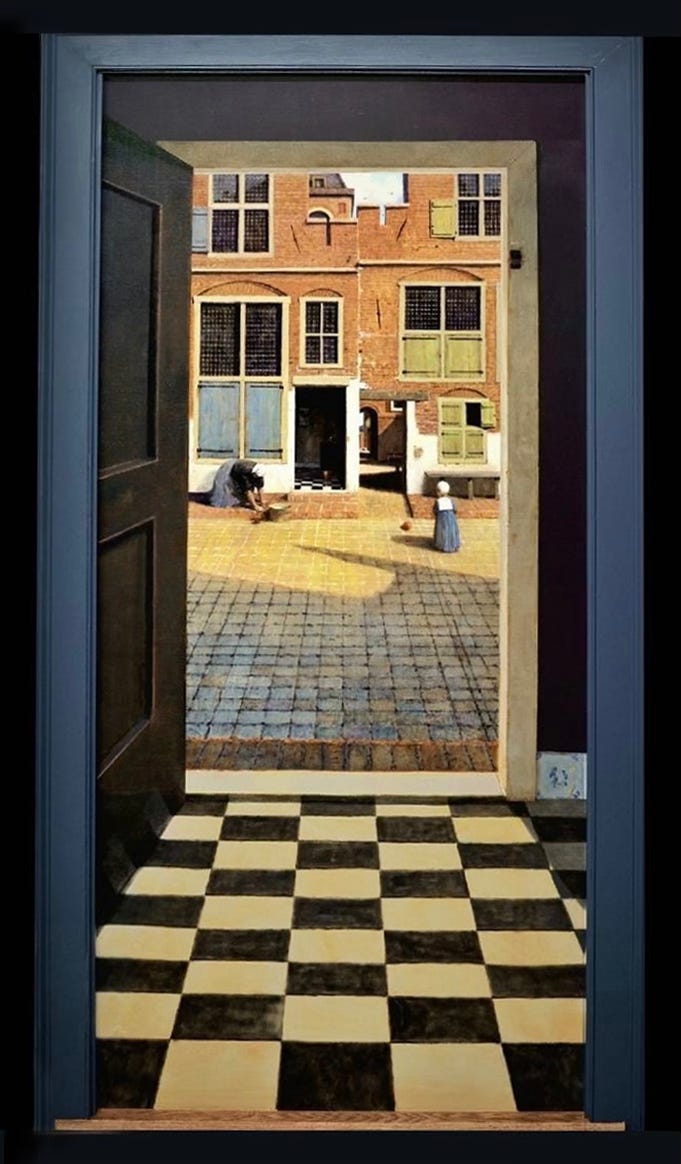
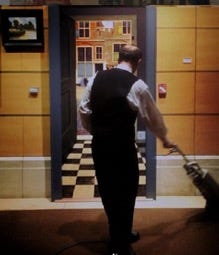
That painting sits on the floor. The bottom frame is an oak door threshold, and the sides are ordinary door casings. The blue door frame is “real,” and the rest of it is the painting. The piece is about seven feet tall, maybe three and a half feet wide.
I made up the scene. When I was trying to make sure the perspective for the floor would be correct, I couldn’t stand back far enough because it’s so large. A couple of friends and I brought the painting downstairs to an empty space. We laid it on the floor, and I stretched strings out about 20 feet on either side. Then I could figure out the perspective of the floor pattern.
It was fun because some people didn’t immediately realize that it isn’t a real space and didn’t know whether they should be walking into this place or not. The painting was shown in a small gallery at the Four Seasons in New York and it ultimately went to a good Quidley client.
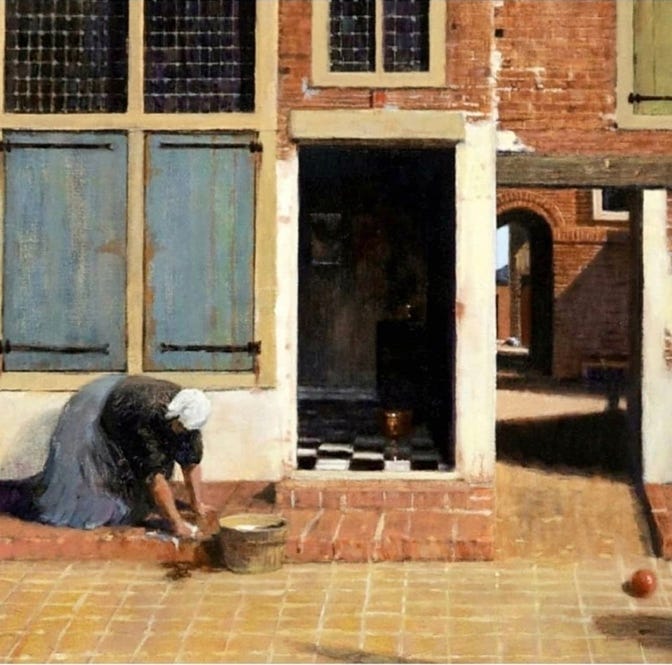
This is a cleaner [see photo below] at the Four Seasons, coming across the Doorway to the Golden Age for the first time. He probably works nights and the painting wasn’t there the previous night.
Yes. I never lived in 17th-century Holland, so it had to.
No, despite my age [he smiles].
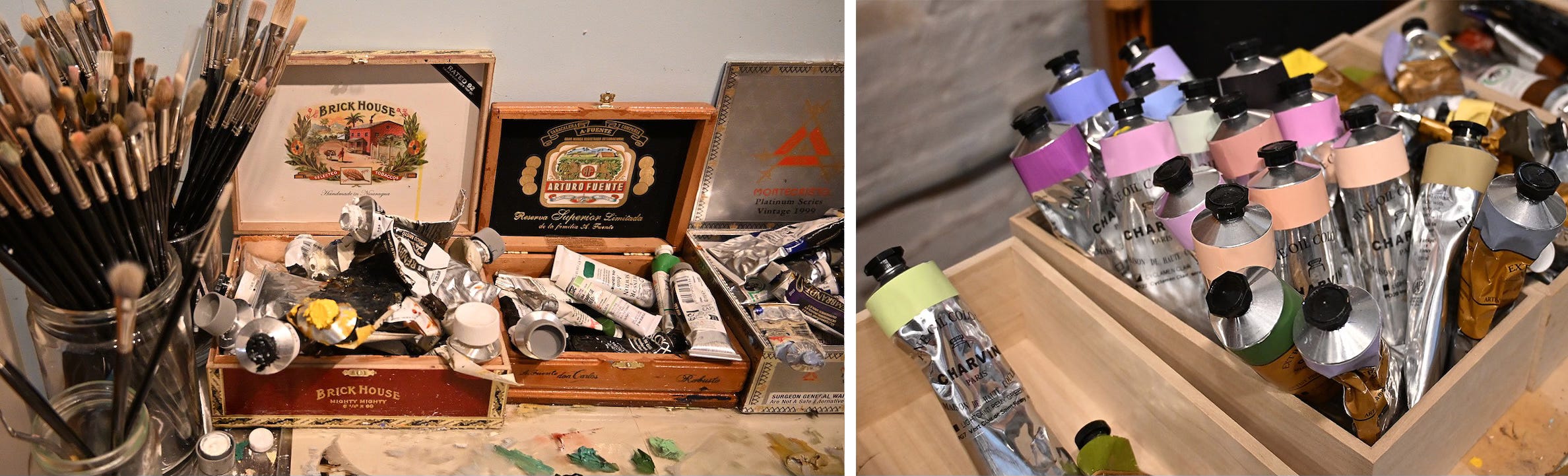
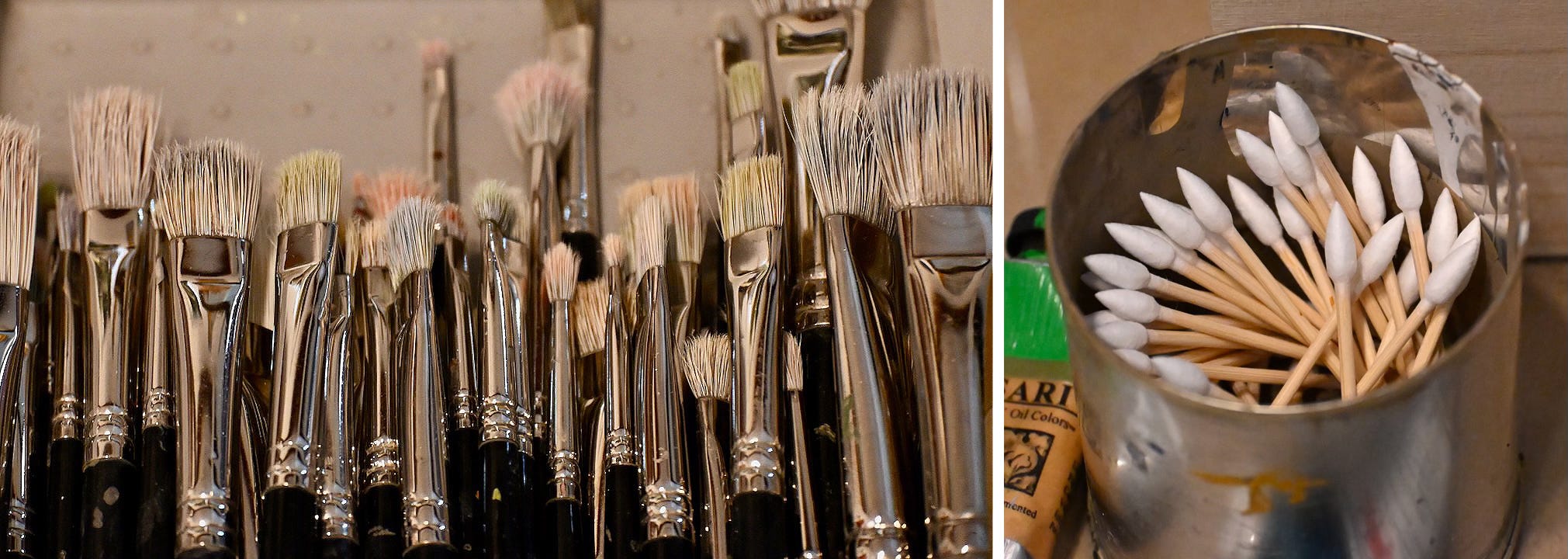
I realized that the only way I was going to learn was by haunting museums, buying as many art books as I could, and introducing myself to as many paintings as possible. When I went to museums, I would try to take pictures apart [not literally]. I did a great deal of that. And as you can see, I’ve got many, many hundreds of books here.
At the time, I was still working as an assistant manager of a lumberyard. My boss was fired on Labor Day, 1979, and I quit on principle. I was really quitting to paint, but I couldn’t possibly say that to myself because I didn’t have any money in the bank.
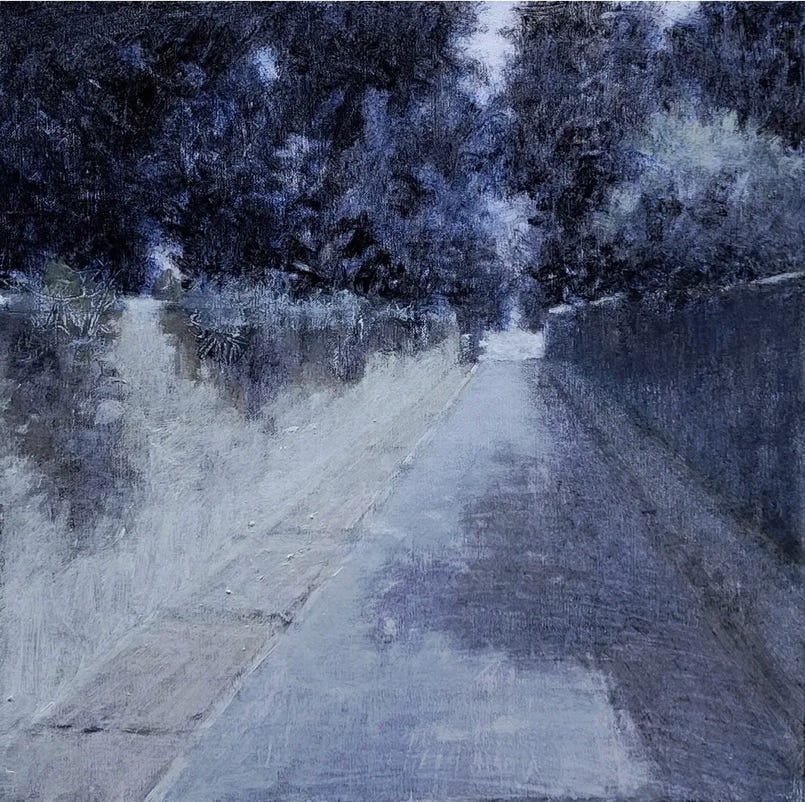
I went to the local art center, Garrison Art Center in Garrison, NY, and asked if I could have a show opening the Friday night of Thanksgiving weekend and closing on Sunday. They agreed, and because they knew I was trying to launch my painting career, they said they wouldn’t charge a commission on any of the sales, which was great. It’s a small, not-for-profit gallery.
I created about 40 pieces, including small drawings, still lifes, and landscape paintings. Like a lot of beginning artists, I acquired frames at tag sales. Sometimes I modified a painting’s size so it would fit into the frame I had.
Back when I worked at the lumberyard, I became friendly with a great number of weekenders from New York. I invited them to the opening and they came, buying all the pieces. The paintings were not very expensive—the total for the 40 pictures sold was about $2,000. But they bought them as a way to launch me.
Selling all the pieces at the show reminds me of that saying, “Yesterday, I couldn’t even spell artist, and today I are one.” [We both laugh.]
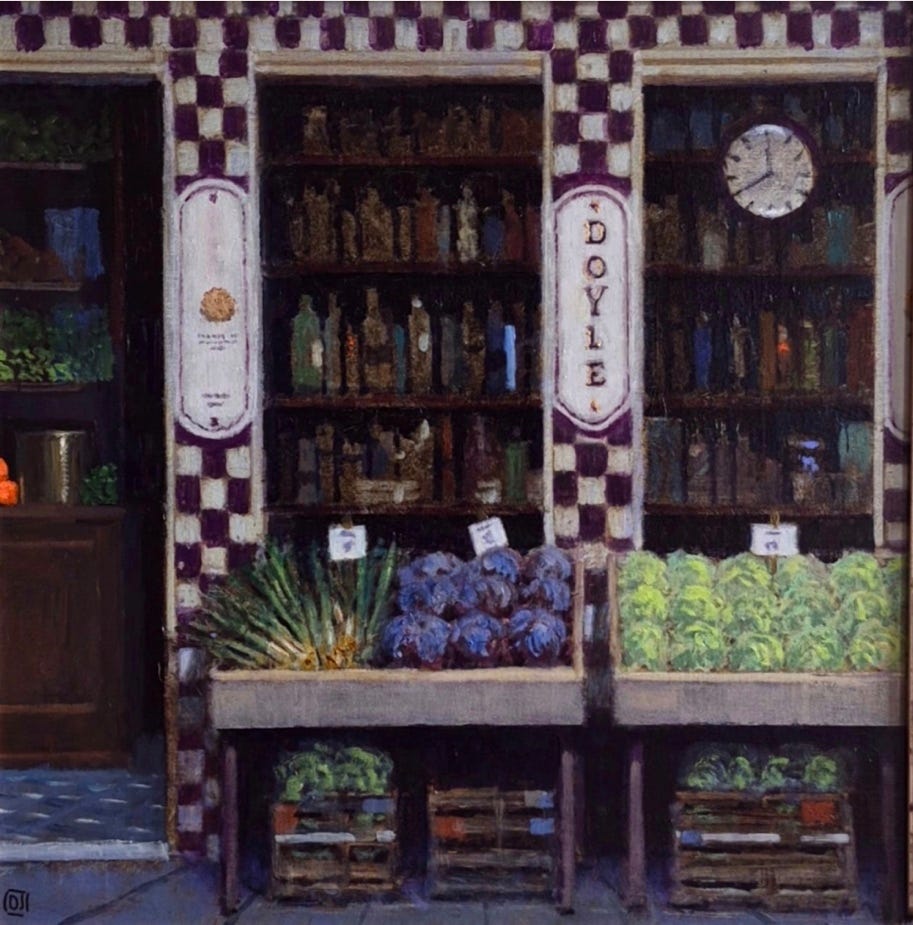
I don’t think so. The only thing that you might glean from it was my determination and discipline to produce all the pieces between Labor Day and Thanksgiving. But I think that’s the only consistent thread.
You know that old expression: “Play the game for more than you can afford to lose... only then will you learn the game.” [Attributed to Winston Churchill]
If you’re holding on by your paintbrush and everything depends on it, then you either fall by the wayside or you figure it out, right? Also, at the time that I was having my initial successes, very few people were painting large traditional landscapes. I was lucky enough to have the field somewhat to myself.
Seeking representation, Donald made an appointment to show his paintings to a New York City gallery. At the time, he lived in Cold Spring, New York, in the Hudson Valley. It was during his struggling artist days, so filling the gas tank and paying for parking in the city were big expenses. He toted a cardboard box of paintings in their “tag sale frames” into the gallery. The gallerist who had invited him was speaking on the phone. She covered the mouthpiece and indicated he should put the paintings on the floor, against the wall. He unloaded the paintings and lined them up. Still on the phone, the gallerist took a quick look and said, “No thank you.” The callous rejection was soul crushing.
But the dismissive gallerist opened the door to a serendipitous meeting. Donald hauled his box of paintings to a tiny space on 57th Street, Tatistcheff Gallery. Peter Tatistcheff agreed to test the waters and to keep the paintings for 90 days. He introduced Donald to Steve Doherty, editor of American Artist magazine, who had dropped by the gallery to deliver magazines. They chatted and a few days later Donald’s landline phone rang. It was American Artist magazine: Could they send a writer and a photographer out to develop a story about him?
His success streak continued. A friend of Donald’s showed slides of Donald’s paintings to John Pence, who had a prominent gallery in San Francisco. John Pence called: Could Donald be ready for a solo show in November?
Yes. I had nine months to learn how to paint! [Ha! I suspect that by this point he figured out how to paint.]
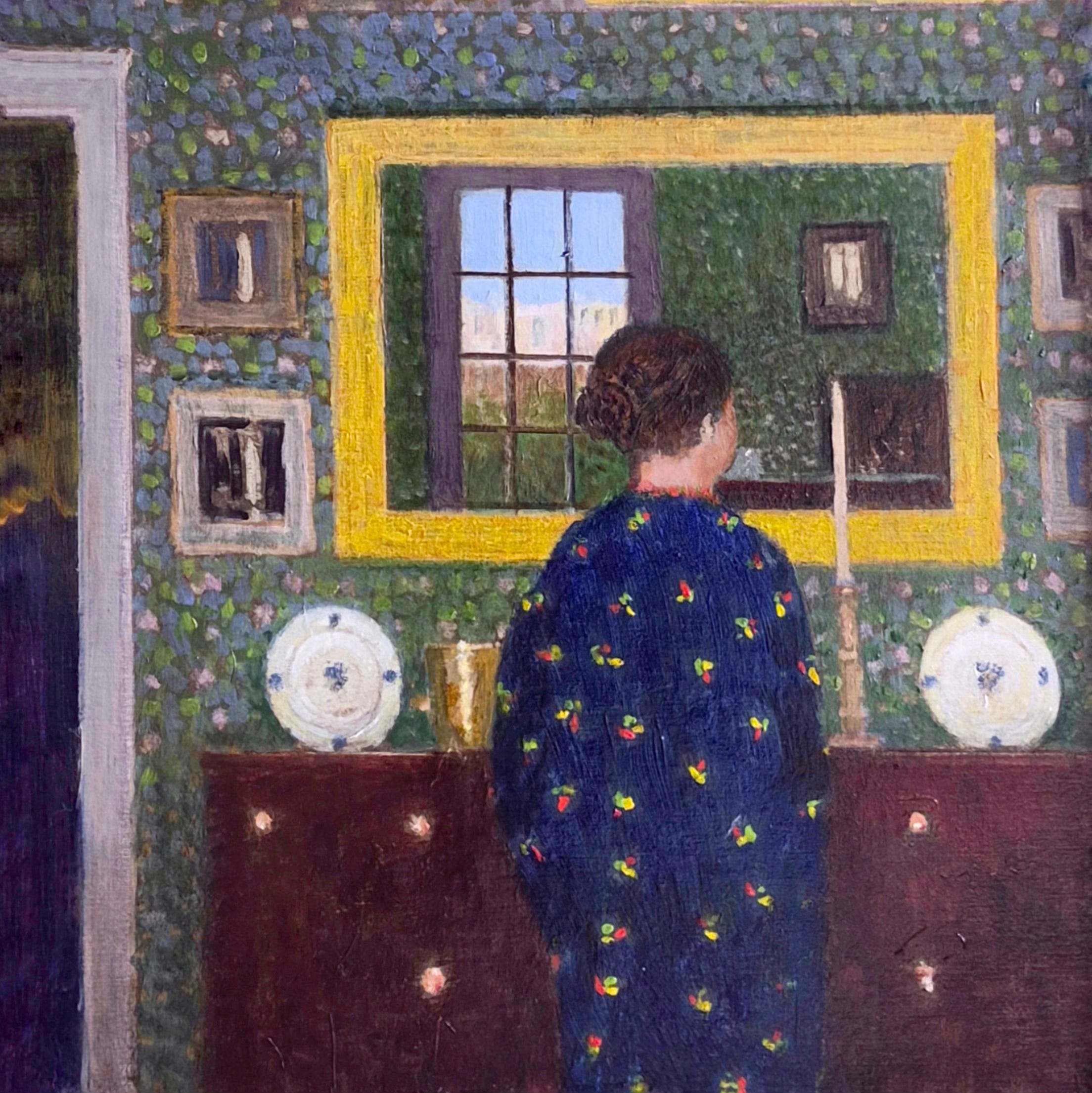
Well, before I started painting, I was rather keen on the Hudson River School because I was living in the Hudson River Valley. I don’t really remember what paintings were in that fall 1982 John Pence show. But it was reasonably successful. Until about 1990, I had a show there every two years.
I joined the Hoorn-Ashby Gallery on Nantucket. After some time, Mary-Claire [the gallery owner] asked what she needed to do for me to be exclusive with her gallery. I said, teasing, “Well, you have to open a gallery in New York.” About four months later, she opened a gallery on Madison between 65th and 66th.
We worked together for about 17 years or so. Now I’ve been with Chris Quidley on Nantucket for about the same amount of time.
In the meantime, I bought a house in southwest Burgundy (France). I would go there on May 1 and stay for the whole summer, mostly gardening.
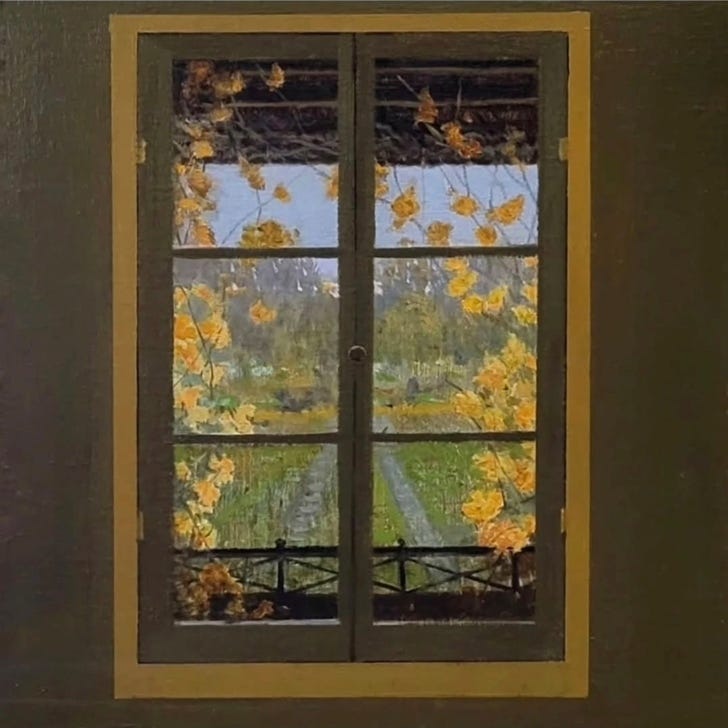
No. I would return to the United States on October 1 and paint for a New York show that opened every year around January 20. I would usually produce 10 or 12 large paintings [averaging 36” x 54”] as well as a few little ones.
After the opening, I would go to London for two weeks to decompress. Then I’d return to the United States and spend about 10 weeks producing enough paintings for the gallery to have for the Nantucket summer season. Then I would go to France on May 1st. [I could get behind Donald’s version of work-life balance.]
I was so exhausted from seven months of painting essentially full-time. I barely slept during that time and I needed to recharge. [Donald showed me photos on his blog of the stunning gardens he created, transforming an unremarkable plot into a charming tableau replete with wisteria draped over a wooden fence. The gardens had a timeless and sophisticated quality similar to his paintings.]
I was always starving in the beginning. My first show was successful, but then what? I wasn’t showing in any galleries. Who am I going to sell paintings to? I only have so many friends, right?
A couple years before I had my first show at the John Pence Gallery and before the American Artist magazine story was published, I was at a dinner party hosted by a retired museum director. During dinner conversation, I described 19th-century artists who benefited from the largesse of this man in Ohio who funded their trips abroad to paint. On their return, they gave him pieces they created on their travels.
The next day, the dinner party host called and asked what I would charge for 12” x 16” paintings if I were to take a trip. I told him $500 apiece. He, friends, and I found 15 people who wanted to support the trip, and I wound up with “commissions” for 15 paintings, resulting in $7,500 to fund a trip for three months.
When I returned, there was a party. The people who contributed drew numbers to determine the order in which they would choose their painting. I was relieved that everyone seemed happy.
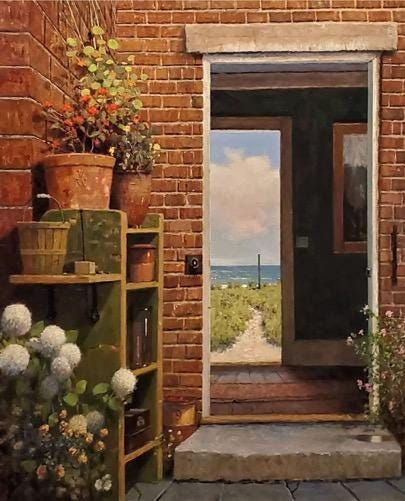
Subsequently, in 2015, a client who had bought a number of large paintings some years before contacted me. He was now head of an Irish pharmaceutical company. He asked if I would be interested in a painting trip to Ireland, the expenses for which he would cover. You can imagine what I replied. Soon after, I received round-trip, first-class tickets to Dublin. I painted for three weeks, moving along as I wanted, and began 24 12” x 16” plein air paintings. To my surprise, he bought all 24, an experience that is an artist’s dream.
At the tail end of that trip, I tacked on a teaching assignment at the Welsh Academy of Art in Crickhowell. Over the years I’ve taught plein air workshops in Scotland, Canada, Norway, the Netherlands, Ireland, France, and Italy. In the U.S. I’ve taught in Maine, New Hampshire, Georgia, North Carolina, and New York’s Adirondack Mountains.
Yes, in 2017, I started and funded a traveling fellowship that I awarded to artists on a competitive basis. I established a board, and we voted to select the artist. When I started it, I gave them $5,000, and then ultimately that became $7,500, to go to Europe and paint for as long as they could make the money last. It worked out very well and the people who received it were incredibly appreciative. It made a real difference for them.
I sponsored it five times, but then COVID came, and I didn’t start it up again.
That I had the hubris to think I could do this with no money in the bank and virtually no training, that I could actually teach myself. Of course, the problem with teaching yourself is that it takes a quite a while before you realize that it may actually be possible.
Well, nowadays, the quality and the accessibility of realist art training is huge. There are a number of ateliers that will teach you to paint and draw. Ateliers can produce painters with extraordinary skills, but the painters may have nothing to say. It’s both a tremendous benefit to have all those skills and a tremendous liability if you can’t grow past that.
Perhaps. It probably made it take longer, and it probably included a lot of tears. But it’s also why my paintings don’t really look like anyone else’s paintings.
The profound answer to that is that I don’t know.
Nope. And that answer is not to be mean. I just don’t know the answer. Through the years any number of people have told me that they could walk into a very large room filled with paintings and, even if it’s a subject they don’t associate with me, they can identify my painting from across the room. What that quality is, I don’t know. But I’m trying to hold on to it, which is hard when you don’t know what it is.
The only thing that perhaps joins them together is that the ones that I like best or I think are most successful are ones in which I became thoroughly engaged in the space, particularly when it’s a made-up space.
Did I say that? That’s essentially true.
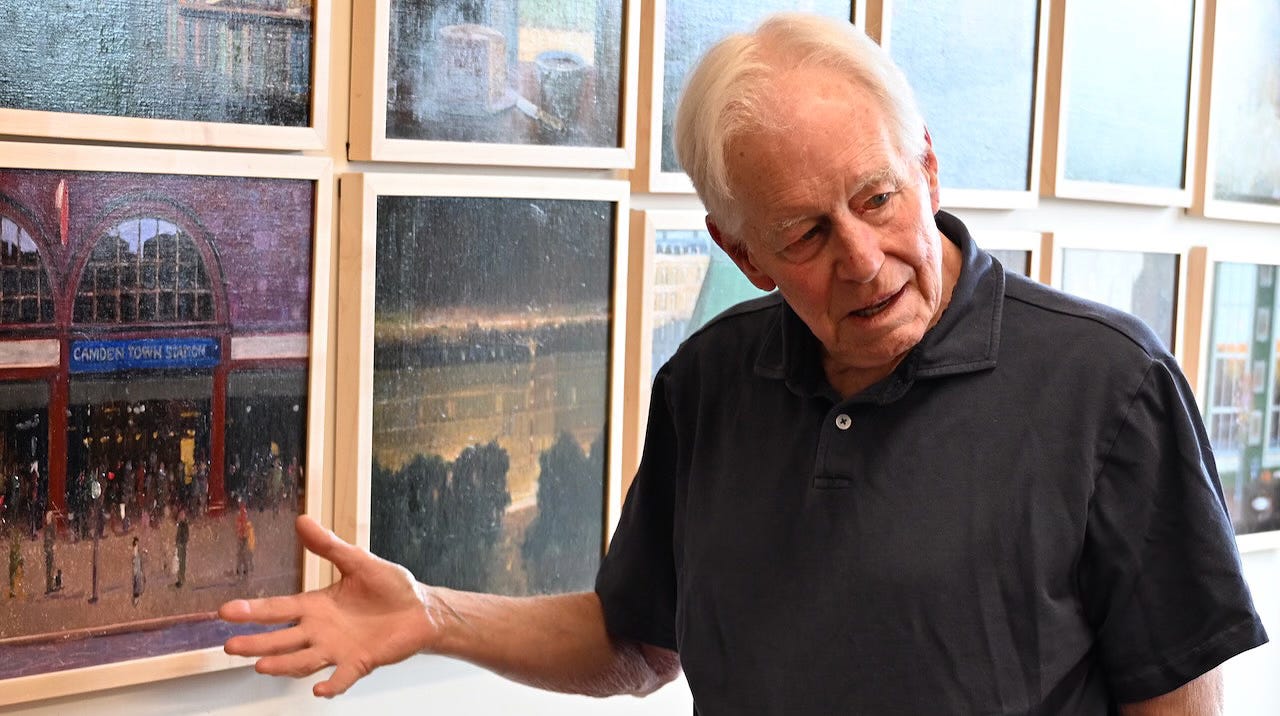
Pointing to his Camden Town Station painting, he says: These are not real people, and they’re not carefully drawn, but Mrs. Smith has no question in her mind that those are people. Mrs. Smith participates in the painting, entering into a compact with me, one in which we both agree that those are people. She has begun to participate in the completion of the painting because she gives meaning to those forms that I have just indicated.
Often there are things in a painting that are merely prompts for the viewer’s imagination. [He points to an area in the painting.] That’s maybe a tree or some kind of a bush. That stuff back there is some kind of foliage, right? But it’s not really there. The distance between this and a photograph is huge, and yet, Mrs. Smith says, “Those are all trees.” Although she doesn’t realize it, she’s making the painting with me.
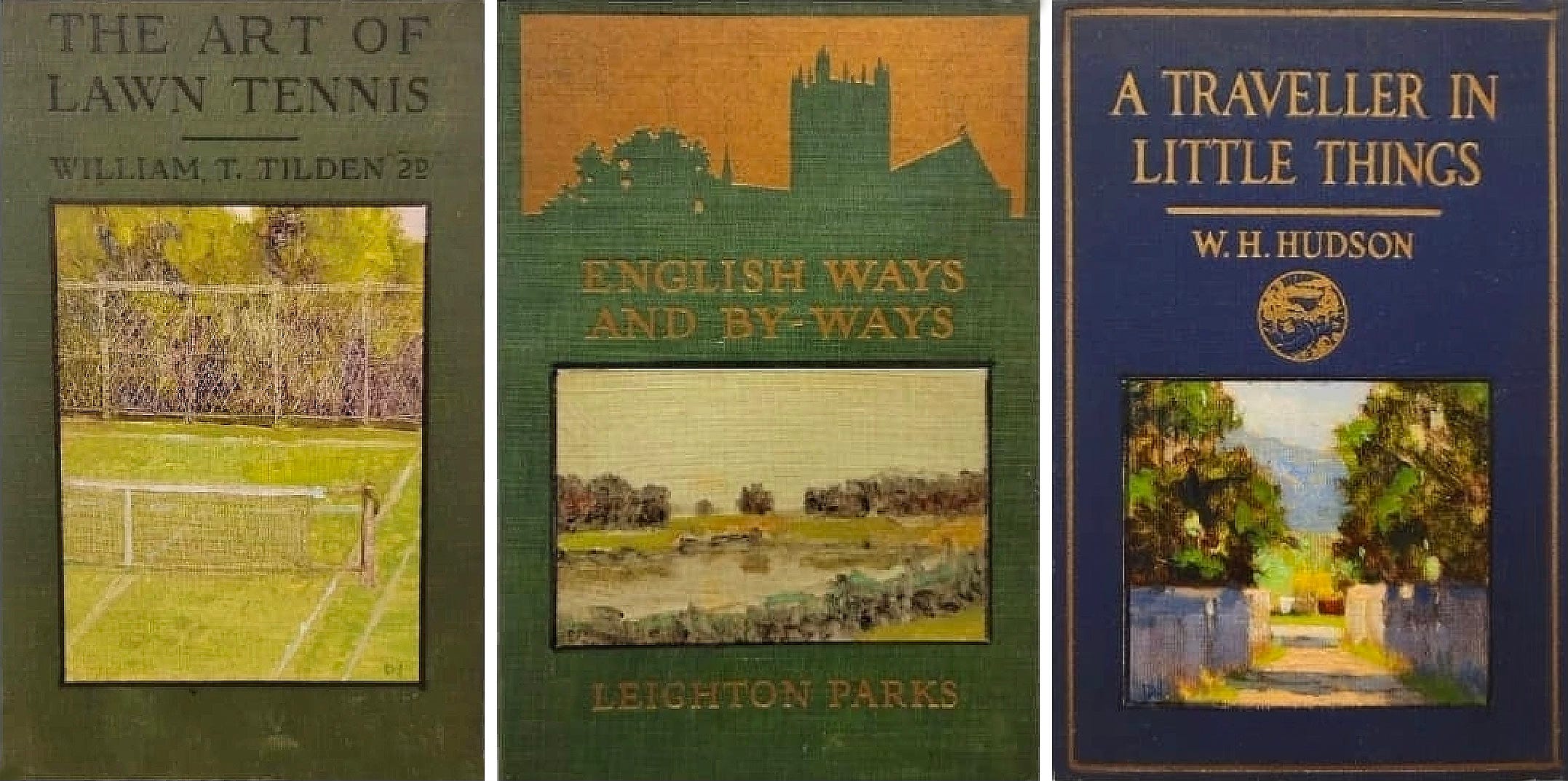
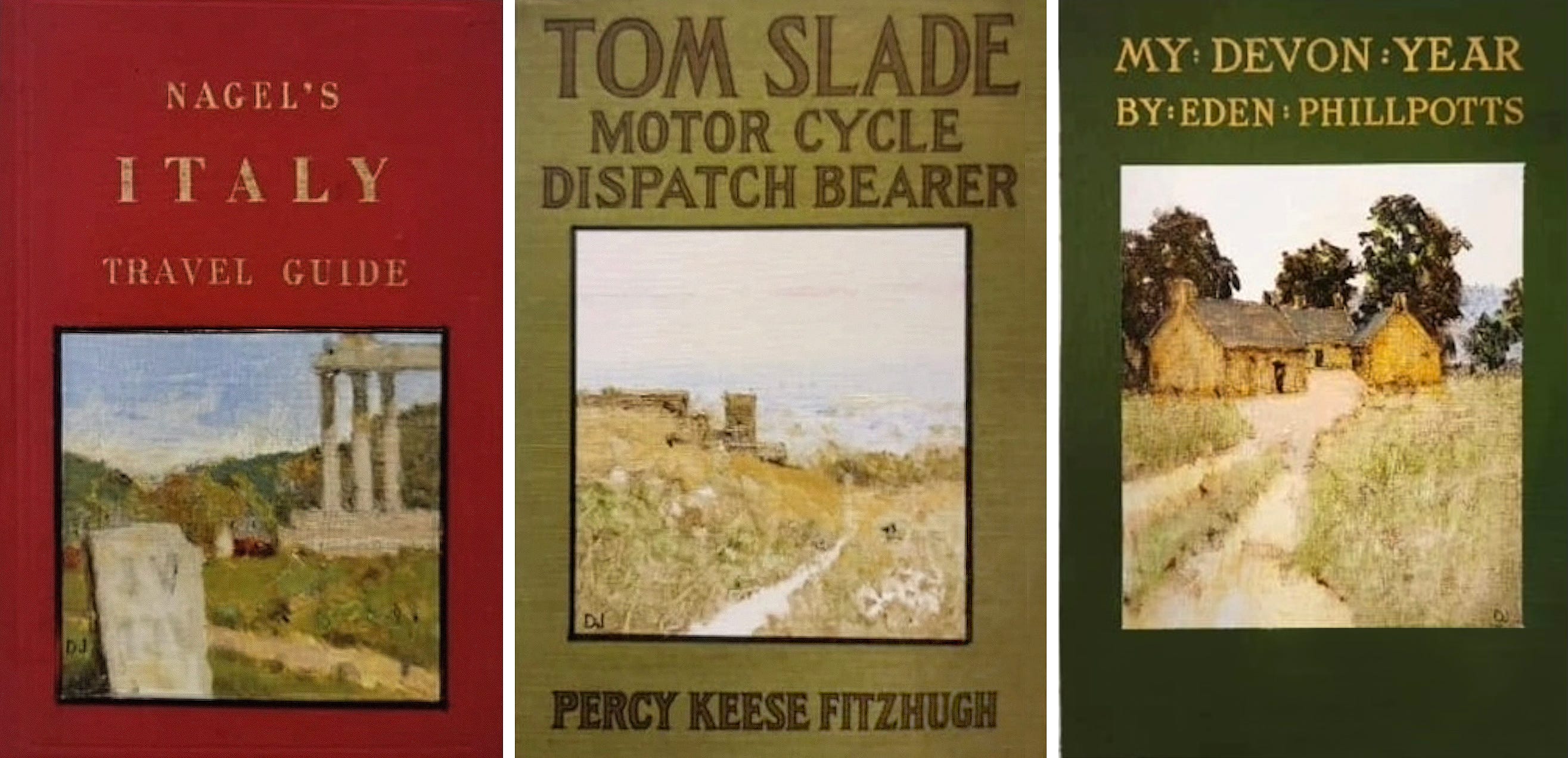
That’s impossible to answer. They have to find it.
Probably by accident.
I couldn’t afford not to learn and not be focused unless I wanted to go back to having a real job.
There was no Plan B.
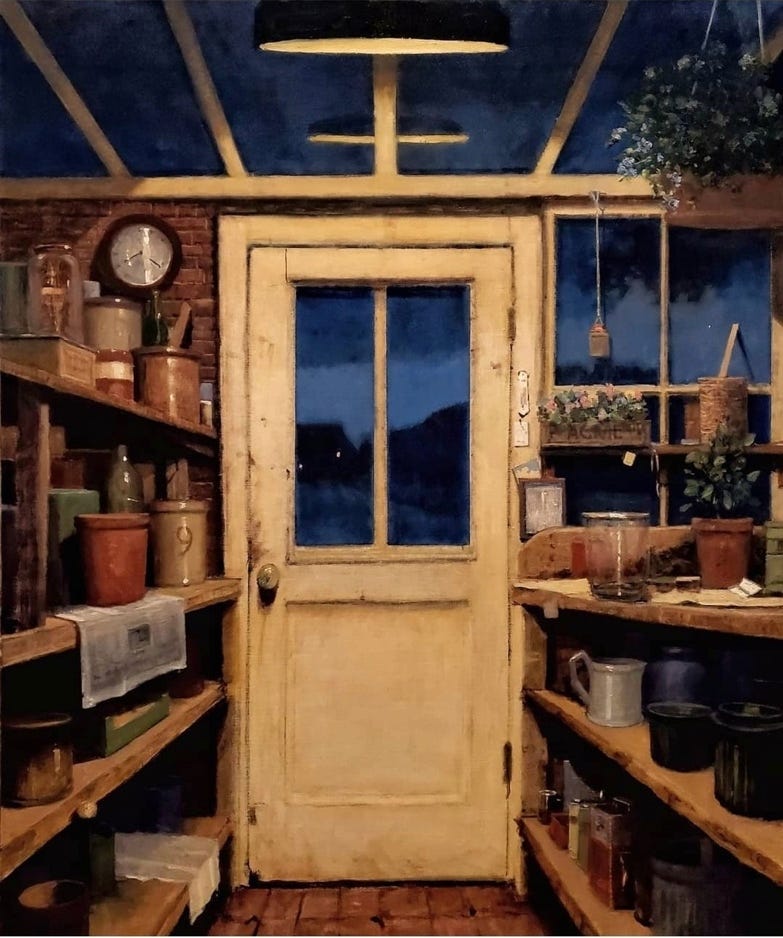
When I was first starting, I would have thought Vuillard was a joke. I would have said, “They’re not drawn correctly and you can’t tell a person from the wallpaper.” Now I admire his work.
Many years ago, I took a group of students to the Wadsworth Atheneum in Hartford, CT. I had been talking to them about the fact that when they would look at paintings, it should be of less interest to them whether or not they like a painting.
What’s important for them, as students, is to look at the painting and to identify that thing within the painting they would like to emulate. Every painting is a learning opportunity for the painter. Don’t think, “Oh, I like that or I don’t like that.” That’s hardly of any value, right? Find the lesson for you in the painting.
I took the students to a room of 16th- and 17th-century Italian and Spanish Baroque paintings because I knew they would hate them. I asked them to collectively choose the painting they disliked most. They agreed on a specific one. Fortunately, the label was on my side [so they couldn’t see who painted it].
I talked about the painting for about 40 minutes, explaining various aspects of it. Finally, by the end of it, I don’t think they liked it any better, but they respected it in ways that they hadn’t before because they had really looked. My point was that even if you don’t like a painting, it can help you learn what to do or to avoid. At the end I said, “Do you know who painted this?” Somebody looked closely at the label and said, “Michelangelo Merisi.” I said, “Do you know what his other name is? It’s Caravaggio. He’s the person that you’ve been slamming.”
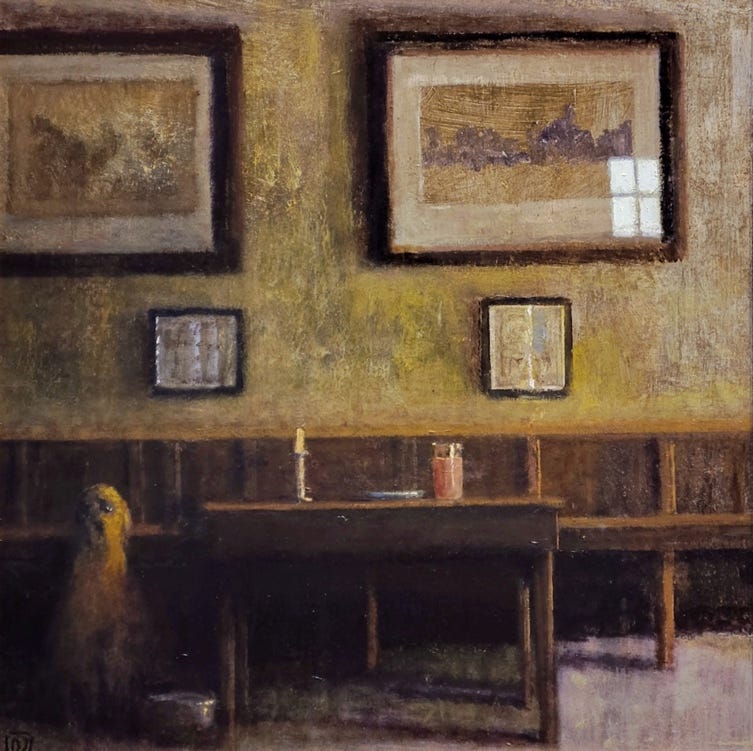
During the period from 1870 to 1920, probably in England. A group of painters I respect were painting in England during that time, which was the last moment of that specific phase of realist painting. This was the last full flush before the advent of modernism.
There are so many. William Nicholson, certainly, George Clausen, Henry La Thangue, and an English painter from the 20th century named Ruskin Spear.
I was blown away by the show of Sargent watercolors at the MFA a few years ago, partly because they were masterful and partly because I find watercolor insanely hard.
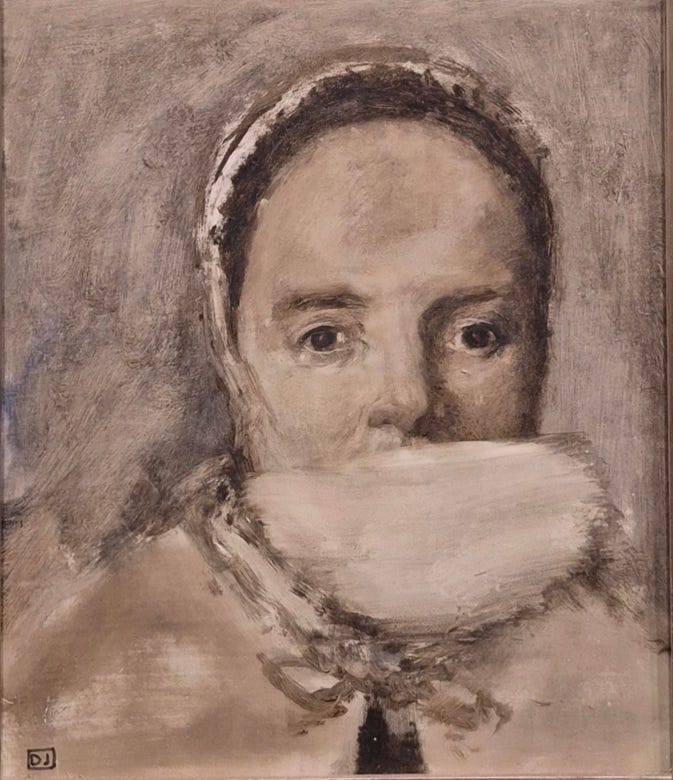
When I first started painting, I was terrified of color, not having a clue how to mix it. I began painting this little grisaille [painting using only a greyscale or monochrome hue palette] copying a Frans Hals portrait.
I got this far, and the mouth wasn’t right, so I wiped it off. I thought, “Well, I’ll just go back and I’ll do it again.” But I never did. This has been hanging around—a studio mascot—for 40-plus years now. She finally got a frame. The title of the painting became what my mother always said to me: “Wipe that smile off your face.” [Which of course, Donald says while smiling.]
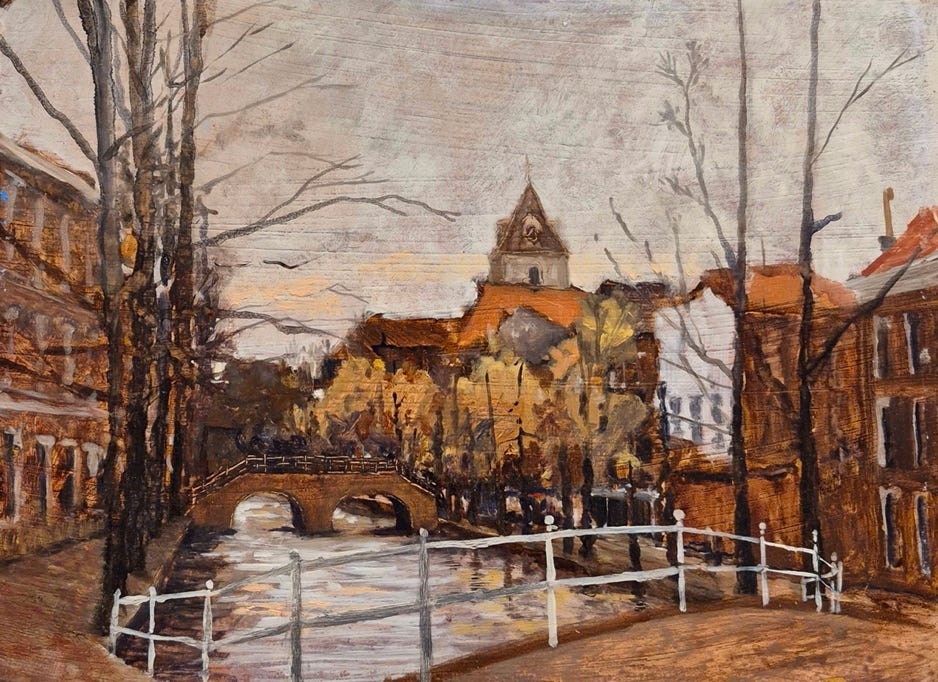
This one is from that first 1980 commission trip I described. The canal is called Oude Delft. Today, I would paint the railing a little better. But what’s interesting is that there are aspects of it that I couldn’t paint now because I know too much. It’s also a studio mascot because it reminds me that things [Donald’s painting skills and style] weren’t always as they are now.
We haven’t talked about my lovely wife, Ginny Williams, who is a very talented painter. She has a studio in Wenham [MA]. You can find her work at @gcwilliamsfineart on Instagram. We’ve been married for five years and are constant artistic supports for each other. [They had a COVID wedding.]
We do, but not in depth. We might say to the other, “That line’s crooked” or “What do you think about this?”
Yes, I wear my boots every day of the year unless I must dress up. I stand all day long and they give a great deal of support.
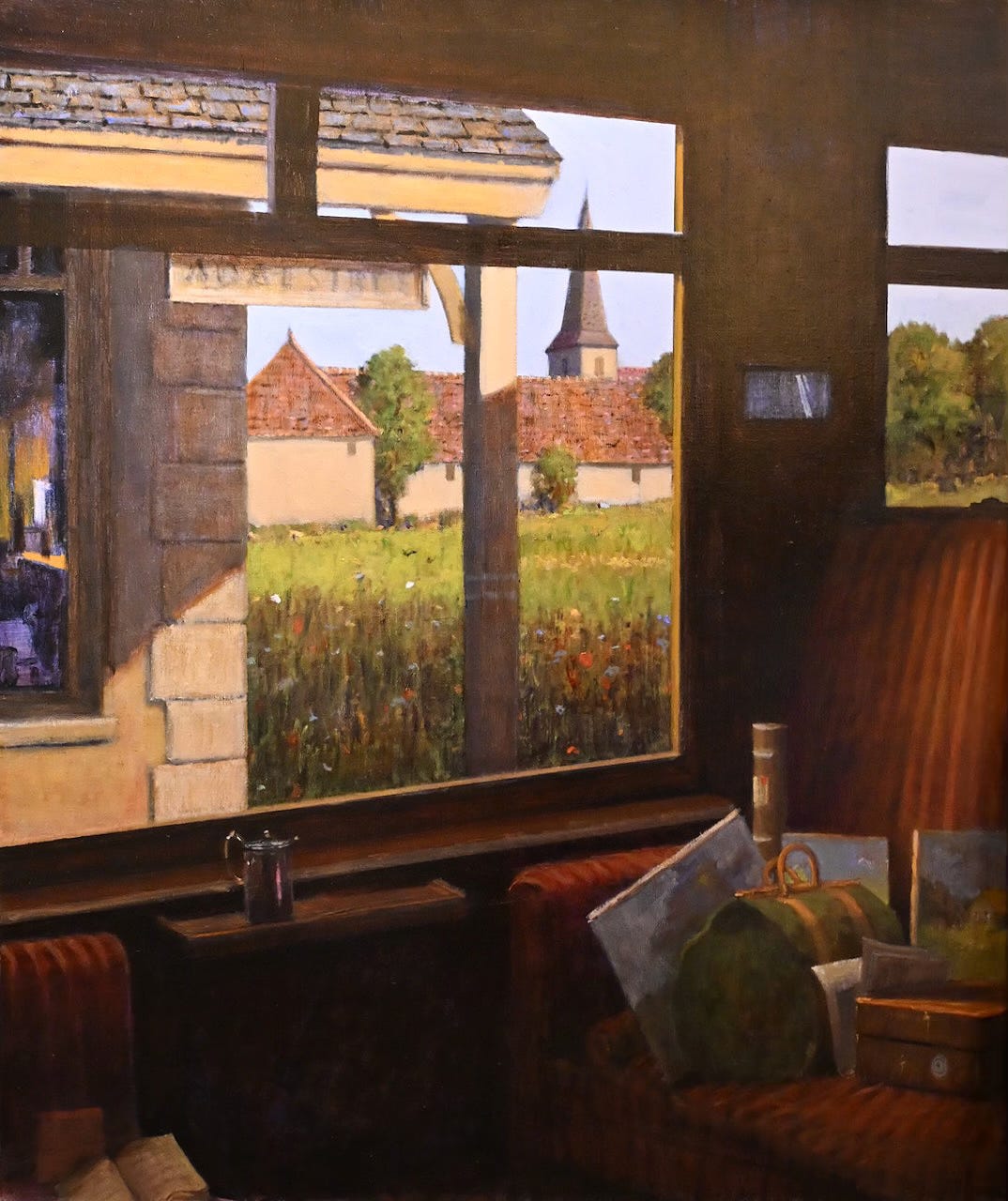
While I made The Painter’s Holiday, I thought back to all my painting holidays in Europe. There, on the seat, is all the painter’s gear. And I was thinking of one of my favorite poems, Adelstrop, by Edward Thomas, who was killed in the First World War.
I think the poem’s a great way to end. Happy Painting to you.
ADELSTROP
Yes, I remember Adelstrop—
The name, because one afternoon
Of heat the express-train drew up there
Unwontedly. It was late June.
The steam hissed. Someone cleared his throat.
No one left and no one came
On the bare platform. What I saw
Was Adelstrop—only the name
And willows, willow-herb, and grass,
And meadowsweet, and haycocks dry,
No whit less still and lonely fair
Than the high cloudlets in the sky.
And for that minute a blackbird sang
Close by, and round him, mistier,
Father and farther, all the birds
Of Oxfordshire and Gloucestershire.
Here’s where I describe what I would serve if Donald and his wife Ginny came to dinner, which they are invited to do. Donald jokes that food is fuel, but I suspect that all his time spent in France has influenced his food preferences and so I propose the following:
Julia Child’s Coq au Vin
Creamy Polenta
Haricots Verts Amandine
Salade Verte
Tarte Normande
Donaldjurney.com
@donaldjurney
Folly Cove Fine Art
Quidley and Company
Todd Bonita Gallery
Williams Fine Art
Comments
Nothing yet. Say the first thing.
Sign in to join the conversation.