
This article is for educational purposes and does not constitute legal, regulatory, or policy advice. Government employees should consult with their agency’s legal counsel, AI governance office, and relevant oversight bodies before implementing AI collaboration practices.

A state workforce analyst is managing a caseload surge following federal workforce reductions. Applications have tripled in three months. Leadership needs a briefing by Friday on capacity gaps and projected demand through Q3. The analyst turns to an AI assistant to help model case throughput, flag at-risk applicant categories, and draft an executive summary for the state director.
The AI produces a confident, well-structured document. It cites relevant statutes, references prior rulemakings, and presents a cost-benefit framework that reads like it was written by a seasoned policy professional. There is just one problem: how do you verify it before it influences policy affecting millions of people?
This is the central challenge of People+AI collaboration in government. The stakes are not quarterly earnings or client satisfaction. The stakes are public trust, democratic accountability, and the welfare of communities who have no choice but to live with the consequences.
Government sits in a fundamentally different position from the private sector when it comes to AI collaboration. Three factors make this true.
Public trust is the operating license. A private company that makes a mistake loses customers. A government agency that makes a mistake erodes the public’s confidence in democratic institutions. Every AI-assisted output that leaves a government office carries the implicit weight of official authority. When that output contains errors, the damage extends far beyond the immediate decision.
Transparency is not optional. FOIA requirements, open records laws, and the Administrative Procedure Act mean that government work products are subject to public scrutiny. An AI-assisted analysis that cannot be explained, defended, or audited is a liability. The question is not just whether the output is correct, but whether the process that produced it can withstand public examination.
The regulatory landscape has reversed direction, not settled. The framework most government employees learned first is gone. Executive Order 14110 was revoked on January 20, 2025, and EO 14179 replaced its posture with a directive to roll back AI regulation. What replaced it is not a comprehensive federal mandate but a set of narrower instruments reaching agencies through procurement and through a fight with the states. Government employees are still subject to AI rules and responsible for implementing them, but the rules now arrive through contract terms and litigation risk rather than a single governing order.
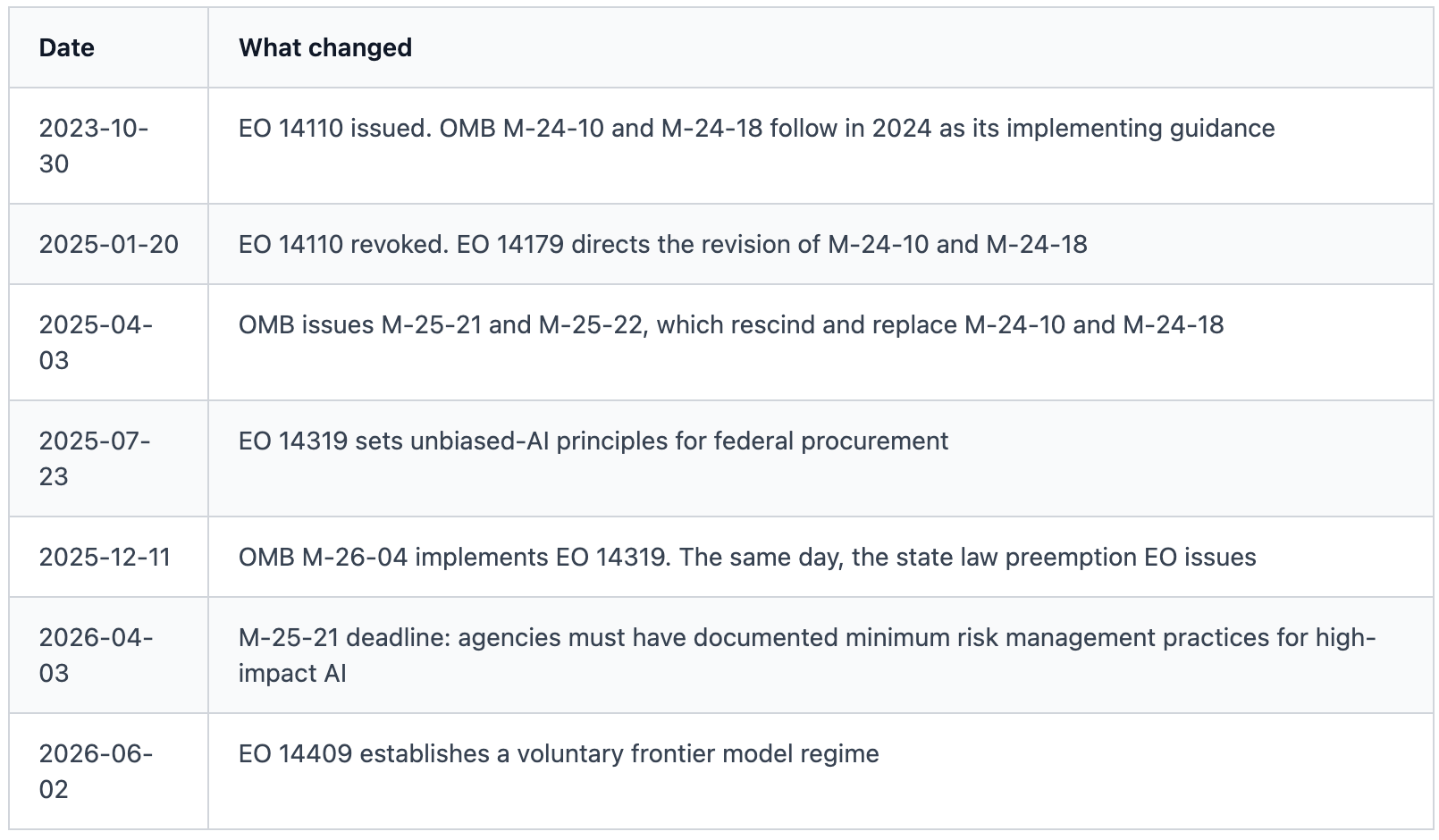
Every citation a government employee would have used in 2024 is now wrong. The governing executive order was revoked, and both implementing memoranda were rescinded and replaced within fifteen months.
OMB M-25-21, “Accelerating Federal Use of AI through Innovation, Governance, and Public Trust” (April 3, 2025) rescinds and replaces M-24-10 in terms. The framing shifted toward acceleration, the Chief AI Officer role was recast to promote adoption alongside governance rather than sit in an oversight posture, and CAIOs gained authority to waive minimum practices for a specific application on a written risk determination, recertified annually.
But look at what survived. M-25-21 collapsed the old safety-impacting and rights-impacting categories into a single “high-impact AI” definition, then imposed seven minimum risk management practices on it: pre-deployment testing, a documented impact assessment, ongoing monitoring, operator training, human oversight with a fail-safe, an appeal path for affected individuals, and a public feedback channel. The impact assessment must cover data fitness and civil rights impacts, carry an independent internal reviewer who was not involved in development, and bear the signature of whoever accepts the risk. Non-compliant high-impact use must be discontinued. Agencies had until April 3, 2026 to document implementation.
OMB M-25-22 (same date) rescinds and replaces M-24-18, covering competitive sourcing, vendor lock-in avoidance through data portability, and performance tracking.
EO 14319 and OMB M-26-04 (December 11, 2025) layer procurement obligations on top. Agencies buying large language models must contractually require the unbiased AI principles plus vendor documentation covering model and data cards, training data provenance, acceptable use policies, and disclosed inappropriate use cases. Compliance is material to eligibility and payment, with explicit termination authority. Procurement policies had to be updated by March 11, 2026.
The December 2025 state law preemption EO directs DOJ to run an AI Litigation Task Force challenging state AI laws and Commerce to identify conflicting state statutes, with broadband funding eligibility attached. Carveouts preserve state authority over child safety, AI infrastructure, and government procurement. For a state or local employee, the law governing your agency’s AI use may be under active federal challenge while you are trying to comply with it.
The states have not slowed down. Sixteen new state AI statutes were enacted in the eight months after the preemption order. Texas TRAIGA took effect January 1, 2026 with a NIST AI RMF safe harbor; Utah’s framework runs to a July 2027 sunset. A professional in one state now works under a different obligation set from a counterpart in another, with the federal position contesting both. EveryAILaw tracks what is actually in force.
Across a revoked executive order, two rescinded memoranda, and a change of administration, the operational duties on the person using the AI barely moved. Every practice in that list of seven is something a careful professional was already doing. M-24-10 did not invent the idea that you should check the output before it affects someone’s benefits eligibility.
The consequence for how agencies invest is direct. A compliance program built around a specific memorandum’s section numbers had to be rebuilt in April 2025 and adjusted again in December 2025. A workforce that had internalized the underlying verification behavior needed a document update, not a retraining program.
And the deregulatory turn does not reduce the individual’s exposure. It increases it. When a prescriptive rule tells you exactly what to verify, verification is a compliance step someone else specified. When the guidance shifts toward acceleration, when your CAIO can waive minimum practices for your application, and when what remains arrives through contract clauses and unsettled preemption, verification becomes a judgment you personally own.
PAICE (People + AI Collaboration Effectiveness) measures collaboration across five behavioral dimensions. Accountability carries the highest weight at 30%, reflecting a straightforward reality: the person who signs off on an output owns it, regardless of how it was produced.
For government employees, this principle is not abstract. A contracting officer who relies on AI to evaluate bids still bears personal responsibility for the award decision. A policy analyst who uses AI to draft a regulatory preamble still owns every claim in that document. The AI cannot appear at a congressional hearing. The AI cannot respond to an inspector general inquiry. The human can, and must.
AI offers genuine value as a research accelerator for government work. Legislative analysis, regulatory review, and constituent correspondence all involve large volumes of text that benefit from AI-assisted summarization and pattern recognition.
Policy analysts can use AI to identify relevant precedents across thousands of pages of regulatory history. Legislative staff can use it to compare bill language across jurisdictions. Research teams can use it to surface themes in public comment submissions that would take weeks to catalog manually.
These are legitimate productivity gains. The danger lies not in using AI for these tasks but in confusing speed with reliability.
AI cannot create policy rationale. It assembles language that resembles policy rationale, drawing on patterns in its training data. Government policy must be grounded in specific statutory authority, specific factual findings, and specific analytical methods. When an AI drafts a regulatory impact analysis, it is pattern-matching against documents it has seen, not reasoning from the record of the particular rulemaking.
Verification practices for policy work:
Cross-reference every statutory citation against the actual text of the law
Confirm that referenced data comes from authoritative government sources (BLS, Census, OMB)
Verify that cost-benefit figures are derived from defensible methodology, not plausible-sounding estimates
Check that the analysis reflects current regulatory guidance, not superseded versions, and specifically confirm that any cited executive order or OMB memorandum is still in force rather than rescinded and replaced
Ensure that legal interpretations align with your agency’s established positions
A well-structured People+AI workflow treats AI output as a first draft that accelerates the analyst’s work, not as a finished product that the analyst merely reviews.
Government procurement is one of the most rule-bound domains in professional life. The Federal Acquisition Regulation alone runs thousands of pages. State and local procurement codes add layers of jurisdiction-specific requirements. AI can help navigate this complexity, but the risks of AI misinterpretation are significant.
Contracting professionals can use AI to help with initial market research, to identify relevant contract clauses, and to draft sections of solicitation documents. AI can accelerate the review of vendor proposals by flagging potential compliance issues or summarizing technical approaches.
AI tools may misinterpret regulatory language that has specific legal meaning in procurement contexts. Terms like “responsible,” “responsive,” and “best value” have precise definitions under federal acquisition law that differ from their everyday usage. An AI that treats these as ordinary English may produce analysis that appears reasonable but is legally incorrect.
Jurisdiction-specific requirements add further complexity. A procurement practice that is standard in one state may violate another state’s competitive bidding requirements. AI tools trained primarily on federal procurement language may miss state or local variations entirely.
Procurement is where the current federal AI framework actually binds. Under EO 14319 and OMB M-26-04, the contracting professional is the enforcement point. If a vendor’s model card is missing, vague, or silent on training data provenance, the agency is required to reject the model, and the contracting officer is the person who has to notice.
This is a verification task disguised as a paperwork task. A vendor model card is produced by a party with an interest in the outcome, and reading it for completeness is not the same as reading it for accuracy. An AI assistant summarizing vendor submissions will report that documentation requirements were addressed, because the documents exist and use the expected vocabulary. Whether the disclosures are substantive is a human judgment.
Procurement verification checklist:
Confirm that vendor AI documentation meets EO 14319 / M-26-04 requirements in substance, not just in form: model and data cards, training data provenance, acceptable use policy, disclosed inappropriate use cases, end-user feedback mechanisms
Confirm that all referenced FAR clauses are current and correctly cited
Verify that evaluation criteria comply with the specific procurement authority being used
Check that small business and socioeconomic requirements are correctly applied
Ensure that jurisdiction-specific requirements are addressed, not just federal standards
Have legal counsel review any AI-assisted solicitation language before publication
Government agencies handle millions of constituent interactions each year. AI can help draft responses to inquiries, summarize case files for review, and route requests to appropriate offices. The efficiency gains are real and meaningful, particularly for agencies facing staffing constraints.
Every communication leaving a government office on official letterhead represents the agency’s position. A constituent who receives an incorrect answer to a benefits inquiry may make life-altering decisions on it. A business owner given wrong guidance on regulatory requirements may invest in the wrong direction.
The government employee must own every communication. This means reviewing AI-drafted responses not just for tone and grammar but for substantive accuracy. Does the response correctly state the applicable regulation? Does it accurately describe the constituent’s options? Does it reflect current policy, or has the underlying guidance changed since the AI’s training data was compiled?
An effective People+AI workflow for constituent services separates drafting from approval. AI handles the initial draft, pulling from templates and knowledge bases. The government employee reviews for accuracy, adds case-specific details, and takes ownership of the final communication. The employee’s name goes on the response because the employee verified it, not because they happened to be in the loop.
AI produces policy language that reads well and follows standard formatting conventions. That surface competence makes it tempting to treat drafts as nearly final. But a single mischaracterization of statutory authority can undermine an entire rulemaking. Domain experts must review AI-assisted policy work for substance, not just style.
Government records carry legal weight. An AI-generated summary entering the official record without verification becomes part of the administrative record courts may review, and inaccuracies there can compromise the agency’s legal position. Verify every AI output bound for an official record against primary sources.
AI tools process text. They do not understand regulatory context in the way that experienced government professionals do. An AI may correctly identify that a regulation exists without understanding how it interacts with other regulations, how it has been interpreted by courts, or how agency practice has evolved beyond the text. Regulatory expertise remains a human responsibility.
The federal framework is the cleanest example, because the AI gets it wrong in a way that sounds authoritative. EO 14110 and M-24-10 generated an enormous volume of guidance, implementation plans, client alerts, and conference material while in force, and that corpus is heavily represented in training data. The revocation is a single event; the rescission of M-24-10 is one sentence inside a memorandum. Far less text stands behind the correction than behind the error.
What makes this dangerous is that it fails subtly. Much of the substance carried forward, so an AI-drafted memo citing M-24-10 will describe requirements that are largely still real, under a citation that is dead, using a category name (”rights-impacting AI”) that no longer appears in the governing document. A reviewer skimming for whether the content sounds right will pass it. A reviewer checking whether the cited authority exists will not.
This is the verification imperative in its most concrete form: an output can be substantively reasonable, internally consistent, well-cited, and still resting on a legal authority that was rescinded.
When agencies adopt AI to increase efficiency, there is pressure to streamline verification. This inverts the priority. Verification is not the bottleneck AI adoption must overcome; it is the safeguard that makes adoption responsible. Time saved by AI-assisted drafting should be reinvested in review, not removed from the workflow.
AI can help draft interagency memos and summarize positions from other agencies. But interagency coordination depends on relationships, institutional knowledge, and political awareness that AI cannot replicate. Using AI output as a substitute for direct engagement with counterparts at other agencies risks miscommunication and missed context.
You do not need to wait for an agency-wide AI initiative to develop your own collaboration skills. Start by understanding where your current strengths and gaps are.
The PAICE assessment provides a behavioral baseline. It does not test what you know about AI policy or whether you can recite OMB guidance. It observes how you actually collaborate: whether you catch errors, verify claims, and maintain accountability for outputs. It takes about 15 minutes and is free for individuals.
Practical first steps:
Take the PAICE assessment to establish your behavioral baseline
Identify one routine task where AI could assist with drafting or research
Build a verification checklist specific to your role and domain
Practice the habit of treating every AI output as a draft, never as a final product
Document your verification process so it can withstand scrutiny
Agencies considering broader adoption of AI collaboration tools need visibility into their workforce’s readiness without creating surveillance concerns.
PAICE is built with privacy by architecture. Individual results go only to the individual. Agencies receive cohort-level data: distributions, percentiles, and trend lines. This makes it structurally impossible to identify any individual’s score from the aggregate, so no employee becomes a liability target based on their results.
Agency rollout considerations:
Use cohort-level data to identify workforce-wide skill gaps
Design training programs that target the specific behavioral dimensions where your workforce shows weakness
Align AI collaboration standards with the M-25-21 minimum risk management practices for high-impact AI, particularly operator training and human oversight, which are workforce capability requirements rather than documentation requirements
For anything procurement-adjacent, align with the EO 14319 / M-26-04 vendor documentation regime
For state and local agencies, track whether your governing statute is exposed to the federal preemption challenge, and build verification practices that survive either outcome
Anchor training to behaviors rather than citations, so the next framework revision costs a document update instead of a retraining cycle
Establish verification protocols that are role-specific, not one-size-fits-all
Create feedback loops where lessons from AI collaboration incidents inform training
The public’s trust in government AI use will not be earned through policy statements alone. It will be earned through demonstrated competence: government employees who use AI tools effectively while maintaining the verification rigor and accountability that public service demands.
This is not a technology challenge. It is a people challenge. The AI tools will continue to improve. The question is whether the people using those tools will develop the behavioral skills to use them responsibly. For government professionals, the answer to that question carries consequences that extend to every community they serve.
Want to understand your own readiness profile? Take the PAICE assessment to discover your strengths and opportunities.
Get Involved:
Take the assessment (free, always)
Explore our Baseline offerings (for organizations)
Read the whitepaper (comprehensive framework)
📖 Governance and Accountability:
Your AI Policy Is Not Enough - Why measuring behavior matters more than documenting intent
AI Collaboration Governance - Building governance frameworks that actually work
Why Accountability Scores Lower Than You Expect - The most critical dimension for public servants
📖 Regulatory Reference:
EveryAILaw - Version-controlled tracking of AI regulation obligations across jurisdictions, including which instruments are in force, superseded, or revoked
EO 14319 and the federal LLM procurement regime - Vendor documentation requirements agencies must enforce
The state law preemption order - What the DOJ challenge means for state and local agency AI programs
📖 Industry Guides:
AI Collaboration for Legal Professionals - Verification practices for licensed professionals
AI Collaboration for Cybersecurity Professionals - High-stakes collaboration in security operations
No posts
Comments
Nothing yet. Say the first thing.
Sign in to join the conversation.