
Happy Tuesday and welcome to a nerdy essay about light. Next week, paid subscribers will receive a special recipe that I learned during my time in Italy. In the meantime, check out my past posts here and learn more about my day job here.
This is a post I’ve been wanting to write for some time but that I ended up delaying by an extra week because I was traveling in the land of its birth. This technique is particularly apparent to me when I’m traveling and working with the natural light available, and we’ll be talking a lot about it on the culinary tour that I’m co-leading in France!
Join me in France! 3 spots left
More to come on my recent trip to Italy, but in the meantime, please enjoy the nerdiest post I have written to date.
One of the first lighting techniques that I fell in love with is famously-hard-for-American-photographers-to-pronounce chiaroscuro. I first learned about this way of capturing objects and people way back in high school Art History class.1 Here we go into a mini art history and photography lighting lesson. Wheee!
Now that I speak a bit of Italian, the technique is easier for me to explain: chiaro, in Italian means light. Scuro means dark. This style is all about harnessing the power of light to stand out against the dark parts of your photo to create depth and drama and help guide your eye through the composition of the painting to the subject. Contrast is the name of the game.
Extra nerd moment: there’s an extreme form of chiaroscuro wherein complete darkness (the color black or extremely dark browns) is used in contrast with a subject shown completely in the light. This is called tenebrism, which takes its name from the Italian tenebroso, meaning dark and gloomy.
The name that’s most often associated with this technique is Caravaggio. A Renaissance painter with a penchant for trouble, this painter was famous in his lifetime for his dramatic paintings, many of which caught the attention and money of the powerful patrons of the time. Part of the allure was his striking use of yellows, oranges, and browns against black or dark brown/blue backgrounds to mimic beams of sunlight or candlelight. This technique, which quickly became Caravaggio’s calling card, still stands out today when you’re admiring his work, like this portrait of Saint Francis of Assisi, which is currently on display at the Museo e Cripta dei Cappuccini in Rome where I saw it recently, which finally motivated me to write this post.

Using these techniques work on several different levels: the contrasting colors create dynamic canvases, to be sure, but they also allow the artist to use light as a compositional tool. I was really impressed by the signage in the museum that detailed exactly how chiaroscuro drives the composition in the above photo, which I’ve paraphrased here: The light is flooding into a dark cave or room from the upper left corner of the painting. It hits the back of Saint Francis, creating a strong line for our eyes to follow, then glances off of his cheek and down onto the skull that he holds in his hands, pulling our eyes down along with it. It’s a subtle thing that works behind the scenes in your brain to make a photo or painting appealing, and hence its genius.
In case you’ve missed it, I’m wildly obsessed with taking techniques, compositions, and themes from paintings, particularly from the period right after my man Caravaggio was doing his thing. Dutch painters like Jan Davidszoon de Heem, Pieter Claesz, and Clara Peeters had this technique down, and used it to show off fruits, vegetables, meat, and cheese in dramatic lighting that gave these everyday items a profound status. All of the sudden, during this era, real life and simple, everyday objects were being celebrated instead of scenes from the Bible. It was a big deal!
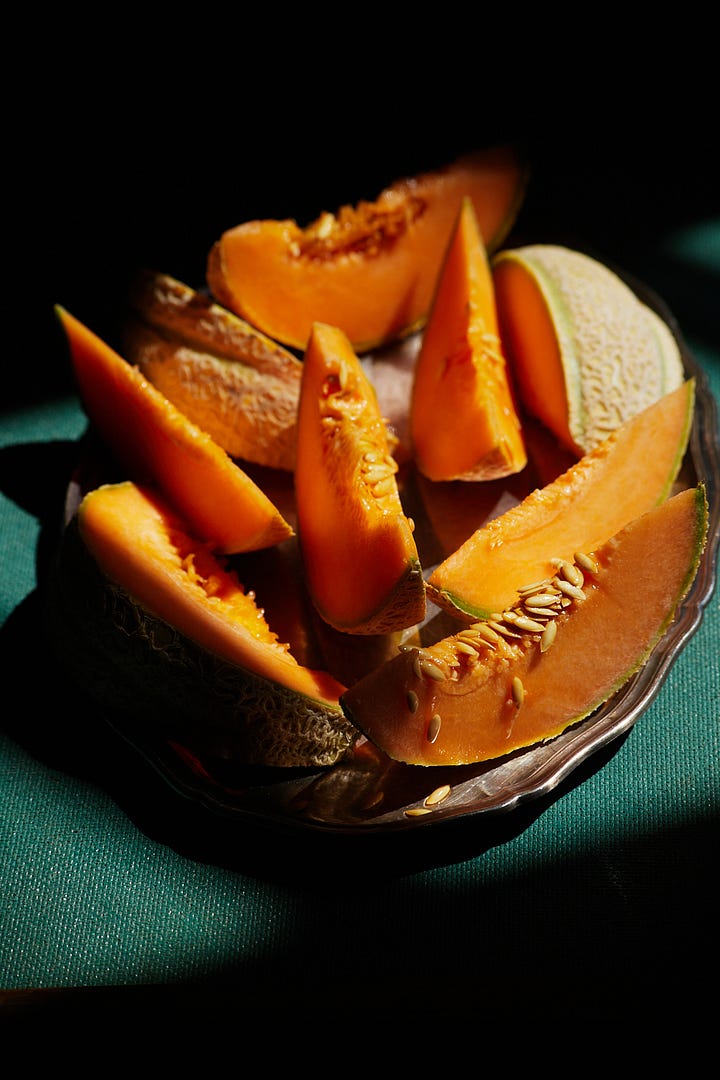
Because it’s still one of the most dramatic and fascinating ways to harness the power of light in food photography, and you don’t have to be an expert in artificial light to use it. Here’s a gallery of photos, using both natural and artificial light, in which I’ve put this technique to use to help highlight subjects, guide your eye as a composition technique, and add drama to food portraiture:


Thanks for being a part of Page and Plate. I have a big audacious goal to grow this newsletter this year. Can you help me out with that and forward to a friend so they can subscribe, too? See you back here next week for an Italian classic!
Huge shout-out to Mr. Fielder, who taught one of the most interesting classes of my high school education.
No posts
Comments
Nothing yet. Say the first thing.
Sign in to join the conversation.