
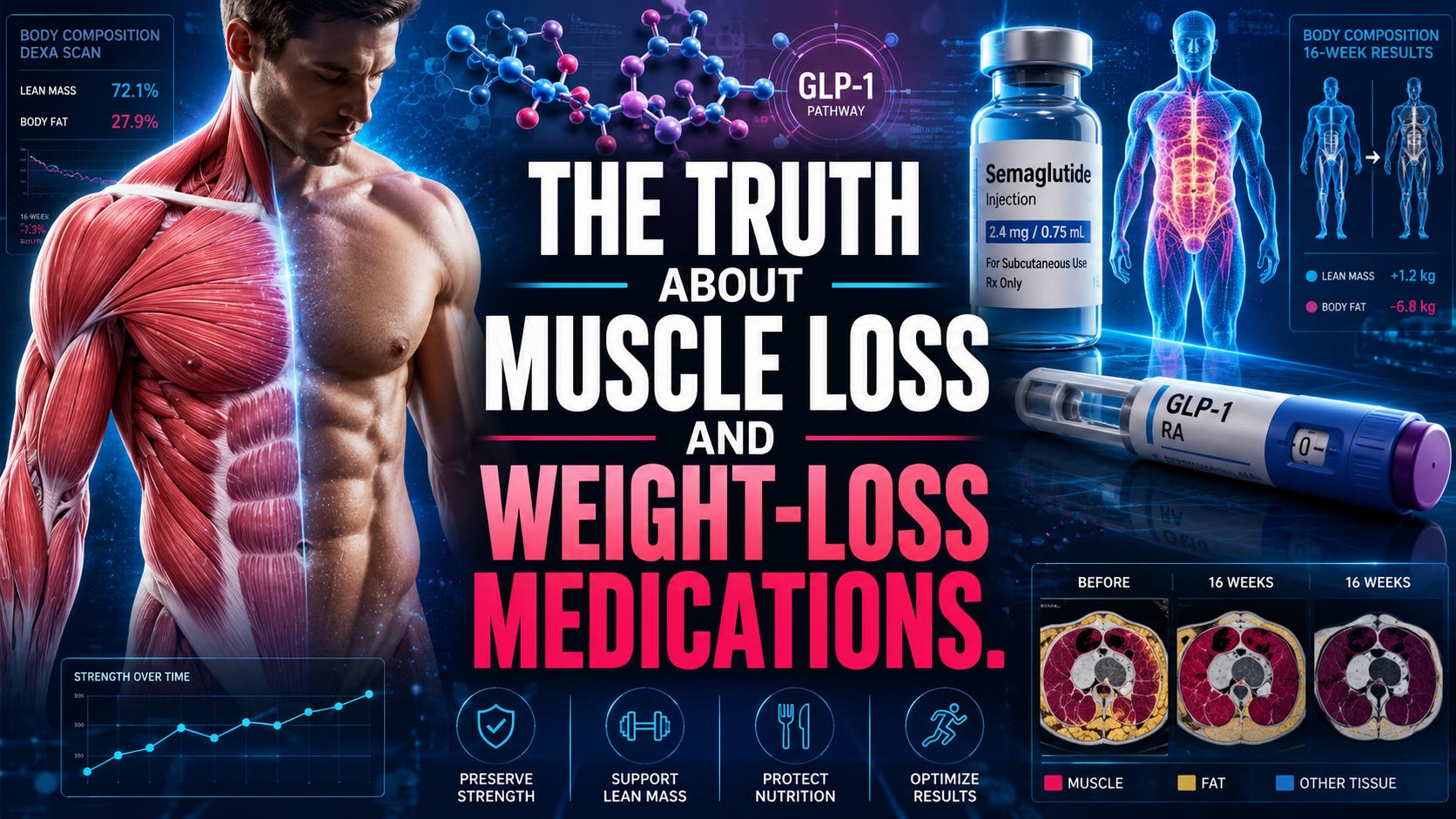
Weight loss by any route results in both muscle and fat loss.
Diet, surgery, weight loss medications it makes no difference.
That’s not the message you will see plastered across social media, however.
What you will see on social media is that GLP-1 medications don’t just shrink fat; they strip muscle, and that patients finish treatment weighing less but somehow worse off.
Often with less ‘muscle’ than when they started.
Social media will say less muscle.
The trials, however, will say less lean mass.
(The distinction will become important later)
But “do you lose lean mass?” was always the wrong question.
Because the answer is yes and it always has been.
The questions worth asking are:
How much?
What sort of tissue? and
Whether any of it costs you something you’d actually notice.
Separate those three factors, and you start to see a far more nuanced and indeed reassuring story.
Conventional nutrition studies already tell you what to expect.
Lose weight that way, and roughly 25% of what disappears is lean tissue rather than fat [1].
Bariatric surgery removes the most lean tissue in absolute terms, for the obvious reason that it removes the most weight [2].
But the proportion of lean mass loss is about the same.
So where did the panic start?
A small body-composition substudy done inside the first big semaglutide obesity trial suggested that the lean mass loss was closer to 40%, which started to ring some alarm bells.
That 40% figure was never in the paper [3]. Someone calculated it afterwards.
What the substudy actually reported was a roughly 10% drop in lean mass against a 19% drop in fat, with the lean proportion of the body rising rather than falling [3].
A few years have now passed, and we have far more data to work with.
Pool twenty randomised trials and around sixteen thousand people, and a clearer picture starts to emerge [1].
As a share of weight lost, lean mass came to about 35% on semaglutide, roughly 25% on tirzepatide, near 27% on the older drug liraglutide.
Plain lifestyle programmes? About 26% [1].
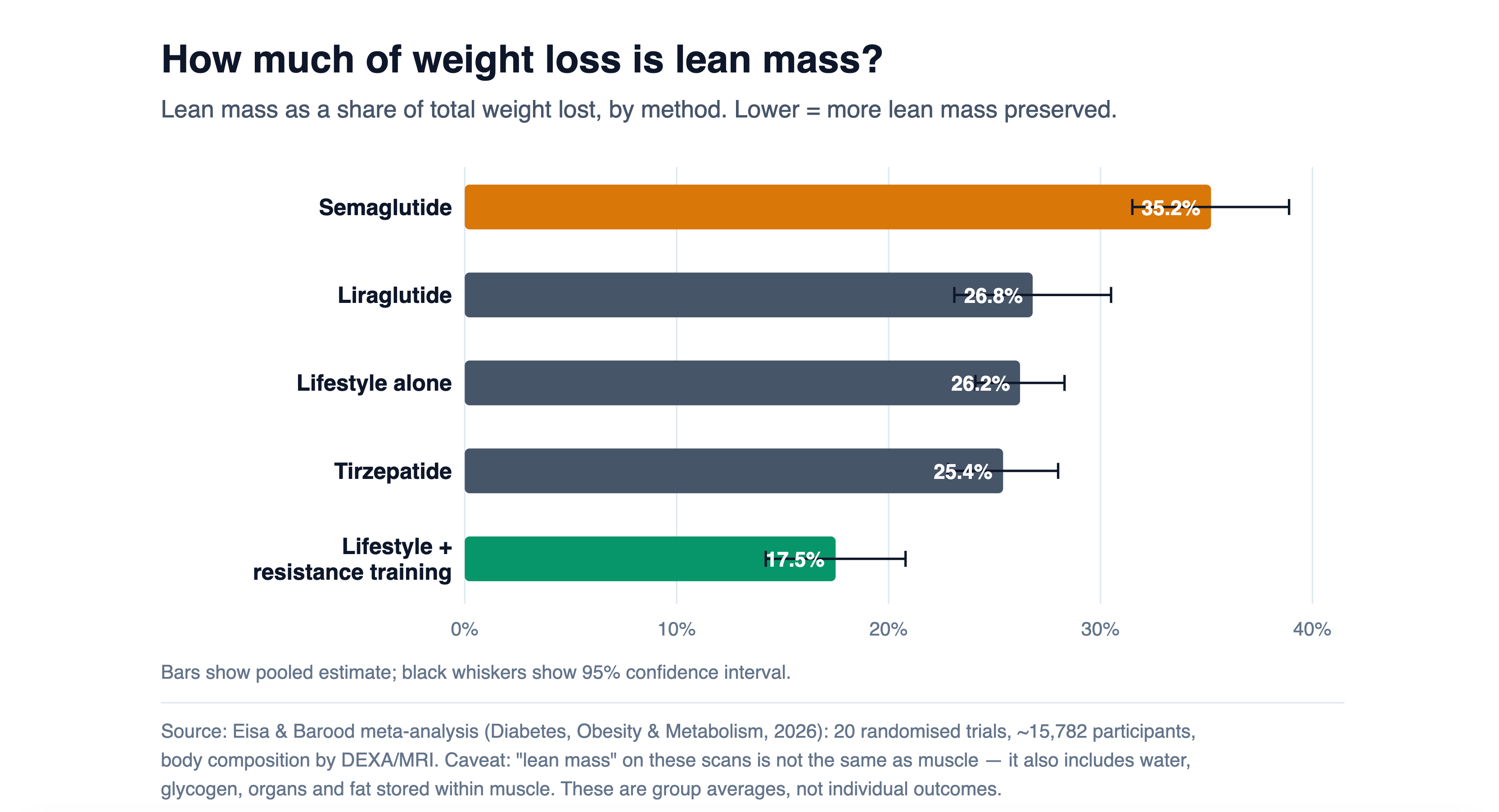
So the figure we should be really focused on is that the percentage of lean mass loss can be significantly reduced by combining any weight-loss approach with a high-protein diet and regular resistance training.
But there are even more complexities we really need to address.
The lean mass figure everyone worries about comes from a DEXA scan, and DEXA doesn’t measure muscle.
It splits your body into three crude categories: fat, bone, and “everything else,” then labels that last bin as lean mass.
Most people then just use this as a proxy for muscle mass.
Within the category of lean mass sits muscle, yes, but also water, glycogen, your organs, and the fat threaded through muscle like the marbling in a steak.
A scan that lumps muscle together with the fat inside it can’t tell you which one actually changed [4].
Drop your glycogen and water, lose some of that internal marbling, and the lean mass number falls while your muscle is arguably better off.
Weight loss medications go after visceral fat hard, the dangerous stuff packed around the organs, the depot you most want emptied [3].
A shrinking lean mass figure can sit happily alongside a body composition that’s genuinely improving.
If you look at the muscle itself in more detail, things get even more interesting.
In one human study, thigh muscle on MRI shrank while knee-extension and grip strength held flat [5].
Mass may fall, but strength remained unchanged.
Give people with severe obesity a year on semaglutide and grip strength climbs.
The share meeting criteria for sarcopenic obesity falls from roughly half of them to a third [6].
Heart failure patients walk meaningfully further [7].
Animal work built specifically to tease the drug apart from the dieting finds the drug no worse on muscle loss than eating less [8].
Strength and the ability to do real things hold up, sometimes improve, even as the weight drops.
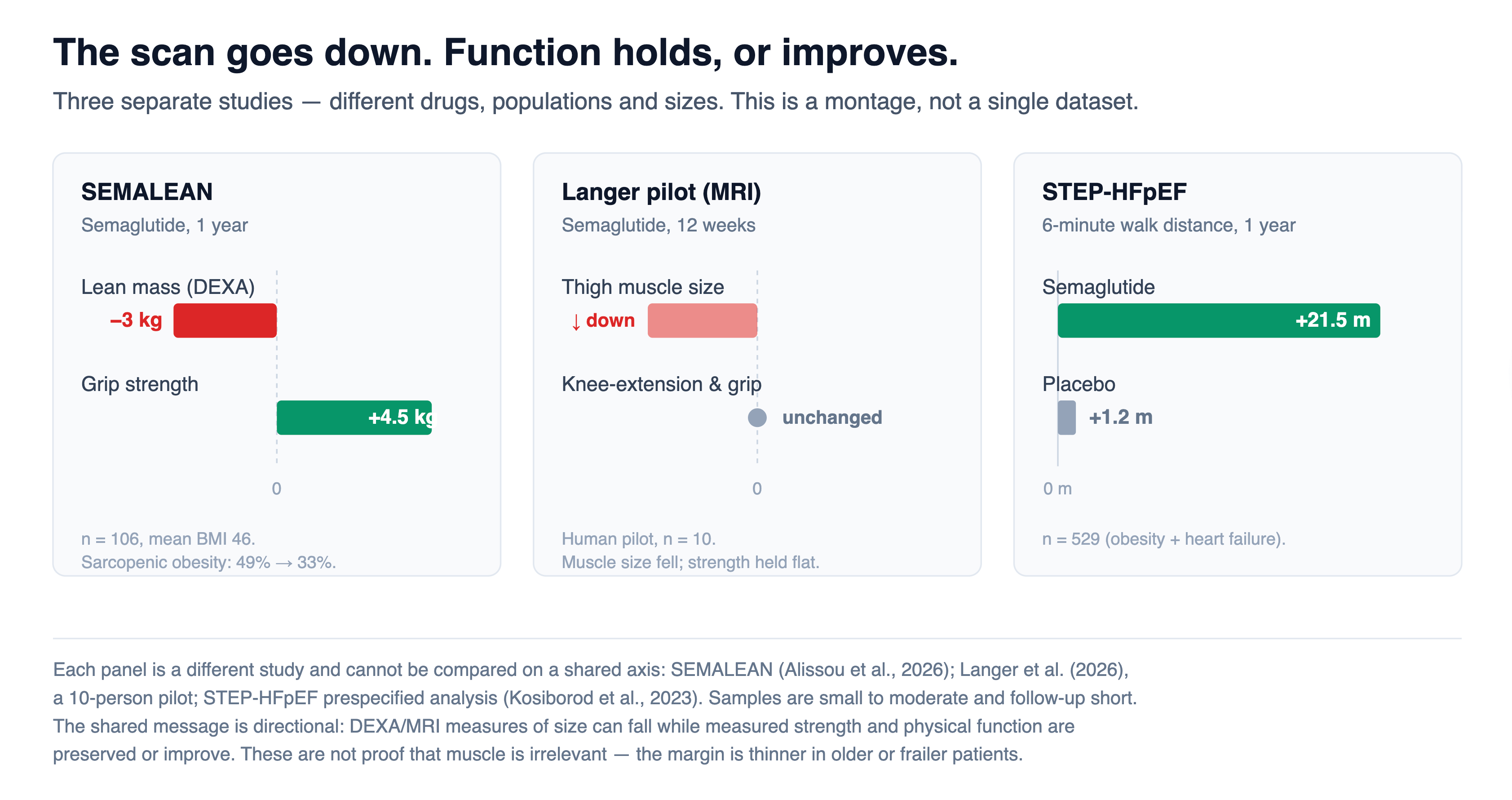
Function survives in trials, on average, in people who were broadly moving and eating like adults.
Two levers do nearly all the work, and thankfully you control both.
Protein intake is the first, and intake on these drugs is often grim. One analysis clocked it at barely 33 grams a day, nowhere near enough to defend muscle through weight loss [9].
The same appetite suppression that makes the drug effective makes it absurdly easy to undereat the one nutrient protecting you.
Resistance training is the second.
Where protein and lifting are taken seriously, lean mass largely stays flat [10].
Most of the reassuring functional data comes from small, short studies, some leaning on crude tools.
The clean long-term human experiment that fully separates drug from diet doesn’t exist yet.
“Function is preserved” does not mean muscle is irrelevant, and the margin is thinner for an older or already frail patient. A falling lean mass number is not proof of harm.
What if we could ‘Add' muscle?
If the weight loss drug’s target is mostly fat loss, in the future you might be able to add a second one for muscle growth.
An early-phase trial pairing semaglutide with a muscle-targeting antibody held onto lean tissue and pushed grip strength past the drug alone [11].
This really does open up the possibility that in the future we will have options to dial fat mass down as needed and dial muscle mass up as required.
That possibilty would have seemed like a fantasy only 5 to 10 years ago.
More than anything it is an incredible illustration of how amazing fast scientific progress has been made in this field.
So do I worry about lean mass loss with my patients on weight loss therapies?
Yes, but only when they are not hitting their protein targets and not doing regular resistance training.
So is muscle loss a ‘non-issue’? Of course not.
But it’s nowhere near as big of an issue as social media would have you believe. (Surprise, surprise)
I continue to be amazed by these weight-loss technologies, and I know this journey has only just begun.

Eisa M, Barood S, et al. Lean mass changes with incretin therapy versus lifestyle intervention: a systematic review and meta-analysis of randomised controlled trials. Diabetes, Obesity and Metabolism. 2026.
Wang Y, et al. Body composition changes after bariatric surgery or treatment with GLP-1 receptor agonists. JAMA Network Open. 2026.
Wilding JPH, et al. Once-weekly semaglutide in adults with overweight or obesity (STEP 1). New England Journal of Medicine. 2021;384:989–1002, and its DEXA body-composition substudy.
Erlandson MC, et al. Muscle analysis using pQCT, DXA and MRI. European Journal of Radiology. 2016.
Langer HT, et al. Weight loss with GLP-1 medicines does not result in a disproportionate loss of muscle mass or function in obese mice and humans. Cell Reports Medicine. 2026.
Alissou S, et al. Impact of semaglutide on fat mass, lean mass and muscle function in patients with obesity: the SEMALEAN study. Diabetes, Obesity and Metabolism. 2026.
Kosiborod MN, et al. Effects of semaglutide on symptoms, function, and quality of life in patients with heart failure with preserved ejection fraction and obesity: a prespecified analysis of STEP-HFpEF. Circulation. 2023.
Baranowski BJ, et al. Semaglutide impacts skeletal muscle to a similar extent as caloric restriction in mice with diet-induced obesity. Journal of Physiology. 2025.
Korus E, et al. Dietary intake patterns and nutritional adequacy among adults with overweight or obesity treated with GLP-1 or dual GIP/GLP-1 receptor agonists. Journal of Translational Medicine. 2026.
Al-Badri M, et al. The effect of structured intensive lifestyle intervention on muscle mass in patients with type 2 diabetes receiving GLP-1 receptor agonists (14-PUB). Diabetes. 2024;73(Suppl 1).
Heymsfield SB, et al. Bimagrumab plus semaglutide alone or in combination for the treatment of obesity (BELIEVE): a randomized phase 2 trial. Nature Medicine. 2026.
LEAN mass preservation with resistance exercise and protein during semaglutide/tirzepatide therapy (LEAN-PREP). ClinicalTrials.gov identifier NCT06885736.
No posts
Comments
Nothing yet. Say the first thing.
Sign in to join the conversation.