
A cheap, commonly used over-the-counter supplement now has randomised trial evidence that it slows calcium building up in your coronary arteries.[1]
But…. I’m not recommending it to my patients.
Let me explain.
A trial in JAMA Cardiology has shown that a form of vitamin K2 (MK7) slows the rate at which coronary artery calcification progresses.[1]
On first pass, this would seem like a major win.
It might be.
It might also be very harmful because most people misunderstand coronary artery calcification and its role in plaque repair.
So let’s start with some basic facts on coronary artery calcification and the scans required to get the information.
A CT Calcium Score or CAC scan is a CT scan that measures calcified plaque in the heart’s arteries, and it’s one of the best tools we have for assessing cardiovascular risk. [2]
A calcium score of zero is one of the most reassuring results in all of cardiovascular medicine.[2,3] A high score is a clear indication that atherosclerosis is already present, and your odds of a future heart attack are increased.[2,3]
The score is a record of a disease that has already happened.[4]
Think of calcium as the scar tissue of old plaque, the hardened residue of injury and inflammation that ran through the artery wall years ago.[4,5]
People carrying more calcium have more disease, and more disease carries more risk.[2]
More calcium, more risk. Less calcium, less risk.
So a supplement that slows the accumulation has to be good news.
Not so fast
It isn’t that simple, and statins are the reason we know.
Statins are one of the most studied drugs in cardiology, and the fact that they prevent heart attacks and extend lives is not in dispute.[6,7]
Scan someone on a statin, though, and their calcium score frequently climbs rather than falls.[8,9]
High doses and longer treatment can speed it up.[10,11]
The drug I’m most confident saves lives makes the number we fear look worse.[12]
The explanation is that statins harden plaque on purpose.
They turn soft, inflamed, rupture-prone lesions into dense, quiet, calcified plaque.[7,11]
In that setting the calcium isn’t damage. It’s closer to a callus over a wound.[4,5]
A treatment that lowers coronary artery calcification might help you, harm you, or change nothing real at all.
The number can’t tell you which. You need outcomes for that.[6]
We need to measure heart attacks. Not changes in coronary calcium.

The biology is genuinely good. Your arteries make a protein, matrix Gla protein, that acts as a brake on calcification.[14]
The brake only engages once vitamin K switches it on; run short on vitamin K and the protein idles in its inactive form while calcification carries on.[14,16]
Menaquinone-7, MK-7, is a long-acting vitamin K2 that is well absorbed and stays in the circulation far longer than vitamin K1.[15]
It keeps that brake working, lowering the inactive form of the protein in a dose-dependent way.[16,17] Restore the brake, slow the process. Clean logic.
Clean logic has a habit of dying in trials.
The earlier vitamin K studies, in diabetes and in older adults, mostly came back flat.[18,19] Pooled together, the whole literature has been small, inconsistent, and short on hard endpoints.[20,21] Good mechanism, unconvincing results. Which is what made the latest one worth a second look.
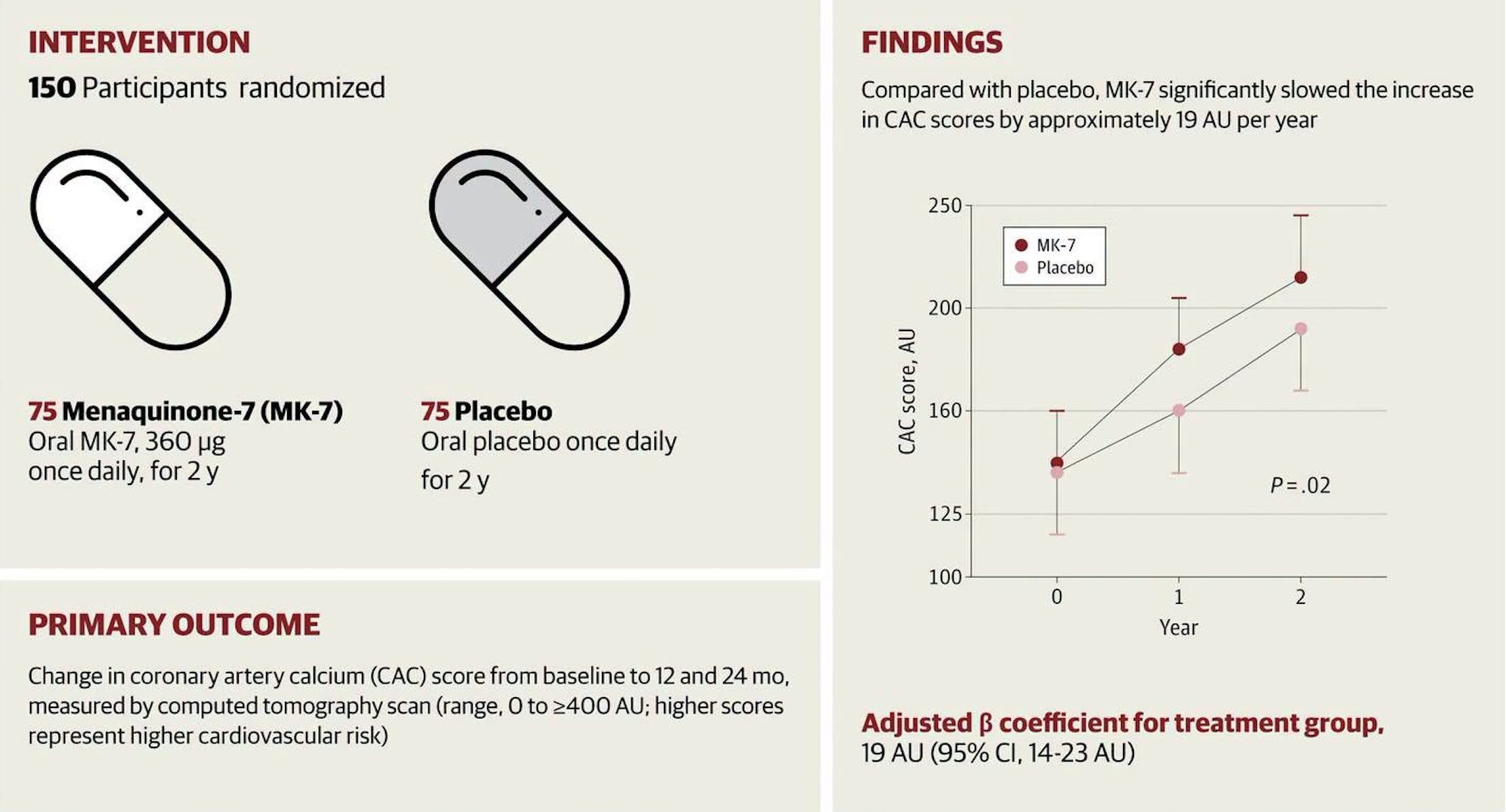
In the VitaK-CAC trial, Dutch researchers randomised 180 patients with mild, established coronary disease, calcium scores between 50 and 400, to either 360 micrograms of MK-7 a day or a placebo for two years.[1]
The calcium still rose in both groups. It just rose more slowly on MK-7, by around 19 Agatston units a year.[1]
A separate measure, calcium mass, agreed.[1] Safe, well-tolerated, decent adherence.[1] The trial did what it promised.
So why am I unmoved? Because of everything I have laid out above.
The study moved a marker, not an outcome.
It shows MK-7 changes a number on a scan and says nothing about heart attacks, strokes, or a single extra day of life.[1]
The fine print is worse for the believers.
The share of fast progressors didn’t differ between groups.[1] Neither did the narrowing of the arteries or the number of vessels involved.[1]
The effect seemed to concentrate in early plaques turning calcified, and after the statin lesson, we cannot even assume that slowing that step helps.[1,6]
We might be delaying plaque healing. Nobody knows.
Strip the optimism away and you’re left with a positive result, on a soft endpoint, in a small trial, for an effect whose benefit could run either way.[6]
What does a sensible person do with this?
You stop falling for the proxy because a mechanism does not guarantee an outcome.
The defining mistake in modern health is to fall in love with a number and forget what it stands for. The calcium score is brilliant at one job, telling you whether disease is there and your risk is real.[2,3]
It’s a blunt instrument for judging whether a treatment is working.[6]
The things that actually shift outcomes are dull and proven.
Get apoB and LDL down.
Control blood pressure.[13]
Don’t smoke.
Sleep, move, and start years before you think you need to, because in prevention, time is the only thing you can’t buy back later.
None of that is uncertain.
MK-7 is.[1,6]
If your calcium score is high, the instruction isn’t “find something to lower it.”
It’s “your risk is real, so pull the levers we know change events.”[13]
I’m not against MK-7. I’m just for outcome data, and I am certainly not in favour of mechanism data that may actually be causing harm.
The biology holds up, the trial is real, and I’d be happy to be proven too cautious by a bigger study with hard outcomes.[6]
If that arrives, I’ll change my mind without hesitation.
Because that is what good scientists do.
You always update your model.
But only with the most useful information.
But medicine is full of interventions that changed a marker and hurt the patient.
The supplement slows a number.[1]
Whether it saves anyone is a question only an outcome trial can settle.[6]
Until someone runs it, MK-7 can wait. The things that have already proven to work, however, can’t.

Vossen LM, de Leeuw PW, Schurgers LJ, et al. Two years of menaquinone-7 supplementation and coronary artery calcification: a randomized clinical trial. JAMA Cardiol. Published online June 10, 2026. doi:10.1001/jamacardio.2026.1279
Greenland P, Blaha MJ, Budoff MJ, Erbel R, Watson KE. Coronary calcium score and cardiovascular risk. J Am Coll Cardiol. 2018;72(4):434-447.
Hecht HS. Coronary artery calcium scanning: past, present, and future. JACC Cardiovasc Imaging. 2015;8(5):579-596.
Mori H, Torii S, Kutyna M, Sakamoto A, Finn AV, Virmani R. Coronary artery calcification and its progression: what does it really mean? JACC Cardiovasc Imaging. 2018;11(1):127-142.
Nakahara T, Dweck MR, Narula N, Pisapia D, Narula J, Strauss HW. Coronary artery calcification: from mechanism to molecular imaging. JACC Cardiovasc Imaging. 2017;10(5):582-593.
Blaha MJ, Choi S. Coronary artery calcium progression—a useful outcome in clinical trials? JAMA Cardiol.Published online June 10, 2026. doi:10.1001/jamacardio.2026.1267
German CA, Shapiro MD. Statins and coronary artery calcium: what’s the score? Atherosclerosis. 2021;316:71-72.
Houslay ES, Cowell SJ, Prescott RJ, et al; SALTIRE Investigators. Progressive coronary calcification despite intensive lipid-lowering treatment: a randomised controlled trial. Heart. 2006;92(9):1207-1212.
Schmermund A, Achenbach S, Budde T, et al. Effect of intensive versus standard lipid-lowering treatment with atorvastatin on the progression of calcified coronary atherosclerosis over 12 months. Circulation. 2006;113(3):427-437.
Saremi A, Bahn G, Reaven PD; VADT Investigators. Progression of vascular calcification is increased with statin use in the Veterans Affairs Diabetes Trial (VADT). Diabetes Care. 2012;35(11):2390-2392.
Henein M, Granåsen G, Wiklund U, et al. High dose and long-term statin therapy accelerate coronary artery calcification. Int J Cardiol. 2015;184:581-586.
Shahraki MN, Jouabadi SM, Bos D, Stricker BH, Ahmadizar F. Statin use and coronary artery calcification: a systematic review and meta-analysis of observational studies and randomized controlled trials. Curr Atheroscler Rep. 2023;25(11):769-784.
Blumenthal RS, Morris PB, Gaudino M, et al. 2026 ACC/AHA guideline on the management of dyslipidemia. Circulation. 2026;153(17):e1154-e1276.
Wei FF, Trenson S, Verhamme P, Vermeer C, Staessen JA. Vitamin K–dependent matrix Gla protein as multifaceted protector of vascular and tissue integrity. Hypertension. 2019;73(6):1160-1169.
Schurgers LJ, Teunissen KJ, Hamulyák K, Knapen MH, Vik H, Vermeer C. Vitamin K-containing dietary supplements: comparison of synthetic vitamin K1 and natto-derived menaquinone-7. Blood. 2007;109(8):3279-3283.
Dalmeijer GW, van der Schouw YT, Magdeleyns E, Ahmed N, Vermeer C, Beulens JW. The effect of menaquinone-7 supplementation on circulating species of matrix Gla protein. Atherosclerosis. 2012;225(2):397-402.
Westenfeld R, Krueger T, Schlieper G, et al. Effect of vitamin K2 supplementation on functional vitamin K deficiency in hemodialysis patients: a randomized trial. Am J Kidney Dis. 2012;59(2):186-195.
Zwakenberg SR, de Jong PA, Bartstra JW, et al. The effect of menaquinone-7 supplementation on vascular calcification in patients with diabetes: a randomized, double-blind, placebo-controlled trial. Am J Clin Nutr.2019;110(4):883-890.
Shea MK, O’Donnell CJ, Hoffmann U, et al. Vitamin K supplementation and progression of coronary artery calcium in older men and women. Am J Clin Nutr. 2009;89(6):1799-1807.
Lees JS, Chapman FA, Witham MD, Jardine AG, Mark PB. Vitamin K status, supplementation and vascular disease: a systematic review and meta-analysis. Heart. 2019;105(12):938-945.
Vlasschaert C, Goss CJ, Pilkey NG, McKeown S, Holden RM. Vitamin K supplementation for the prevention of cardiovascular disease: where is the evidence? A systematic review of controlled trials. Nutrients.2020;12(10):2909.
No posts
Comments
Nothing yet. Say the first thing.
Sign in to join the conversation.