
I arrived in Durham early on a clear February afternoon between contracts. I was after an informal meeting, a few days away with colleagues Up North. Their schedules allowing, I would not meet the first of them until later in the afternoon. I had time for a small adventure of my own.
The river Wear lay below the city in its deep curving cut, dramatic from the window of my train as I approached the station. It is a sight to see if you haven’t. The cathedral rose on its mighty Norman peninsula of rock, the central tower a black outline against the sky.
Up close and inside, light from the nave came down in long vertical bands between massive columns. The stone grooved in thick cylindrical forms shouldering the weight of the vault high above. Here and there the carving showed a flat, simplified pattern that recalled work from far to south, the Alhambra I would have guessed.
I walked the length of the nave and stopped at the Galilee Chapel, stumbling upon the tomb of the Venerable Bede. Here the stone was plain. I stood there for several minutes because the name had been known to me since school and because the scale of the place seemed to require some acknowledgment. Bede had written in his Ecclesiastical History that the present life of man upon earth seemed to him the swift flight of a sparrow through the mead-hall where a king sat at supper in winter. Fire blazing in the midst while storms raged outside, the bird flew in at one door and out at the other, safe for a brief space of the light then vanishing again into the cold. His story one of my mother’s favourite observations of life and the world. She was still with us in the mead hall in those days..
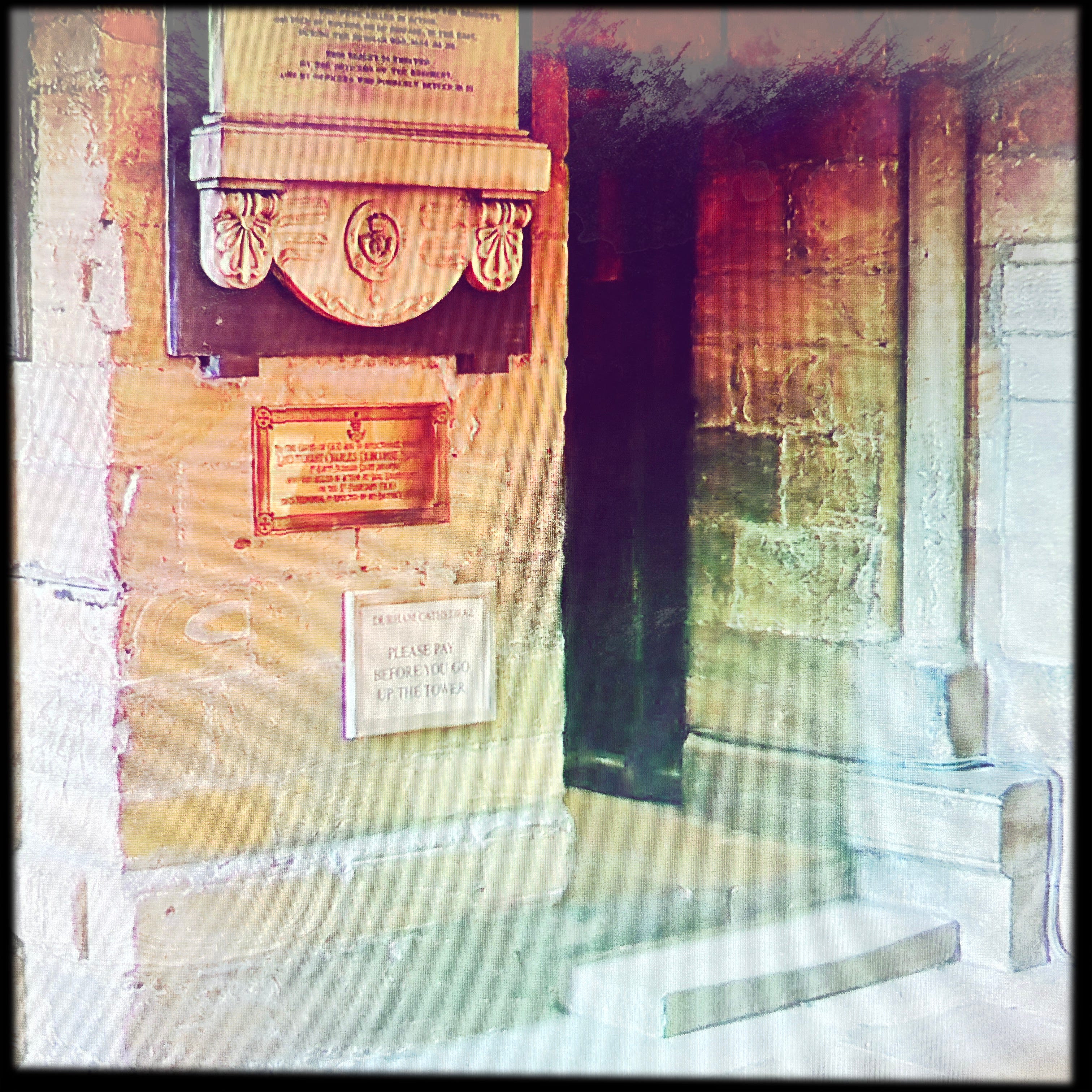
The stairs to the central tower began behind a door near the crossing. There were three-hundred and twenty five of them to count, for those so inclined. A narrow spiral that turned steadily upward. Never brave with heights, or rather always needing to be, I preferred not to consider the number with specific care. The steps were uneven in places and the walls pressed close on either side. My shoes made a steady sound on the stone, one at a time and up. No one else climbed at that hour. The air grew cooler as I rose and, a half pack a day of Silk Cut telling even at thirty, my breath came harder. Keeping one hand on the inner wall for balance, the steps grew narrower still near the top. I paused once on a small landing to let my legs settle and attend the quiet that followed when I stopped moving. Then I continued until the final turn opened onto the platform and the open air.
The parapet was low. The drop began immediately beyond it, two hundred feet to the ground. Below that, another one hundred feet down, the river moved between its steep banks, inscrutable at this height. Away into the near distance, the roofs of the city lay in irregular blocks of slate and tile, the cloister appearing as a square of green and stone. On a clear day, on this day, the view reached north toward Sunderland and the low hills beyond, not that I could pick out any single distant monument from where I stood. For one thing, I was hardly standing. I would dare it for a moment and crouch back at the safety of the stair.
I could feel the sun just, a vanishing pressure on my face, and the air was cold, moving in thin currents about and above the tower. I sat at the top step with my back against the wall, letting my hands rest on my knees. The sky stayed cloudless and the light falling without warmth on the stone.
It was here that the thought of him returned. Elliot. We had been the same age and from the same kind of family, the same schools at the start. He had chosen marriage and a house that needed painting each spring and now a child whose arrival his letters mentioned with careful detail. One of these letters had come a couple years earlier when he was still deciding things; it carried a faint scent of his study, of Montblanc ink and woodsmoke and something like vetiver. On one of his visits, from the days when he still had the time and inclination to visit, I showed it to him; the envelope had carried an unfranked stamp. He asked whether I minded if he kept the envelope. It was from England and its stamp unfranked and something to do with his letter inevitably reaching its destination. He was always the better Lacanian. He explained he needed it for a contest of valor and needs must. I told him that I did not mind though I now suspected the message carried some special charge I had allowed to go unnoticed and became irrationally jealous of its possession, as though by keeping the envelope he had claimed a fragment of my own crossing, proof that something between us had been marked for delivery and he had somehow taken it back.
Of course, I was not actually worried about an envelope. His request had been exact, something small at a time it seemed when larger questions still remained open between us.
The view from the tower did not change any of that. The river carried on its curve below or so I imagined. The longer I sat there exposed to sun and sky the less inclined I felt to risk peering out over the edge and into the abyss.
The sparrow in Bede’s account had flown into the hall at one end and out again into the night and storm, the moment inside only a short space between two doors. If Elliot had lingered in the warmth; I had already passed through.I stayed seated until the cold from the step reached through the cloth of my coat, a possession of those times I lost track of in a move and now dearly miss. I had to take some thought to the time and was not entirely certain of how long it would take from here at the pinnacle down to the parking lot. I rose as the hour began to run short and started down the spiral again, the steps turning in the same sequence as I wound my way down to the nave. Ahead of me an evening of owls, most welcome, and my introduction to Nabakov, a minor horror.
Comments
Nothing yet. Say the first thing.
Sign in to join the conversation.