
I had written most of this article before getting stuck at a point where I was unable to find out an important piece of information. I used the time to analyze a news item from AP/PBS that showed gaps in their reporting and published it here. The current article explores the news as it was reported in Israel. I wrote it as a journalist’s journal.
14 August 2026
Now an international incident, I first learned of what happened in Qusra, from a report on Israel’s Kan 11 TV channel yesterday evening. Qusra is a Palestinian Arab village in Area B in Judea and Samaria (aka the West Bank). Area B is under exclusive Palestinian Authority (PA) civil administration and conjoint PA and Israeli security responsibilities.
Not interested in their next segment, I zapped the remote and went to Channel 14 just as they began reporting on the same Qusra incident.
If I ignored the landscape shown in both videos, I could have imagined they were reporting on different events. Channel 11 told viewers that extremists established an outpost beside Palestinian homes, blocked access routes, cut water and electricity, and effectively trapped three families in their homes. Its reporter attempted to reach the families but was stopped by the IDF about 300 metres away.
The translated transcript is in the Appendix.
Channel 14 physically took viewers to the location of the disputed settler outpost structure, pointed out that one home was approximately 30 to 40 metres away, and declared that whatever occurred, it was certainly not a “siege.” It then provided evidence and testimony about Palestinian attacks on the settlers.
The translated transcript of this news report is in the appendix.
Channel 11 is a public broadcasting station, and I do not find it biased toward the left in the way I find Channels 12 and 13, or toward the right as I find Channel 14. I watch both of them and i24 for my news. I24News did not add anything new and was somewhere between the two other reports.
I want to share with you where my thinking about what I had just seen took me.
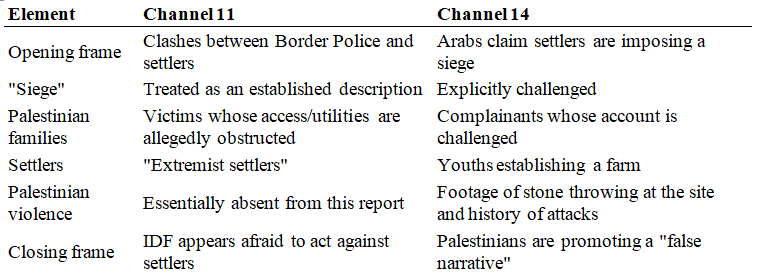
I drew up a table comparing the major claims of the Channel 11 and Channel 14 reports:
Table 1. Differential reporting of the Qusra incident
As I sought more details that would help me understand what really happened at Qusra, I thought it would be instructive to look at Facebook posts by activists on both sides of the political spectrum.
The first is written by rightwing activist Elisha Yered, a resident of Ramat Migron in the Binyamin region of Samaria north of Jerusalem; the second by Standing Together, a leftwing anti-“occupation” NGO in Israel.
I translated the Facebook post in which Yered gives his account of the context in which the Qusra incident took place. I have not independently verified all of Yered’s claims. However, his allegation concerning Qusai Abu Rida is not without supporting evidence. Channel 14 previously aired video that it identified as showing Abu Rida participating in an attack on a Jewish shepherd and reported that he was arrested following the incident and later released. The report also showed footage it said depicted him throwing stones at Jews walking on the terraces below his home.
Here, I will only show his summary; the full details are in the translated post in the Appendix to this article. According to Yered:
A village [Qusra] that supports terrorism.
An Arab [Qusai Abu Rida] who is himself involved in terrorism and should be in prison.
A house built far from the village for clearly nationalist purposes
Zero violence against Arabs by the shepherds, who themselves have been attacked.
Zero violence against the security forces.
After a solidarity march to the site with other leftwing NGOs, Standing together published a video of the visit, accompanied by an explanatory text. For space considerations, I am giving you the bullet points here and you can read the entire text on Facebook:
For days, violent Israeli settlers – with the backing and protection of Israeli forces – have surrounded these families’ homes, harassed and threatened them from outside, and blocked the roads leading to them.
The settlers cut off the families’ water and electricity, while their presence and threats left the families afraid that stepping outside could put their lives in danger.
Food and urgent medical assistance were also prevented from reaching them.
They should not have to depend on activists pushing past military obstruction simply to receive what they need to survive.
This is what occupation and settler terror look like in everyday life. Delivering basic supplies is not enough, the siege must end, the settlers must be removed, and these families must be protected and rescued immediately.
We will keep fighting settler terror, forced displacement, and the system that enables them, and we will keep fighting until the occupation ends.
Drawing on the Israeli reports and other material I examined, here is what I can say with confidence that I know at this point:
1. Hilltop youths set up a tent along a road or path near three homes on the outskirts of Qusra and apparently near a spring at which they were watering their sheep.
2. They spread rocks from the roadside rock barrier onto the road, preventing the movement of vehicles when the army came to take their van.
3. Everyone says the tent and their grazing plot are in Area B, where the Palestinian Authority exercises civil authority and the youths had no authorization to establish an outpost.
4. Israeli soldiers compelled the youths to leave the area after they had joined them in prayer.
5. The youths came back.
Here is what is missing from all the reports to substantiate claims made:
1. Visual evidence of property damage, of broken water pipes, and of disconnected power infrastructure.
2. Visual evidence of the settlers surrounding the houses rather than just at one spot down the road from them.
3. Visual evidence of settlers attacking residents of the houses.
4. Views of the backs of the houses to see if there were other ways of moving in and out.
This APT image gives the clearest view I found of the physical relationship between the encampment and one of the homes. The tent is visible down the road from the walled compound. What the image does not show is what was happening on the other sides of the house.
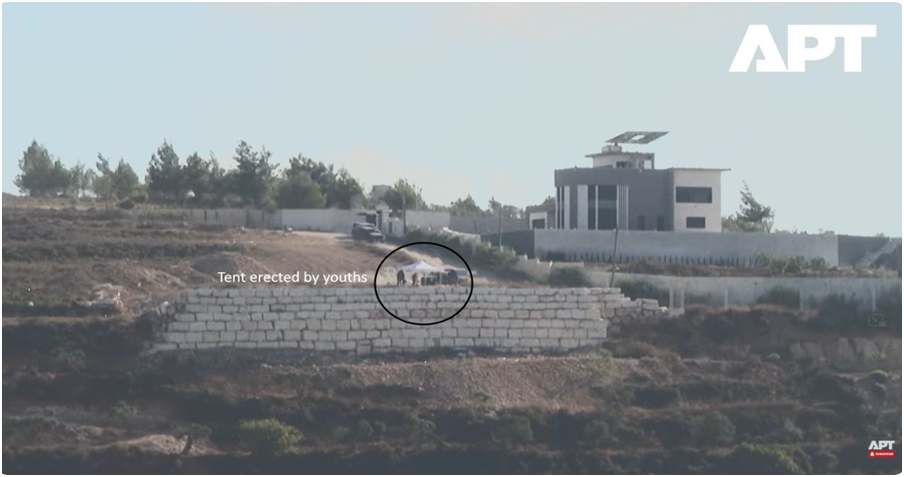
But even if there was no usable back entrance, that does not establish that the families were deprived of food, water or other necessities. Israeli forces were already present at the site. The IDF has delivered humanitarian supplies under active wartime conditions in Gaza; supplying a small number of families in Qusra would hardly have presented a comparable logistical problem. Yet none of the reports I examined asked about this and only talked of the families’ dwindling food and water supplies.
I would have loved to drive out there and see the location for myself and talk to the Arab residents of those homes myself. I would have loved to talk to the Hilltop Youths who set up their tent illegally.
But more than that: I would love to talk with all the politicians, IDF officials, and journalists who called this a siege and claimed that the Hilltop Youths there were preventing the residents of the house from going out to get food for 3-4 days. I wanted to know what they were basing their statements on.
Then I read a statement released by Oded Revivi in which he called the behaviour of the youths “contrary to morality and justice.” Revivi has over 15 years of experience in leadership roles in Judea and Samaria and has also represented the settlement movement in its dealings with representatives of the United States, Europe and others. I was interested in understanding his thoughts.”
An English translation of Revivi’s full written statement is in the Appendix. He agreed to speak with me on the phone.
Revivi told me that he was not an eyewitness to what happened in Qusra but was relying on “what [he] managed to collect from different sources and the picture that [he] managed to create for [himself].” And he believes that he has “more or less the full picture.”
I began by asking if he had seen evidence for the claims made against the youths aside from the simple fact they built a tent and blocked the access road to the spring. He saw no evidence of a siege around the homes in question, saw no evidence of property damage or interference with water or power supplies to the homes.
Then he told me that giving him a list of immoral things the youths may or may not have done was beside the point.
I still pressed the matter. I told him that there seemed to be other trails and roads between the houses under “siege” and the village. But he was as adamant as I was:
It is clear that what the youths did, and even just bringing materials, building the huts or whatever construction they built, was not on land that was designated for them, was not land which is owned by them. . . . It does not matter to me if there are two roads leading to a specific house or one road is blocked, so you can say it is not a full siege, it is a partial siege. Why does there need to be any blockage on a road that does not belong to you?
“In Qusra, you have one specific event,” he stated, “and two different interpretations for it. It brings up two different emotions and then leads to at least two different acts of response.” And the main concern for him was the “bigger picture and it is what some of the people who do these acts do not understand.” Even given the context concerning the violence against Jews emanating from Qusra’s population, he says:
In no scenario and in no circumstances is it the job of the youths to do law enforcement.
He fears:
. . . that at the end of the day, the phenomenon will become so widely spread that even if they are a small minority, they are the ones who are going to dictate the response and policy of foreign countries against Israel. . . . I think that is something we need to try and have, not in the back of our heads, but just in front of us at all times.
Several outlets told us that 15 Palestinian families had been instructed by the IDF to leave their homes because of an imminent IDF operation in the town. It was not clear to me whether the three families at the centre of the “siege” reports were included among those 15. Six families had already left before the rest were told they could, actually, remain in place.
Some news reports suggested that the IDF operation was related to demolishing the illegal encampment near Qusra. But one possibility I could not rule out was that the planned operation concerned counter-terrorism rather than the encampment. Qusra has a documented history of violence against Israelis. But without knowing when the evacuation orders were first issued, I could not establish whether the operation plans predated the youths’ arrival.
I asked Revivi if he could tell me when the original orders to leave their homes were given to residents of Qusra. He did not know and he said that is irrelevant to the immoral and dangerous behaviour on the part of the youths.
Just before I spoke with Revivi, Regavim shared a new report in which they argued that American-Palestinian dual citizens are exploiting their unique position in the town of Turmus Ayya, not far from Qusra, to manipulate public opinion into believing that “settler violence” is a widespread phenomenon. The parallel caught my attention. The owner of one of the “besieged” houses in Qusra, Loui Ridi, lives in Ohio, and he returned just as I was finishing editing this piece. CNN recorded him putting an American flag up on his property.
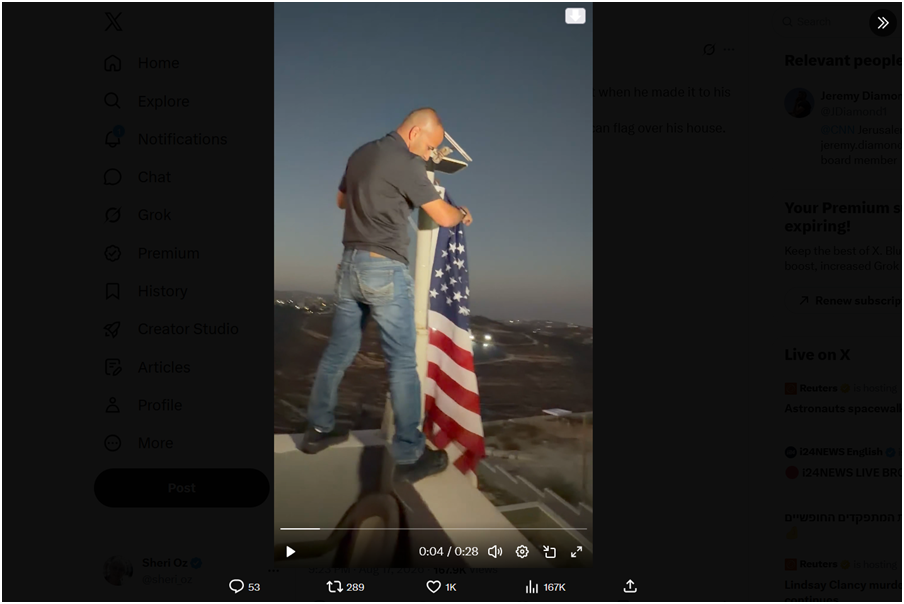
Revivi commented that this:
. . . creates more complexity to a situation that historically is complex, and we know that we have enemies who are trying to take advantage of it, and in that respect, we are playing into their hands.
In Conclusion
I began this exploration wondering if I could find what really happened on the outskirts of Qusra. My readers already know (from this article and others) that I publish what I find whether it supports my political position or not.
For some of my readers, what the youths did in this instance is illegitimate regardless of the details, whereas for other readers, the context plays an essential part in looking at what they did.
After speaking with Revivi, I find myself reflecting on a different question: does moral judgment depend on proving the most dramatic version of events? If the youths illegally established themselves on land that was not theirs and deliberately blocked even one road, how much does the rest matter to the moral judgment?
And then, if that alone is enough, how did the story become one of families besieged in their homes, settlers swarming around them, utilities cut and people being starved out if “all” they did was set up a tent 40 metres down the hill from one of them?
But there was another twist in this story and I will have to leave that for a separate article. Stay tuned . . . .
Substack’s payment system is not currently operational for writers in Israel. If you want to support this work, you can do so directly via PayPal/Buy me a Coffee,
or Ko-fi. I appreciate one-time or repeated donations to my writer’s fund.
Reader support keeps this work sustainable.
Channel 11 TV News Item
Clashes this morning between Border Police forces and settlers on the outskirts of the village of Qusra in Binyamin. Several days after a tent was erected adjacent to the Palestinian homes, this morning the IDF and Border Police finally evacuated it, but the settlers returned immediately afterward. The evacuation did not go smoothly. Additional activists streamed to the area, blocking access roads with large rocks and making things difficult for the security forces.
Footage from the scene shows extremist settlers blocking the access roads and later continuing to sit at the site on sofas and mattresses, even though the IDF had previously announced that the illegal outpost would be evacuated.
[Palestinian speaker:] “Really, [they are making] films, black films. Everyone sees, and the journalists see. The settlers are making a lot of trouble.”
The new outpost was established three days ago by Jewish extremists from the nearby Tal Talpiyot outpost, several hundred metres away, and is closing in on the homes of three Palestinian families, comprising about ten people.
[Palestinian speaker:] “They cut off the water, they cut off the electricity, and they settled there. The army comes, sits with them, drinks coffee, takes pictures with them, mingles with them, and leaves.”
According to the IDF Spokesperson, during attempts to evacuate the site, Central Command chief Avi Bluth and other commanders arrived. They condemned the incident and ordered further measures. It was also decided to take disciplinary action against the force involved, which had been documented at the location several days earlier, when it was seen praying with the settlers and refrained from evacuating them.
[Palestinian speaker:] “All these paths, everything you see here, all these houses, nobody dares approach there because of the settlers. And most of the time the army helps them.”
“The spring, the water source of our village, which provides water to many homes here in the village, they cut it off from the village. They use it alone.”
[Several sentences here are badly garbled in the transcription. The speakers appear to be discussing their presence at their own homes and their ability to approach them.]
Several media outlets organized together in an attempt to reach the homes of the besieged families, after journalists who had tried to reach them on previous days were attacked by settlers.
[Channel 11 reporter:] “We are here at a roadblock manned by Home Front Command reservists. We are approximately, I think, 300 metres from the besieged Palestinian home here among the houses of the village of Qusra. Home Front Command reservists are here.”
“Under IDF instructions and an order from the commanding general, they are telling us that this is a closed military zone. We cannot continue toward the family. Despite the evacuation that took place here, despite the IDF reporting that the routes had been opened, these are currently the instructions they have received. They cannot allow us to pass.”
Despite IDF briefings that Border Police forces were expected to arrive during the day and once again evacuate the settlers, the evacuation did not take place and the settlers remain in the area.
[Palestinian speaker:] “I always said that the State of Israel is a state of law. But now I say the State of Israel has no law. Where is the law? Where is the government? Where is the Shin Bet? Where are the police? Where is the army? Where? Where is everyone? Do they not see this?”
Since the terrorist attack two weeks ago in the village of Tal in Samaria, 13 outposts have been established. But it appears that the IDF is deterred by the settlers’ response and is afraid to act in the manner required of it.Channel 14 TV News Item
A turbulent morning in Binyamin. Arabs from the village of Qusra claimed that several settlers were imposing a siege on homes containing Palestinian families.
With the assistance of anarchists and extreme-left activists who were invited to the area, media crews arrived and hurried to declare that residents of the nearby Tal Talpiyot farm were besieging the Palestinian family’s home.
The IDF Spokesperson later joined this determination, noting that the commanding general would arrive at the scene to ensure that the besieged family had sufficient water.
[Channel 14 reporter at the site:] “I am now near Tal Talpiyot, at the point where the structure that was talked about so much this morning stood.”
“You can still see the posts from the structure here, and the sofa that the youths used. About 30 or 40 metres from me is the building in which, it was claimed, the people who were supposedly under siege were located.”
“You can clearly see the distance between the place where the structure stood and the buildings belonging to the Arab residents who live here in the area. Many things can be said about what happened here today, but a siege is certainly not what happened.”
We came today to the Tal Talpiyot farm to see up close what really happened.
[Settler:] “We are here in a huge bloc where, until now, there was terrorism here. Until now, at this antenna, there was an armed guard. A few years ago...” [remainder of sentence unclear in transcript] “...there was an armed guard here at this antenna.”
“And since we came here, everything has opened up. Jews walk around everywhere here. We have returned here, improved the springs on this mountain, we have returned here.”
“We experience a lot here from the Arab side.”
The youths who established the farm at this strategic location, situated in the heart of Area B, have been attacked many times by Arabs from the village of Qusra.
As can be seen in this footage, residents of the houses who complained about the settlers can be seen throwing stones at the youths.
[Settler:] “This is something one of these Arab rioters did to us. And that is it. This is what we live with every day. We try to work as much as possible with the police, with the army.”
“As things become more publicized, we try to work through the system. Everything that happens, we report to the authorities.”
It therefore appears that the terrorists attacking the settlers are doing everything possible to prevent the expansion of the settlement enterprise.
And they do not hesitate to promote a false narrative, as happened this morning.
Elisha Yered’s Facebook Post
There are some incidents I can still understand, but what is happening with the Yesha Council and the chorus of condemnations from the right, who are being swept along like a blind herd, is a complete bankruptcy.
Not one of them checked the details or even tried to understand the incident. They all rushed to echo the media’s messages and play their part as tools in the cynical and malicious election campaign of the left-wing parties.
Stay with me for a moment. Try to ignore the background noise you have heard, and let us go through the details together, because the descriptions being thrown around here, including by people on the right, have gotten completely out of control.
The location of the incident at the centre of the uproar is the slopes of Jabal Ein Eineh, the second-highest mountain in Samaria, situated between Migdalim and the Shiloh bloc.
On the ridge adjacent to the mountain lies the village of murderers, Qusra, which has for years carried with it a rich history of terrorist incidents: a horrific lynching of boys during a bar mitzvah hike, additional lynchings of hikers, explosive-device attacks, and regular rioting.
Over the past five years, the Palestinian Authority and the village councils have designated Jabal Ein Eineh as a critical target for Arab control. It dominates the entire area and effectively constitutes a regional base of control. Whoever controls the Jabal will control the entire area.
From that point, an extensive operation began to build roads to the mountain, prepare plots, and rapidly construct houses with assistance from the Palestinian Authority. The village councils also provided assistance and funding to encourage an Arab foothold on the mountain. One of the Arabs who took up the task was Qusai Abu Rida, an Arab nationalist from the village of Qusra.
About eight months ago, at the eleventh hour before the ridge was taken over, a settlement nucleus consisting of families and young men went up and established a foothold on the summit of the Jabal. The site was given the name Tel Talpiyot.
In Qusra, they understood the strategic significance and launched a series of terrorist incidents against the residents of the hilltop and any Jew who dared set foot in the area. A flock of sheep was poisoned, two explosive devices were planted and neutralized at the last moment by bomb-disposal experts, residents were subjected to lynchings, and shepherds were attacked and injured.
One of the leaders of the terrorist activity was Qusai Abu Rida, who built his house on the slopes of the mountain. He was documented participating in a severe lynching of a shepherd, forcibly restraining the shepherd together with other rioters while another tried to behead him with a hoe. He was arrested but, absurdly, released. In another incident, masked rioters were documented throwing stones from his house at hikers who were on their way to a nearby spring. And only about three weeks ago, terrorists fired from the vicinity of his house toward the hilltop.
About two weeks ago, following the heat wave that made it difficult for the flock to walk long distances, several shepherds erected a shade structure on the slopes of the hill, two terraces below Qusai’s house, which, as noted, served as a forward stronghold for terrorism and sits on the main route to the spring used for watering the flock.
No one acted violently toward any of the residents of the house, despite the fact that these are full-fledged terror operatives. No one prevented the family from leaving and returning to its home. And certainly no one raised a hand against the security forces. On the contrary, those on the hilltop have always made an effort to maintain cooperation and good relations with IDF soldiers in the sector. The soldiers were even documented praying Mincha together with the young men, an event that, strangely, became controversial.
Qusai, the Arab who, as noted, is waging a campaign to remove the Jewish presence from the entire mountain and is connected to left-wing organizations, decided, regardless of the facts, to launch a campaign. Journalists reported dramatically, the IDF Spokesperson came under pressure and issued a condemnation, Avi Bluth hurried to the scene, and forces were sent to carry out demolitions and confiscate the hilltop’s vehicles.
Several dozen youths tried to block the road to prevent the confiscation of the Ranger, an act of protest of the kind that has been carried out a hundred times or more at Kaplan. But despite their anger, not one of them raised a hand or engaged in violence.
From that point, everything proceeded according to plan. The incident was inflated by brilliant strategists on the left who decided long ago that the settler-violence libel would be a central theme in the left’s election campaign, and even people on the right fell one after another like dominoes.
To summarize briefly:
A village that supports terrorism.
An Arab who is himself involved in terrorism and should be in prison.
A house built far from the village for clearly nationalist purposes.
Zero violence against Arabs by the shepherds, who themselves have been attacked.
Zero violence against the security forces.
Now tell me: why the hell have the Yesha Council and people on the right spent the past two days condemning these youths, effectively declaring their blood fair game, and babbling about “raising a hand against the security forces,” when this nonsense bears no relation whatsoever to reality?! Can they not understand that they are simply soldiers in a malicious political game?
Feel free to share this or ask them yourselves.
Oded Revivi’s Statement: Silence Will Cost the Settlement Enterprise Dearly
“As someone who served as head of the Yesha Council’s foreign affairs desk and maintained close contact with Ambassador Mike Huckabee, I feel an obligation to warn those who call themselves right-wing but act against the settlement enterprise: Do not try to label one of the settlement enterprise’s greatest friends in the United States a leftist,” says Col. (res.) Oded Revivi this morning, with evident pain.
Revivi served for more than 15 years as head of the Efrat Local Council and was one of the senior figures in the Yesha Council. He also served as a representative of the settlement movement in its dealings with representatives of the United States, Europe and others.
According to Revivi:
“It was not only the events in Qusra that led Ambassador Huckabee to decide to use very harsh words, calling the Israelis who acted there ‘Israeli terrorists’ and describing their actions as ‘criminal.’ It was also the support of some right-wing leaders who supposedly seek to advance settlement but whose actions result in an own goal and drive people away.
“The silence in Jerusalem in the face of these events also became particularly jarring to the ambassador. When an action like this took place, contrary to morality and justice, one of our greatest friends expected official Israel to point the moral compass in the right direction. When that did not happen, he decided to act.”
Revivi, who oversaw the construction of thousands of housing units during his tenure and also hosted Huckabee in Efrat, added:
“We must not allow ourselves to become confused by the election campaign and the desire to scrape together a few more votes. Domestic politics that tramples the national interest will ultimately endanger everything we have built. If a true friend like Huckabee has to bang on the table, all of us need to stop and ask how we lost our way, and correct it immediately. Continued support, continued silence, will cost the settlement enterprise dearly,” he concluded.
Comments
Nothing yet. Say the first thing.
Sign in to join the conversation.