
In 1972, Yale architects Robert Venturi, Denise Scott Brown, and Steven Izenour helped usher in the development of postmodern architecture with a treatise called “Learning from Las Vegas.” It centers on a 1968 Las Vegas visit by the architects and a cohort of their students. The book highlights so-called “lessons” and inspiration from the sometimes outrageous/ridiculous advertising/architecture of the time in both the eponymous city and other audacious structures around the world. Last year, I was asked to give a talk about that book to a bunch of Vegas history nerds and enthusiasts at a conference put on by the Las Vegas Neon Museum called “Duck, Duck, Shed.” The conference title comes from a labeling convention applied to the structures of interest advanced by this Venturi/Brown/Izenour book.
I called the talk “Still Learning From Learning From Las Vegas.” And the reason I think they asked me was that despite having no background in architecture, I do have a deep-rooted love of all things Las Vegas. And here was a serious book about my hometown which, let’s admit it, is rarely taken seriously. Indeed, as I was to learn, it was even more radical in architectural circles because it used the cliché-ridden, bombastic Las Vegas Strip (and surrounding city) as the foundation of the ideas advanced.
My talk surrounded this idea. A glorified, non-fiction book review, not necessarily about the content as much as how it made a local kid feel when I first happened upon it. Despite not understanding a lot of it. In spite of not really (at the time of the first read) giving a whit about architecture. I became fascinated with this book even as many of the lessons of urban planning advanced in that era have long been abandoned by modern-day architects and Las Vegas, too.
But as I told the crowd, for me my continued fascination is premised on the fact that the book turns out to be the first major recognition that bold and brash Las Vegas – with all its unconventional beauty and design, quirks, scale, missteps and myths – was worth exploring.
And now, whatever shape Vegas presently is in, I believe the city sadly lacks in but should continue to warrant surveys, analysis, and distillation. For better or worse. Cementing the fact that there is value in studying this hotbed of tourist-driven decision-making. And by understanding how we create structures, and live and move through our spaces, we can gain insight into aspects of desire, diversion, determination, but maybe as more and more people flock to living in Las Vegas - we can figure out how the “two Las Vegases” I like to talk about can coexist through their systems, values, and even architecture.
Yet, asking questions and looking too closely at ourselves is not really our strong suit. I do like to ask questions, though, and this book was one of the major inspirations for that attitude about my city.
And so I gave my talk. I began with the same quote I use in every talk about any aspect of Las Vegas. It’s from my favorite Nevada-connected author, Claire Vaye Watkins. I find her assessment to be instructive. It’s an invaluable contextual clue to recall whenever we discuss the forces that shape the city inside and out. Whenever we dive into the myths that so easily take root, and the difficult conversations we scrupulously and adeptly redirect. It’s also a solid, versatile caution for all of us wandering the valley for whatever purpose. It is the epigraph of a collection of essays I’ve been working on for what seems like decades.
“You have to be careful in Las Vegas. The place will be whatever you need it to be.”
And then I made it clear that even though I was asked to speak on one of the most famous architecture books of the twentieth century, I did not have any specialized knowledge of the discipline or its theories.
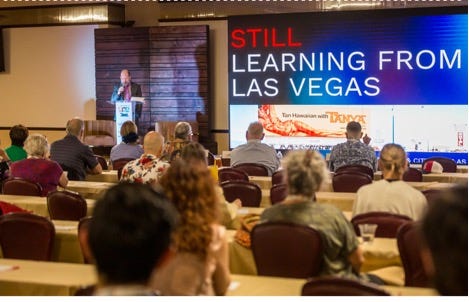
Here’s the text of that opening day presentation:
“Good morning. Welcome to Duck, Duck, Shed. These are three words, um, two architectural words that I know how to pronounce. Spoiler: I will mispronounce almost every other, even basic architectural term, as it comes up. Same goes for well-known architects. In fact, I’m not convinced that Rem Koolhaas isn’t a made-up name - because c’mon. Too perfect. I also feel I should disclose that I’m not an expert at creating PowerPoint presentations, though that should become self-evident quickly, if not already. Finally, I AM a semi-retired criminal lawyer and a podcaster - which only further confuses my authority on the topic of this book and will probably make you double mistrust me before we even start because - yikes - what a combo.
So, why me? Only my lifelong obsession with all things Las Vegas can answer that. My parents randomly ran into each other, both as separate tourists from the same Midwestern city at the Stardust Hotel. Approximately nine months later, they brought me into the world for the first time, and shortly thereafter, we moved here, where I’ve been ever since. This is where I grew up. And I’m not being hyperbolic with a cheeky map of the Strip from 1971 - this is where I literally was raised until age 13 and then about two blocks away til about 1991. I call myself a Vegas kid or a casino kid, and for good reason. And as a Vegas kid, I was specifically cursed, or blessed, with a fascination with what it means to be of Vegas, or more broadly, what Vegas means to be of the world. As such, I developed a deep intrigue. All things Vegas. It’s history and evolution. It’s coming of age and arrested development. Petulant Vegas. Perplexing Vegas. Progressive Vegas.
I always knew it was someplace - unique - only reinforced in my seven years away for schooling before I returned home for good.
And as much as I stumbled around for answers to whatever available sources and stories could come my way, it was during my stint as a sophomore at the University of Arizona, and my work-study job in their Architecture library at the checkout counter, that I first encountered “Learning From Las Vegas.” In 1985, it was a book that I stamped in and out quite a few times. Once, I grabbed it for myself, hungry to learn what there might be to learn. Impressed with the fact, of course, that an Ivy League group found my city to be worthy of an academically rigorous study. That they spoke of the buildings and design that surrounded my everyday existence was invigorating. Impressive schematics, familiar images in photos being dissected, and lots of fancy words and comparisons to epic and mythic places like the gardens of Versailles. That this was an essential book, at least to the students and faculty, may have been my first source of real hometown pride. I’ve read and re-read this book countless times, and while it’s been rightfully described as a common-interest book - it isn’t the theory but the context that has stuck with me so long - and it’s that context, then and now - that i submit is the central idea to why we, especially those enamored with Las Vegas - can use it to learn things still today. And if at this point, you’re wondering why I’m still talking about MYSELF instead of this book - well, from my vantage – the more of this place that I am, the more appropriate it is for me to speak to how parts of this book are still worth discussing and debating so many years after its publication.
Apart from its place in the world of architecture, again to which I cannot speak with authority, I can say that not only is Learning from Las Vegas part of our city’s literary canon, but that general takeaways from the observations and findings of Denise Scott Brown, Robert Venturi and company are still part of the conversation and as the title of this talk suggests - we are still learning and ignoring lessons developed over 50 years ago from some smarties from Yale.
So as I understand it, the Yale crew was ready to blow the lid off of modernism and go after the concept of the architect as epic hero and create a study not as architects felt the public should experience the great buildings, but how the prevalent and undisciplined appearance of commercial developments across the country was vital to understanding the language of new architecture in a time of urbanism. That these roadside endeavors were communicating with symbols and signs, accommodations, and invitation. That the future of buildings was more about engagement than monument, and concluded that the granddaddy of all commercial strips was the Las Vegas Strip and that the 5 or so miles of hotels, casinos, retail, gas stations, wedding chapels, front-facing parking lots, porte-cochères, and BIG OL CRAZY SIGNS were ripe for review. So they came here for 10 days in 1968, took about a gazillion photos, filmed from their rental cars and a helicopter in the sky, and told the world that this city (and especially the main focal point - the LV Strip - although to a lesser extent, Fremont Street proper) was the epitome of what all architects should be mindful of as the world moved forward.
Now that might be the most non-architectury summary of this book, but indulge me as we talk about this book as a book and just a little more about my relationship with the city and this book.
Obviously, Las Vegas Boulevard isn’t the only commercial strip in Las Vegas; it was just the one since the 1950s that got all the action. Parallel, and only a block away, was a little commercial strip indistinguishable in design from maybe hundreds of others around the city. This Strip-adjacent center where I grew up in the 1970s had everything my family (and Strip performers and employees) needed in a set of connected storefronts. There was the barber shop and beauty shop, a Sicilian pizza joint, Tal, the cobbler to the stars. Raul, the tailor to the stars. Hudson Cleaners, Mr. E’s Supermarket (first sighting of Space Invaders), a florist, the Landmark pharmacy, a dark and foreboding bar called Archie’s Tavern that I would always peek into if the door opened - which it did an inordinate amount in daytime hours. There was a huge parking lot out front and a Googie-style, giant neon sign announcing “the Somerset Shopping Center.” It was called “Somerset,” and it was beautiful.
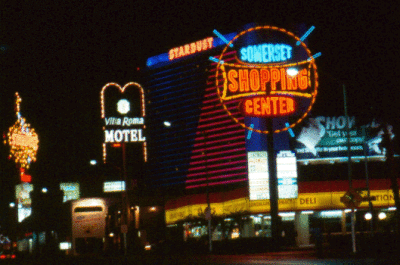
Recently, the whole shopping center was leveled and replaced by a giant deli that vibes like an airport hangar. The developers are notorious in Las Vegas for running a collective of weekly/monthly rentals at an aggregate fee that would make Oliver Twist’s Mr. Abbot blush. In 2022, a United States Congressional House Select Subcommittee found this company “particularly egregious” in their practices.
They “repurposed” the old Somerset sign to advertise their deli without any of the old flair or neon panache. They also named their deli after a storied, beloved, tiny one from 1989 that they acquired in 2018 in a different, but nearby strip mall. The new signage at the new location, in a new building with a totally different concept, touts that they’ve been around “since 1989.” Their website gives no tribute or mention by name of the original owners. I guess they paid for the historical marker - they get to exploit it.
This, by the way, is a great metaphor for where we’ve come and why we need more “learning” indeed.
But okay, so-long Somerset. Let’s go back to learning from the Strip with all its choices old and new!
The Strip was, from its origins, a hobbled-together collective of mostly unrelated properties with dozens of voices and architects working not in conjunction but in competition for the tourist eye from the highway - unburdened by real zoning laws, codes, city planning, or cohesion. And the Yale group wasn’t the first to notice. To fully understand the context of what Las Vegas had become that caught Denise Scott Brown’s attention - we should first take a brief journey down what other intellectuals had published prior to the arrival of the Yalies.
Starting in the 1950s, there was a steady onslaught of popular writing about our City in the journals of the day. Of course, there were handfuls of movies and even a few novels (and more than a few dime store potboilers) set in the city too. The public image of Las Vegas as an escapist land of tacky disguised as classy, and clever belying ridiculousness had already taken hold. Partly by the intention of the army of publicists bombarding popular media with staged images, partly from the word of mouth I’d imagine of the growing middle class of visitors heading back to wherever they came from with stories, some of which might even be true, and because of the growing roster of big name entertainers who made it a gathering of a lot in a place that was relatively small.
But perhaps the first real big-deal treatment of our city from a heavyweight writer was Tom Wolfe’s 1964 essay “Las Vegas (What?) LAS VEGAS (Can’t hear you! Too noisy) LAS VEGAS !!!!” that appeared in Esquire magazine. Call this a precursor to the book we’re talking about today. He wrote lines like:
“He had been rolling up and down the incredible electric-sign gauntlet of Las Vegas’ Strip, U.S. Route 91, where the neon and the par lamps - bubbling, spiraling, rocketing, and exploding in sunbursts ten stories high out in the middle of the desert - celebrate one-story casinos.”
AND
“Las Vegas is the only town in the world whose skyline is made up neither of buildings like New York, nor of trees, like Wilbraham, Massachusetts, but signs. One can look at Las Vegas from a mile away on Route 91 and see no buildings, no trees, only signs. But such signs! They tower. They revolve, oscillate, they soar in shapes before which the existing vocabulary of art history is helpless. I can only attempt to supply names - Boomerang Modern, Palette Curvilinear, Flash Gordon MIng-Alert Spiral… signs have become the architecture of Las Vegas and the most whimsical, Yale-seminar-frenzied devices of the two late geniuses of Baroque Modern, Frank Lloyd Wright and Eero Saarinen, seem rather stuffy business, like a jest at a faculty meeting compared to it.”
In 1967, Joan Didion added on with her short piece, Marrying Absurd, in the Saturday Evening Post.
“Almost everyone notes there is no ‘time’ in Las Vegas, no night and no day and no past and no future; neither is there any logical sense of where one is. One is standing on a highway in the middle of a vast hostile desert looking at an 80-foot sign that blinks STARDUST or CAESARS PALACE. Yes, but what does that explain? This geographical implausibility reinforces the sense that what happens there has no connection with ‘real’ life. Nevada cities like Reno and Carson are ranch towns, Western towns, places behind which there is some historical imperative, but Las Vegas seems to exist only in the eye of the beholder. All of which makes it a stimulating and interesting place….”
By the time Learning from Las Vegas was published, we also could add on Hunter S. Thompsons’ take in Fear and Loathing in Las Vegas (1971) with its provocative subtitle: A savage journey into the Heart of the American Dream and the epitome of pop culture - arguably the biggest franchise of its time - James Bond arriving with Diamonds are Forever and even the biggest to that date TV movie in the guise of the Night Stalker (1972) which was all about how vampires terrorize our streets at night - in the city that makes the most sense for vampire to do so with so much action and post-modern streetscapes! Begrudgingly, I’ll mention Viva Las Vegas (1964), if for no other reason than its seeming popularity at the time and its Technicolor glory in some of the establishing shots of the Strip, and maybe also The Godfather, with its important references to Las Vegas, which only cemented the mystique. To put it another way, Vegas had become part of the popular conversation, and it hasn’t eased up on the gas since then.
So, the Learning From Las Vegas arrived (and was republished in 1977 with a second preface from Denise Scott Brown, alone). Now, however deep we are into this discussion, let’s finally talk about the book—and let’s start with those prefaces. (c’mon y’all really didn’t expect a straight architecture talk?).
Perhaps one of the most interesting things we learn from the original preface is that, just prior to the expedition, Venturi sent a letter to the then-mayor of Las Vegas, Oran Gragson. It was filled with flowery language and a plea for assistance:
“The main thrust of the work will be an analysis and evaluation of the physical form of Las Vegas. Particular emphasis will be on the Strip, but viewed in the context of the region and in relation to the city and especially the downtown. Our philosophical stance will be that the Las Vegas Strip is the example par excellence of a new city form which is emerging in America and which must be understood by architects and urbanists.”
And then this little zinger that, from a 2025 lens, is kind of remarkable: “If our urban potential is to be realized. Behind our decision to conduct a studio on Las Vegas lies one strong recommendation: You have something very good here. Be careful not to spoil it by using aesthetic controls which apply to more traditional cities. The Strip could be ruined by good taste.”
He then asked the Mayor of Las Vegas for about $9,000, which, in 2025 dollars, would have been about $82,000, to study the Strip. Luckily for Venturi, the letter found its way to the City of Las Vegas planner Don Saylor- who came off as a fanboy and brought the proposal to the Regional Planning Council, to whom he was the advisor, to see if they might have the dough. But it seemed like a fairly haphazard ask. Here’s how the Review Journal reported it.
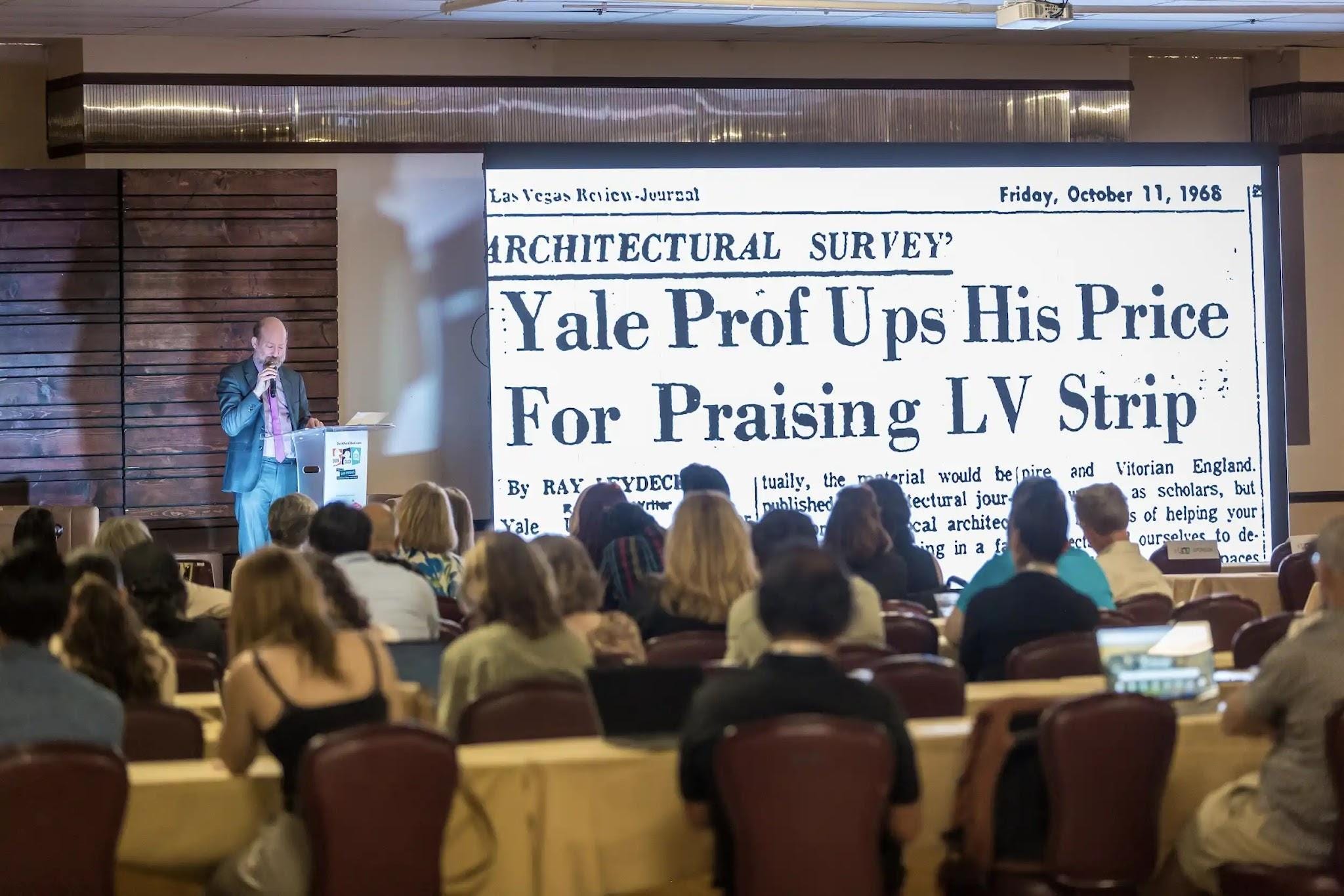
In the preface, Venturi seems to take great offense that the request was never met, as if to say, do you know how important this is gonna be. And maybe emboldened by what was clearly Mr. Saylor’s enthusiasm, and undaunted, Venturi believed he had an inroad and made a second request for a little extra to do some filming too. Here’s how that was reported.
And while he didn’t get the dough from the government, and there is a not so subtle tone of bitterness against the RJ in the preface, it does turn out, they wound up with comps a plenty from the Stardust and deep discounts elsewhere - which is maybe the best learning from Las Vegas - you can’t just demand juice - you gotta work it a little in our town.
I honestly love how pissy he got about the RJ - and also, as we’ll see in a minute, how his warning to the alleged planners of the unplannable Las Vegas strip manifested in the text.
But before I get to book talk (and spoiler, it’s not going to be that deep or insightful, just some of my impressions), I want to mention the second preface from the second edition written by Denise Scott Brown, which rightfully establishes her equality in the project with an excellent call-out of the unfortunate domination of upper-class males in the profession and their obvious biases. She also gives the reader additional homework to better contextualize the book and respond to critics. Despite its revolutionary impact in critiquing the prevalent mode of modernism in architecture, my further reading suggested that other architects did not necessarily shun the authors, but rather did not fully embrace them, even as they continued to build and work on theory and inspiration. Because of my nerd-dom, I tracked down some of the referenced articles including one penned by Scott Brown called “On Architectural Formalism and Social Concern; a Discourse for Social Planners and Radical Chic Architects” a clever and thoughtful reflection on the social responsibility of all disciplines in creating things, objects and spaces for the masses that could spawn its own festival on holistic approaches to city building - but also Radical Chic Architects is a great band name up for grabs.
So what I love most about the book - and yes, after however long it’s been - here it is, but don’t blink; it won’t last too long - is the photos. At once nostalgic for me, as I probably traversed this Street on foot, on bicycle, by car (both soon to be asleep in the backseat and as driver) as much as any human has over a 50-some odd-year period, though it is not a competition. Like many people, the old Las Vegas is lovely and transcends whatever might have been thought of its gaudiness at the time. The photos, while obviously serving the purpose of the study, reveal a joy and lightness of that time that any visitors, even fancy Yale architects, couldn’t avert their deadpan, serious eyes from. It shows up in the images in the book and the ones collected in other forums from those trips as well (I highly recommend getting your hands on the Las Vegas Studio book, which has a bevy of unpublished photos).
And while a lot of the captions are great and instructive, one perhaps stuck the longest and provides me with the central takeaway as a Vegas observer, fanatic, and annoying critic - the caption simply read: “the order in this landscape is not obvious.”
The rest, as an observer of Vegas, I found fascinating even if it often was over my head. The text, in lots of places, sure, but so too with the various comparative analyses of directional spaces, symbol word architecture, pattern maps, elevations, etc. All fascinating. And as excited as the Las Vegas city planner was in his words that someone would be coming to Las Vegas to: “recognize the contribution we are making to city planning. Our ideas, he said, “are breaking away from hidebound and traditional concepts and allowing freedom of thought and design to develop urban areas that make for good living.” He continued, “I would jump in the air and click my heels with joy if someone from a place as prestigious as Yale were to come here and label the Las Vegas area as a good form of urban design.”
But is it? (Pause for laughter). I mean, I don’t think that was EVER the conclusion of anyone associated with this book. More so, what I got from Learning from Las Vegas is merely proof that cities could evolve and even become grand examples from “below,” if you will. That a place like the Las Vegas Strip in particular could arise as a product of abject popular culture and desire; that it could evolve in an unorganized way out of the necessity of getting attention over any intellectual pinings of architects or city planners. And in the car culture days of the 60s and 70s, our city unabashedly did all the things - all the time - making signs stars, and communication king to the travelers locked on the highways. No one at the time in our country did it bigger, and the authors found a connection to a very human, very ancient drive - hence the comparisons to Versailles, Rome, and Victorian England. I don’t think the authors ever thought living in Las Vegas based on this design was “good” per se, but that it was special and important to note.
I mean, it fit right into Venturi’s famous quote in response to other famous quotes!
They also, perhaps with a little chagrin, noted that change was a part of the ethic of our city and there was concern that it would change itself right out of relevance. Hence the warning in his letter to the Mayor. And change did come, and it came quickly.
Even as early as the 1977 edition of the book, Scott Brown noted there was already change afoot, not just in light of the well-documented oil crisis that had people traveling on the roads less, but in the structures and signs.
“In the nine years since our study was initiated, Las Vegas and the Strip have changed too. Some buildings have new wings and restyled facades. Some signs are no longer there. Delicate and intense neon high readers have given way to bland, white, plastic rear-illuminated message boards that alter the scale and vitality of Strip ornament. Portes cocheres now vie with signs as bearers of symbolic information.”
Little did she know the changes that would come. Actually, from my perspective, little changed on the Las Vegas Strip and even Fremont Street from 1969 until 1989. Sure, a tweak here and there. The MGM being the biggest entry. But who could have imagined the complete refashioning into our current era that began with small booms that made the Mirage - and all the big boom implosions that followed - making our cluttered by light series of unique populism into a caterwaul of heaviness, a blobification of the center - a marginalization of the weird - but also a place where more people would come and come than ever before.
Impressive, of course, but by 1997, on the 25th anniversary of “Learning from Las Vegas,” even Venturi was like - yeah, Vegas’ importance as an architectural landscape rich in inspiration is over. In that same interview, Denise Scott Brown extracted perhaps the lesson that resonates the most with me. She said, “We learned about symbolism in architecture. We re-established the fact that architecture does contain symbols, and these symbols can be read to have meaning. These iconographic parts of architecture are very important and have never been entirely lost from architecture, even though the modern architects thought they had obliterated them.
Those symbols remain in my mind on the Strip even as the structures that communicated them are gone. Call them ghosts, or myths, or a vortex - the mix-up of scale and seeming chaos in service of the tourist good remains. The grand buildings with their obvious purpose may not align with the joy of rebellion, but populism, taken to an extreme, remains. With the signs gone, Steven Izenour said, what we loved the most was gone. Scott pointed out the constraints and limitations of the LED signs, “though she predicted the tech might get better.”
And now where are we today….
Today, we aren’t the Las Vegas model; we’re compared to Times Square. We block our sights with scaffolding for a race. We move underground. You can’t see the Horseshoe Hotel from the street. We resist outside assessment or independent information. Will someone else barnstorm us to find our truth, or will we, for once, let down our guard and figure out for ourselves what makes our urban environment sustainable?
But I will disagree with Venturi and his crew that Vegas isn’t unique or worth learning from anymore. Not for them, perhaps, or architects of their ilk, but the development of Strip City (a term coined by the late UNLV history professor Eugene Moering) should be on any urbanist’s radar for a 100-thousand-dollar study! How all the oval around this street has become its own city-state. The insatiable drive for more, and bigger and new, to keep it fresh and allegedly relevant. The casting of any traditional planning model around stadiums to contain the big stadiums all in Strip City. To scoff at the traffic jams and the big boxy LEDs. To turn technology up to 11.
We are obscuring the bones even further with sometimes hairbrained, Hail Marys, but now again inspired madness - the sort of spontaneous weirdness the authors embraced, even if they too understood that corporations weren’t the best to sanction the lasting accidents that made Las Vegas what it was in the 1960s and 1970s, when it did, and in such a vastly interesting and important way.
Past architects would make buildings to last forever, then 50 years; now Vegas has shown it can be far less. That change of the scenery is a constant. Not without its real issues, impact on businesses, strains on public transit, three major tragedies, all of which arguably would have been preventable; all with some degree of nexus to the size and scale of Strip City. It’s all worth studying, and as Learning from Las Vegas showed and continues to show - understanding what people like and being thoughtful about how it influences what happens everywhere.
No posts
Comments
Nothing yet. Say the first thing.
Sign in to join the conversation.