
Obesity is falling—in a few countries at least. And it is nothing to do with weight-loss drugs. What is going on? For decades governments have wrung their hands as obesity has risen relentlessly. All sorts of policies were tried: taxes, labels, calorie counts, school food, advertising bans, and public campaigns. Nothing seemed to move the needle.
With hindsight the reason is obvious: once weight is gained, the body defends it and fights hard to keep it. Easy to put on, hard to take off. No traffic light labels or food advertising bans are going to shift those mid-life kilos. Policy was trying to fight biology. The outcome was obvious. Biology won.
The good news
A brand new way of looking at obesity appeared in a paper1 in May. Rather than comparing two points in time to see how obesity has changed, the new measure seeks to look at a country’s trajectory—its obesity velocity. Whether you have high obesity like America, or low obesity like Japan, this view asks what the direction of travel is.
What this view of the world reveals is that the world was not failing at all. Around 2000, long before weight-loss drugs, the rise in obesity had started to slow, and in a few countries had halted. Better still, more recently in Spain and Italy, and women in France, it seems to be declining2.
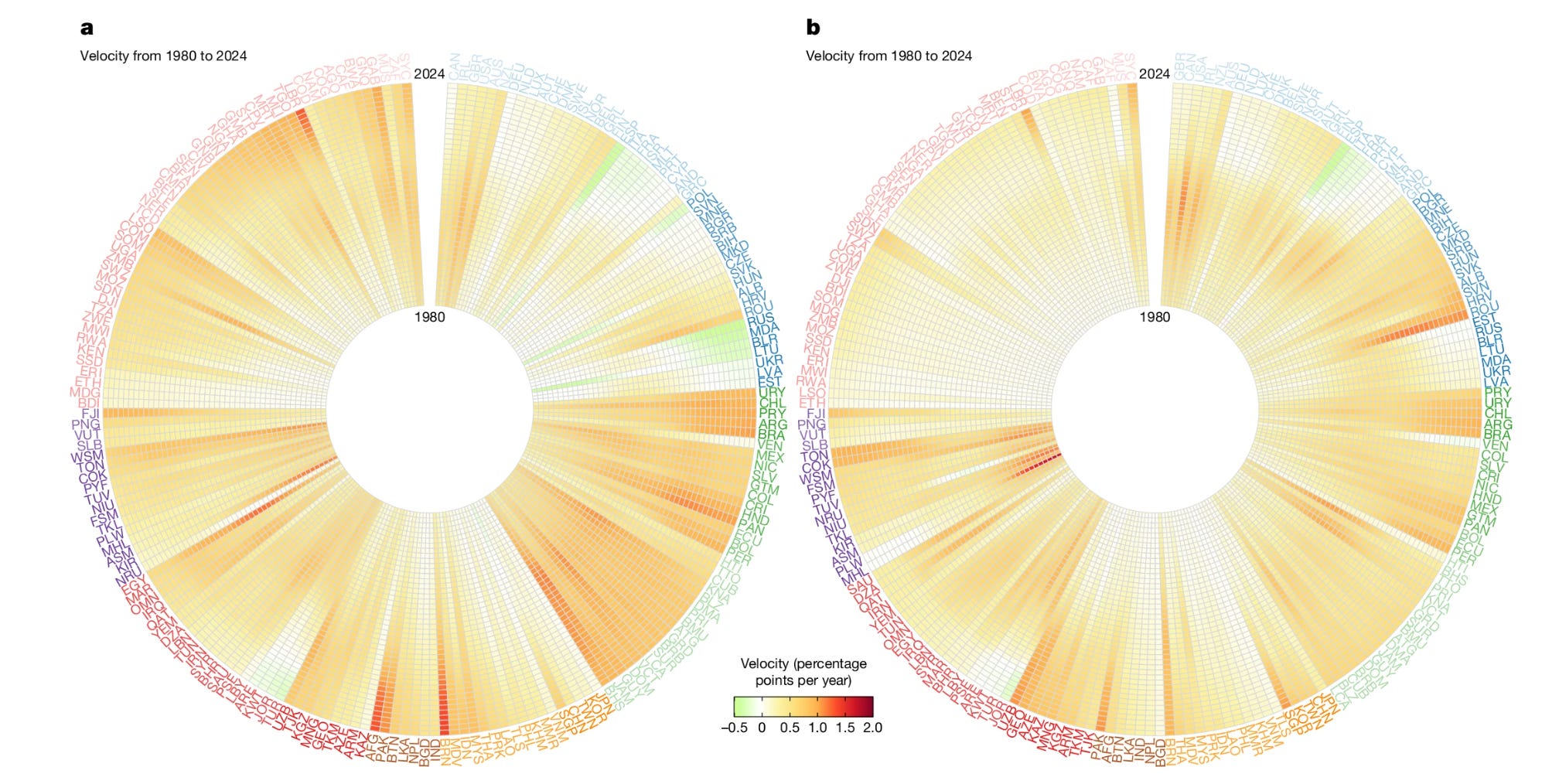
What did these countries do? That is very much a matter of debate. And, word of warning, everyone seems to have skin in this game. Governments and food policy advocates might argue that the declines in velocity shows that food policies work. But food firms and libertarian types don’t like the idea of the nanny state telling people what they can eat, or increasing the cost of food with taxes, and like to argue that these policies are ineffective. (I note here with some small exasperation that libertarian types seem perfectly happy with making pension contributions a default with an opt-out, but less so when you ask them to make the default meal salad with an opt-out for burgers. But I digress).
I will admit there are good reasons to listen to the libertarian types. This is not simply because I have to listen to them every week at work but because they often, rather annoyingly, have some useful points to make. And one reason for the changes in obesity velocity may be shifting cultural, social and economic factors that changed norms and expectations. (And, yes, I know governments can influence this.)
One idea about obesity has been that it transitions alongside socio-economic factors. The first stage is where it is rare and only found in wealthy elites. After this it rises rapidly as economic development brings processed food and sedentary work. The third stage is a plateau. This happens first in higher-income and more educated groups. At stage three the social gradient has flipped. Obesity is now a curse of poverty, not wealth. After the third stage the idea was that in a fourth stage obesity declines. In 2019 when these stages were proposed there was no evidence of it. Today it seems that there is.
Yet even though socio-economic factors may help address obesity, it is also clear that societies have benefited from better food policies. Everything from having better nutritional information on foods, better meals in schools, more healthy choices on menus, better education about food and fewer vending machines with junk food in them—particularly in schools. As for specific policies with evidence to back them, the paper says there isn’t enough evidence… with one possible exception: sugar-sweetened beverage taxes. These, says the paper, have had a measurable, albeit small, effect on obesity in multiple places. (Cue whooping in the back and fist pumps from the food policy wonks.)
As we got wealthier, smarter and cared more about what we ate, the food environment changed. That shift came from policies and market forces. And, no, I can’t prove it, I don’t have a RCT. It just seems obvious. If we had left everything to market forces then we would all be doing our weekly shopping from vending machines at the end of the street that dispense only Mars Bars and Coca Cola. If we left everything to governments, we would all be tearing coupons off to get our weekly allocations of bad foods. The sweet spot, if I’m allowed one, is somewhere in the middle.
The bad news
It is easy to forget just how difficult it was to get a healthy snack twenty years ago. In 2000, if you stopped at a corner shop the snack options were: crisps, chocolate and, if you were lucky, a flapjack so sugary sweet and syrupy that the memory still makes the corner of my eye twitch. I still remember the one glorious day when I stopped by a concession stand on a tube platform and bought my first “Eat Natural” bar. It was just nuts and dried fruit and apricots all glommed together in a yoghurt coating. I devoured the whole thing in a loved-up swoon, and studied the wrapper wondering if it was possible to buy shares in this new company. It was a revelation: actual real food in a snack bar.
But this slow shift to better food and eating is a rich world story. There is another planet entirely where obesity is accelerating faster than at any time since 1980. In 110 countries for girls, and 91 countries for boys, the velocity of obesity was higher in 2024 than in any other year since 19803. The majority were in low-income and middle-income regions. The highest velocities were seen in girls in Tonga and Samoa and among boys in Peru. Just a shade under 1 percentage point in growth every year.
Where do weight-loss drugs fit in?
The new weight-loss drugs are a new tool that could help drive national rates of obesity down—improving health on many dimensions. There is a debate about whether this has happened yet in America where the drugs are most widely used. Unfortunately, when we last looked at this the answer was that there are probably not yet enough people taking them for this to register in national data. See our piece on this last year.
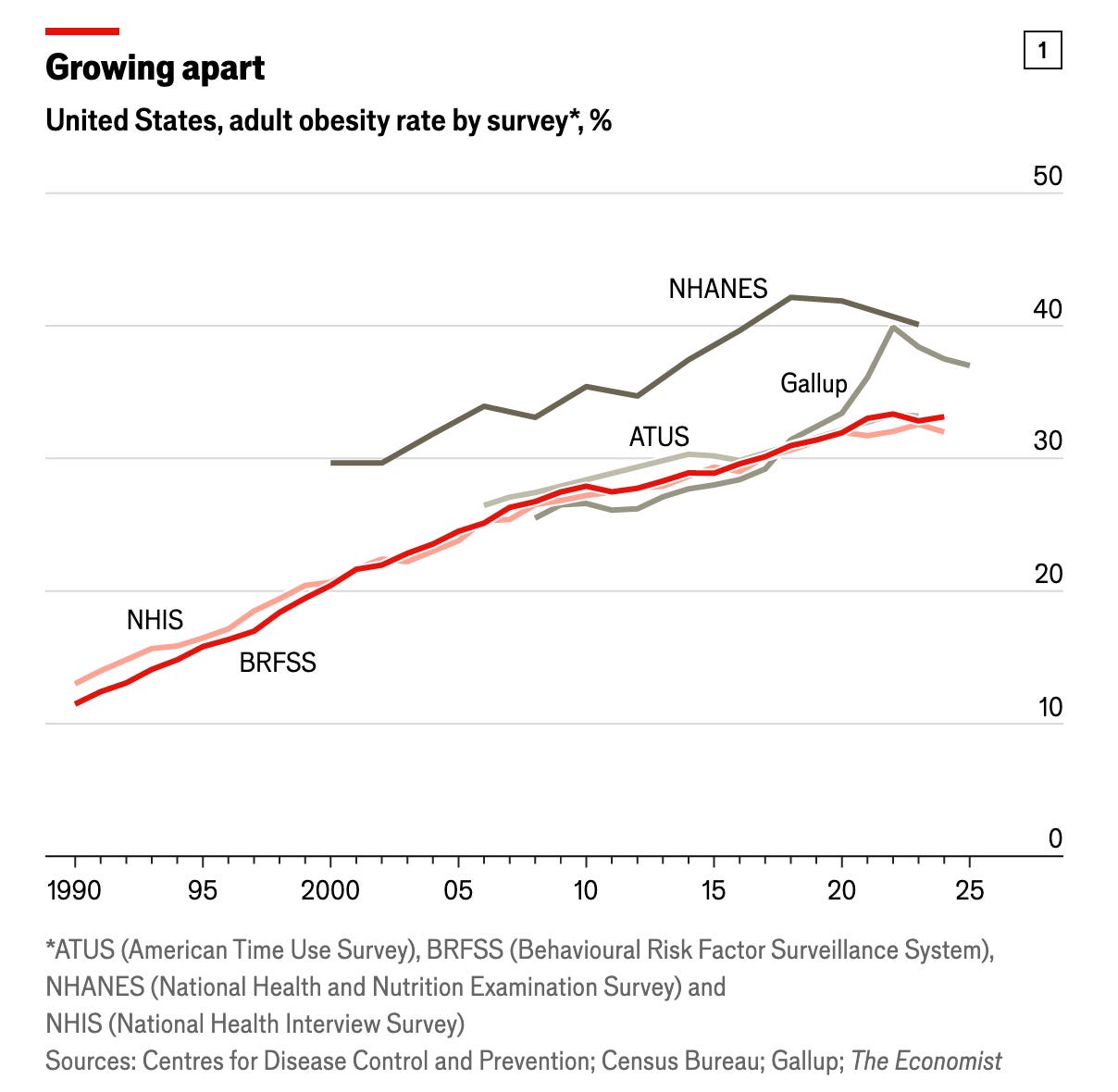
I would make an educated guess that weight-loss drugs will work well in countries who deploy them widely enough to tackle high rates of obesity where the velocity is zero or lower. But the availability of cheap generic versions of semaglutide opens up the possibility of trying to use them to decelerate the rise obesity in low or middle income countries. They look set to be popular in India and China.
But if the availability of these drugs is not matched with a healthy food environment the side-effect will be malnutrition. This is horrible concern but also a testable hypothesis—do areas with healthier food environments have better outcomes from weight-loss drugs? And rather than wait for a problem to occur, governments in poorer countries need to think hard about how to support the growth in knowledge and availability of healthier foods alongside weight-loss drugs.
On one part of this planet we are finally winning against obesity. In most other places we are not. Do poor and middle-income countries have to repeat our mistakes? Or can drugs and our hard-won knowledge help them skip more quickly to the defeat of obesity.
Other articles
“In some countries (Spain and Italy for both sexes and France for women), velocity had become negative, that is, obesity was declining, with PP > 0.80;
Comments
Nothing yet. Say the first thing.
Sign in to join the conversation.