
Imagine you stumbled upon a magical map (think Harry Potter’s Marauder’s Map) that revealed the hidden infrastructure of American power.
When you open the map, the surface layer of the economy fades away. The Mag7, the frontier labs, the defense primes, and consumer giants — they all disappear. What remains is the physical substrate beneath it: the mines, the factories, the processing plants, and the specialty materials the whole system silently depends on.
The map would not lead you to Wall Street or Silicon Valley. It would take you into the American heartland. To a rare-earth separation facility you’ve never heard of, or the one domestic plant that makes magnets inside every guided munition, or to the sole supplier of the heat shield material every hypersonic program depends on. It would chart the physical nodes that determine whether an F-35 can fly, whether a data center stays online through a demand surge, whether a supply chain survives the next shock.
These are America’s single points of failure (SPOFs), and the map would show you exactly where each one sits.
Then it would pose the more interesting question: What would you do with it?
An adversary would use it as a target list — showing the exact threads to pull to make the system seize. An investor might read it as something else entirely: a guide to the most interesting opportunities in the economy.
Here is the unsettling part. That map is not hypothetical. Someone has already drawn it.
For thirty years, while America optimized for efficiency, Beijing was drawing its own Marauder’s Map — and then occupying the ground it revealed, node by node, until it controlled the chokepoints the rest of the world forgot to care about. China didn’t need to steal America’s map. It built its own, and then used it to capture the territory the map describes.
Today, SPOFs are simultaneously a strategic crisis for America, as well as one of the most mispriced investment opportunities of the next decade. Together, they create the most valuable map in the world, and the blueprint for what must come next in America’s reindustrialization story.
Single points of failure (SPOFs) are the predictable result of thirty years of a very specific economic logic.
After the Cold War, American industry made a collective decision to prioritize efficiency over resilience. This led to just-in-time supply chains, production concentrated in low-cost geographies, and procurement systems optimized for the lowest price. The thinking was sound — why maintain redundant domestic capacity when you could buy cheaper from abroad?
What the model missed was the criticality of SPOFs.
Consider TSMC. Today, one company — on one island, 100 miles from mainland China — manufactures roughly 90% of the world’s most advanced chips. Every iPhone. Every AI training cluster. The guidance systems on America’s most advanced weapons.
A SPOF is not just a company with a lot of market share though. It is a node whose loss would cause a critical system to fail before a substitute could be brought online.
Three questions matter in identifying a SPOF.
First, what stops if the node disappears? Second, can anyone else do the job? And third, how long would it take them to qualify and scale?
In other words, three variables determine an SPOF’s importance: criticality, substitutability, and time.
Some SPOFs are physical: a plant, mine, furnace, or production line. Some are technical: a material, machine, or process with no ready substitute. Others are geographic, regulatory, financial, or human. The most dangerous SPOFs usually combine several at once—one qualified process, in one aging facility, run by an older skilled workforce, inside a company with very little room for error, producing an input or capability that American power relies on.
And they are surprisingly hard to find.
Most large companies understand their first-tier suppliers. Beneath that, visibility fades quickly. A prime contractor may know who delivers a subsystem without knowing where the alloy comes from, who made the tooling, or whether the only qualified sub-tier supplier is one bad quarter away from bankruptcy.
The Pentagon estimates that more than 200,000 suppliers support its weapons programs and day-to-day operations. In 2020, it began mapping roughly 40,000 parts in the F-35 supply chain. Five years later, it had country-of-origin data for first- and second-tier suppliers covering about 30,000 of them.
The F-35 is one of the most scrutinized industrial programs on earth. If we still cannot see all the way down its supply chain, imagine what sits beneath a regional utility, an advanced reactor developer, or a fast-growing AI infrastructure company.
You cannot secure what you cannot see. And you cannot invest against a dependency you have not mapped.

Of course, not all chokepoints matter equally. A bottleneck in the supply chain for decorative ceramics is technically a SPOF. But it is also not really a problem.
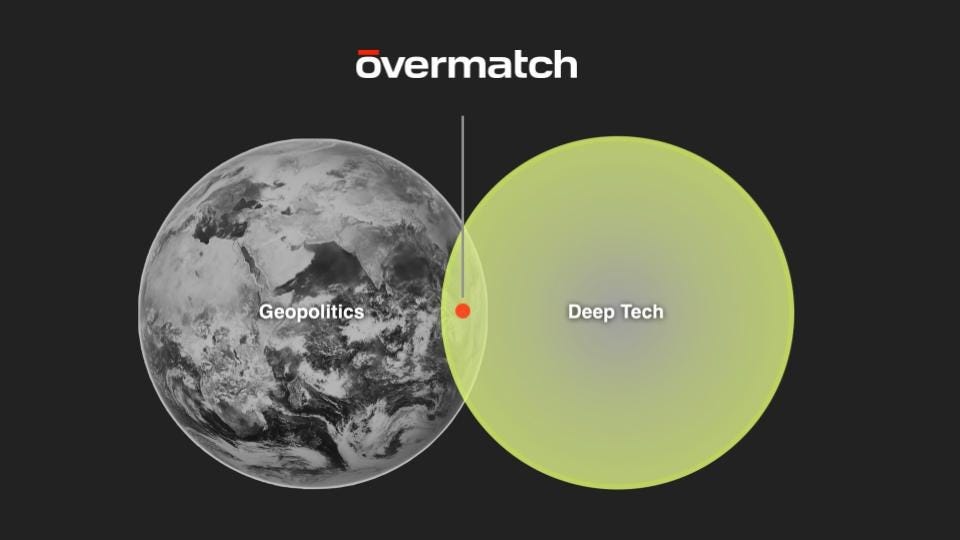
What we care about are SPOFs that sit at the intersection of two forces that will dominate the next twenty years: Geopolitics and Deep Tech. Every SPOF we underwrite must clear at least one of those filters. The best ones clear both.
The Geopolitics Filter. Defense and space are the canonical cases. Modern weapons systems are extraordinarily complex — an F-35 contains more than 300,000 components sourced from thousands of suppliers — and the chain is only as strong as its weakest link. When that link runs through Beijing or Moscow, it is not a supply chain problem. It is an existential one. The same logic applies to nuclear infrastructure, shipbuilding, satellite communication systems, and the advanced manufacturing base that underlies all of it. These are industries where the customer — the U.S. government — has declared that security of supply is more important than price. That declaration is worth everything to the operator sitting at the chokepoint.
The stakes are not theoretical. China has already demonstrated it will weaponize supply chain dependencies in a crisis. America’s adversaries have spent years mapping our industrial vulnerabilities, and they know exactly which threads to pull. The chokepoints that matter for national security are the ones our adversaries have already targeted. Find those, and you’ve found the investments that governments will pay almost any price to secure.
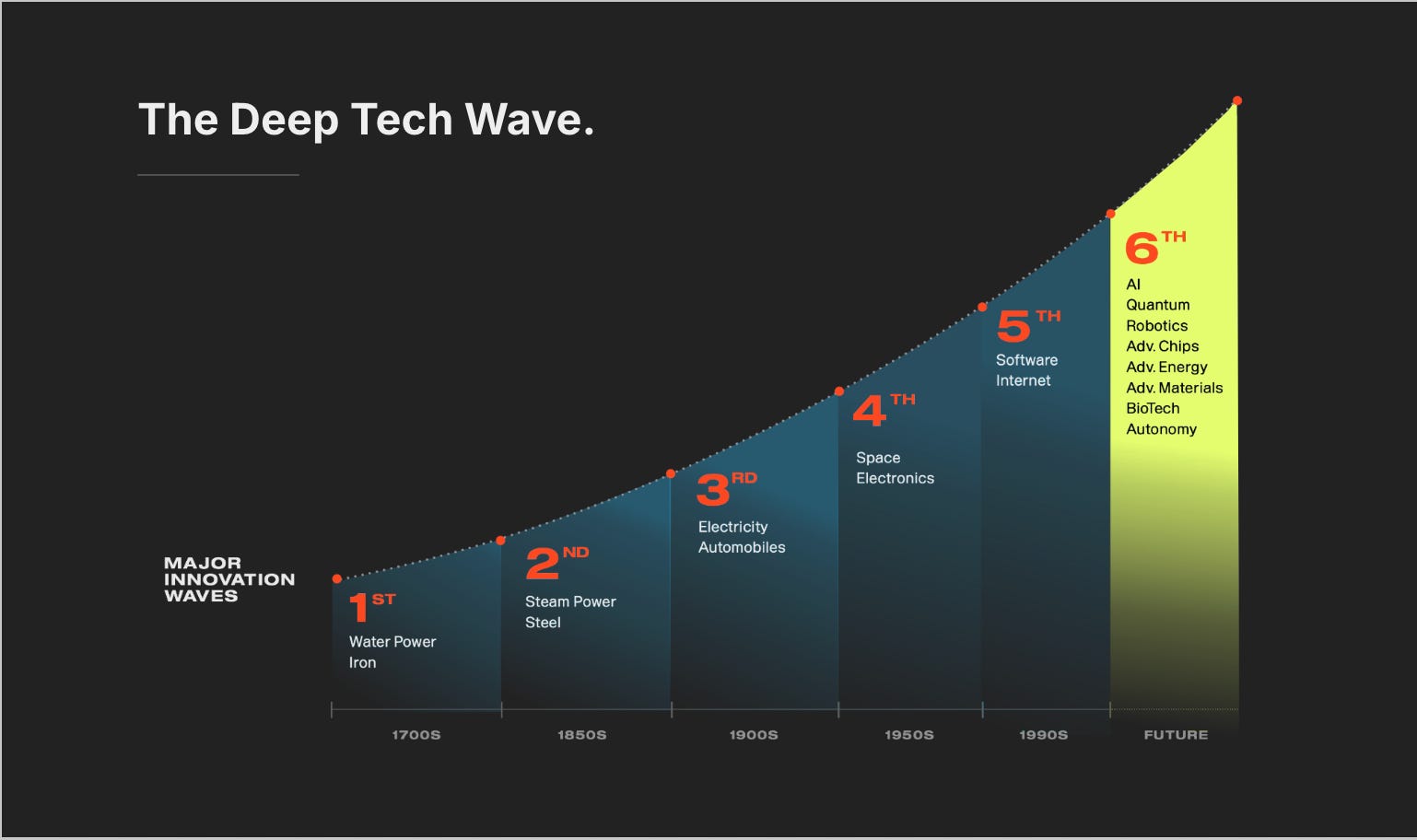
The Deep Tech Filter. The new deep tech wave across AI, compute, energy, manufacturing and space is running into supply chain walls that America didn’t anticipate. The AI buildout is fundamentally a physical infrastructure problem: purpose-built chips, specialized networking hardware, massive power draw, exotic cooling. The bottlenecks are real and multiplying — high-bandwidth memory, advanced packaging substrates, the specific copper grades required for hyperscale interconnects.
Take energy as an example. The explosion in data center demand is stress-testing supply chains for grid equipment, battery components, and critical minerals. Transformers are backordered by years. The materials that make a wind turbine spin and a battery charge are produced, overwhelmingly, in places America can no longer afford to depend on.
The biggest opportunity lies at the intersection of geopolitics and deep tech. Government urgency meets commercial demand. Strategic necessity reinforces market growth. The business case is insulated from both geopolitical risk and economic cyclicality.
America’s future strategic capabilities will depend on this geopolitical/deep-tech intersection, and whether founders and companies can turn single points of failure into engines of renewal.
The most successful companies in strategically important industrial markets rarely succeed because they discovered a secret opportunity. They succeed because they consistently execute better than their peers over long periods of time.
Owning a critical industrial capability is only the starting point. Building an enduring business requires disciplined capital allocation, operational excellence, technical expertise, trusted customer relationships, and leadership teams capable of navigating complex manufacturing, regulatory, and supply chain environments.
While every company follows a different path, several characteristics appear repeatedly among successful industrial platforms:
Mission-critical products or services that customers cannot easily substitute.
Long-term customer relationships built on reliability, quality, and technical expertise.
Disciplined reinvestment in people, operations, and technology.
Strong operational execution that improves competitiveness over time.
Prudent capital allocation that balances growth with financial resilience.
A culture of continuous improvement that compounds advantages over many years.
Importantly, these capabilities cannot be acquired overnight. They are developed through years of operational experience, customer trust, and disciplined execution. This is one reason why successful industrial businesses often enjoy durable competitive positions once those capabilities are established.
For investors, the opportunity is often less about identifying a single critical asset than recognizing management teams capable of consistently strengthening and expanding those capabilities over time.
There is one more dimension of the SPOF thesis that prior vintages of venture capital did not have: the government is now both a buyer and a co-investor.
For the first time in decades, the U.S. government has matched its rhetoric about supply chain security with capital. Hundreds of billions of dollars are in motion — through the Pentagon, the Department of Energy, the Defense Production Act, the CHIPS Act, and a dozen other mechanisms — specifically to rebuild the critical industrial capacity that America spent thirty years offshoring.
This capital doesn’t go to everyone. It goes to operators with credibility, with assets, and with the trust of the agencies deploying it. It goes to the companies that have already demonstrated they can acquire, fix, and scale a SPOF — and that have the government relationships to ensure that capital is deployed efficiently rather than wasted.
For the right operators, this creates a dynamic that barely exists anywhere else in venture: non-dilutive government capital that de-risks the investment, validates the thesis publicly, and unlocks the next acquisition cycle. The government becomes not a customer but a structural co-investor — one whose mandate is to see you succeed and whose checkbook, by private-sector standards, is essentially unlimited.
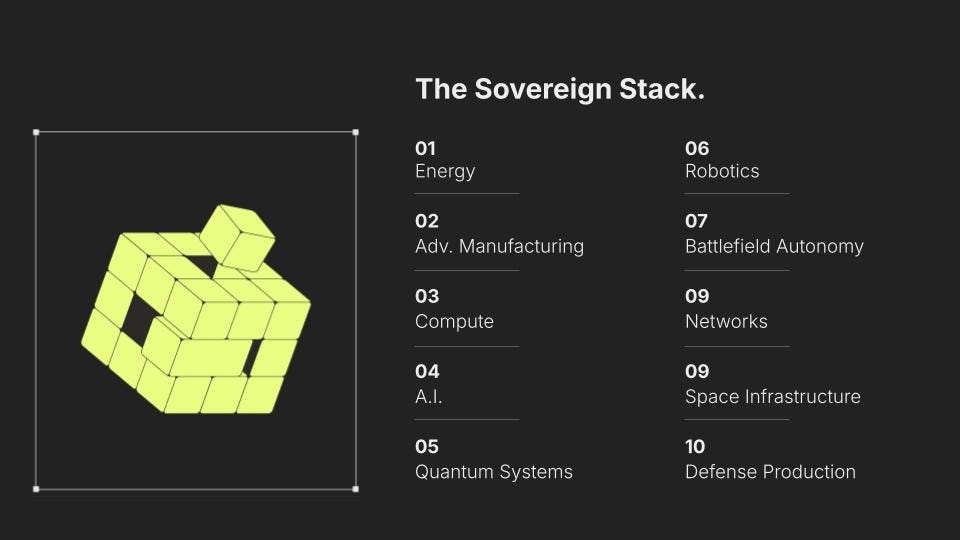
Overmatch invests in SPOFs that sit at the intersection of geopolitically-critical industries and deep tech, including sectors like AI, Compute, Energy, Advanced Manufacturing, Defense and Space. We call these sectors the “Sovereign Stack,” because they are the critical capabilities any nation state must own in order to maintain their security and independence.
Within those sectors, we’re looking for a specific combination of attributes:
The business must sit at a genuine SPOF — one with no current domestic substitute, structural barriers to entry, and clear relevance to national security or critical infrastructure. The harder it is to replicate the position, the more we want to back the founders tackling it.
It must be a uniquely differentiated team — a group that understands the financial intricacies of these assets, has deep ability to navigate government, and has the operational knowledge needed to fix broken industrial businesses and drive costs out of systems that have been neglected for decades. We want operators with first-principles instincts, not analysts with supply chain theories.
And the business must have the ability to scale — with a credible path from cost compression to margin expansion and towards industrial scale.
For founders, this presents an exciting challenge. It is an opportunity hidden inside America’s industrial base. Every single point of failure is both a vulnerability and a map to a company that needs to exist. If we get this right, we will create new capabilities, restore American industrial depth, and make the country harder to break.
No posts
Comments
Nothing yet. Say the first thing.
Sign in to join the conversation.