

Jack Megaw
Writing and photography by Jack Megaw | The Overload
In the World Rugby Laws Of The Game the men’s and women’s laws inside of the white lines are identical. (In fact, the only mention of women’s rugby in the laws is a smaller requirement for run off area around the pitch)
In November, World Rugby announced that a Size 4.5 ball would be used on an experimental basis as part of the 2025-26 Women’s SVNS Series. In late April, it was announced that the trial would be extended to the fifteens code in the WXV Global Series. A nations league style rehash of WXV, will see 12 women’s national teams competing in a home-away format, as well as featuring a six team challenger series playing in Hong Kong.
Gilbert
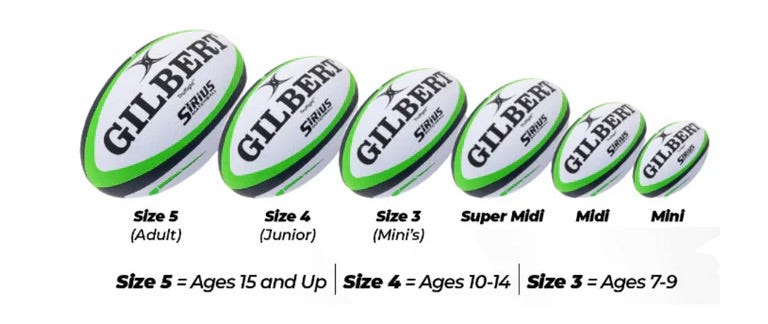
Senior level rugby is played with the size 5 ball, and that ball is recommended for ages 15 and above. For ages 10-14, a smaller Size 4 ball is recommended. For ages 7-9, a Size 3 ball is recommended. These recommendations are gender neutral.
A different size ball wouldn’t be unique to women’s rugby. The WNBA famously uses a smaller and lighter ball than the NBA, measuring an inch smaller in circumference. It has been suggested a smaller ball could improve parts of women’s rugby, when it comes to ball-handling, and allow players to better showcase their talent.
What do the players think?
“I like it,” Asia Hogan-Rochester commented. “It’s done in the WNBA, for hurdlers, AFL etc. Personally speaking, it makes it a lot more manageable to express all of my skillsets.”
But there’s a problem...rugby isn’t only played with the hands. Kicks from open play, set pieces, and restarts are a crucial part of the sport. Taking players who have been kicking with a Size 5 ball since their teenage years, and forcing them to adapt to a smaller Size 4.5 ball risks also impacting performance on the pitch in a negative way.
Through the first four matches of the Women’s Six Nations campaign, England fly half Zoe Harrison has only missed one conversion, having scored 16.
Talking on the topic to BBC Sport, Harrison had only just been made aware of the change in media interviews. She described the introduction of smaller balls for the WXV Global Series, where England will play Canada, Australia and New Zealand, as “the worst decision someone has ever made.”
The Red Roses fly half continued, “I’ve not kicked any less than a Size 5 since I was the age of 14. It will spin in a different way, and there is not the same amount of surface area for you to wrap your foot around.”
World Rugby has had positive responses from players after the use of the Size 4.5 ball in sevens. “Along with the sevens players, we’ll carefully take stock of player feedback, injury surveillance and shape of the game data from the WXV Global Series,” said World Rugby’s chief player welfare and rugby services officer Mark Harrington. “From there, together with the wider women’s game, we’ll assess the findings and look at where we go next.”
So how is the trial going?
The Overload dove into the numbers. In the 2024 Dubai Sevens, a code where players kick conversions via a drop kick, an average of 2.7 successful conversions were kicked per match. In the 2025 event, after the implementation of the Size 4.5 ball, this number dropped to 2.2 successful conversions per match. An 18.5% decline in conversion success rate.
But there’s a flaw in our Dubai Sevens numbers. On the eve of the 2025 Los Angeles Sevens, the series cut the number of core teams on the women’s series from eight to six. So an 18.5% decline is actually deceptive. With elite talent more concentrated on the SVNS Series, we can assume that the decline across players in overall conversion rate is actually worse than that.
[A lack of publicly available statistics from World Rugby relating to tournaments prior to the 2025-26 season make it difficult to give a true estimate to judge individual players by their conversation success rate. We would also be interested to know if knock-ons have decreased with the introduction of the Size 4.5 ball]
As journalists, we are often told to follow the money…
There are certainly equipment manufacturers which stand to make a significant financial gain from an implementation of the Size 4.5 ball into women’s rugby. This includes Gilbert, World Rugby’s collaborators in the Size 4.5 ball experiment, who recently extended their joint partnership through 2033.
Another factor is the added financial and logistical cost at the point of use. If all women’s senior level rugby is to shift to a Size 4.5 ball, then there are significant costs associated with the change, as teams across the professional and amateur game will be forced to make the switch. There will be additional logistical challenges not being able to share equipment between the men’s and women’s game at amateur level. This will impact clubs, leagues and tournaments. Finally there is the skill adaptation and crossover period which athletes of all levels of women’s rugby would need to undergo.
This writer’s view?
Testing a new size ball for women’s rugby isn’t a bad idea per se, there is a massive disparity of testing of women in the field of sport science. But testing in competition, at the highest level, does have a feel of preparation to implement the new size ball across the game - while potentially failing the sport at the amateur level.
The question we have to ask is a smaller ball going to make a significant positive impact on the game? Or should we continue to celebrate what is great about women’s rugby, rather than finding expensive solutions to non-issues?
So is women’s rugby adopting a Size 4.5 ball “the worst decision someone has ever made.”
It’s probably not the ‘worst’ idea.
But maybe the question is:
If it’s not broken…why are we trying to fix it?
No posts
Comments
Nothing yet. Say the first thing.
Sign in to join the conversation.