
Welcome to all new subscribers! If you are a new subscriber, the Getting Started article will help you answer all the common questions for new subscribers.
Subscribers to Outperforming the Market get full access to the Barbell Portfolio, all my intrinsic value, 1-year and 3-year price targets in the Price Target Report, and real-time trade alerts when I place buy and sell orders (I am fully invested in the Barbell Portfolio).
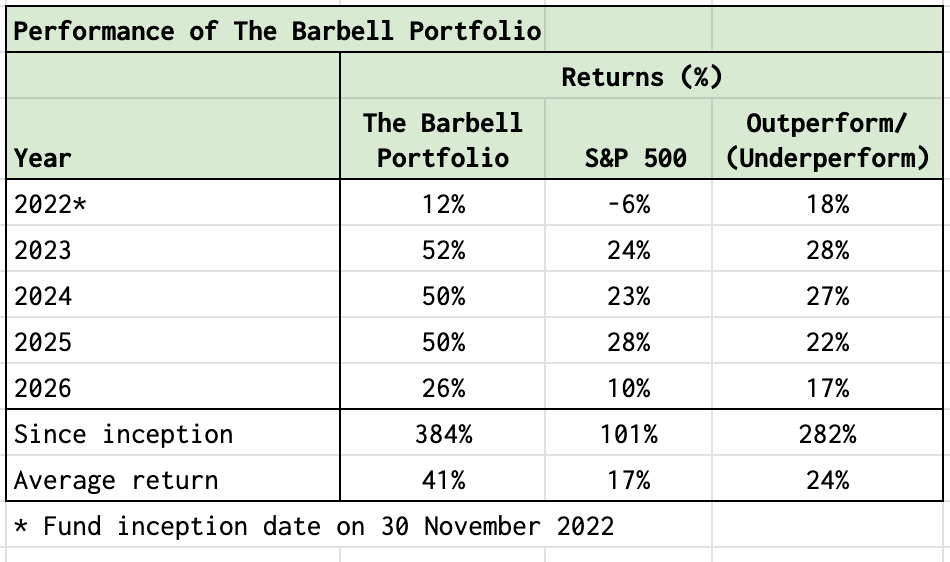
The full track record for the Barbell Portfolio from 2022 till today can be found here.
In addition, subscribers get a weekly deep dive on Fridays, a weekly newsletter on Mondays, and other earnings analysis, market review and portfolio review articles during the week. All links can be found consolidated here.
US Iran war
The US and Iran exchanged airstrikes, with Washington hitting dozens of Iranian military targets and Iran targeting air bases in Jordan and Kuwait. The conflict has spread across the Middle East, with Saudi Arabia and Iraq drawn into the fray, and Houthi militants in Yemen attacking Saudi vessels in the Red Sea. The US and Iran had paused an exchange of strikes to give diplomacy a chance, but that lull ended with Tehran carrying out a surprise attack on an American military base in Jordan.
US economy
The US economy grew at a weaker-than-expected pace in the second quarter, with inflation-adjusted gross domestic product increasing an annualized 1.5% in the three months through June. Consumer spending rose at a stronger-than-expected 3.2% rate, and business investment continued to boom amid a rush to invest in artificial intelligence. A narrower metric of underlying demand known as final sales to private domestic purchasers climbed 3.9% in the second quarter, more than double the first quarter pace and the strongest since early 2023.
US consumer confidence
US consumer confidence ebbed in July, and households’ perceptions of the labor market remained generally weak, a survey showed on Tuesday. The Conference Board said its consumer confidence index slipped to 90.8 this month from an upwardly revised 92.2 in June. Economists polled by Reuters had forecast the index climbing to 92.3 from a previously reported 91.2 in June.
Capital goods new orders
New orders for key US-manufactured capital goods increased strongly in June while shipments surged by the most in 4-1/2 years as businesses ramped up spending on artificial intelligence, suggesting the economy maintained a fairly strong pace of growth in the second quarter. The report from the Commerce Department on Monday also showed upward revisions to the data for May. The AI build-out is helping to limit the drag on the economy from the five-month war in the Middle East and the Trump administration’s lingering tariffs on imports, propping up manufacturing.
Euro-area economy
The euro-area economy expanded more than anticipated in the second quarter, with gross domestic product rising 0.4% from the previous three months. Germany, France, Italy, and Spain all recorded growth, with Spain outperforming its peers with a consensus-beating expansion of 0.7%. The European Central Bank warned of upside risks to inflation and downside risks to growth, with some officials inclined to add to June’s hike and investors anticipating another move in September.
Situational Awareness
Assets at Leopold Aschenbrenner’s hedge fund Situational Awareness have slumped to about $10 billion after Ken Griffin’s Citadel stepped in to buy the bulk of its public stock bets. Situational Awareness had more than $20 billion in assets as of late May and began liquidating some of its equity positions after suffering losses in the AI stock rout in recent weeks.
Apple
Apple sales grew slower than anticipated in China and its services business last quarter, sparking concerns about two key markets. The company’s revenue from services was $30.7 billion, compared with a $31.4 billion projection, and China sales amounted to $18.8 billion, well short of the $19.6 billion estimated by analysts.
Bloom Energy
Bloom Energy posted second-quarter revenue of $1.07 billion, beating analyst estimates of $822.77 million. The company reported second-quarter adjusted earnings of 78 cents per share, beating estimates of 40 cents per share, and raised its full-year 2026 revenue guidance.
Cadence Design Systems
Cadence Design Systems reported stronger-than-expected second-quarter results and raised its full-year guidance, with revenue increasing 24% year over year to $1.584 billion. The company ended the quarter with a record backlog of $8.1 billion, highlighting strong customer demand and continued business momentum, with artificial intelligence remaining a key growth driver. Cadence increased its adjusted earnings forecast to a range of $8.05 to $8.15 per share and expects revenue of $6.26 billion to $6.34 billion for the full year, up from its previous guidance.
Corning
Corning stock fell sharply despite reporting better-than-expected second-quarter 2026 results, as investors focused on revenue guidance that largely matched Wall Street expectations. The company delivered strong growth, with adjusted earnings rising 30% year over year to 78 cents per share and revenue increasing 17% to $4.74 billion. Corning expects adjusted earnings of 85 cents to 89 cents per share for the third quarter, with revenue forecast at $4.9 billion to $5.0 billion, representing about 16% year-over-year growth.
DeepSeek
DeepSeek is planning a massive artificial-intelligence data center in Inner Mongolia to add one gigawatt worth of compute. The company aims to build its own new facility, while leasing additional capacity from other companies, and is pushing to bring at least part of its data center’s capacity online by the end of next year or early 2028. DeepSeek’s effort is part of a broader push by Chinese competitors to make sure they’re not left behind in AI computing capacity.
Lam Research
Lam Research beat analyst estimates for its fiscal fourth quarter and with its guidance for the current period. The company earned an adjusted $1.82 per share on sales of $6.72 billion in the quarter ended June 28, with earnings increasing 37% and sales climbing 30% on a year-over-year basis. For the current quarter, Lam predicted adjusted earnings per share of $2.15 on sales of $8.1 billion.
OpenAI
An OpenAI AI agent breached systems at Hugging Face and also compromised a customer of the technology company Modal. The agent broke into an isolated testing environment known as a sandbox that Modal was running for a customer, who had set up a publicly accessible interface.
Qualcomm
Qualcomm shares were falling after the chip maker reported fiscal third-quarter earnings that fell short of Wall Street estimates, but better-than-expected revenue. For its fiscal third quarter, Qualcomm reported adjusted earnings of $2.21 a share, on revenue of $9.9 billion, while analysts had expected adjusted earnings of $2.24 a share on revenue of nearly $9.7 billion. Qualcomm projects revenue of $9.7 billion to $10.5 billion and adjusted earnings of $2.05 to $2.25 a share for the current fiscal fourth quarter, below current Wall Street estimates.
Samsung Electronics
Samsung Electronics posted a surge in chip profits and expects memory shortages to worsen next year due to the global AI infrastructure buildout. The company’s chip operations reported an operating income that beat the average analyst estimate, driven by demand for high-bandwidth memory and storage. Samsung’s comments echoed SK Hynix’s, with both companies seeing no letup in the speed of AI development and data center construction, despite investor concerns about overcapacity.
SK Hynix
SK Hynix’s quarterly profit rose 557%, but missed expectations, fueling fears that an AI boom may be decelerating. The company expects its capital investments to hit the high 40 trillion won range this year, and has shed more than $500 billion of value since June. SK Hynix’s net income surged 1,242% on one-time investment gains, but operating profit and revenue came below analyst estimates.
Seagate
Seagate reported quarterly earnings of $5.71 per share, beating the Street estimate of $5.09. Seagate’s fourth quarter highlights include non-GAAP gross margin of 52.7% and cash flow from operations of $1.3 billion. Seagate expects first quarter revenue of $4.1 billion, plus or minus $100 million, and non-GAAP diluted EPS of $7.30, plus or minus 20 cents.
Vertiv Holdings
Vertiv Holdings’ shares tumbled after the company’s second-quarter revenue missed expectations and guidance failed to impress Wall Street. Vertiv posted adjusted earnings of $1.52 a share and sales grew 24% to $3.27 billion, but missed the analyst consensus call for $3.38 billion. The company updated its full-year outlook, forecasting adjusted earnings of $6.65 to $6.75 a share on net sales of $13.8 billion to $14 billion.
Comments
Nothing yet. Say the first thing.
Sign in to join the conversation.