
Friends, foes, and other h*es,
Yoyoyo! It’s KB, back at you once again. Almost weekly when I log into Threads, I see an emerging writer asking if it’s necessary to get a Master of Fine Arts (or MFA) in Creative Writing. It also continues to be a panel about this at almost every writing conference I’ve attended since 2015. “Should I get an MFA?” feels like the existential writer’s question of the 21st century. As an MFA-dropout-turned-author-then-MFA grad, I’ve got thoughts! Opinions! Resources!
But first: some updates.
Have you found yourself stuck on exactly how to write an essay or memoir? Have you felt hung up on the form, or felt bored by your own language? I made a post for that!
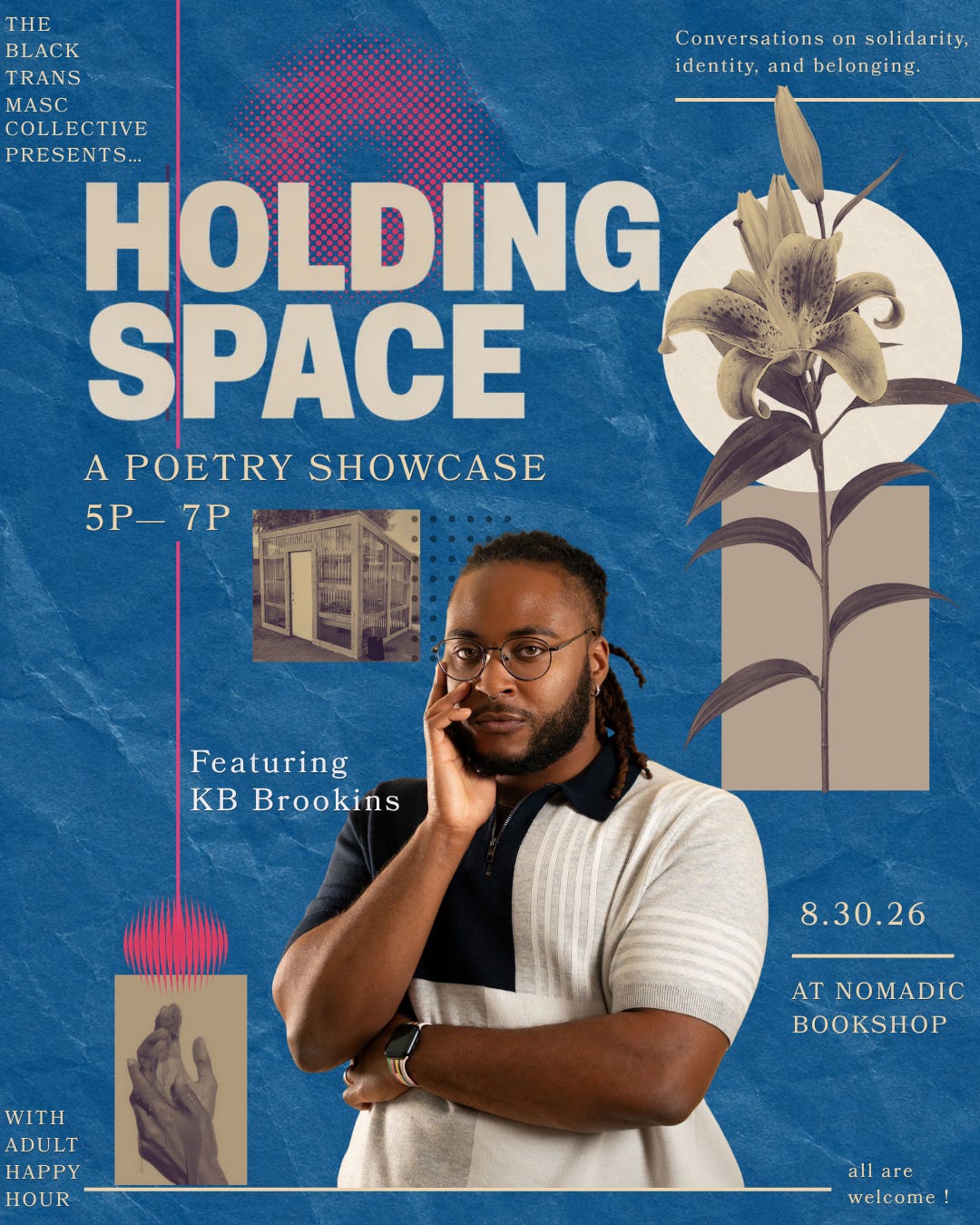
Bay Area peeps: I’ll be reading new work with the Black Transmasc Collective on August 30th, 5-7pm at the Nomadic Bookshop. This will be my first IRL reading as a bay resident, and the first time I’m reading on a lineup of all Black transmasc writers!!
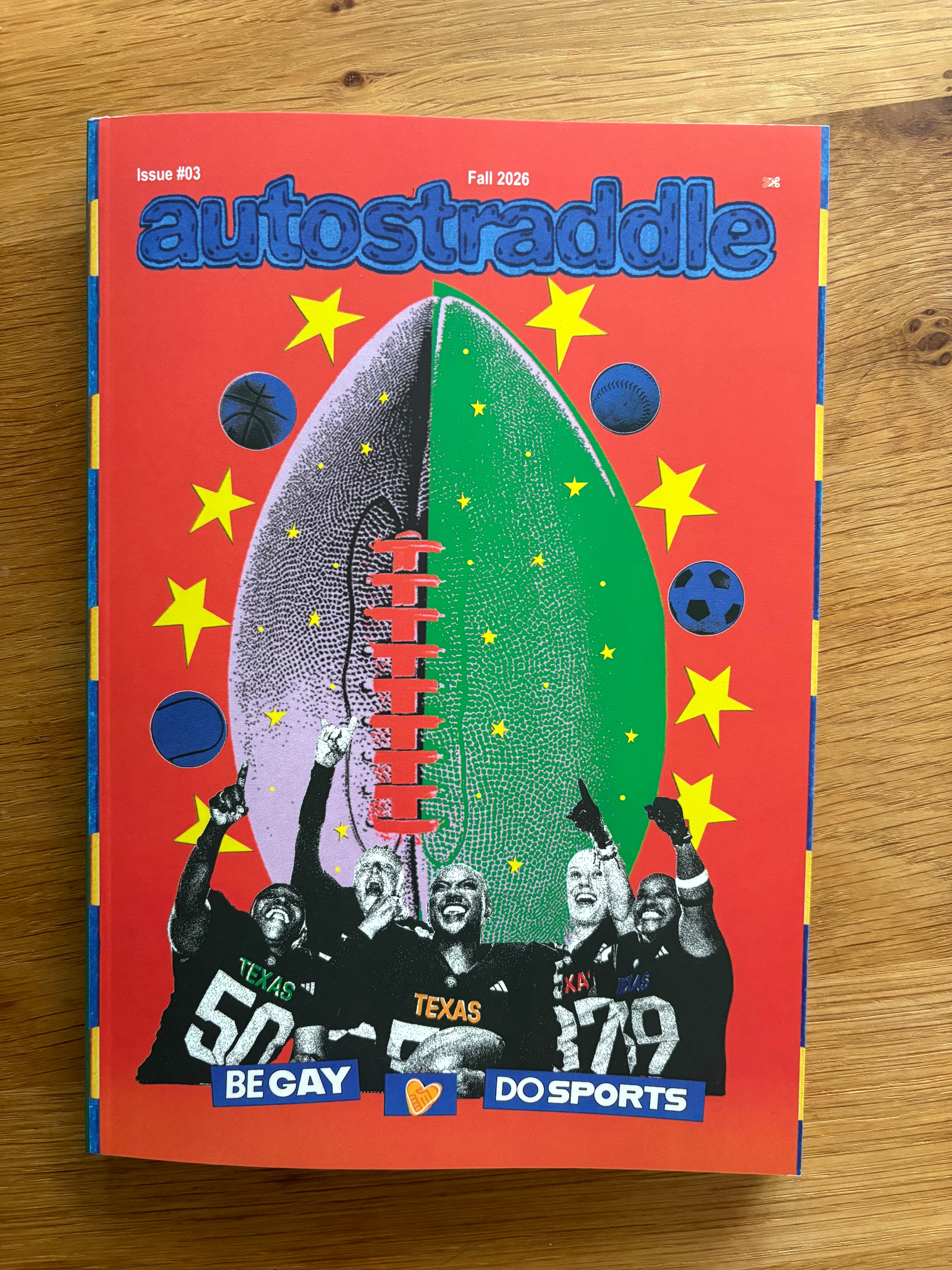
I’ve got a piece called “I Can’t Bottom Anymore” in this very cutesy print edition of Autostraddle that you can buy here!
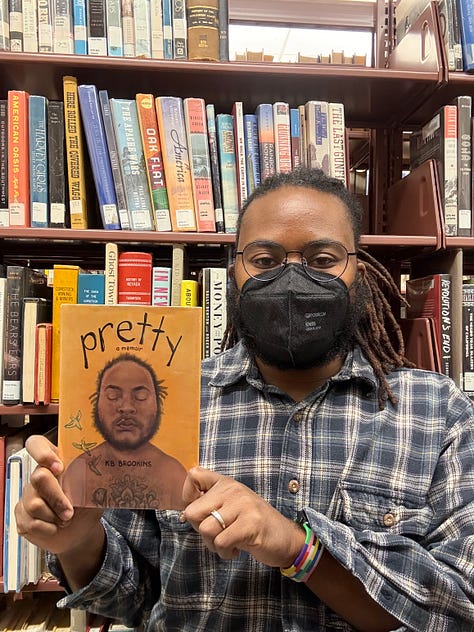
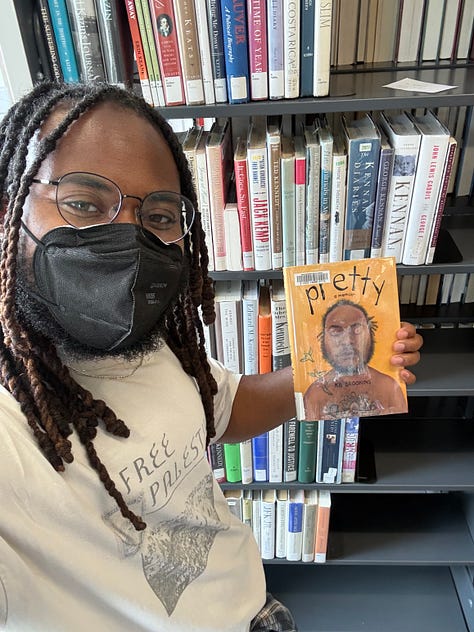
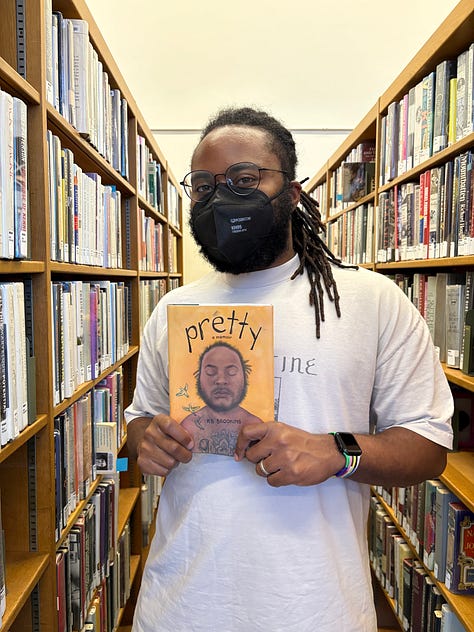
I’m v pleasantly surprised by how many places in the bay have Pretty on their shelves :) getchu a copy here!
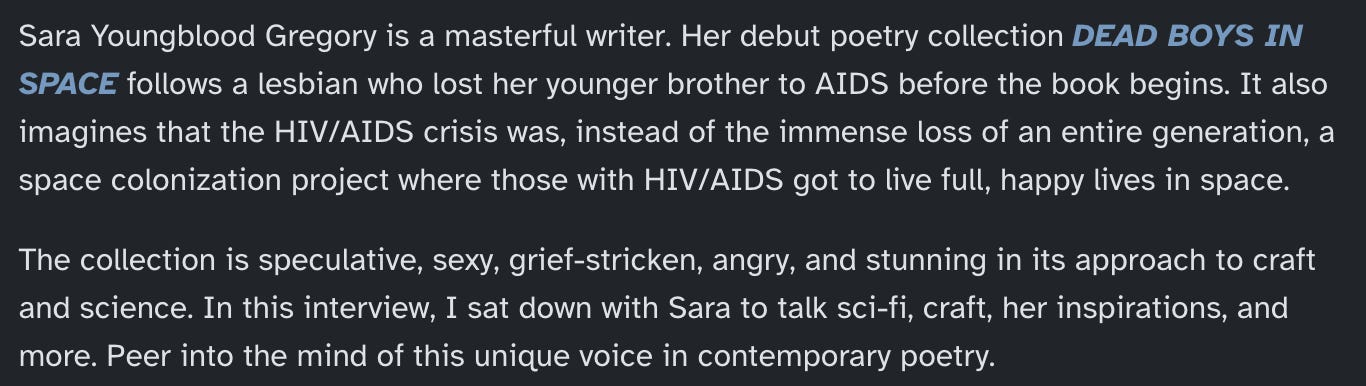
I got an interview with the writer Sara Youngbloog Gregory in many wor(l)ds that you can read here!
I’ve also got 9 poems, 2 short stories, and an essay coming to your inbox by the end of the yr :)
That is the golden question — or at least a question probably every Creative Writing professor and panelist is fielding from you hungry writers. I gave some thoughts in this post a while back, but I figured hey! It’s almost MFA application season, so I’ll give you an extended view into my neuroses around MFA’s in hope that it’s helpful to you.
In 2016, fresh off of the double-whammy that was the first Trump election (the first election I voted in D:), I was very eager to leave my hometown lol. I love it dearly, but it is ultimately a safe haven for conservative politics, and this Black trans writer could not take another year in a place where people were praising a dingbat for becoming president. My cortisol was high AF, and I had no idea what I was doing after undergrad.
“Should I get an MFA?” I asked myself. Famous last words.
I applied to four and got into three. Woo woo! I chose the one that was closest to my best friend and gave me the most funding. Unfortunately, that friend died before I started this MFA — which left me a flaming hot mess in an unfamiliar place. I was the only Black person in all three years of the program, and the program only had one Black professor. I write like I speak (Blackly), and one white boy literally called me “spoken word” LOL. My work and my mental health was getting worse.
So after my first year, I dropped the hell out.
A few slick-mouthed peeps from that program said, in different words, “you can’t really be a writer without an MFA.” To that I said: watch me. Within one year of leaving that program, I moved to Austin, went to probably every literary event in the city, gained writerly friends outside of academia (that I still have to this day), and submitted to 100+ opportunities. Of course, most of those submissions were rejections (lol), but I ultimately got 10 or so pieces published (yay!) and got into my first non-academic writer’s workshop: Lambda Literary (double yay)!
What I’m saying is: I gained momentum.
And I kept trending positive in 2018, then 19, then 20. More publications, more friends, I had a day job and worked the page and the stage at night and on lunch breaks. I used my lil book discount to get any book that was recommended to me. I worked my ass off — partly to prove those people wrong, and parly cause I love this shit! The writing/reading/being around writers stuff is the stuff that kept me alive as I was going through a pretty intense personal tragedy.
And then, it happened.
I kept doing my thing and kept hitting walls. You must have an MFA to apply to this fellowship, FAQ’s would say. I also learned, through leading a few workshops with the Austin Library system, that I loved to teach, but I’d never be able to teach the age group I wanted (undergrads & up) without an MFA. Even with a book (and I had a chapbook published + a full-length poetry collection on the way), I couldn’t get a teaching job at all.
“Should I get an MFA?” I said — much more reluctantly. The answer, for me, was yes.
This time, I went into the MFA thing with some clear goals:
I want the teaching experience so I can get a teaching job
I want the piece of paper so I can apply to more fellowships/grants that I’m currently not eligible for,
I wanna improve my writing chops across multiple genres — ideally poetry, fiction, and screenwriting.
I also had boundaries:
The program must be fully-funded (I didn’t want to go into debt)
It must be in Austin or low-residency (I didn’t want to move)
It must be diverse (To ensure this last one, I talked to a few students in the program and asked them to be honest about the program’s makeup along race, gender, and sexual orientation — three demographics that matter to me and my work)
So: I chose UT Austin (i.e. I applied only there twice, and I got in the second time).
Thanks for reading Out Of This World! This post is public so feel free to share it.
the answer for “should I get an MFA?” is really a secondary question. Your primary one is something like “I want to get to the next phase of my literary journey. How do I get there?” The answer to that question has two tracks:
Besides undergraduate teaching experience, everything that you can get at an MFA you can just create on your own. It’s not centralized in one place, but it is all possible! Here’s how I personally made my own MFA (before returning to get one):
Attend short-term workshops.
At these, you get feedback on your work, meet agents and editors of presses, generate new work, and meet peers and faculty that you can ask for letters of rec in the future (major key)! I did a few of them pre- and post-MFA and 100% recommend it. Some of them are called retreats, fellowships, conferences, etc, but the function is the same. Here’s a (non-definitive) list of some notable ones:
McCormack Writing Center (formerly known as Tin House)*
Aspen Words’ Summer Words Writers Conference
In Surreal Life (virtual)*
VONA (for writers of color)
The Watering Hole (for poets of color)*
Lambda Literary Writers Retreat (for LGBTQIA+ writers)*
Cave Canem (for Black poets)
Hurston/Wright Foundation’s Week and Weekend Workshops (for Black writers)*
The Kimbilio Retreat (for Black fiction writers)
Kundiman (for Asian/Asian American writers)
CantoMundo (for Latino/a/e writers)
Macondo Writers Workshop (for activist writers)
You’ll notice that a lot of them happen during the summer or winter because a lot of the teachers are on an academic schedule.
*These are ones that I personally have done and would be happy to talk to you about :)
Be a community member.
Go to events at you local library and independent bookstores. Go to your local open mics and reading series’. Get to know booksellers and librarians by name. Go up to writers whose work you like and say “I like your work” lol. It helps your writing to just… be around writing. It also makes being a writer more fun (imo)!
Join a writing group.
If you’re looking or a group of serious writers to give you feedback on your work, I bet that already exists someplace near you outside of academia! Search for it on Facebook, Instagram, Threads, TikTok. Look at the flyers at your local library, coffee shops, independent bookstores. If it doesn’t exist, I bet you can also create it! I myself have made a few over the years and have benefitted greatly from it.
Read, analyze, and apply!
Read books, ask yourself “why do I like/dislike this?”, read essays/other resources about those books, and then apply what works in them to your work. Often, that’s what an MFA is doing!
If you need structure/accountability, consider creating (or being a part of, if you can find it) a study group. Currently, I’m in a book club where we read one Toni Morrison novel a month then talk about it as a group. It’s remarkable how better your writing gets once you start reading, analyzing, and applying!
If you are like me and must get an MFA in order to teach, or apply to stuff you can’t currently apply to, or have some structure, or simply, you just want to get one, here are some things I suggest.
Make a list of goals.
Ideally, they would be SMART goals. Besides the ones I’ve already listed, here are a few examples:
I want to write a book of poetry that I feel confident sending to presses in 3 years.
I want to take a course in screenwriting in the next year.
I want to gain 2 years of undergraduate teaching experience.
I want to gain at least two people that I can share my work with in the next 6 months.
Make a list of boundaries.
Besides the ones I’ve already listed, here are a few examples:
I don’t want to attend a literature-intensive program (i.e. I’m mostly taking courses in english, not creative writing)
I don’t want to attend an in-residency MFA.
Keep your options open.
Poets & Writers has a great MFA Programs Database. Check it out to see what all is available for you.
Look at the MFA’s course offerings.
Do you want to take classes in fiction and CNF? Poetry and screenwriting? How often to they offer these classes? Look at all this before you apply. This way, you don’t get stuck at an MFA that can’t offer what you’re looking for.
Don’t choose an MFA just because you want to work with one specific faculty member.
That person may go on maternity leave, or sabbatical, or you might not get in their classes. And then you’re SOL! It’s better bet — time and money-wise — if there are multiple people there you would like to/wouldn’t mind working with.
Don’t go into debt getting an MFA.
They don’t guarantee a job on the other end. I’ve heard of people doing it and doing just fine afterwards, but in this economy, I can’t recommend it.
Talk to current students after you’ve been accepted.
They can give you an idea of what it’s like living in that town, what type of workshops to expect, work load, demographics, etc. It’s a major key that I wish I would’ve done the first time.
Keep up with instructors and classmates post-grad.
These will be, if you’re lucky, people you can count on to write letters of recommendation, or edit your book, or be your agent, or write a review for your book, or be a conversation partner for an event, etc. It’s better to not do the literary thing alone!
Do what you want! Just make it an informed decision. If you’d like to chat with me personally about stuff like this and more, consider becoming a paid subscriber. They get 30-minute office hours with me up to once a week (more info here)!
Till next time!
Love, Peace, & Chicken Grease,
KB
No posts
Comments
Nothing yet. Say the first thing.
Sign in to join the conversation.