
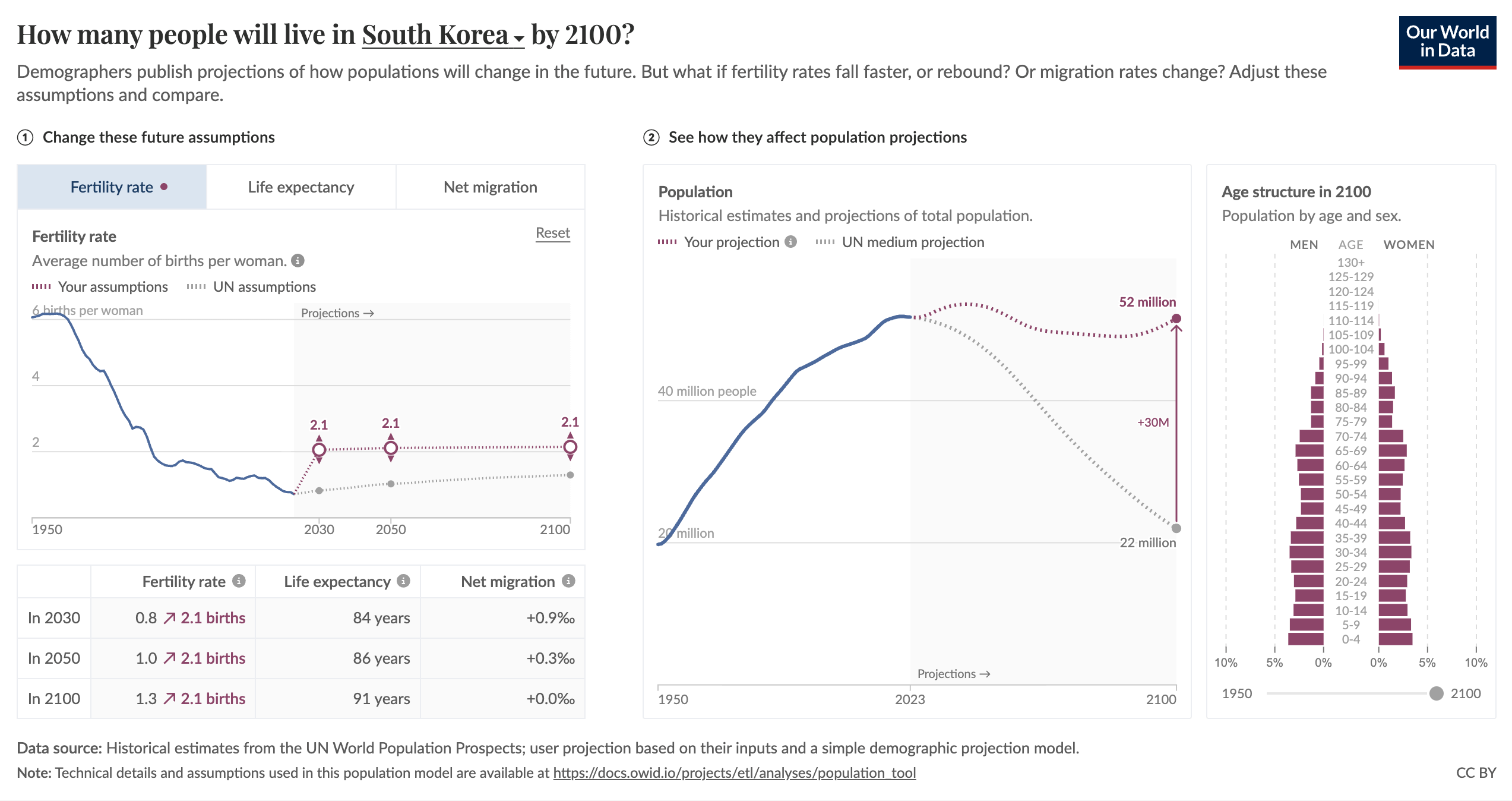
How many people will live in your country in 2100?
Demographers publish projections using assumptions about key demographic changes, most notably fertility rates, life expectancy, and migration rates.
But no one knows for sure how many children people will have decades from now, or how migration will shift. So it’s worth asking what the population would look like if things turn out differently from what the UN or other demographers assume.
Our colleagues Daniel Bachler and Sophia Mersmann built a population simulation tool that lets you do just that — for every country in the world. Pick a country, adjust the assumptions, and see how the projections change, for both total population and age structure.
For instance, what would happen if fertility rates recovered to replacement level, or migration was cut in half?
And in a new article, Hannah Ritchie uses the tool to focus on South Korea, whose population is projected to more than halve by 2100, from 52 million today to just 22 million. What would it take to stop the decline? And how likely are these different scenarios?
One in four children in the world today suffers from “stunting”. That’s 150 million children under five.
A stunted child is too short for their age due to poor nutrition and frequent infections. Stunting suggests that their physical and cognitive development has been hindered, and the effects can last a lifetime.
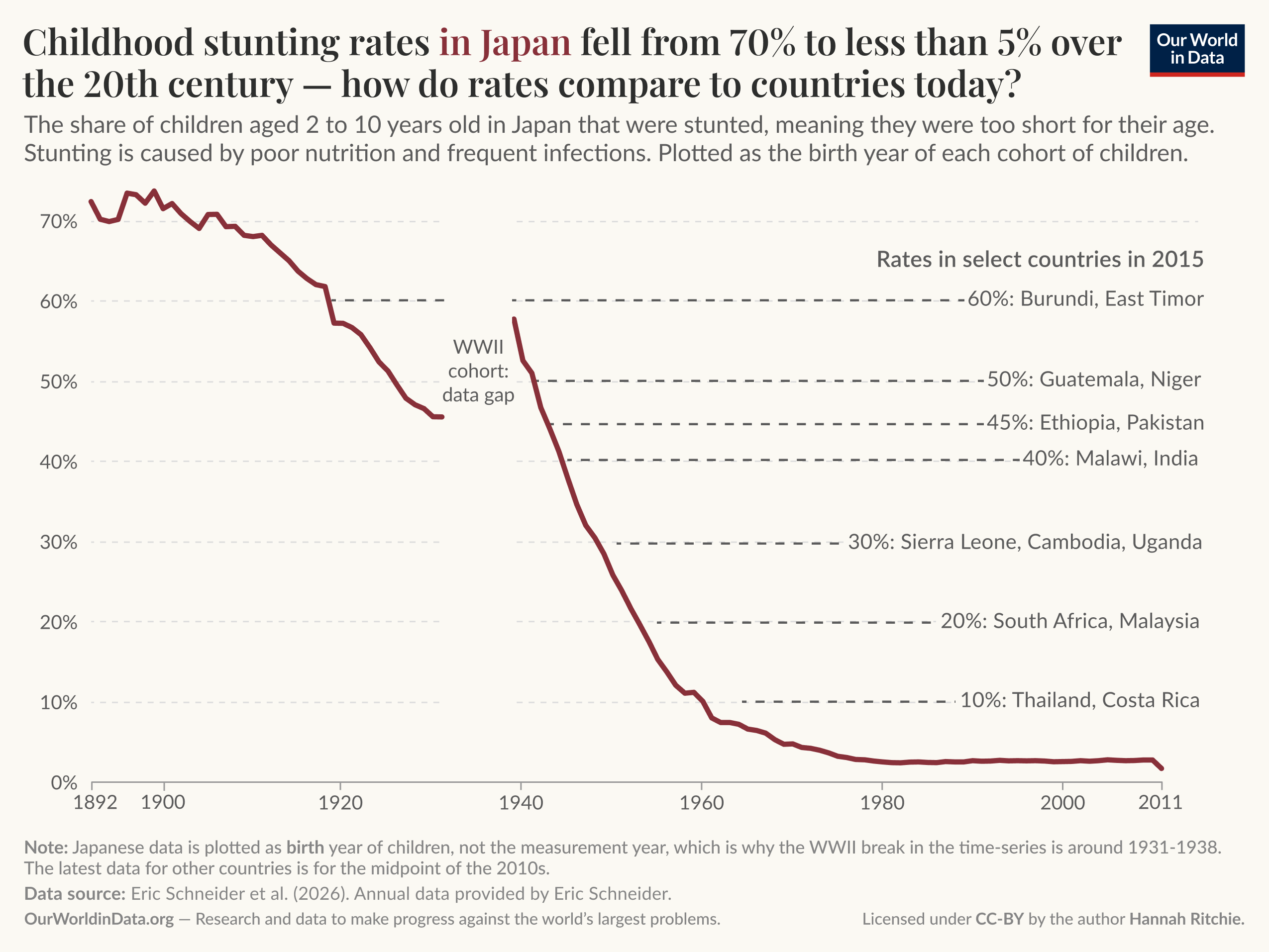
In many countries, stunting was once prevalent but has now been nearly eliminated. Japan is one such success story that has particularly high-quality data.
But there are still many countries, especially in Asia and Africa, where stunting affects more than a third of all children. You can see this in the chart.
How have some countries made so much progress against stunting? And what can other countries where rates are still high learn from this?
In a new article, Hannah Ritchie and Tuna Acisu answer these questions by zooming in on Japan.
Before World War II, Japan focused on tackling infectious diseases, particularly through the expansion of clean, piped water. Stunting declined at a moderate pace.
After the war, they tackled both disease and diet, with diversified foods, school lunch programs, and more. This multifaceted approach made progress nearly three times faster.
Read Hannah and Tuna's article
Bite-sized insights on the world and how it’s changing

More than a million people die from road injuries every year →
Cereal yields in Ghana have increased much faster over the past decade →
Japan closed nearly all of its nuclear plants after Fukushima, but some are coming back online →
Tajikistan’s remittances are worth nearly half the country’s GDP →
Our dedicated Data Insights newsletter delivers new insights right to your inbox every few days.
We’ll often see headlines quoting how many gigawatts of new solar farms or coal plants China is building. But it’s hard to get a meaningful sense of scale for how electricity generation in China is changing.
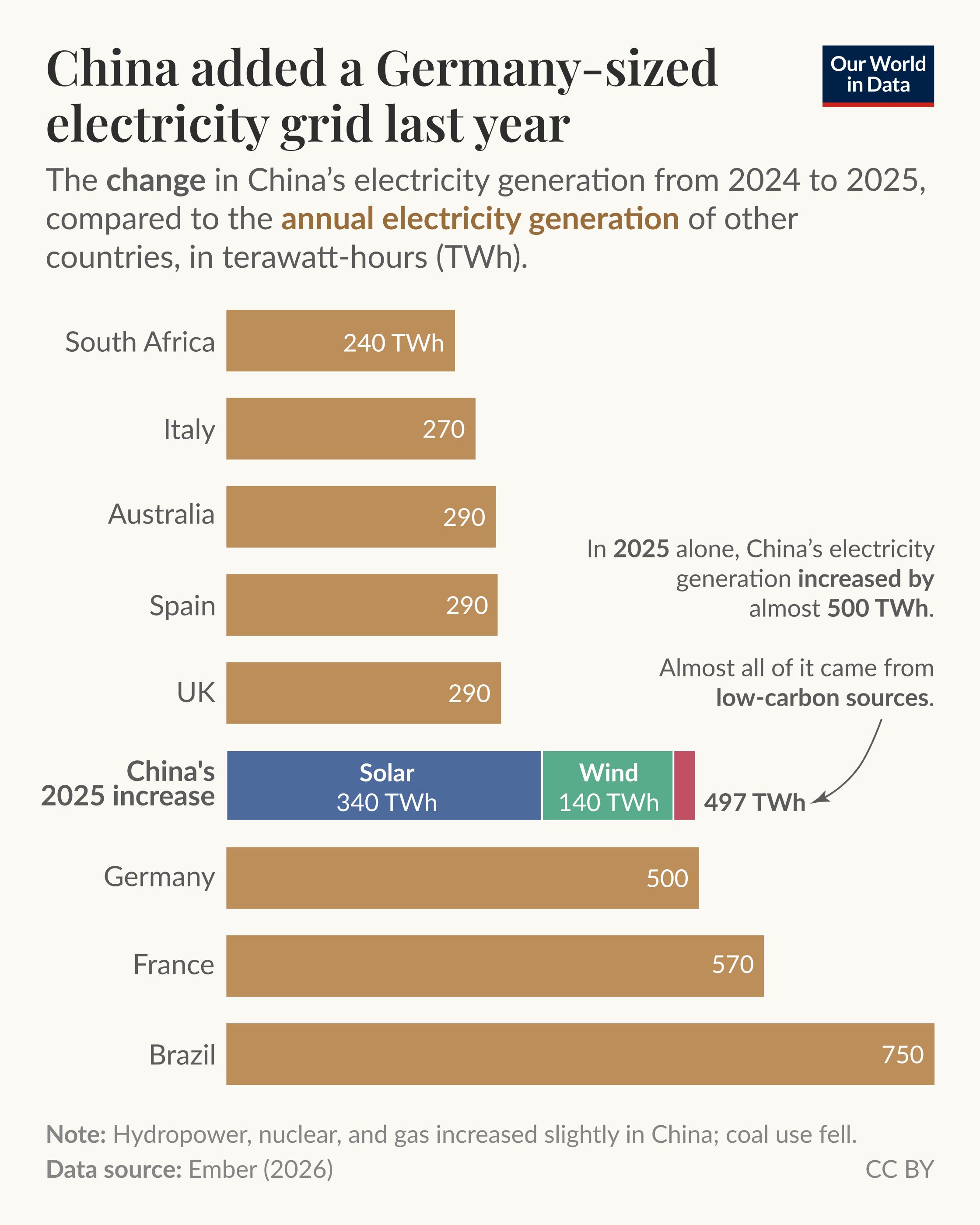
The chart here puts it in perspective.
In 2025 alone, China’s electricity generation increased by almost 500 terawatt-hours (TWh). This is compared here to the total amount of electricity that whole countries generate each year.
Germany generates almost exactly that amount. That means China effectively added a Germany-sized grid to its electricity system in just one year.
What’s also quite staggering is that almost all of this new generation came from solar and wind. China generated 340 TWh more electricity from solar than the year before.
That’s more than the UK and Spain, for example, generate from all sources each year. Low-carbon sources grew so much that coal power in China actually fell slightly.
Why do we need to know about progress if we are concerned about the world’s largest problems? Explaining the mission of Our World in Data.
We spend around 80,000 hours of our lives working: 40 hours a week, 50 weeks a year, for 40 years. That’s a lot.
It makes choosing a career one of the most important decisions we’ll make, particularly if we want to help build a better world.
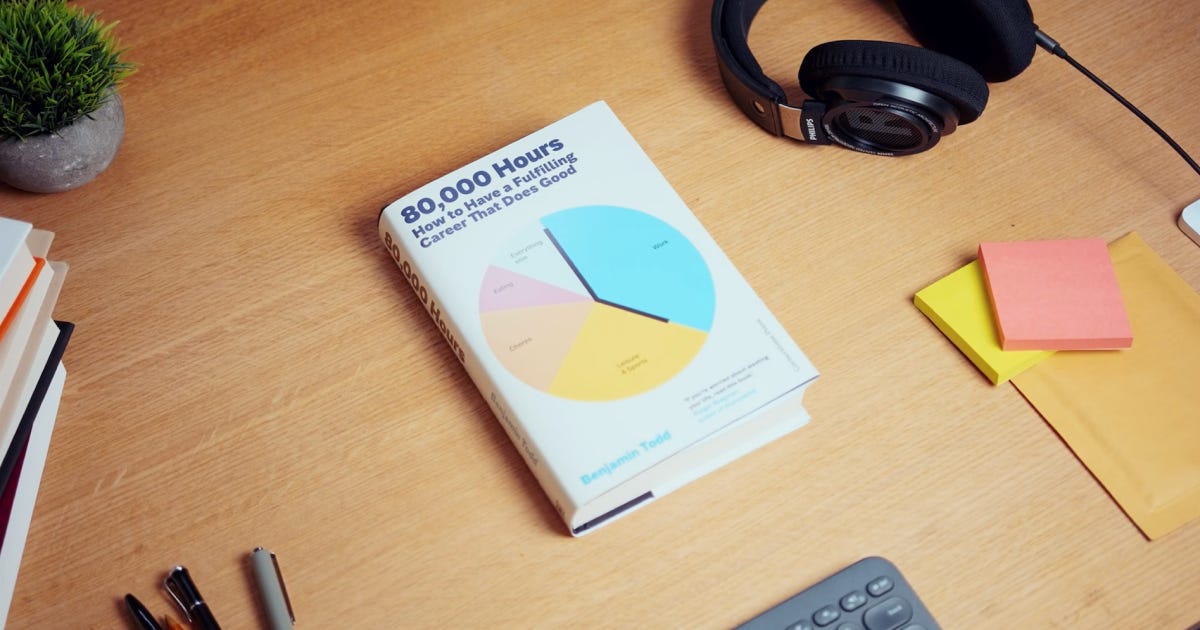
A new book by Benjamin Todd argues that most standard career advice has little research behind it, and doesn’t account for how AI is changing the job market.
Todd is the founder of 80,000 Hours, a nonprofit with a mission to help people have a positive impact with their careers.
Drawing on years of research and advising thousands of people, Todd covers what makes a fulfilling job, where you can have the biggest impact, and which careers are likely to thrive in the age of AI.
I’ve long recommended 80,000 Hours to anyone thinking about their career. I even found my role at Our World in Data through their job board!
– Pablo

Fertility rates — measuring the average number of children per woman — have been falling worldwide.
Most countries are now below the “replacement rate” of 2.1 children, and their populations are expected to shrink and age by the end of the century.
In a recent article for the Financial Times, John Burn-Murdoch digs into why, and what might be done about it.
“In previous decades, the world’s fertility rate went down because couples had fewer children. Now the main reason is that there are fewer couples”, he argues.
He notes several barriers to coupling, such as falling home ownership and a rise in young adults who live with their parents.
But the most important driver of the recent decline, he argues, is smartphones and digital media, which affect the way young people socialize and couple.
If digital media is indeed a major cause, it suggests a possible solution: changing our digital habits.
– Charlie
The mission of Our World in Data is to increase understanding of the world’s largest problems and drive informed action to solve them.
We are a nonprofit, building Our World in Data as a public good that’s freely available to everyone. Help us do more by supporting us with a donation.
Comments
Nothing yet. Say the first thing.
Sign in to join the conversation.