
The Bluegrass of Kentucky was the center of development for four industries important to 19th and 20th century America: horse racing, bourbon, hemp, and tobacco. Each of these industries required a large number of very skilled workers. Kentucky farm owners used a large pool of enslaved Africans, and enslaved workers outnumbered the slave holders. What happened when they had to free their slaves?
The end of slavery in Kentucky was a complex process because many slaveholders could not see a way to run their businesses without slaves. On December 18, 1865, the 13th amendment was ratified and slaves became free, though Kentucky would not ratify the 13th amendment until 1976. The only way for businesses to remain open was to pay their newly freed workers.
The newly freed people needed somewhere to live. This resulted in the establishment of black hamlets throughout the Bluegrass, where freed people owned their land and homes. A few hamlets predated emancipation, but most were established after 1865. The newly freed landowners built homes, established farms, and planted trees for shade.
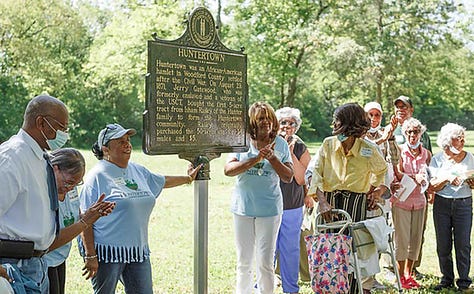
Some years ago, while working on my book Venerable Trees, I surveyed a number of the black hamlets. In Woodford County, I visited Huntertown, which is now the Huntertown Community Interpretive Park, designed to celebrate the lives of its former residents. I had the help of some Woodford County High School Students.
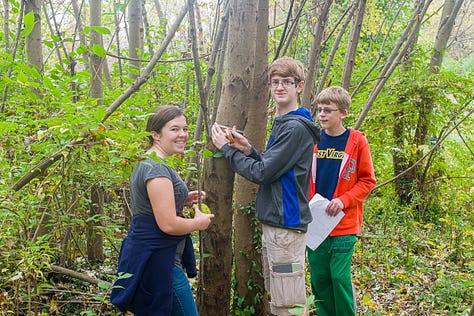
To my surprise, the hamlet was dominated by silver maples, Acer saccharinum. I did not expect this on a Bluegrasss upland: silver maples are bottomland trees found along rivers and larger creeks. Part of Huntertown was originally a wetland, so I thought that might be the explanation. I then explored some of the black hamlets that are still accessible and found, again to my surprise, that silver maple is a dominant tree in most of them. I plan to survey more hamlets as time permits.
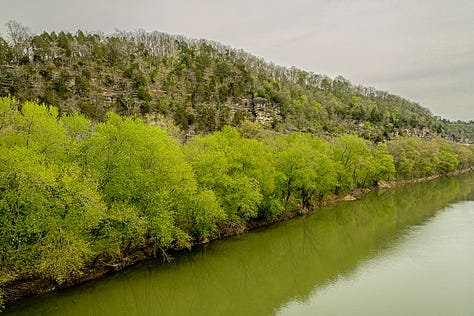
Think about the history of these settlements. Like most of the Bluegrass, the land was open pasture, originally cleared by bison, later maintained by grazing livestock. When they established the black hamlets, the new landowners were poor, lacked resources, but needed shade. Remember that these landowners were highly skilled at all aspects of farming, including plant establishment. I think that they went down to the Kentucky River and transplanted small silver maples to their new hamlets. Silver maple is easy to transplant and grows well after planting. The freed people would have known this.
We should, perhaps, think of silver maple as the unofficial tree of the black hamlets.
No posts
Comments
Nothing yet. Say the first thing.
Sign in to join the conversation.