
Before getting to our lightning story, I want to update you on what we are doing at Our Trees. This is a science-based but nontechnical newsletter for people who are interested in trees. We cover a wide range of tree-related topics. Some general information:
The majority of our stories are open to every subscriber, paid or unpaid. We want these stories to reach a wide audience.
We deeply appreciate our paid subscribers and hope that you will consider supporting our work with a paid subscription. Replies/comments are generally open to paid subscribers. We will soon be requesting input from our paid subscribers about the direction and content of Our Trees. Some special stories will be reserved for paid subscribers.
We will now be publishing stories on a weekly basis, with 1-3 stories each week, typically on a single topic. Notes will appear regularly, though not on a fixed schedule.
At about 4 this morning, I was awakened by a sharp series of thunder claps, with bright light pulsing outside my windows. This has been the wettest summer in the Bluegrass in my memory, with large effects, both positive and negative, on our trees and forests. More on that later. For now, let’s focus on lightning, since that is what woke me up.
Lightning is among the most important causes of tree death, even if we only count trees directly struck by lightning and ignore forest fires caused by lightning. The effects of lightning on trees is very complex and depends in large part on the physiologic status of the tree, especially on the distribution of moisture and solutes like sugar or salts within the tree. Here is an example of a tree struck in mid-summer.
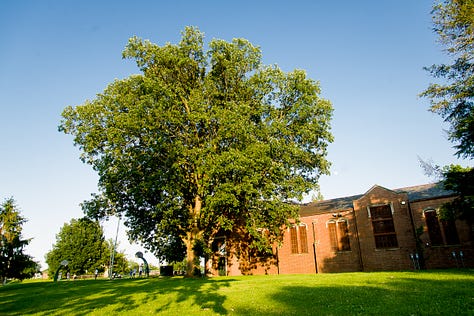
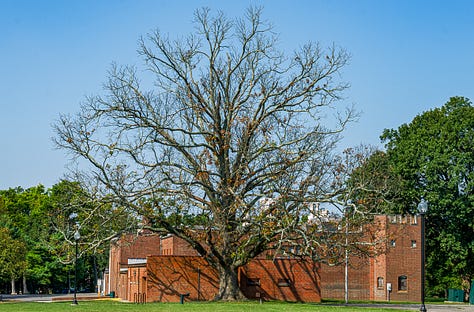
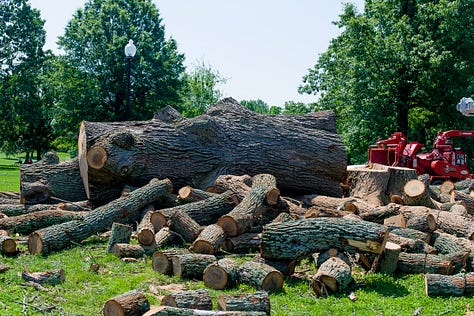
The tree was at the peak of its growing season when struck. There were no external signs of damage except that the leaves immediatly wilted and fell off. All the tissues in the stem were dead immediately after the strike. When we cut up the tree to remove it, all the layers of the stem - inner bark, cambium, sapwood - were entirely dead. My interpretation is that all those tissues were wet and actively growing, allowing a pathway for the lightning to pass through the entire tree.
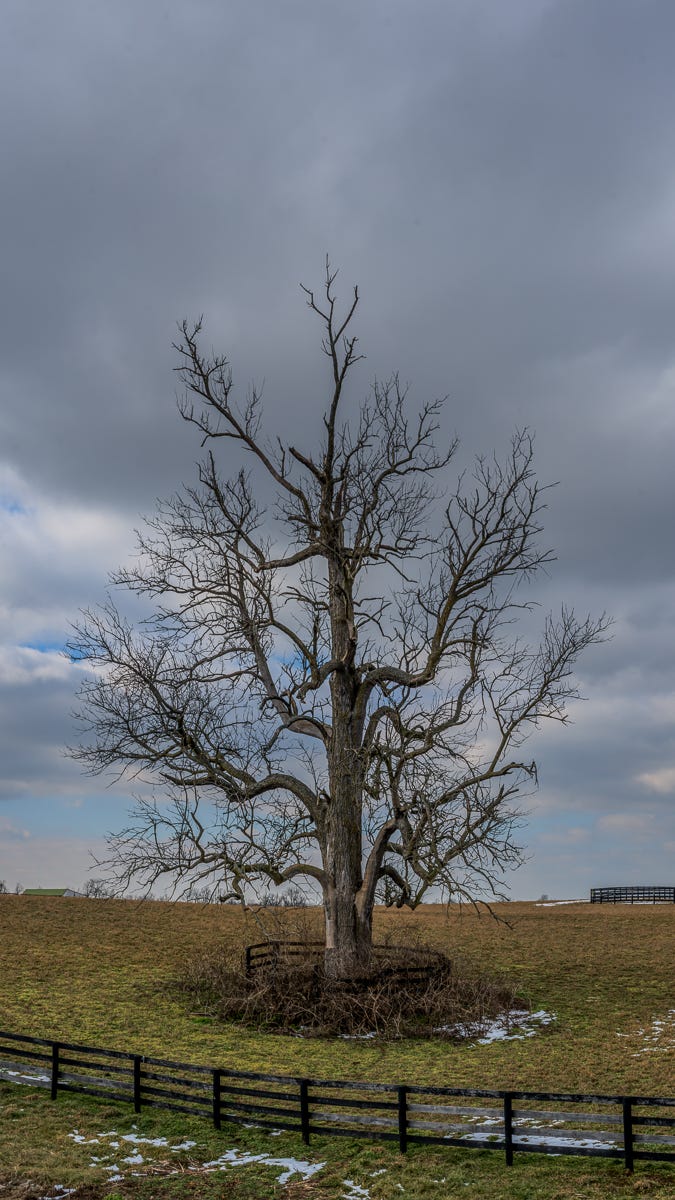
Here is a blue ash, Fraxinus quadrangulata, killed instantly by a lightning strike at the peak of the growing season. I examined the tree and found, to my surprise, that all the fine roots were dead and looked as if they had been cooked. The remainder of the tree gradually deteriorated as shown in the photo, but death of the roots was the proximate cause of death.
These patterns are consistent with a tree struck in the middle of the growing season. They are usually killed but not always with obvious symptoms. In contrast, many trees survive a lightning strike if it is not at the height of the growing season. Once the cambium stops dividing, the moisture content of the phloem and cambium declines. The path of lightning through the tree is then the heartwood and sapwood.
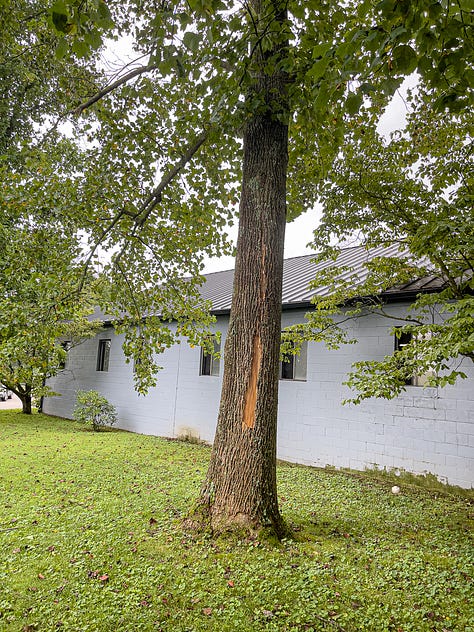
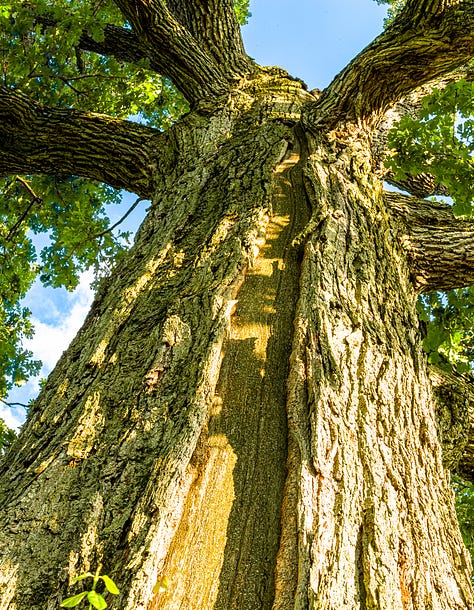
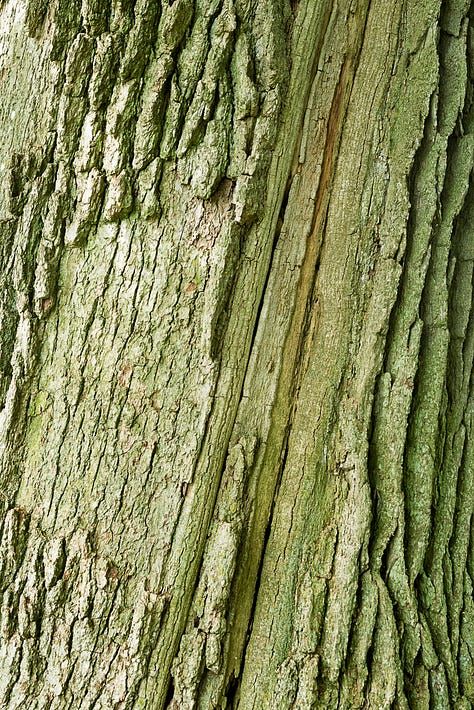
Here are three trees struck by lightning but not killed. It is common for a strip of cambium to be killed, and the tree then creates wound tissue. The tree in the center lost its upper crown. The bur oak on the right has a lightning scar that is many decades old.
There is clear evidence that climate change is increasing the frequency of lightning strikes. I have the clear sense that the rate of tree mortality to lightning strikes in the Bluegrass is increasing, though I have not collected data.
Individual trees can be protected by installing lightning protection, but the cost is very high and requires a large amount of labor by skilled tree climbers. However, the damage that could be done by a tree being struck and then falling can be much greater. If you have an important tree in your yard, I certainly recommend that you consider protecting it.
The real solution, though, is to reduce the rate of lightning strikes. The way to do that is to end the climate crisis by eliminating fossil fuel use and taking some other steps. The end of fossil fuel use is in sight: solar and wind energy are already much cheaper and their costs will continue to go down. The more we can accelerate the transition to renewable energy, the better off we will be in all respects.
No posts
Comments
Nothing yet. Say the first thing.
Sign in to join the conversation.