
Originally published 16 January 2021
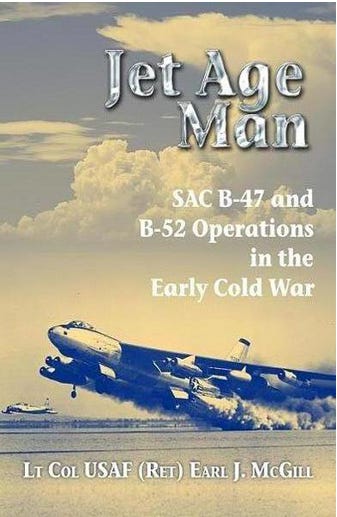
A fascinating first-person narrative of the author’s experiences in Strategic Air Command (SAC) during the Cold War. He flew (or maybe, "survived”) a particularly dangerous and challenging aircraft, the long-retired B-47, and later in his career the much safer B-52.
This is a profoundly interesting series of vignettes from the early days of the Air Force, which found itself in the odd position of becoming perhaps the most important service (from a narrow and perhaps ultimately misguided strategic/policy perspective) only a few short years after it split from the Army after World War II.
The author’s first operational aircraft, the B-47, was a product of theory, not of experience. No one had ever built a supersonic heavy strategic bomber before. It was bleeding edge in every sense, especially in that it was profoundly dangerous to fly, stalling and killing its crew routinely due to its very narrow and unforgiving flight envelope. The narrator lost many, many friends to the aircraft and had numerous close-calls himself.
From the author’s statistics - 12 planes in every 100 suffered a catastrophic crash. Almost 500 people died as a result.
How did such an unsafe plane enter mass production? Was it designed poorly?
Short answer is that the plane was fine - as long as you flew it how it was intended. The B-47 was designed before the coming of age of the surface-to-air missile. It had been originally designed to fly too high and too fast for Soviet interceptors and anti-aircraft guns to successfully engage.
However, early in the B-47’s lifetime, it became clear that new Russian SAMs were incredibly effective at shooting down aircraft at high altitudes. This led USAF planners to change the B-47’s tactical profile. Instead of high, fast, and straight, they ordered low, fast, and evasive.
The density of the atmosphere at lower altitudes, coupled with the thrust capability of the engines in dense, humid air, led to drastically underpowered engines that made take off and landing exercises in super-human precision. This, coupled with the unplanned stress on the airframe due to the denser air and more aggressive maneuvering, turned a safe plane into a lethal one.
There is an important lesson here to everyone, not just aerospace engineers. Systems of any type and any complexity, once operational in the world, will always, due to unpredictable circumstances, will be employed in ways unplanned.
It appears so clear, looking back with hindsight, knowing about current aircraft and air defense systems, that the B-47 would be doomed. It is important to note that it was not clear at the time - nowhere near so obvious.
Where are we blind now? What assumptions of ours are deeply, obviously, flawed? Is it even possible to know?
Good questions to ask.
—
The book is also an interesting view through the “Doctor Strangelove” window, into that time of the early Cold War.
The book shows the trickle-down of grand national strategy into the lives of young pilots and enlisted men. The cold, pragmatic war-room calculus translated into life and death operations by the airmen manning the bombers. To be specific - the strategic imperative to present a credible threat of nuclear destruction to the Soviet Union led to unprecedented defense spending and thousands of lives lost in training, all for something that never happened.
While that sounds wasteful - it was absolutely essential. Those lives were not given in vain. The Cold War was won through the collapse of the Soviet Union, in no small part due to the grit and determination of the servicemen who contributed to nuclear deterrence. In addition, each crash contributed to the body of knowledge that would improve aviation safety (and directly lead to improvements that make our current passenger planes so incredibly safe today).
The technology races prompted by the Cold War can be directly traced to things like the internet, the microchip, and countless other consumer technologies we enjoy today.
——-
McGill, E. (2012). Jet Age Man: SAC B-47 and B-52 Operations in the Early Cold War. Helion and Company. https://www.amazon.com/dp/B00COCM0XW/ref=docs-os-doi_0
No posts
Comments
Nothing yet. Say the first thing.
Sign in to join the conversation.