
Although I am a liberal, I am also a radical. This means that I have a highly ambivalent attitude towards socialist, especially Marxist, forms of social critique. Despite their theoretical failures - and there are many, including their unjustified aversion to “bourgeois” social science and political philosophy - I am also attracted to their flirtation with new ideas and the promise of “real Utopian” change. Recently, I delved into Herbert Marcuse’s “Eros and Civilization” and Mark Fisher’s posthumous “Postcapitalist Desire” (which draws heavily from the former book).
Since they go together so well, and since I found them both quite interesting, it makes sense to review them together. Let me start, chronologically, with Herr Marcuse:
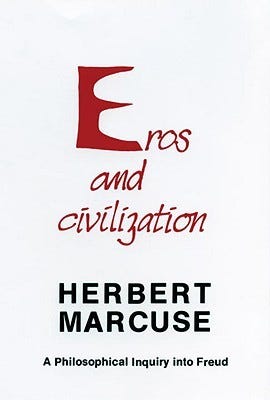
“Eros & Civilization: A Philosophical Inquiry into Freud” (H. Marcuse, 1953)
Before reading this book, I will readily admit to some biases against Herbert Marcuse. I was primed to see him as a somewhat cranky relic of a different time when Marxism and psychoanalysis - both famously dismissed as pseudoscience as Karl Popper - were, for a while, les causes célèbres among both German-Jewish intellectuals and Western student radicals. But surely today (almost) nobody can take seriously the twin suggestions, associated with Marcuse-type radicals, that the United States is a totalitarian society, or that capitalism is hostile to sexual desire?
Every few years, I even manage to convince myself that I am over Freud and Marx. But they keep on making a comeback. This is because people working in those flawed traditions have made enormous contributions to social theory. Nobody can deny that Eros & Civilization is a book of (flawed) genius and awesome inspiration. Here, Herbert Marcuse has achieved a rather difficult task of turning Freud and Marx into creative, non-doctrinaire weapons of a kind of general, libidinal condemnation of modern society. Although the end result is rather terrifying, even morally irresponsible, it is rather powerful stuff. Who said that social theory should be easy, comfortable, or "nice"?
Before going over content, let me comment on style and form. Marcuse writes like a German, mostly dry and humourless. Nonetheless, behind the bureaucratic façade, there is a quick-wittedness and "earthiness" about him that only the best in the Frankfurt School can match. This means, on the one hand, that he can ground his analysis on concrete examples and the young people's concerns, including Cold War paranoia, militarism, media propaganda, consumerism, etc. And, on the other hand, it means that this book manages to be quite entertaining, engaging, even uplifting, despite the rather somber, dark, and pessimistic "Kritik" that it espouses. Without such stylistic virtues, the book would be just another gravitationally heavy dust collector. And make no mistakes about it: there is plenty of jargon still to be had! Putting together Marxist and Freudian jargon - even if Marcuse does it in idiosyncratic ways - is a recipe for terminological mayhem. Some readers will necessarily be turned off by the more jargon-imbued chapters. This is to their detriment, since they never get to the very good stuff. And there is plenty of that, too.
The most impressive theoretical feat of the book is that it can appeal to so many audiences. It can naturally appeal to radicals frustrated by Communist orthodoxies. It can appeal to social scientists willing to consider Freudian insights into the social realm. And it can appeal to young people frustrated by prevalent conservative attitudes towards sexual and lifestyle liberation. But it can also appeal to those readers (including myself) who take a more critical attitude towards Marxist doctrines and Freudian theory. In a nutshell, Marcuse makes a compelling, "real Utopian" case that we can, and we should, dare to dream about a society without "surplus repression" - a society of maximal, uninhibited desire fulfilment, where exploitation ceases, and the categories of work and play collide into each other. Although unabashedly Utopian, extremely unconstrained, and only barely within the limits of what is reasonable to hope for, Marcuse's vision is sufficiently grounded in real-world possibilities for radical social and political reforms to be something more than "pie in the sky" fantasizing. As society progresses, such visions become realistic. Indeed, Marcuse himself points to the possibility (already recognized by Marx) that capitalism keeps on producing more and more stuff, which makes the society more and more capable of surviving without alienated labour. Nor is there any reason to believe that the basic insights of Marcuse's analysis necessitate a Marxian vision. Unless, of course, by the Marxian vision, we simply mean the basic commitment to egalitarian and libertarian emancipation - but this would give Marx too much credit, since many forms of liberal and democratic radicalism, to say nothing of non-Marxist forms of socialism, share that basic vision, and it is not clear that Marx's vision is the best one. In my opinion, an emancipated, sexually liberated, and imaginatively uninhibited society where surplus repression is minimized is not only feasible (in the long run) but compatible with the anarchist and liberal dream of equal freedom for all. I am mostly convinced: against all odds, Marcuse has seduced my inner Spinozist and Nietzschean radical of the worthwhileness of the task of mining moribund Marxism and fraudulent Freudianism for novel insights. And most impressively, this can be done without accepting either tradition’s justifiably derided tendency towards dogmatism - despite Marcuse’s own failings in this regard.
Going forward, more work needs to be done to combine Marcuse with other radical thinkers of social emancipation, such as Kropotkin, Foucault, Deleuze/Guattari, E.O. Wright, and Mark Fisher. But Frankfurt School insights should also be combined with the epistemic and evolutionary insights of the experimental liberal tradition of Hume, Mill, Spencer, Hayek, and Gaus. This is the best way to turn the inspirational daydreams of socialist radicals into (potentially) workable prototypes of real Utopias. We cannot go back to the world that Marcuse still inhabits, a dream world ignorant of the laws of political economy. The socialist calculation debate decisively proved the need for widespread social decentralization. So, we need to put together (radical liberal) defenders of the pluralistic Open Society and (emancipatory socialist) defenders of libidinal anti-repression. Although reckless readers can easily read Marcuse as a blueprint for anti-civilizational destructiveness (in no little part due to Marcuse's own moral recklessness!), careful readers equipped with the insights of non-ideal philosophy (Hayek, Valentini, Gaus, etc.) may discover in this book, not merely the elusive lucid dream, but the effective dream catcher; not merely the Satanic, radical fire of enormous destructive power, but the Luciferian spark capable of sustaining new life. (Rating: 4/5)
OK, let me now move to Fisher, who is significantly less impressive, but still worthwhile. He speaks more to the contemporary, post-Millennial condition of so-called late capitalism - although capitalism has ironically been misjudged to be in its “late” stages pretty much ever since 1848. Anyway, Fisher:
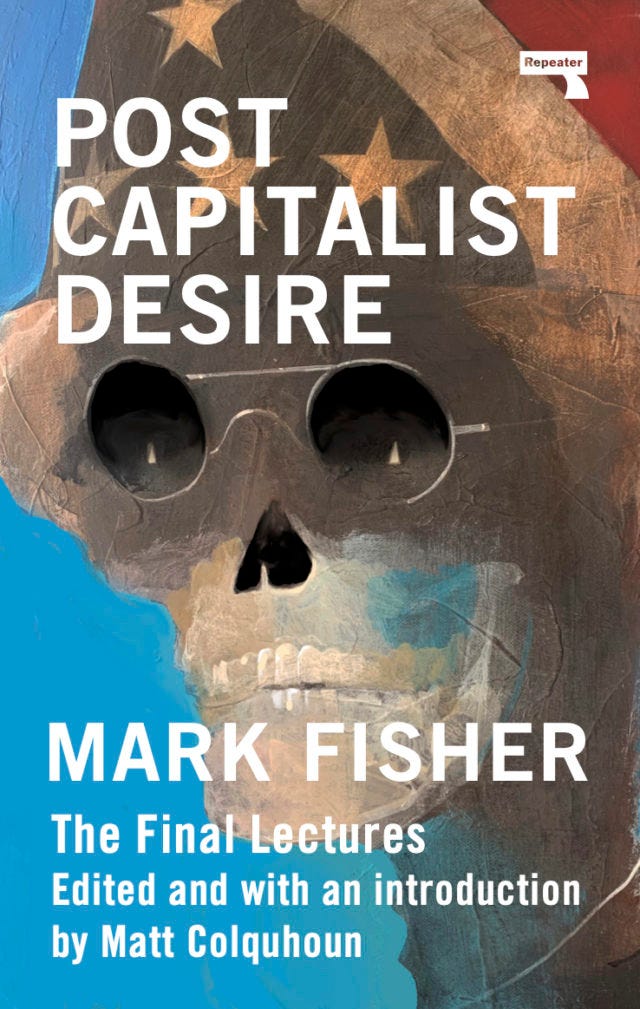
“Postcapitalist Desire: The Final Lectures” (M. Fisher, 2020)
For a while, postmodern philosophy was obsessed about "the death of the author." More prosaically, the actual death of a well-respected author, considered (perhaps sacrilegiously) as a mortal being, poses its own problems of interpretation. After the untimely death of someone who cultivated an avid fanbase, there is always the temptation to engage in posthumous hagiography. Their last published work - or better yet, as in this case, posthumous publication - is easy to interpret as their last will and testament that contains signs of some final revelation. An alternative approach is to see author's final words as a random bullet on the fly, originating in a gun with many unfired bullets remaining, an incomplete and hazardous interjection, emanating from a "thinking thing" flooded by a ceaseless river of thought. In this latter spirit, I read Mark Fisher's final lectures. They are enlightening and provocative, as always, but ultimately unsatisfactory and incomplete - by no means Fisher's best material. First, the lectures are incomplete. They stop as soon as things get really interesting. Second, the pedagogic need to engage with student questions, although it produces Socratic engagement and occasional "anamnesis," tends to slow things down and keep the discussion at a rather superficial, introductory level. This means that some of Fisher's more out-there ideas and theoretical concerns get barely mentioned or developed. None of this is to deny the absolute pleasure that many of his students must have felt, and many of the readers of these lecture notes must continue to feel, having someone as engaging and thought-provoking as Fisher as their intellectual guide. But nobody comes to Fisher because they want final answer. They want thought-provoking challenges to the status quo, and remedies to the low point of radical imagination as captured in the title of his book, Capitalist Realism: Is There No Alternative?. In these lectures, as elsewhere, Fisher's combination of Adorno-style cultural pessimism and post-Marxist apocalypticism lend the lectures a sense of personal, economic, and ideological impasse. Some of the expressions of his melancholia appear to be symptomatic of his subjective struggles rather than any objective analysis of historical or sociological conditions. For example, the confident way that he analyses the bankruptcy of the modern music industry has an element of truth to it, but this truth expresses the author's barely masked idiosyncratic psychological attachment to particular musical subgenres of his youth. And whenever he tries to get serious, his normative prescriptions appear as hopelessly naïve or backward. For example, his political longing for the revival of unionism and class politics, as exemplified by the stuffy leftism of Jeremy Corbyn and other fossils of 20th century Marxism, I find hopelessly unworkable. Leftism that learns little from the mistakes of the past, and that does not incorporate significant elements of liberalism and anarchism, cannot ground the future. At the same time, his serious engagement with Universal Basic Income (UBI) is more forward-looking and in line with a needed creative realignment of politics. Furthermore, in the realm of theory, Fisher's passionate plea for the continued relevance of the Freudo-Marxist concepts of desire and pleasure, although not wholly original, is exciting and titillating. This obsession, indeed, is what makes Fisher worth reading today. He builds up on thinkers like Marcuse and Lyotard, Freud and Marx, with the help of contemporary examples like the Occupy movement, to generate a kind of vague miasma of hope (for it still reeks of fantasy and Opium) for prefigurative politics. I wholly agree with him that the capacity to dream big, and the related courage to be Utopian, are among the most important human characteristics to nurture. His dismissal of the emancipatory power of globalized, market-based liberalism still obfuscates his vision. Although I am less beholden than him to the Marxist vision, the important thing is the ability and willingness to pursue radical alternatives to the status quo, I find Mark Fisher enjoyable and lucrative reading. He offers creative perspectives on important issues. But beyond his handful of points about capitalist realism - which he has articulated in multiple works - I do not find him as an especially original, multi-faceted, or profound thinker. These lectures, scattershot and incomplete though they may be, give a real sense of the intellectual adventure that Mark Fisher invites his students and readers to engage in. But they also reveal some of the weaknesses in his analysis, having to do with the avenues of "real Utopias," the concrete recommendations for radical change, and the need to move beyond Marxism. So, after passing through Fisher, as they should, wannabe radical intellectuals should move beyond him. (Rating: 3/5)
…
Summing up. Although my overall estimation of the Frankfurt School and the contemporary “theory industry” remains relatively unchanged (and mostly neutral), I find myself gravitating towards a kind of unholy rehabilitation exercise: a rehabilitation of theoretically flawed socialist thought through the purifying fire of non-ideal social and political theory. What if we take Utopian theorizing seriously but subject it to rigorous liberal “testing”? This may be an unorthodox, “off-label” use of the Hayekian market economy, but one justified on grounds of necessity. Testing emancipatory ideas in the Open Society, one hopes, tempers radicalism with liberal prudence (although it might also water down radical experiments beyond recognition). Such a purification ritual would force socialists to face the limits of socialist thought. But it also forces liberal and non-socialist thinkers to engage more seriously than before with (what is left) of Marcuse, Freud, Marx, et al. Why not combine Marcuse and Popper, or Fisher and Hayek? This path may turn out fruitless or fruitful; but at least it builds bridges between two warring territories. Doing so may also generate enough escape velocity to allow analytical political philosophy to launch itself (again) outside the gravitational orbit of Harvard. Breathing fresh air - even dangerous, toxic air - may be better than withering, or rotting, under Rawls’s long shadow.
No posts
Comments
Nothing yet. Say the first thing.
Sign in to join the conversation.