
Most people assume the world runs on fixed rules. Prices are set. Power structures are rigid. Opportunities are either there or they're not. You either qualify, or you don't. My best friend and I have extensive personal experience that we've A/B-tested, and we've concluded that it's better to ask for forgiveness than permission. Proceed at your own risk; we have the appetite and the savviness to do so. Exercising agency is not formally taught, and its bounds reach well past the box that rules pretend to draw.
In reality, most of what we accept as “rules” are just agreements that nobody bothered to challenge. I hilariously learned this: through watching my mom haggle in places that aren’t supposed to negotiate. She’d do it at grocery stores, department stores, and corner stores. Places where the price tag is supposed to be the final word. I used to stand there as a kid, face warm from embarrassment, thinking, “Why are you even trying?” The price is the price. But time and time again, she walked away with a deal and a new friend. And time and time again, I was wrong.
My family is from Benin, a small country in West Africa. Benin has a vibrant open-air market culture, home to one of the largest open-air markets (by volume) in West Africa, the Dantokpa Market. It’s also home to the floating market in Ganvié, a “floating city.” Where residents in canoes sell produce, fish, and fabrics directly on the water, a lifestyle that showcases the community’s adaptation to its environment. Throughout all of this, my mother witnessed markets as the primary hub for commerce, social interaction, and economic activity. These are dynamic high-energy environments where bargaining is common and personal connections with traders are essential. While growing up, I knew Benin as the kind of place where, if you need something done, you need to know a guy who knows a guy, which requires a different kind of persistence and agency we are not accustomed to in the West.
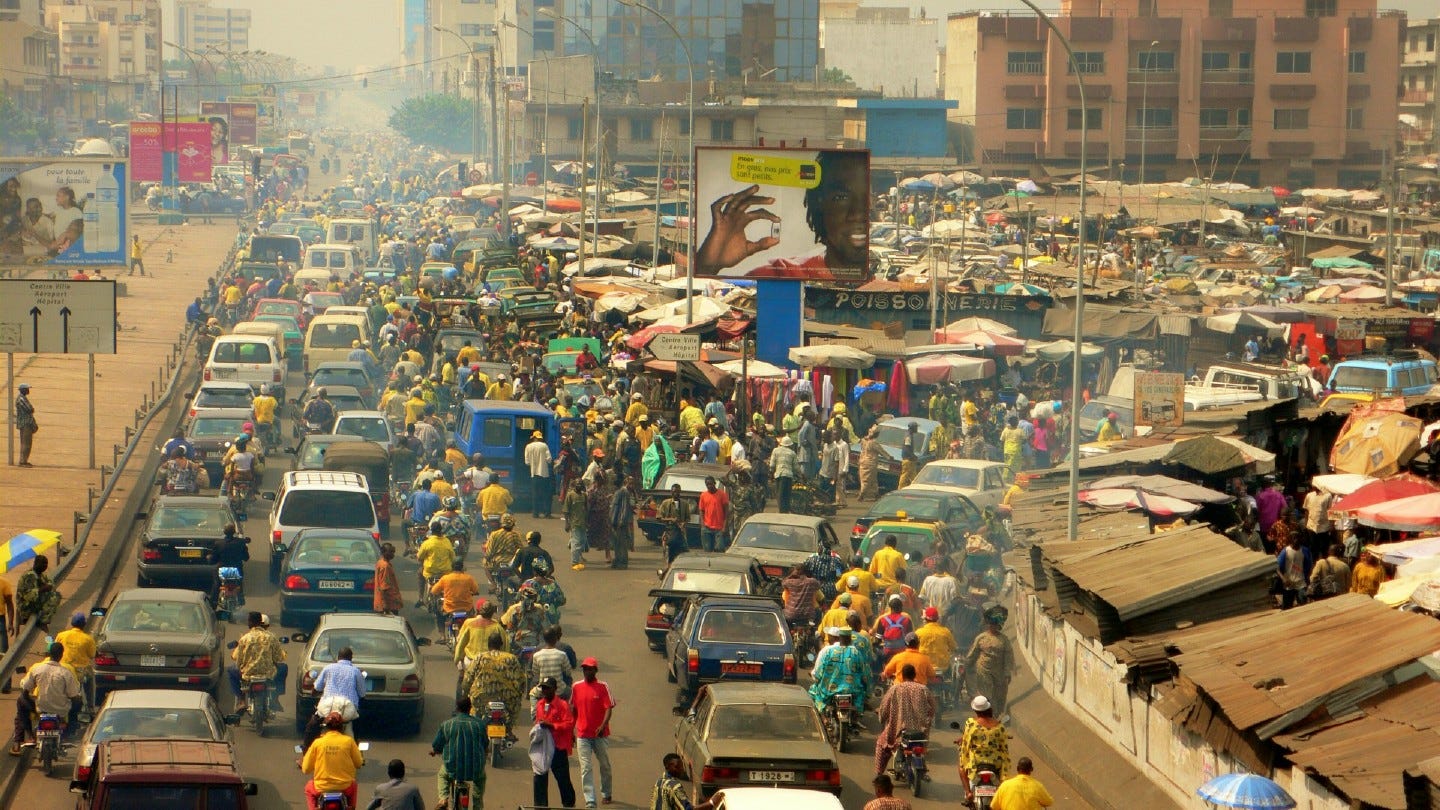
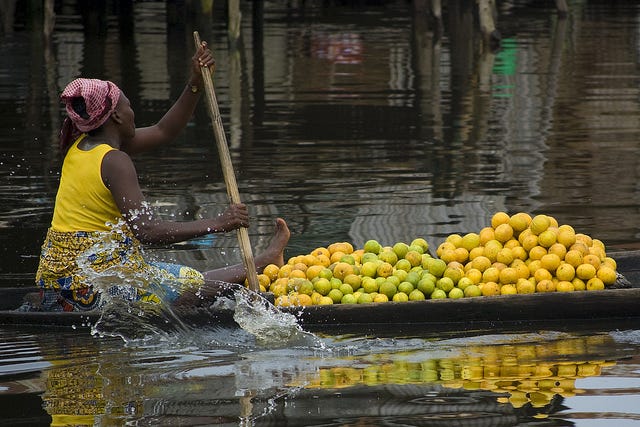
Fast forward to now, and I’m probably worse than she ever was. It’s almost like an addiction and brings me more joy than it probably should. I negotiate everything now. Let’s not get it twisted, it’s not because I’m cheap but actually because the better I got at it, the more I realized it changed how I move through the entire world: the price is rarely real. That’s the first principle I move by: what I call “Reality is Malleable.” Most of what looks like a wall is just a curtain. The price is an opening offer. And that doesn’t just apply to money. It applies to everything. After gaining my own XP in the skill tree of haggling, I completely understand where my mother was coming from. It takes a certain amount of guts to leave behind what you know and start a life in a new environment, with a new culture, customs, and language that you are unfamiliar with. Only one who’s open to negotiating with life can engage with drastic change like this.
Your career path? An opening offer. The salary they quoted you? An opening offer. The way institutions say things have to work? Opening offer. The limitations you’ve accepted about yourself, what you can build, what you deserve? Those might be the biggest opening offers of all. If you walk into life assuming everything is set in stone, you’ll move passively within the boundaries that others have drawn for you. But if you start questioning and pushing those boundaries, you’ll find that most limitations are negotiable. That realization is the foundation of what I call Sovereign Adaptation.
Sovereign Adaptation is a framework for building real autonomy. Not the “quit your job and post about it” kind. The kind where you actually understand how the systems around you work, use them strategically, and reduce your dependence on any single one of them. It’s important to be intentional about the actions you take, what you feed your body and mind, and how you spend your time. All of these shape you into a particular kind of human being.
Sovereign means self-governing: not owned or steered by any single system, institution, or person. Adaptation means staying fluid as the ground shifts, adjusting your approach instead of clinging to one that used to work. Sovereign Adaptation sits at the intersection of two things: tactical maneuvering navigating systems to your advantage) and adaptability (remaining resilient as the landscape shifts beneath your feet). It’s not about total control. Nobody has that. It’s about moving with precision, building leverage, and never letting any one system own you.
Most people either try to beat the system head-on (and burn out) or accept it completely (and get trapped). Sovereign Adaptation is the third option; there’s always a secret third option. You learn the rules well enough to know which ones are real constraints and which ones are just suggestions. Then you move accordingly. One rule of thumb I like to go by is that there are only physical limits; everything else is free game.
Everything I just said can easily slide into toxic positivity territory. “Reality is malleable! Just believe! Manifest!” It’s important to understand that what I’m writing about is not that. There are real forces in the world that actively work to close your options. Blinded by the everyday responsibilities of life, you may not have enough time to look up and realize these things, and they may even affect you subconsciously. Poverty closes options. Systemic racism closes options. Bad policy closes options. Growing up in a zip code with underfunded schools closes options. These aren’t imaginary walls you can just “mindset” your way through. Learned helplessness is also real, and sometimes it’s not even learned. Sometimes it’s imposed.
There’s a concept I thought about but didn’t have a name for until recently, called decision topology. The idea is that every decision you make reshapes the landscape of what decisions become available to you next. Some decisions open up new pathways. Others close them, sometimes permanently. And the ethical weight of any given choice comes down to this question: whose futures are being closed, and did they have a say in it?
This is the part that most “sovereignty” talk completely misses. It’s not just about your mindset or your hustle. It’s about the structure of your possibility space, the actual map of what moves are available to you, and recognizing that external forces are constantly trying to shrink that map on your behalf. Which brings me to something that drives me crazy.
I’m sure you’ve heard the pitch by now. Some guy with a podcast and a rented Lamborghini telling you that school is a scam, college is a waste of time, and you should just start a business at 18. I get where the frustration comes from. Many institutions are outdated, the cost of higher education is absurd, and the system doesn’t always deliver on its promises. Some may even say it’s time to create new institutions to cater to the way of life now.
But those who understand that the world isn’t black and white know this is a deeply nuanced conversation. Technology is changing how we learn and work, yes. But that doesn’t mean the foundation disappears. You still need to build knowledge on top of something. The institutions might need reform or replacement, but that doesn’t make them unnecessary.
Education, at its core, is an option-generating machine. A degree doesn’t guarantee success. What we are commonly exposed to is that they open doors that are very difficult to open without one. And in this life, you need to be opportunity-maxxing. Your education doesn’t necessarily have to be formal, and there are different modes of learning. The priority should be that every decision that expands your set of future possibilities is topologically a good decision. In this blanket case, one degree leads to a credential, which leads to a network, which leads to an opportunity, which leads to leverage. Each step probabilistically increases your chances of building the kind of autonomy I’m talking about.
The “drop out and grind” narrative sounds sovereign, but for most people, it actually narrows their topology. It closes futures before they even knew those futures existed. It’s a different kind of trap wearing freedom’s clothes on restriction’s body.
Real Sovereign Adaptation means playing the long game with your options. Because life is an infinite game. Use the institution while it’s useful. Extract the knowledge, the credentials, the network. But never confuse the institution with the destination. It’s a vehicle, not a home.
The point isn’t “always go to school” or “never go to school.” The point is: understand your decision topology. Know which moves expand your future possibility space, and which ones contract it. Then act accordingly, with your eyes open. This is where two more principles come in: Question Everything, including the people telling you to question everything. And prioritize Adaptation Over Rigidity, because the move that worked for one person at one moment isn’t a universal answer.
The framework covers five areas of life where sovereignty actually matters. Not as separate self-help categories, but as interconnected systems that reinforce each other.
Mental Autonomy. Own your thoughts, control your perspective, recognize when you’re being manipulated, and resist it. This is the foundation, because if your thinking is compromised, nothing else holds.
Physical Resilience and Self-Sufficiency. Master your body, your health, and your capacity to endure. Prevention over treatment. The more physically independent you are, the harder you are to control in a world that seeks to control you at every turn. Without our health, we are nothing, and we can do nothing.
Financial and Economic Sovereignty. Reduce dependence on centralized institutions. Build leverage. Create your own economic pathways instead of waiting for permission to participate in someone else’s.
Governance and Strategic Systems Awareness. Learn how rules get made. Learn who controls them. Learn how to maneuver through institutions, not just complain about them. This is where my professional work lives, and it’s probably the least discussed area of personal sovereignty.
Spiritual and Ethical Alignment. Autonomy without purpose becomes ego. Ground your actions in something deeper than self-interest. For me, that’s Islam. For you, it might be something else. But the principle holds: if your sovereignty isn’t anchored in service and accountability to something bigger than yourself, it collapses.

The Sovereign Adaptation framework is not crypto-libertarian sovereignty in a humanitarian wrapper. It is a framework built by someone who watched institutions tell him polite lies early on in life, someone who learned that the credential machine would not credential him on the timeline he wanted, and someone who watched a five-year professional relationship slowly become exploitative. It’s closer to a survival ethic than anything. It’s a way to give the reader insight into the business I am building, the problems I’m focused on solving, and the movement I am bringing to life.
I’ve been developing this framework privately for a while. It started as a personal operating system, a way to make sense of how I was already moving through the world. But every time I’ve shared pieces of it, whether with a friend who needed material for a graduation speech or a stranger at the gym who asked me, “What moves you,” they’ve all felt it resonated. The idea is that if you become a sovereign individual, you will be more capable in general. Now, if you are capable, that means you can empower someone else to be a sovereign individual. Over time, this becomes a network effect in which capable individuals help others become capable individuals. That's another core principle of the framework: Autonomy is a Responsibility. Once you’ve got leverage, you don’t get to just sit on it. You owe the next person a hand up. That’s how sovereignty scales without becoming the same extractive game we’re all trying to escape.
This is the first piece in the Sovereign Adaptation series. Each one that follows takes a principle or a domain and gets tactical. We’ll walk through what it looks like, how to test it, and where it has actually worked. If this resonated, subscribe and follow along.
No posts
Comments
Nothing yet. Say the first thing.
Sign in to join the conversation.