
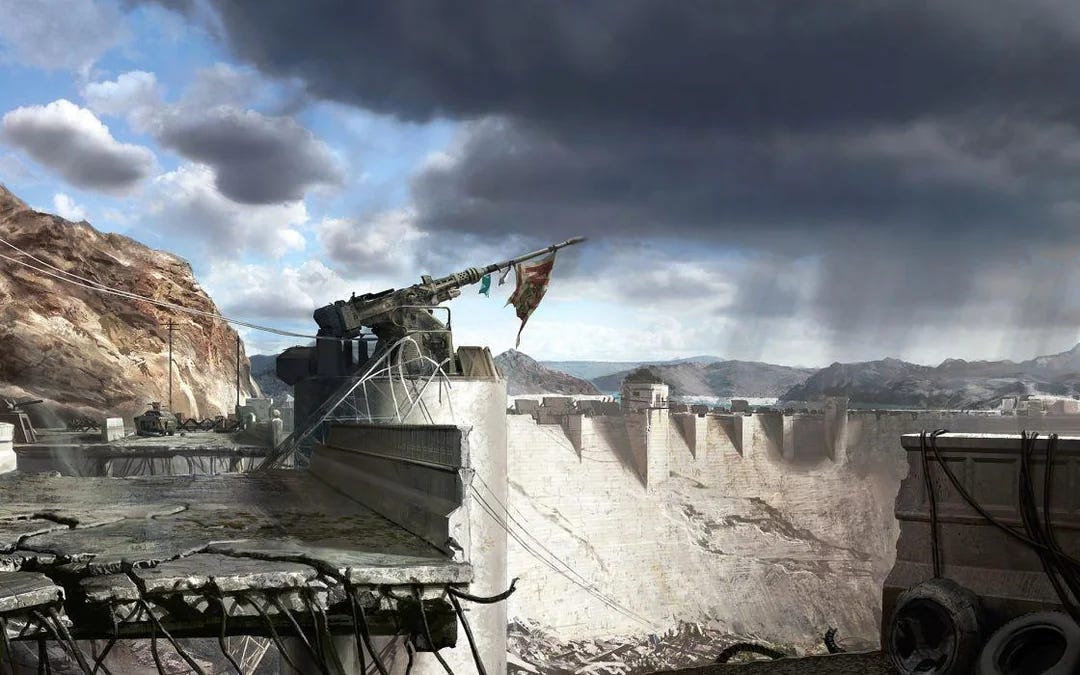
Fallout: New Vegas, Obsidian Entertainment, 2010
Why do states go to war? Is there any appreciable difference in what states want from wars? How do different states respond from the presence of other sovereign security actors?
More importantly: did there need to be a final victor in the war for the Mojave?
The Bear—the New California Republic—and the Bull—Caesar’s Legion—are presented in Fallout: New Vegas as two political communities locked in an inevitable struggle for the fate of this aforementioned desert.
When we think of the sources of conflicts between states we tend to want to look at them as interchangeable black boxes for the sake of being able to create general theories about state behavior1.
But why?
It would be easy to see the conflict that arises between the NCR and Caesar’s Legion as being born of two direct security competitors in proximity to one another.
You can obviate the need for a nuanced look at their contingent political dynamics by just pointing out that they’re the two strongest military and economic powers—no different than general theories propagated about Athens and Sparta or the United States and China2.
Their conflict would obviously follow from a competition for influence, in this case over the Hoover Dam and New Vegas.
But that all misses fundamental questions.
Yes they end up in conflict. But why?
Why are they there in the first place? Why do they view influence over the region as a vital interest? What do they want to gain from the conflict? Why do they even see the other as being a threat that can only be managed via war?
I’d put forward that both states—and all other states for that matter—need to be understood holistically as political entities shaped and formed through their ideological characters interacting with their respective domestic constituencies.
It is a product of particular people in a particular moment making a determination about the costs they were willing to bear to obtain something.
I’m going to forgo rehashing the ideological characteristics of both states here—but I will point out that the NCR is a deeply flawed representative democracy and Caesar’s Legion is a personalist totalitarian state.
However, regardless of the structures of both states they both depend on the support of domestic constituencies. For the NCR this primarily consists of wealthy ranchers, traders, homesteaders, and urban populations.
Caesar’s Legion is slightly simpler in that Caesar’s core domestic audience is his military and traders—at least as far as you can discern from what’s available in the game.
The NCR, being a democracy, needs to maintain legitimacy in the eyes of a large set of stakeholders who demand that the NCR protect and expand their economic interests.
This is the NCR's primary interest in the Mojave.
The NCR has an ideological interest in expansion as a successor state to America: they have a claim to the continental United States.
The president of the NCR—Kimball—consequently stakes much of his discrete political identity as being an expansionist able to grow the borders of the NCR.
There is also an obvious ideological clash with the existence of a totalitarian state in opposition to the NCR’s professed ideology.
I do want to emphasize, however, that the NCR’s primary push towards the Mojave comes through domestic economic interests.
The Legion’s domestic interest is more straightforwardly ideological. They’ve staked their legitimacy on their ability to bring stability through expansion and assimilation.
Previously conquered peoples are brought in as new stakeholders through an explicit compact based on a shared ideological project that necessitates further expansion.
Resultantly, as a political entity there is little if any power base that has influence over state decisions outside of their military.
If the Legion doesn’t violently expand—the Legion would lose legitimacy with this all important core constituency of the military. The support of traders who profit from Legion expansion is of marginal importance in comparison.
Which brings us to the central point: while both states are pushed to conflict to appease domestic audiences, they are pushed for divergent and unequal causes. This causes both states to view the scope and scale of conflict in vastly different terms.
For Caesar’s Legion the war in the Mojave is existential.
The autocratic distribution of power into a narrow audience—what is often referred to when people speak of autocratic brittleness—would collapse if the state is no longer able to uphold its end of the bargain.
They win or they die.
Conversely the NCR’s motivations lead to seeing the Mojave as far less consequential.
While the war would confer advantages for domestic audiences in the NCR—these are merely benefits on the margins. It means more water for ranchers. More trade for merchants. A new market available in New Vegas. The prestige of reclaiming lost territories of the United States.
These are all worth fighting for from the NCR’s standpoint, but it is all contingent on being obtained at an acceptable cost in resources and manpower, balanced against support from a wide swath of domestic interest groups.
It’s also worth expanding on how ideology serves a function of acting as a filter through which domestic audiences perceive and rank their interests.
The NCR—as a more modern state with broad stakeholders—is taking actions which provide the widest benefits possible.
The economic interests of the NCR overlap between various interest groups, and the move into the Mojave potentially improves the basic life of a large swath of the population who have unmet demands.
What is—and is not—seen economically beneficial in the NCR is determined by the structure of the NCR as a proto-industrial state based largely on agricultural trade and limited manufacturing.
What is perceived as an economic benefit follows from the underlying ideological structure of the NCR as being a quasi-mercantilist society. If the NCR possesses a given set of resources, they are better off as a political community, and the economic leaders of the NCR are given significant deference as members of that body.
Conversely, Caesar’s Legion has an identity constructed explicitly around totalitarian submission of the self to the state and the assimilation of all competitor communities.
Interests—seen through this lens—means that domestic audiences see benefits as being ranked almost exclusively around territorial conquest and exerting control over other states.
Pressure groups within Caesar’s Legion instead advocate for different courses of action around when or which particular states the Legion should come into conflict with.
Rather than valuing economic interest groups—an activity that the Legion actively maligns—they give deference to ideologically committed military leaders.
To put it more simply, the citizens of each community rank the intangible value of different activities much differently.
The cost-benefit analysis that the stakeholders of each state engages in is radically skewed around the values they place on various actions in the world.
All of this to say that an abstract entity we call a state does not fight wars. People who make up a state fight wars.
So was the war in the Mojave inevitable?
No. Of course it wasn’t. It wasn’t any more inevitable than the clash between Athens and Sparta.3
It was the product of contingent domestic demands of both states overlapping and coming into conflict. Demands shaped by the ideological characters of both states.
Constituencies can be appeased through other means.
There was no law of nature that said Caesar needed to take his Legion to the Mojave. There were also alternative options to placating his military through offers of land and treasure: the same method used by his namesake.
Likewise, the NCR always retained the ability to reform its agricultural sector, focus on domestic economic growth, or simply use the flexibility of a democratic system to sustain a short term popularity hit by not meeting the demands of interest groups.
It was also not fate that two states with those particular ideologies would meet in that moment with those particular sets of interests. Nothing was predetermined that certain interests arise at certain times.
Just as Athens was never bound to lose to Sparta4, the fates did not cause the NCR and Caesar’s Legion to clash over the Hoover Dam.
Whether or not people go to war is actually a question about what it is that a political community—or the meaningfully influential members of a political community—actually want and how dearly they want it.
For the purposes of this I’m going to ignore constructivists. Mostly because they would agree with me and then I couldn’t write about Fallout: New Vegas again.
Yes Graham Allison. I am talking about you.
I am once again talking about you Graham Allison.
You’re not going to believe this. But yes. This is once again a reference to Graham Allison.
No posts
Comments
Nothing yet. Say the first thing.
Sign in to join the conversation.