
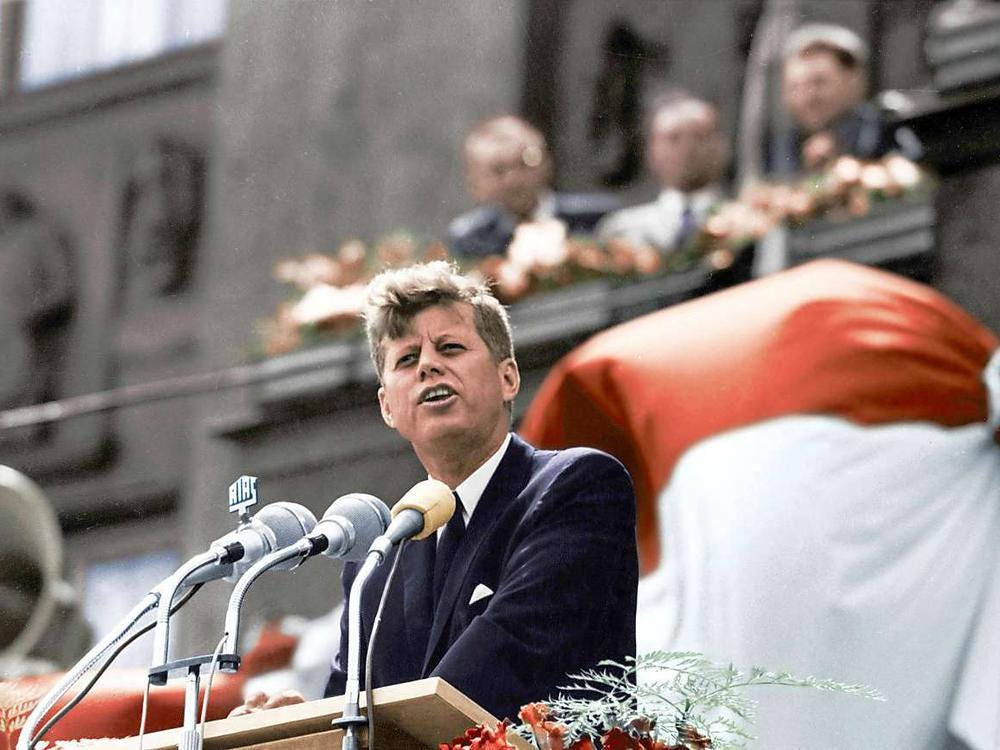
John F. Kennedy delivering the “Ich bin ein Berliner” speech in Berlin, June 26, 1963
In little more than a year, the Trump administration has overseen the most radical reordering of the international system since the fall of the Soviet Union.
Adopting a predatory approach to other nations, he has, through threats, economic coercion, and violence, strained America’s relations with Europe to a point of breaking; thrown the Middle East into renewed discord; weakened the nascent anti-China bloc in the Pacific; and sown doubt amongst our North American friends.
It has been an erratic and destabilizing period for the World.
However, the approval ratings for Trump have—thankfully—finally fallen off a cliff.
His policies and governing style have been so widely disliked as to all but ensure the Democratic Party will take the House, and likely the Senate, in the upcoming midterms.
When Congress changes hands, the source of American foreign policy is going to shift as well.
The United States still has considerable resources to draw upon as an actor, and liberals need to start drawing up our policies to push following the midterms.
Which is to say, all of this damage may not be entirely terminal.
Trump is an all-consuming personality whose ego and erratic policies have wrought so much chaos that it can be ascribed to his own idiosyncrasies, his sycophantic allies, and his rapidly diminishing political movement.
His personalist approach to politics is so far outside the norm of our political life that you would have to look to 19th-century President Andrew Jackson for the nearest comparable figure.
There is room to demonstrate to the rest of the World that Trump is an aberration. He is greatly diminished, and the political movement he represents is slowly dying.
Congress embodies the American People—and they have a duty to prove to the world that they can represent a stable and reliable America in the wake of MAGA politics.
The first and most important priority for an incoming Democratic majority in Congress needs to revolve around repairing the Transatlantic relationship with our NATO partners.
There is—and will be for some time—a deficit of trust with our European partners. We have threatened to annex Greenland by force, we have thrown Ukraine under the bus, and we have coerced our friends with continual threats of exploitative economic harm.
We have done all of this while working to undermine their governments and questioning our commitment to NATO.
That doesn’t mean we do not have options.
Ukraine has fought nobly in our absence. They should not have to.
The first and most important step we can take is to return to providing Ukraine with military and financial assistance. This can be accomplished entirely through legislative means and likely has enough support within the GOP old guard to overcome any resistance from the Trump administration.
It accomplishes both the task of protecting a core national security interest of the United States—countering Russia—while simultaneously providing a credible demonstration of America’s interest in remaining engaged in Europe.
It will also crucially generate something we have been sorely lacking for the past year: goodwill.
We can, once again, credibly claim to be using American power to back a morally just cause in Ukraine. If there is to be an international system worth restoring, it ought to be one worth defending, and we have to demonstrate that with tangible actions.
It is, however, not enough to merely provide security assistance to Ukraine.
There are other options we have related to security in Europe that Congress can tackle.
Security assistance, more generally, is a legislative matter, and we can ensure that military aid is provided to the smaller NATO States through legal means.
Likewise, in an era of greatly strained armament production, we can force the matter of joint industrial cooperation with European States in our authorizing legislation.
We have expertise and technology that are unique to America and highly sought after, which we can still draw upon as a bridge to re‑embed the United States in Europe’s security architecture.
Which brings me to Greenland.
The President threatened the use of force against an ally. Despite the clear illegality of his threats, Europe was understandably rattled. Denmark was alarmed enough to prepare to blow the runways on the island.
It risked the fabric of the single most important national security interest of the United States—NATO.
This one is not quite as easy a fix, legislatively speaking, considering the fact that the threats themselves were illegal in the first place.
Short of impeachment, something that is nearly impossible, there is little that can be done to stop the President from screaming about his territorial ambitions.
There is, of course, the matter of Congress reclaiming its war-making ability, which will need to be done. But that is unlikely to happen while Trump holds the power of the veto.
However, there is Congressional oversight. Members of the House and the Senate can make every member of the administration involved in the scheme to annex Greenland utterly miserable until the end of their term in power.
While that sounds minor, it will create a bureaucratic nightmare for anyone involved and a public embarrassment should anything akin to the Iran-Contra affair emerge from the proceedings.
It is—if nothing else—a deterrent against future actions. Enough to at least hold us over until there is a new administration in power and deeper systemic issues in Presidential power can be addressed.
Speaking of our coercion, the United States has also engaged in an imperialistic act of attempting to extract economic power from Europe through coercive tariffs targeting the European Union.
This, again, can be counteracted through Congressional action. Tariffs are authorized through legislation. This authorization can be revoked.
Not only are tariffs wildly unpopular and thus a winning issue to tackle, but it would also be a necessary step—domestically speaking—of reigning in the expansive powers of the Executive.
It will not totally undo the relational damage inflicted by their use in the first place, but it will reassure our friends across the Atlantic that an erratic and temperamental President will not be able to lash out again through the unilateral threats of economic force at his slightest displeasure.
As for our broader reliability, while the treaty establishing NATO itself ought to be enough, there is signaling legislation—think the Taiwan Relations Act—to reassure European publics of America’s credibility.
The theory, such that it exists, is that you can functionally trap a Presidency into honoring their commitments through creating such strong public expectations of action as to force their hand.
You create such political costs for an administration to act against Congressional wishes that they’re forced to adopt Congress’s preferred policy actions.
Moreover, Congress has its own bully pulpit, and they ought to use it.
Similar to how Alexandria Ocasio-Cortez messaged a different vision of Washington at the Munich Security Conference—a United States that protects international law and restrains malign actors globally—our elected Representatives have an opportunity to sell an idea of America in stark contrast to what is being presented now.
In multilateral formats, congressional delegations, and in the media, we need to ensure that the rest of the World knows that American values and policies are still represented and the political movement that has inflicted so much pain on them is dying in real time.
You can’t fix every single issue at once. We’ve done severe damage. Relationships take time to repair. This isn’t 2020, and it’s unlikely that our old friends will be quite as quick to celebrate again this time.
But we can at least give Brussels a chance to catch their breath and give them a bit of hope that they may just be able to wait this administration out until a new President is elected—then we can get back to working together in creating the world we want to see.
No posts
Comments
Nothing yet. Say the first thing.
Sign in to join the conversation.