
In 2020, the Orthodox Church in America's (OCA) website published a report entitled, "Vocation as a Church-wide endeavor." This report addressed a number of challenges for the Church in America as they were perceived at that time, specifically:
A “Priest Shortage” caused by a lack of new vocations and an aging clerical workforce, making it difficult to fill vacancies at existing parishes. “The crisis regarding an upcoming shortage of priests is apparent and can be reasonably inferred from the data...”
Insufficient vocations to fill the missionary needs of the Church; the report correctly identified that just filling vacancies would not actually fulfill the mission of the Church, which is to make disciples across America.
A need for other vocations: “...the Church urgently needs to see to the raising up of choir directors, leaders in religious education, and theologically educated men and women who can serve the Church in a variety of ways...”
In November 2025, the OCA Chancellor’s Office issued a new report declaring the Priest Shortage at an end. OSI is currently preparing a detailed analysis and evaluation of the 2020 and 2025 data, with a look forward into the years ahead. The present article addresses a surprising source of growth not explicitly anticipated by the OCA’s 2020 call for vocations: the rise of a “permanent” diaconate.
From 2010–2025, the OCA records 466 diaconal ordinations and 330 priestly ordinations. In every year except 2016, diaconal ordinations outnumber priestly ordinations. That alone is not surprising: all priests must first be ordained deacons. What is interesting is the shape of this trend over the last 15 years.
From 2010 to 2019, the OCA averaged about 27.5 diaconal ordinations per year. From 2022 to 2025, that average rose to 39.2 per year. In 2020, recorded diaconal ordinations fell to 10, while priestly ordinations fell to 14–an obvious COVID-related disruption to normal operations. But the recovery was uneven. Priesthood ordinations rebounded to the low-to-mid 20s: 26 in 2022, then 25, 24, and 24 from 2023 through 2025. Diaconal ordinations, on the other hand, rose sharply: 30 in 2022, then 42, 43, and 42 from 2023 through 2025.
In other words, the post-2021 period is not merely a return to a pre-COVID norm. In fact, the surge in diaconal ordinations comes roughly two years after the OCA’s 2020 call for vocations--the standard duration of the diaconal vocations program in the OCA.
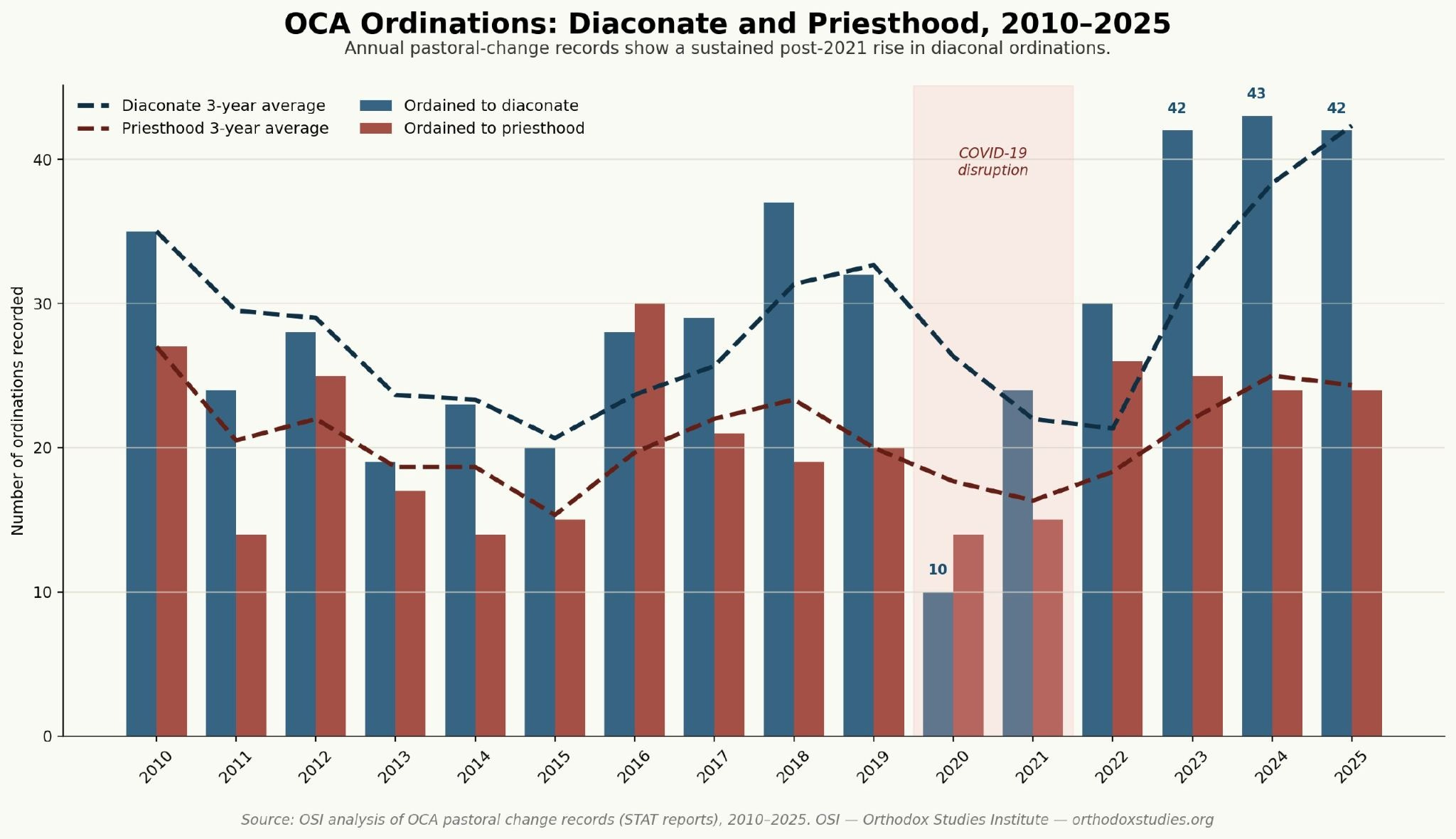
Another way of understanding this difference is to compare the decade before COVID with the recent post-COVID years. When we do so, we see that priestly ordinations rose modestly, from an average of 20.2 per year in 2010–2019 to 24.8 in 2022–2025. Diaconal ordinations rose more substantially, from 27.5 to 39.2. The diaconate’s share of combined diaconal and priestly ordinations also increased, from 57.7% in 2010–2019 to 61.3% in 2022–2025. Notably, since 2022, the increased numbers of diaconal ordinations do not correspond to increased number of priestly ordinations the following year, which is the typical pattern we’d expect to see if these new deacons were seminarians on track for the priesthood. This is evident from the way the 3-year trend lines cease to track with each other post-COVID.
In other words, the diaconate in the OCA is growing dramatically, but that growth is not translating to priestly vocations, but rather into the expansion of a “permanent diaconate” to use a Western ecclesiastical term. The timing of this growth implies that the 2020 call for vocations was successful -- at least insofar as it motivated many men to pursue ordination to the diaconate.
While this does nothing to address a possible priest shortage (in the OCA, the path to the priesthood for a “permanent deacon” remains the same as that of a layman), it is an encouraging trend on its own. Indeed, in “On the Ministry of the Diaconate,” Metropolitan Saba (Isper) of the Antiochian Archdiocese of North America called for a reassessment of the role of deacons in modern times, from a merely liturgical role to an “army” prepared to address the complex pastoral needs of the faithful. A revitalized diaconate may prove to be an important part of the expanding mission of Orthodox Christianity in North America.
Comments
Nothing yet. Say the first thing.
Sign in to join the conversation.