Andrew Slack · Orphans, Empires, and the Search for a Better World
When Superman filmmaker James Gunn called his main character an immigrant, Fox News and friends pounced.
In a string of unhinged rants, they renamed him “Super-woke,” joked his cape reads “MS-13,” called Gunn an “absolute moron” for delivering “lectures” on kindness, and lamented that even Superman was “going WOKE.”
Even Dean Cain chimed in—denouncing the immigrant framing as “too political” and “too woke.” This from the same Dean Cain whose Superman was once detained by military officers demanding to see his green card.
But here's what they accidentally got right: Superman is woke. Always has been. Since 1938, he's been an undocumented alien from a doomed planet, fighting for the vulnerable. The children of Jewish immigrants who created him during Hitler's rise weren't exactly subtle about their politics.
Of course, the Far Right can't admit they hate Superman—that would mean admitting they hate truth, justice, and the American Way.
Fox's meltdown prompted Jose Antonio Vargas and me to write a piece for The Hollywood Reporter (check it out!) explaining what should be obvious: Superman has always been an immigrant. But the more I thought about it, the more I realized immigration is just one piece of a bigger puzzle.
And that bigger puzzle is this:
What exactly is the American Way that Superman fights for? And why are they so desperate to make us forget it?
Like "woke," the phrase has been so corrupted that we've forgotten what it means. Yet Superman never forgot. He spelled it out: "Like ALL TRUE AMERICANS, I MUST STRIVE TO BE A CHAMPION OF TOLERANCE AND DIVERSITY—JUSTICE AND KINDNESS!"
That's not subtext. That's text. Right there on the page, in capital letters.
Yet somehow we've lost sight of this vision. We cannot be what we cannot see. And right now, with the man who inspired Lex Luthor running the White House, the American Way has become invisible. We're losing the very language to describe what we're losing.
This is no small matter. Since stories shape the future, our future hinges on our ability to articulate our story. And for 87 years, Superman has been telling us a story about who we could be if we remembered our highest ideals.
This is why I'm writing this three-part series: The Thirteen Truths of Superman. Because the American story isn't finished. We're in that dark moment when the hero is against the ropes. But that's exactly when something changes.
We need to remember who we're supposed to be. Fast.
But we’re going to need someone with experience who can show us the way.
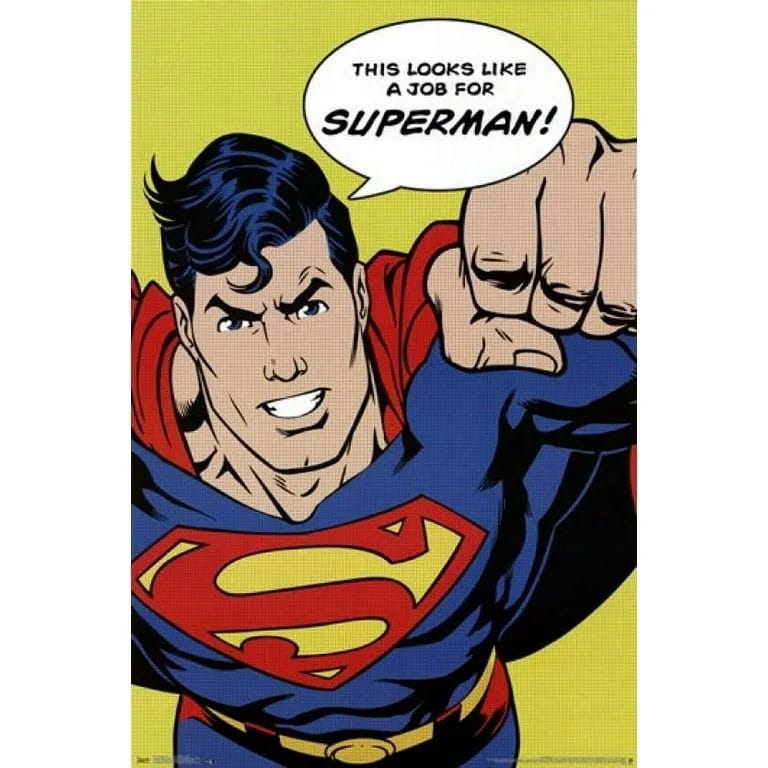
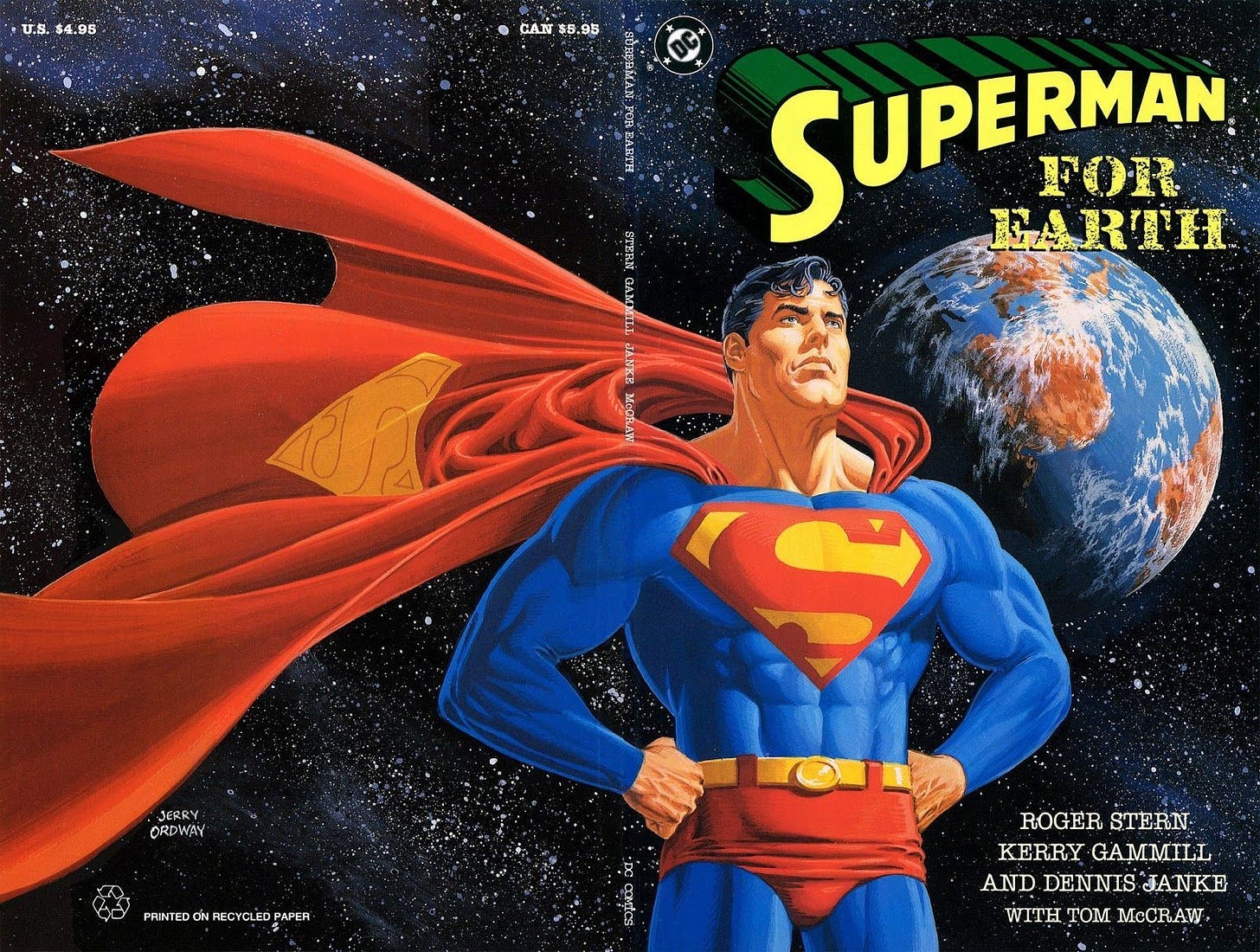
This looks like a job for Superman.
This is the first installment in a three-part series: "The Thirteen Truths of Superman: A Meditation on Truth, Justice, and the American Way." One truth for each original colony.
Superman is an immigrant. A refugee from a doomed planet who came here seeking sanctuary. Like so many immigrants, he changes his name—from the Hebrew Kal-El to the anglicized Clark Kent—learns new customs, and uses his unique gifts to serve a country that once feared him.
In Smallville, when his adoptive mother wanted to call immigration on another undocumented child, Clark reminded her: 'I'm an illegal immigrant, Mom.”
"That's what America is about, really. That's the American Way. Life, liberty and the pursuit of happiness—and second chances... It's not just for the people born here. It's for everyone."
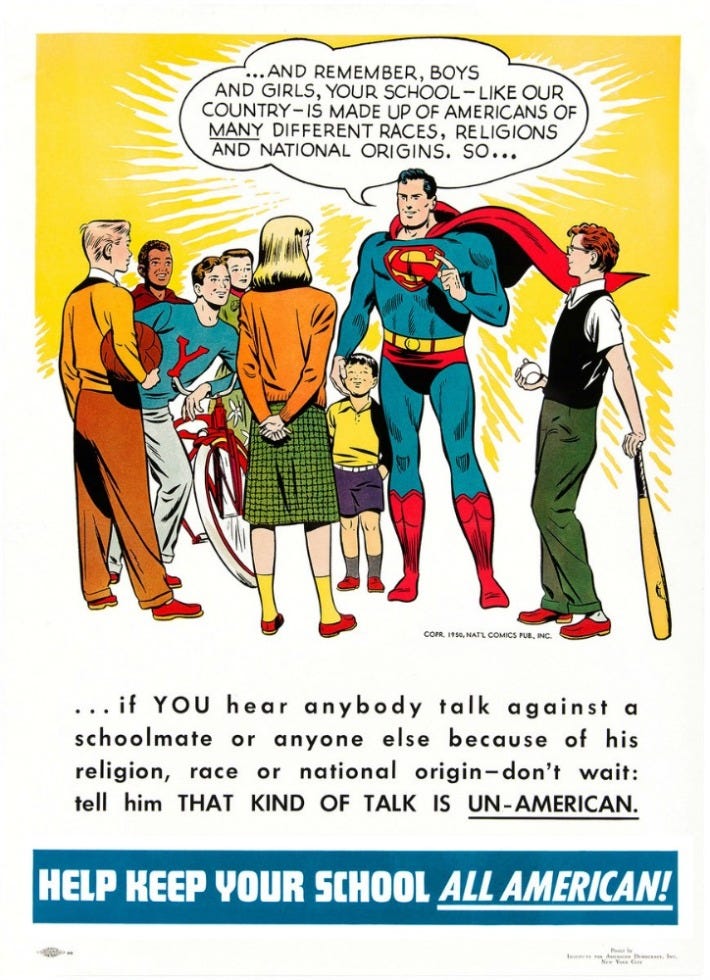
Time and again, he speaks for his fellow immigrants as he does in this iconic 1949 panel where he tells children that America is 'made up of Americans of many different races, religions and national origins.’
Superman’s creator, Jerry Siegel wasn't the Man of Steel. He was Clark Kent—a shy, bespectacled Jewish teenager from Cleveland who felt invisible. His father was murdered behind a counter, and the country offered no protection. Just silence.
So he did what so many children of immigrants have done when America didn't give them reason for hope. He imagined one—molding fantasy from grief like clay, searching for power in a world spinning out of control. And from that clay, a figure began to take shape.
Jerry and his friend Joe Shuster—another working-class Jewish kid with bad eyesight and a pile of dreams—got to work. They weren't strong. They weren't seen. So they made someone who was. Kal-El. The vessel of God they had dreamed into being. A refugee child cast into the unknown with the power to hold the world. Like the golem of Jewish folklore—a powerful protector molded from clay—he would defend the vulnerable.
They made him everything they longed to be. Strong. Able to leap tall buildings in a single bound, to change the course of mighty rivers, bend steel in his bare hands. Able to rise above a sea of urban anonymity and reach for the heavens.
What they tapped into was America's real superpower. Not our military, not our markets, but our belief in infinite possibility. That anyone can become anything.
Their spark ignited a revolution. Other children of immigrants saw that this superhero story had legs—and they ran with it. Nearly all of the top superheroes were created by children of immigrants. Bob Kane (nee Kahn) gave us Batman. Jack Kirby (nee Kurtzberg) gave us Captain America. Stan Lee (nee Lieber) gave us Spider-Man—the broke kid from Queens trying to do the right thing.
Together, they built more than stories. They built a mythology. They launched a $150 billion industry (and who said immigrants aren’t good for the economy?). They opened the door to a multiverse of new realities—drawn by kids who weren’t supposed to belong in this one.
What Siegel and Shuster revealed is this: greatness in America isn't inherited. It's built. In basements. In broken English. In spite of every signal that says you don't belong.
And with a little luck—and a whole lot of grit—you take what this country gives you and turn it into something it can't take back.
You turn life's shit into fertilizer. You turn loss into clay.
You turn invisibility into a man who can fly.
But infinite possibility rings hollow when people lack basic necessities. Superman understood this from the beginning.
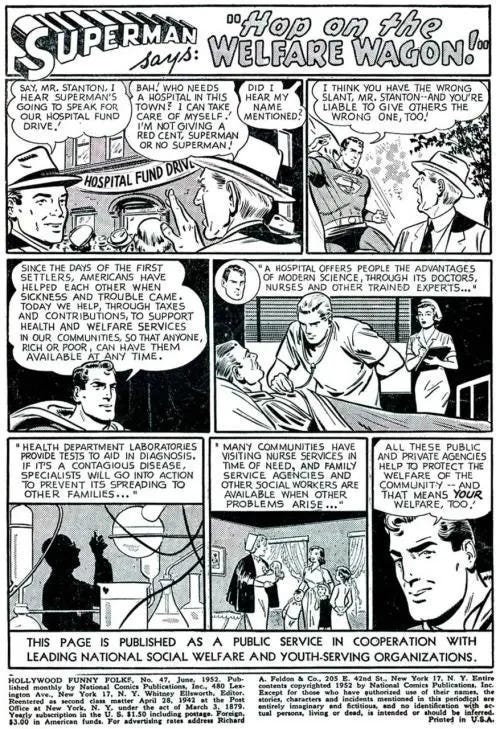
During the Depression, when public programs were dismissed as "communist," he reminded readers: "These programs protect the welfare of the community—and that means your welfare, too! Hop on the Welfare Wagon!"
From the beginning, he sided with truck drivers, mine workers, and exploited children. He busted corrupt politicians siphoning public works funds, stock brokers defrauding investors, slumlords, crooked cops, and every type of creep preying on the vulnerable.
His dedication to solidarity demonstrates that while our sense of infinite possibility should allow us all to reach for the stars, we only shine when we are in a constellation.
Clark Kent carries both Smallville and Metropolis in his heart—rural Kansas and urban America. He brings hometown wisdom to the big city, and metropolitan perspective back to his roots. To Superman, rural and urban aren't opponents—they're organs in the same body.
Red versus blue? That's not American. Red, white, and blue is. E pluribus unum—out of many, one—a principle he extends globally. Superman could solve most problems alone. Instead, he co-founded the Justice League—not as commander, but as colleague. The most powerful being on Earth chose collaboration over control.
This principle shaped America's greatest moments. From the Marshall Plan to the Peace Corps, from the UN to the eradication of smallpox—we've soared highest when we've lifted others. Superman embodies this truth: real strength isn't measured by what you can take, but by what you can give.
Superman's America doesn't say "America First." It says "Earth First"—with America as first among equals, here to serve.
Superman's first published heroic act wasn't stopping an alien invasion. It was interrupting a domestic violence incident. He started where heroism actually lives: in the space between those who abuse power and those they target.
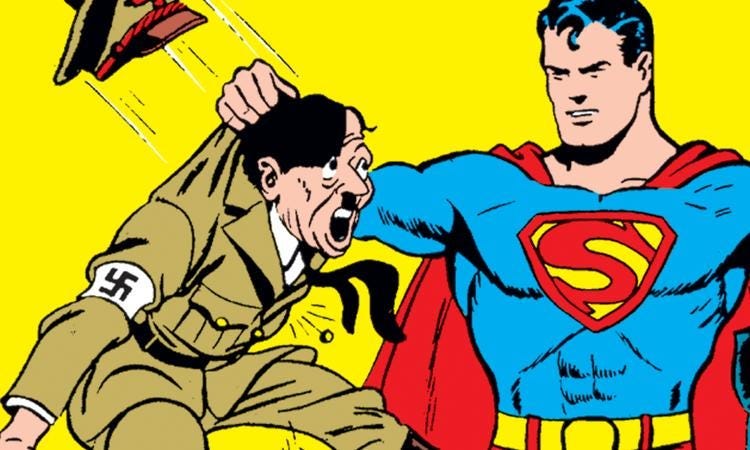
From that moment, a pattern emerged. When isolationists preached "America First" while the Nazis built concentration camps, Superman was already taking on Hitler, two years before the US entered the war.
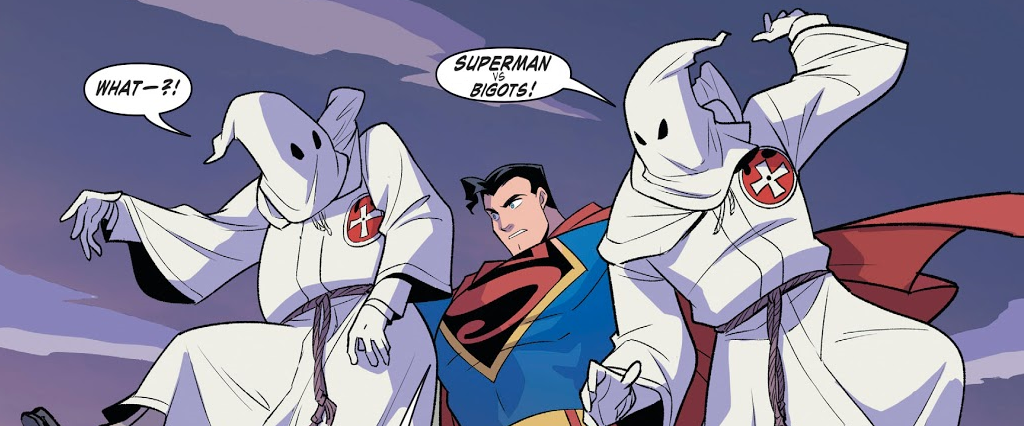
While the KKK recruited young people in earnest, Superman’s writers worked with an undercover reporter to expose their secrets on national radio. The Grand Wizard of the KKK had to keep changing the group’s passwords as their recruitment numbers plummeted.
When a pro-Nazi rally tried to claim Superman as their symbol, he smashed their swastika to splinters and declared: 'I WILL NEVER BE A CHAMPION OF NAZISM! I WILL NOT BE ANYONE'S SYMBOL OF HATE, RACIAL PREJUDICE AND GENOCIDE!' (a sentiment all of us should share)
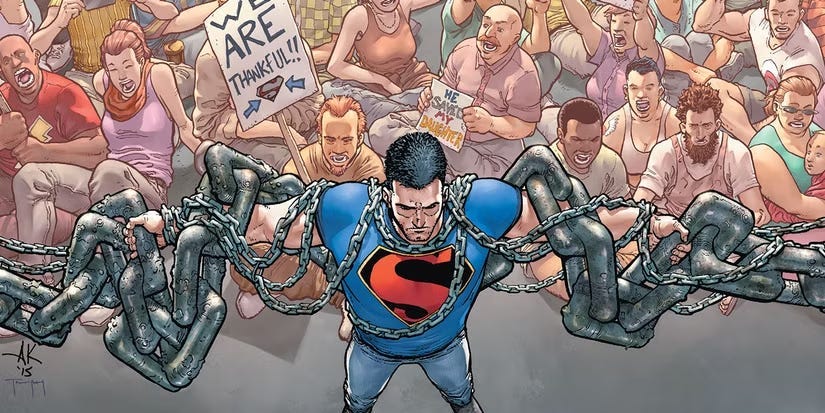
Through it all, Superman’s message never wavered: the American Way means standing between the oppressors and the oppressed. And the work has never stopped. On the heels of Ferguson, he protects Black Lives Matter protestors from police brutality and after the murder of George Floyd, DC shared his promise:
“Until my dream of a world where dignity, honor, and justice becomes a reality for all—I'll never stop fighting. Never."
These five truths barely scratch the surface. For 87 years, Superman has consistently championed progressive values:
In 1949, DC Comics and the Institute for American Democracy—an offshoot of the Anti-Defamation League—distributed a school book cover featuring Superman reminding children that America is "made up of Americans of many different races, religions and national origins." At a time when restrictive covenants barred Jews from neighborhoods and segregation was law, Superman's position was unequivocal.
His creators, Jewish immigrants, made their hero particular enough to be Jewish (based on Moses, Samson, the Golem with a Hebrew name) yet universal enough that all faiths could claim him—though not universal enough for the Nazis, who banned him for being too Jewish and 'super’ into democracy.
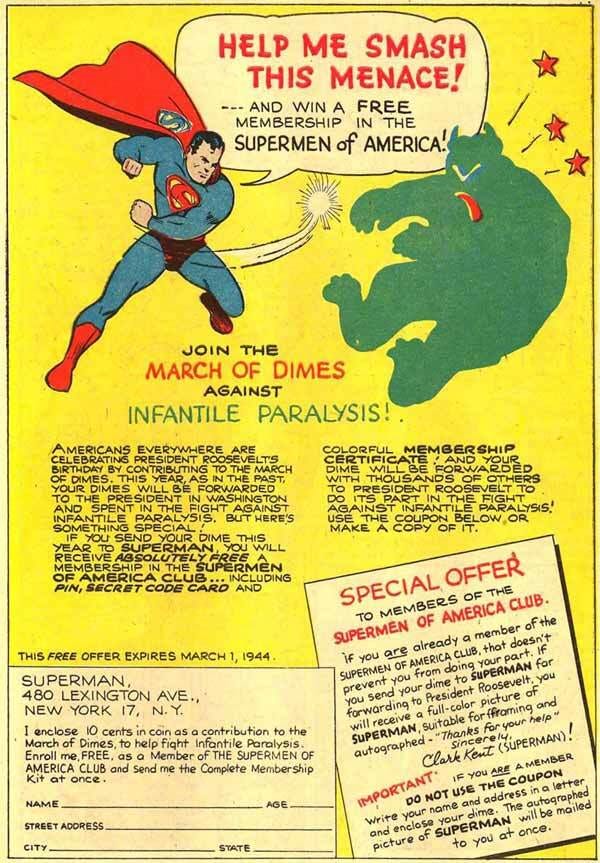
For 87 years, Superman has been a public health champion. He helped raise funds for the polio vaccine in the 1940s, partnered with JFK and LBJ to encourage the National Youth Physical Fitness Program in the 1960s, got 800,000 kids to pledge against smoking in the 1980s, and declared "REAL HEROES WEAR MASKS" during COVID. The man's been protecting public health longer than Fox News has existed.
Clark Kent isn't just Superman's disguise—he's a statement. In Superman's world, journalists are heroes. In a world where some call them "enemies of the people," Superman reminds us that democracy dies without those who speak truth to power.
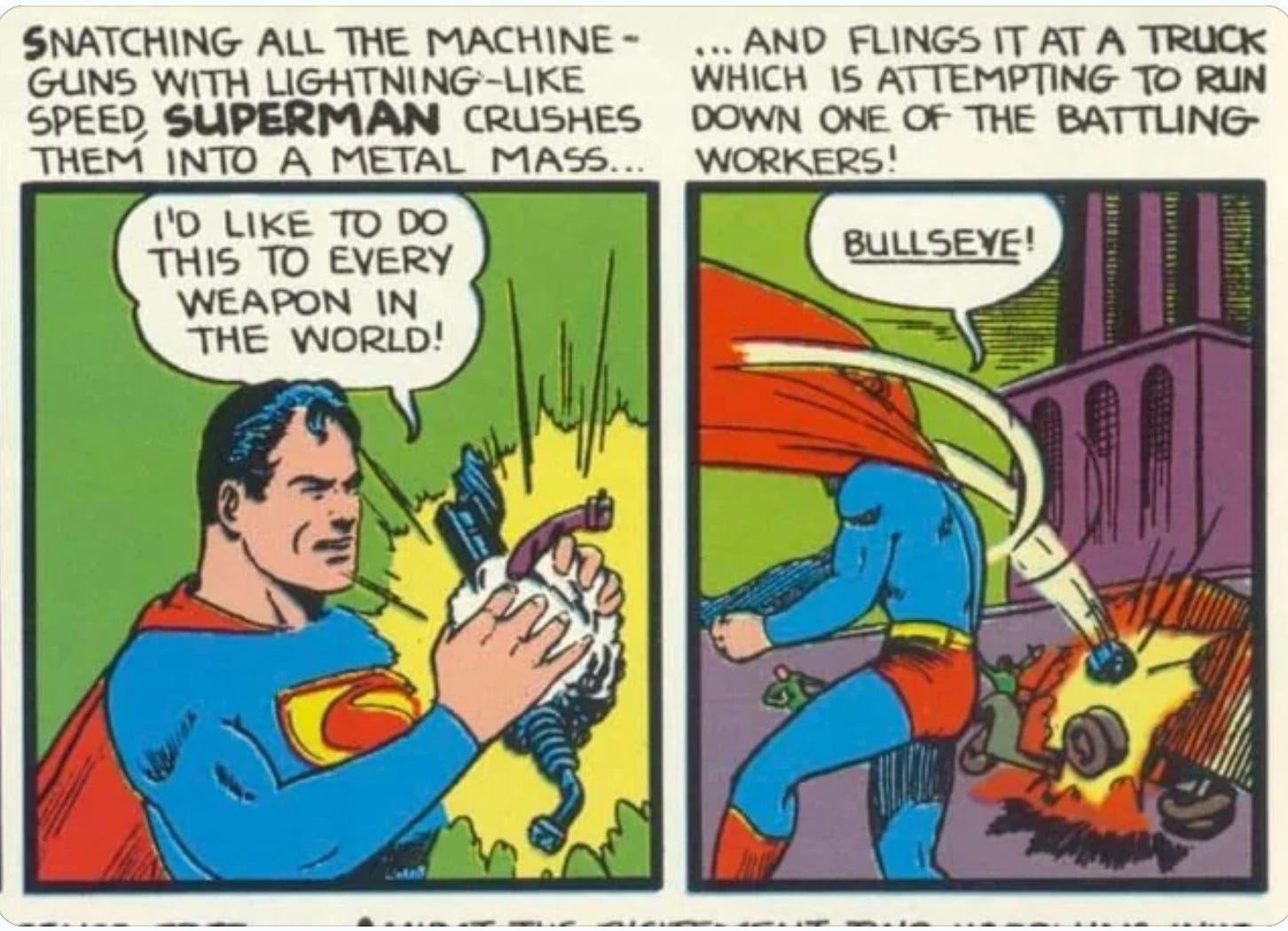
"I'd like to do this to every weapon in the world!" Superman declared in 1940, crushing guns to scrap. He's destroyed nuclear arsenals multiple times, dismantled war machines, and consistently shown that the strongest being on Earth chooses de-escalation over domination. Superman can bench-press continents but helps neighbors with groceries. Real strength doesn't need weapons—it needs wisdom.
Superman is, quite literally, a climate refugee. Krypton didn't fall to war, but to ecological denialism—those in power refused to listen to scientists warning that uranium in the planet's core was churning toward critical mass. They insisted their world was stable until it cracked.
On the heels of the first Earth Day, he sucked smog from the air and hurled it into space. He shut down a chemical plant two years before Love Canal made such dangers undeniable. The most powerful figure in American mythology is solar-powered—drawing strength from the very renewable energy source we need to embrace. His origin story is a warning: ignore science, lose everything.
These ten truths reveal what Fox News accidentally exposed: when they called Superman "woke," they told the truth. For 87 years, he's embodied every supposedly “woke” value they now oppose.
They know the record. They just need us to forget it.
Their panic reveals the real issue: they are on a relentless--and insatiable—crusade to water down truth, mangle justice, and forget the American Way.
And when your opponent does everything they can to make you forget, one of the best ways to fight them is simple: Remember.
Remember that since the beginning, Superman has been fighting for FDR's Four Freedoms: Freedom of Speech. Freedom of Religion. Freedom from Fear. And Freedom from Want. Remember these ten truths as our foundation—a lifting off point toward something greater than ourselves.
Remember what Christopher Reeve understood when he saw Earth from Superman's perspective—that this beautiful, fragile marble hanging in space needs our care. That we should see each other as neighbors in one small town called Earth.
Remember that in a world designed to make us despair, where algorithms feed on our anger, kindness becomes rebellion. As Superman himself tells us: "Kindness is the new punk rock."
And remember who the villain is. And where they come from…
In 1986, when DC Comics redesigned Lex Luthor as a billionaire businessman, architect of the reboot John Byrne confirmed: "Of course, Donald Trump was our model."
I was born in 1979, one year before Trump came fully on to the national stage. For my entire lifetime, I've watched the light of the New Deal slowly fade from our highest ideals. Year by year, with only brief exceptions piercing through the gathering dark, we've witnessed something precious being chipped away—the morning that began in 1933 giving way to an ever-deepening dusk.
The same White House that once sent our grandparents to defeat fascists is now run by one.
The darkness feels total now. But even in the deepest night, memory becomes resistance. Even when they preach cynicism, we can choose the punk fucking rock of kindness. Even when all seems lost, we remember what every superhero story teaches: it's precisely when the hero is against the ropes that they discover something greater within themselves than they ever imagined.
Trump is symptom, not cause. Something deeper made his rise possible—a flaw in our foundation that's been there since the beginning.
We know America's two original sins: slavery and genocide. But there's a third, connected to both, that made a President Luthor like Trump fairly inevitable.
In Part 2, we'll explore America's kryptonite—the constitutional blind spot that's allowed corporate power to metastasize into something our founders never imagined. We'll descend into midnight.
In Part 3, we'll chart a path toward dawn. Because every Superman story, and for that matter, the story of all of our beloved stories of orphan heroes like Superman, follows a very clear arc: the hero discovers their power then faces impossible odds, darkness seems total—and then the sun rises.
We're watching all the light fade now. And as we hold faith in a new dawn, we’ll need something to inspire us through this long and arduous night.
This looks like a job for Superman.
And for all of us.
Tune in next time for the intense and startling next episode in the Thirteen Truths of Superman.
Help others learn more about Superman and the American Way!


Comments
Nothing yet. Say the first thing.
Sign in to join the conversation.