
You cannot claim to be defending something while simultaneously declaring it irrelevant. That is rather like insisting one is saving a cathedral by converting it into a shopping mall. If classical music can only survive by becoming something other than itself, then what exactly has been saved?
The deeper problem is that too many of the boards, administrators, and bureaucrats entrusted with these institutions have spent decades hollowing them out in the name of politics, ideology, marketing strategies, audience development plans, and every fashionable theory except a love of music itself. Attendance will not be restored by apologizing for the art form, declaring it obsolete, or elevating administrators above musicians and marketing departments above masterpieces.
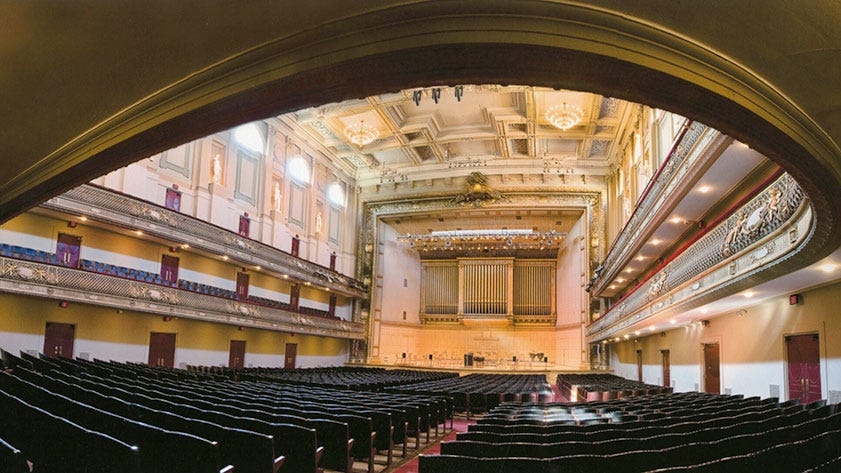
These concerns are very much at issue in the current situation at the Boston Symphony Orchestra, where serious questions have been raised about the transparency, judgment, and competence of the board and chief executive leadership. Whatever one’s view of the particulars, the controversy has exposed a troubling disconnect between those entrusted with stewarding a great musical institution and the musicians and audiences who sustain it.
“The BSO is not an isolated case. Across American cultural institutions — museums, universities, orchestras, theatres — the same pattern recurs: governing boards, composed of wealthy individuals whose social circles have adopted the language and priorities of institutional DEI, impose transformation mandates on organisations whose artistic missions were not designed to serve those priorities.
The Knoxville Symphony fired a clarinetist who won a blind audition unanimously — because his history of “resisting DEI” at the Nashville Symphony made him politically unacceptable. The Department of Justice has now written to the Knoxville CEO: “We have questions.”
The Metropolitan Opera, under financial pressure, is cutting artistic programming while maintaining administrative positions created during its own DEI expansion.
The pattern is consistent: artistic excellence is treated as necessary but insufficient. The additional requirement — unstated but enforced — is ideological alignment with a set of cultural priorities that have nothing to do with how well you play the clarinet, conduct Messiaen, or fill a concert hall.” - Cadenza Admin. Read full article here.
Who, exactly, is defending the music?
The question brings to mind the title of the late Boston Globe critic Michael Steinberg’s collection, Defending the Music. One wonders what he would make of an age in which so much discussion surrounding classical music seems to concern everything except music. We are told endlessly whom the concert hall should represent, what social function it should perform, what demographic targets it should reach, and what political obligations it should fulfill. Yet one hears surprisingly little about Bach, Beethoven, Brahms, or the mysterious power that caused these institutions to exist in the first place. Here is what he wrote in 1970 under the title Real Music Will Survive:
“The public relations industry is likely to become more resourceful, more diligent, and more powerful. Much of what people now assume has to do with art is actually a function of public relations…”
and perhaps even more prophetic:
“For many more, it will be a gig, a commodity to be promoted and sold, grist for the academy, a decoration.”
What we are witnessing is not a failure of music but a failure of FAITH. It is a loss of confidence in the greatness of the very tradition that built these institutions. Concert halls were not founded by focus groups, diversity statements, branding consultants, or strategic plans. They were built by composers, performers, patrons, and audiences who believed that great music possessed intrinsic value. They believed that a Bach fugue, a Beethoven quartet, or a Mahler symphony needed no justification beyond its existence.
Do we still believe that?
There is also something curious about the distribution of outrage. When Trump took over the Kennedy Center, there was no shortage of condemnation. Composers withdrew works. Musicians canceled appearances. Organizations severed ties. Public statements flowed freely in defense of artistic institutions. Yet while many musicians have rightly come to the defense of Nelsons, the response seems comparatively subdued. One cannot help noticing that institutional courage often appears to depend on who is perceived to be holding power. Principles that trumpet loudly in one season become strangely silent in another.
If our musical institutions are to survive, musicians must stop waiting for bureaucrats to save them. The defense of music has always belonged to those who love it, practice it, perform it, and dedicate their lives to it. The guardians of civilization’s greatest treasures are not the people writing mission statements about them, but the people spending six hours a day alone in a practice room trying to master a single phrase of Mozart.
“Corporate trustees tend to impose rigid, commercial templates onto delicate artistic entities. Philanthropy becomes less a civic contribution than a transactional purchase of creative control. They treat a symphony orchestra or a theater company like a retail chain, focusing on standardized metrics, top-down efficiency models, and marketing maneuvers. Long-term artistic cultivation is usually an afterthought. There are reports that trustees oppress through micromanagement; the very name “board of directors” erroneously invites untrained volunteers to intrude on specialized staff operations, thereby eroding institutional stability. On top of that, board members are often ignorant of or indifferent to the art form they are supposed to support.” - Thomas Connolly. Read his full article here for The Art Fuse.
Perhaps we musicians must also accept a measure of responsibility. Institutions rarely lose faith in something before its practitioners do. In our eagerness to appear relevant, we have too often spoken as though music required external justification — as though Bach needed sociology, Beethoven needed politics, or Mozart needed branding. Having doubted our inheritance, we should not be surprised when others rush in to manage it for us.
A civilization survives not because it continually reinvents its treasures, but because enough people love them enough to preserve them. The future of classical music will not be secured by those who explain it away, apologize for it, or dilute it into something more fashionable by kowtowing to pop culture. It will be secured by those who still believe that great music is one of the highest achievements of the human spirit and who are willing to defend it as such.
I would like to end this essay on June 12, 2026, by returning to Michael Steinberg. More than half a century ago, writing in the Boston Globe on January 4, 1970, he offered a prediction that now seems less like a prediction than a permanent truth:
“There will still be music at the end of the ’70s. For the happy few, it will be a life-and-death matter, something to tap all their reserves of love and fury, something, as Toscanini used to say, to put their blood into.”
—————
Follow Boston Symphony Musician, Elizabeth Klein for constant updates.
No posts
Comments
Nothing yet. Say the first thing.
Sign in to join the conversation.