
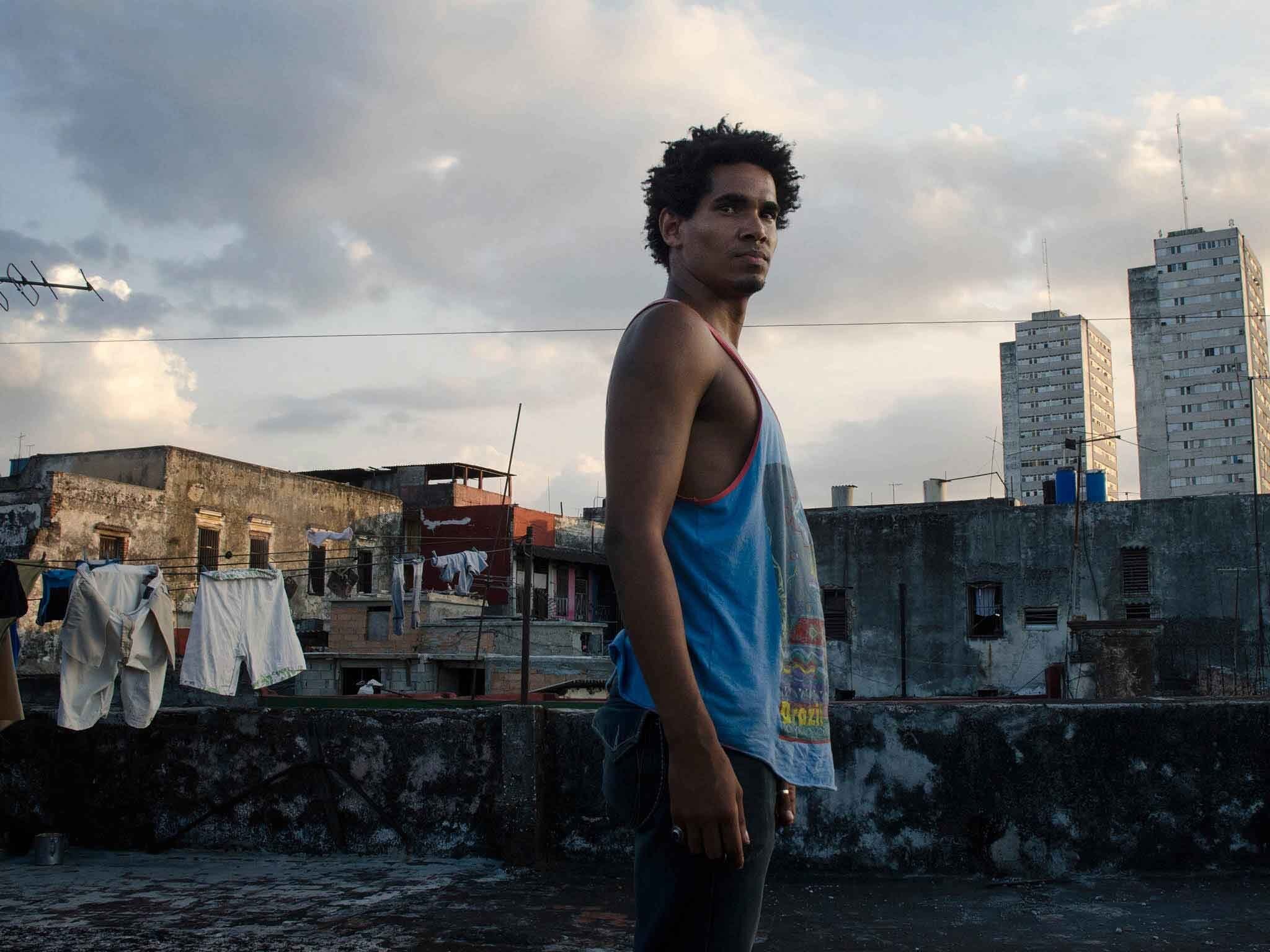
For five years, Otero Alcántara was one of the most recognizable faces of political imprisonment in Cuba. A co-founder of the San Isidro Movement and a participant in the “Patria y Vida” project, he became an international symbol of a government that imprisons young people for protesting, creating art and challenging official power. Arrested on July 11, 2021, he was subsequently sentenced to five years in prison on charges that included public disorder, contempt and insulting national symbols. Human-rights organizations regarded him as a political prisoner. When he arrived in Miami on July 18, 2026, after being released on the condition that he leave Cuba, many exiles expected him to embody the role that had already been assigned to him: survivor, witness and spokesman for the prisoners who remained behind. Instead, they encountered a complicated human being.
The interview that provoked some of the strongest reactions was conducted by Martí Noticias. Otero Alcántara was questioned about military intervention in Cuba, his treatment during his final days on the island and the period he spent under State Security custody at a residence near Guanabo while his departure was being arranged. He described being able to see relatives, drink beer, and eat properly. When asked whether he was concerned that the authorities had filmed those moments and might later use the images to discredit him, he answered with characteristic irreverence that he liked cameras and “sequins.” To some viewers, the remark sounded flippant and painfully out of place. Other critics complained that he appeared incoherent, that he rambled and that he failed to provide the systematic account of prison abuse they expected. His physical appearance also became an object of scrutiny: some remarked that he looked healthier, and heavier, than they imagined a man emerging from a Cuban prison should look.
The reaction soon moved beyond criticism. Unsupported accusations circulated on social media suggesting that he might be an agent of Cuban State Security. Others reportedly called for his removal from the United States. Such claims reveal more about the climate of suspicion surrounding Cuban politics than they establish about Otero Alcántara. Unless evidence emerges, they should not be repeated as fact. There are legitimate questions to ask him. But neither a prisoner’s appearance nor his failure to perform trauma according to public expectations proves collaboration with his jailers.
Otero Alcántara has acknowledged that his international visibility afforded him certain advantages unavailable to less prominent prisoners. He could obtain materials and continue working as an artist. During his confinement, he produced approximately 4,000 works, which he has described not as decorative paintings but as records of the ordeal he endured. Painting, he has said, helped keep him alive. He also maintains that he has used income from prizes and art sales to support his family and the struggle for freedom in Cuba. These circumstances complicate his story, but they do not erase the injustice of his imprisonment. A prisoner does not cease to be a prisoner because he is occasionally given beer, allowed to paint or treated less brutally than someone in the neighboring cell. Nor should survival itself be converted into evidence of guilt. Nevertheless, one cannot deny a certain narcissism in Otero Alcántara’s public persona. His interviews often turn toward his art, his sexuality, his relationships, his money and the mythology surrounding his own image. His language can be vulgar, impulsive and imprecise. He does not speak with the gravity many Cubans expected from someone who had come to represent their political prisoners.
But perhaps the deeper problem is that the exile community expected a symbol and received a man. Some have asked for patience. Five years in prison cannot be metabolized in a few days. A person forced directly from confinement into exile may need silence, psychological care and time before being placed under studio lights and asked to explain the fate of a nation. Trauma does not always produce eloquence. It may appear as confusion, bravado, inappropriate humor, emotional detachment or an intensified need for attention. That does not place Otero Alcántara beyond criticism. It does, however, require us to distinguish between moral judgment and public disappointment.
The controversy also invites a comparison with Aleksandr Solzhenitsyn, another artist and political prisoner forced into exile by a communist regime. Soviet authorities arrested him on February 12, 1974, stripped him of his citizenship and expelled him to West Germany the following day. Approximately two years later, on March 1, 1976, the BBC broadcast his major interview with journalist Michael Charlton. By then, Solzhenitsyn had possessed the time and distance necessary to reflect upon both his imprisonment and the Western society in which he had taken refuge. He brought to that interview more than a testimony about Soviet repression. His experience in the Gulag had produced a moral vision: the conviction that freedom depends upon an uncompromising distinction between good and evil and upon the courage of individuals and institutions to defend that distinction. As he warned, “Freedom is indivisible, and one has to take a moral attitude toward it.” It is in this moral interpretation of imprisonment, tyranny and freedom — not in the circumstances of exile alone — that the contrast with Otero Alcántara becomes most revealing.
In The Gulag Archipelago, Solzhenitsyn described imprisonment as capable of transforming the prisoner. Suffering could strip a person of certainty, expose his weakness and teach him patience. The man who had once judged others without mercy might acquire what Solzhenitsyn called “an understanding mildness” and learn to recognize both the frailty and the unexpected strength of other human beings. Solzhenitsyn did not romanticize suffering or suggest that imprisonment automatically made its victims virtuous. The camp could degrade, corrupt or destroy a person. But it also confronted the prisoner with fundamental moral choices. Even under extreme oppression, the individual retained some responsibility for deciding whether to participate in falsehood and cruelty. Solzhenitsyn emerged from that experience with an extraordinarily developed moral vocabulary. He understood the Gulag as more than an apparatus of state repression. It was the political expression of a deeper corruption: the surrender of conscience, personal responsibility and the distinction between good and evil.
It would be unfair to demand that Otero Alcántara become Cuba’s Solzhenitsyn. They come from different intellectual traditions, practice different arts and speak in radically different registers. Solzhenitsyn was a writer who organized experience through sustained historical and philosophical argument. Otero Alcántara is a performance artist whose language has often been his body, provocation and spectacle. Still, the contrast exposes a legitimate hunger within the Cuban exile community. Many expected someone who had endured five years of political imprisonment to offer a clear account of the system’s cruelty and a moral vision for the country that might replace it. Instead, they heard statements about art, money, sex, pacifism and the possibility of embracing with love a former jailer. His willingness to say that he could embrace his jailer and express love toward him may represent forgiveness. But forgiveness requires moral clarity. Loving an enemy does not mean pretending that oppression is merely another point of view. Mercy without truth can become self-display; reconciliation without justice can become permission for abuse.
Solzhenitsyn’s moral criticism did not end at the Soviet border. Once in exile, he became deeply concerned about what he regarded as the spiritual and civic deterioration of the West. He saw intellectuals reluctant to defend unpopular truths, journalists exercising freedom without accepting responsibility and political leaders separating pragmatic calculations from moral judgment. He also warned of a growing admiration for revolutionaries, particularly the most extreme among them. Western intellectuals, professors and public figures, he argued, too often excused revolutionary violence when it was committed in the name of equality or liberation. They condemned abuses committed by their political opponents while rationalizing similar abuses committed by movements whose ideology they admired. That warning remains urgent.
Democratic decline does not always begin when a dictator abolishes elections or closes a legislature. It can begin much earlier: when citizens cease to believe that truth exists beyond political convenience; when violence is excused according to the identity or ideology of the person committing it; and when intellectuals defend coercion because it is carried out in the name of equality, revolution or historical justice. We can see this danger today in the renewed respectability of Marxist and authoritarian ideas within parts of American academic, cultural and political life. Arguments that minimize communist crimes, romanticize revolutionary violence or treat individual rights as obstacles to collective transformation have moved from the margins into influential institutions.
We don’t need to describe every advocate of economic redistribution or social reform as a communist. Such exaggeration weakens the argument. The real danger lies in excusing coercion when it serves a preferred ideology, treating opponents as morally illegitimate and believing that noble intentions can redeem systems that subordinate the individual to the state. For Cubans, this is not an abstract intellectual dispute. We know what follows when political language abandons moral limits. The Cuban Revolution promised justice, equality and liberation. It produced a state in which rights became privileges distributed according to political obedience.
The Cuban state did not merely abolish representative institutions and confiscate private property. It attacked the independent sources of loyalty and meaning capable of limiting its power: churches, families, civic associations, private enterprise and traditions of personal responsibility. It attempted to replace them with the “new man,” a citizen whose highest obligation was not to God, family or conscience, but to the revolutionary state. Chronic scarcity completed part of this destructive work. When people must steal from their workplaces, participate in the black market, deceive officials or sell access to their bodies merely to obtain necessities, moral compromise becomes embedded in ordinary life. Conduct that begins as a means of survival gradually becomes a social habit. Trust disappears, language deteriorates and the ability to distinguish resourcefulness from corruption becomes dangerously weak. This damage will not be repaired simply by removing the Communist Party, adopting a new constitution or introducing private commerce. Those changes may be indispensable, but they are insufficient.
Democratic institutions do not create the moral character necessary to sustain democracy. The relationship works principally in the opposite direction. Constitutions, courts, elections and markets depend upon moral habits that they cannot manufacture by themselves: honesty, restraint, responsibility, respect for human dignity, tolerance of disagreement and fidelity to truth. Laws can punish certain forms of misconduct, but no legal system can survive if deception becomes normal, corruption becomes admirable and power becomes the only recognized measure of right. Courts cannot administer justice if judges possess no allegiance to truth. Elections cannot preserve liberty if voters reward vengeance, dependency and political tribalism. Markets cannot remain free if contracts mean nothing and theft is celebrated as ingenuity.
For Solzhenitsyn, shared values could not survive without spiritual roots. They emerged from the Christian moral order that shaped Western civilization: the belief that human dignity comes from God and cannot be granted or withdrawn by the state; that good and evil are objective realities; that freedom is inseparable from responsibility; and that every ruler remains subject to a law higher than political power. Within this moral framework, the institutions of democracy could develop and prosper because neither the individual nor the state was understood to be the ultimate authority. The recovery of freedom must therefore include a return to spiritual life and to shared values grounded in morality. Constitutions, elections and courts cannot preserve liberty in a society that no longer believes in truth, sacrifice, forgiveness, self-restraint or the sacred worth of every person. Political opponents must not become enemies to be destroyed; authority must remain limited; and the law must bind rulers as firmly as ordinary citizens. Once these moral foundations disappear, democratic institutions become empty structures — easily captured and turned against the very freedoms they were created to protect.
This is the essential lesson Solzhenitsyn offered both Russia and the West. Freedom cannot be maintained only through laws, procedures or material prosperity. It requires citizens who accept responsibility for its survival. A country may retain elections, courts and a written constitution while gradually losing the moral culture that gives those institutions meaning. As a Cuban exile and political refugee, I understand the anger of those who expected more from Otero Alcántara. At a crucial moment when many Cubans believe political change may finally be possible, they wanted a commanding witness — someone who could speak for the prisoners, name the evil of the system and articulate the principles of a future republic. But perhaps we placed an impossible burden on one wounded man. Perhaps we turned a prisoner into a poster and then blamed the human being for failing to resemble it.
We have every right to question Otero Alcántara’s ideas and conduct. Public prominence carries responsibilities, particularly when a person has come to represent prisoners who cannot speak freely for themselves. But a dictatorship leaves its fingerprints even on those who resist it. Otero Alcántara was born and formed within a society devastated by poverty, repression and the systematic destruction of its moral and civic foundations. He is both an adversary of that system and one of its human consequences. To recognize this does not absolve him of responsibility; it places our judgment within the reality that produced him. If we demand moral seriousness from a man emerging from five years of confinement, and a lifetime under the Cuban regime, we must temper that demand with humility – and most importantly, be prepared to apply the same moral scrutiny to ourselves.
Before asking who will govern Cuba after the Castros, we must ask what convictions will govern those who inherit the country. Do we believe in freedom only for those who agree with us? Do we defend truth even when it injures our political side? Can we distinguish justice from vengeance? Can we criticize a disappointing spokesman without inventing evidence against him or denying his humanity? These are not secondary questions to be addressed after democratic institutions have been established. They will determine whether such institutions can be established at all.
Removing a dictatorship is not the same as creating a free society. Markets may produce wealth, laws may restrain misconduct and elections may transfer authority, but none of them can substitute for a moral culture. Freedom cannot simply be delivered from Washington, purchased through commerce or guaranteed by constitutional language. It must be cultivated through conduct: in our respect for truth, our willingness to judge without dehumanizing and our determination to recognize both evil and human weakness. Otero Alcántara may not be the spokesman many Cubans expected. Yet the controversy he has provoked offers an opportunity more valuable than another trial conducted on television and social media. It invites us to stop waiting for a flawless hero and begin the more difficult work of moral reconstruction.
The ultimate question is not merely whether Cuba is prepared to live without the Castros. It is whether Cubans — on the island and in exile — are prepared to accept the responsibilities without which freedom cannot endure.
No posts
Comments
Nothing yet. Say the first thing.
Sign in to join the conversation.