
Text within this block will maintain its original spacing when published
The tattered Hungarian tent
A man washing a trumpet
at a roadside tap
Children in the trees,
one falling
into the grip of another
from The Distance of a Shout: Selected Poems (Knopf, 2026)
I have probably said this about numerous other authors—Marilynne Robinson, William Maxwell, Cormac McCarthy, Ray Carver, Denis Johnson, James Baldwin, John McPhee, Noy Holland, Toni Morrison, Breece D’J Pancake, Barry Hannah, Sharon Olds—but Michael Ondaatje was my first favorite, favorite author.
It started when a teacher of mine, right before a break, had a conference with me where, after reading one of my short stories, said, essentially, you should read the following. I think I can almost recall, by memory, the following:
The Collected Stories of Breece D’J Pancake, Breece D’J Pancake
Airships, Barry Hannah
By Night in Chile, Roberto Bolaño
Spectacle of the Body, Noy Holland
So Long, See You Tomorrow, William Maxwell
The Collected Works of Billy the Kid, Michael Ondaatje
It was, without question, one of the best weeks of reading of my life. I loved every one of those books, and still do, but it was that final book that stayed with me the longest. In that book, Ondaatje blends poetry and fiction and mythology and history and form and so much more to create this slim volume that is at once this stunning portrait of a voice and also this melding of style and music and image. Here is the literal fourth page of that book:
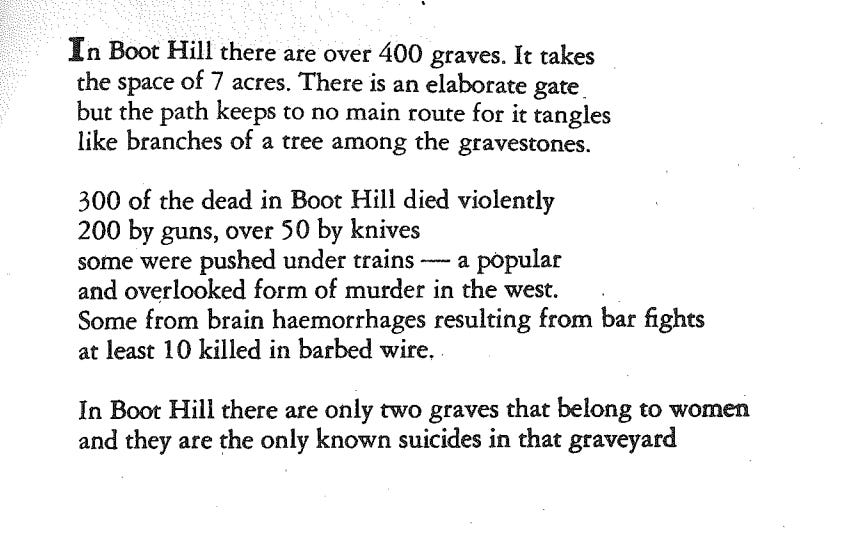
Stunning, right? Violent and aware and tragic and so much more. Those final two lines! They make the poem this thing that transcends the detailed violence of what comes before, as it becomes this documentation of historical female pain. These last two lines hinge on the buildup of what comes before. It’s an act of miraculous craft, situated in a book for which you’d be (briefly, and then never again) forgiven for thinking is some mere riff of a Western.
Just a few pages later, Ondaatje begins a poem with these lines:
Text within this block will maintain its original spacing when published
Mmmmmmmm mm thinking
moving across the world on horses
body split at the edge of their necks
neck sweat eating at my jeans
moving across the world on horses
And these lines are playful and youthful and just as vivid in their own way. They are so full of life. I love that image—neck sweat eating at my jeans. I love any poem that gives itself permission to begin Mmmmmmmmm mm. The same book! It’s the same book! As what comes before! A book of poems and news clippings and stories, all between the same covers.
I read this book by Ondaatje and read it again and again—because you can read this book in one sitting—and then I read what Ondaatje is more famous for, namely his novel The English Patient, which is a visceral and beautiful and lush novel, and which I loved, but did not love as much as The Collected Works of Billy the Kid, but then I read In the Skin of a Lion, which is an absolute marvel of a book that does what great writing can do, which is to look closely at a relatively un-looked-at thing and depict it with such wonder that it expands the reader’s sense of the world as a place where it is possible for miracles to happen in the most ordinary of places. That book contains swinging immigrant bridge-builders and paragraphs like this one, which is an all-timer, just perfect:
Nicholas Temelcoff is famous on the bridge, a daredevil. He is given all the difficult jobs and he takes them. He descends into the air with no fear. He is a solitary. He assembles ropes, brushes the tackle and pulley at his waist, and falls off the bridge like a diver over the edge of a boat. The rope roars alongside him, slowing with the pressure of his half-gloved hands. He is burly on the ground and then falls with terrific speed, grace, using the wind to push himself into corners of abutments so he can check driven rivets, sheering valves, the drying of the concrete under bearing plates and padstones. He stands in the air banging the crown pin into the upper cord and then shepherds the lower cord's slip-joint into position. Even in archive photographs it is difficult to find him. Again and again you see vista before you and the eye must search along the wall of sky to the speck of burned paper across the valley that is him, an exclamation mark, somewhere in the distance between bridge and river. He floats at the three hinges of the crescent-shaped steel arches. These knit the bridge together.
The real joy of Ondaatje’s writing is that he can write a paragraph like this and then a poem like today’s, which captures that same sense of close attention with both brevity and detail. It’s an exercise—today’s poem is—in what is looked at and what is overlooked.
If anything, the presence of a poem like today’s, which enacts what it feels like to try to freeze frame some passing detail as you move past it at 60 miles an hour, alongside, say, the textured richness of that paragraph I just mentioned, shows that writing is more than just style, or, perhaps to say it better: a writer is not merely their style. These two excerpts of Ondaatje’s oeuvre are similar in one magnificent way: they pay careful attention. How else can you write of a person as an “exclamation mark…between bridge and river”? How else can you write of the man washing their trumpet on the side of the road?
Before these characters become testaments of style, they must first be objects of witness. To describe a man who is as thin and small and exciting as an exclamation mark, one must first notice him, so far off, swinging in the distance. I love that about Ondaatje’s writing—and the writing of so many writers I love: the style may oscillate, but the attention never wavers.
In today’s poem, brief as it is, there is this careful buildup. Objects are frozen through the car window’s glass: a tent, a trumpet. But then there is this final image, which moves:
Text within this block will maintain its original spacing when published
Children in the trees,
one falling
into the grip of another
I adore this ending. The poem creates the motion with the empty space, that air that exists between the children in the trees and the act of them falling. The poem moves. And the children do, too. What a strange and beautiful and tender image, isn’t it? Said so simply? And how there’s so much more? How you imagine these children as travelers, and how you imagine them as playful and messy and laughing, and how they are practicing, I imagine, their work, but how they are also, I imagine, having fun. And how they are caring for one another by catching one another. And how the poem shows this, too, with two words—one falling—on one line, and how they are caught in the grip of the line that follows. Did you know a poem could contain a pair of hands? It can, you know. It can.
I am beginning the act of writing this just a few hours after being under a tent myself, having spent the day at my high school’s graduation. These graduation days are, truly, some of my favorite days of life. They are impossible to describe in complete detail, though I find myself trying in the aftermath of each one every year.
My high school has had its graduation under the same big tent almost every year for all the years I’ve worked there. We get there early, us teachers, and we linger about in our thin, black robes as the students and families come in. I would not trade these early hours for anything, these long minutes spent watching the families arrive. And they arrive in droves, the families do, these absolute crews surrounding each student of the hour. They arrive as countless siblings and cousins, as already-weeping parents, as toddlers wearing too-big suits or having just had the hair done up and styled for what seems like the first time. They arrive with enough balloons to take flight. They arrive with gifts. They arrive with posters and print outs. They arrive with Mexican flags and Honduran flags and Ecuadorian flags and Dominican flags. They arrive with photographs blown up to the size of Shaquille O’Neal. They arrive with one last look at their graduating child, a finger licked and used to smooth their hair, makeup touched up in the mirror of a car’s window. They arrive joyous and sweating and anxious and awaiting and proud. I watch them and greet them and see in a mother’s face the face of her son, in a father’s eyes the eyes of his son; I see in a nose, a daughter.
I feel great gratitude for this.
When the ceremony starts, these same families wait with a kind of humming patience through the various formalities of it all: the words and words and more words. But then, when the roll call of names begins, and their children are lined up awaiting their diplomas, every sense of decorum is eschewed, and these families rush closer to the stage, siblings the height of my knees craning between the legs of some uncle—the whole ceremony of it all turning into thirty minutes of continuous applause. It is raucous; it is celebratory; it is unhinged. I saw a former student of mine rushing to the stage to take a picture of her younger sister, holding three different phones with one hand and their youngest brother in her other arm. She caught my eye in the sprint. “Mr. Kelly!” she yelled. “Ah!” I yelled. We were both weepy and sweaty. I remembered, as if in a dream, when she graduated years ago, and when her same sister, graduating now and much younger then, ran to the stage with a baby in her arm and phones in the other.
I sat sweating under a tent in New York City and witnessed this. Maybe someone driving past, catching a glimpse of the tent’s high arc, might not have known what joy occurred within it. Or maybe they would have, having just come from some ceremony of joy of their own. Sometimes it is something else entirely and something surely preciously special to be reminded of what great goodness is occurring along the margins of our sight and the margins of our lives.
Always on these graduation days, as I sit sweating among the teachers, I look at the students, gathered together at the front of it all, many with the flat tops of their caps decorated with quotes or flags or flowers, and see them, often for the first time, as this collective group that experienced something together. I watch them lean into each other and cheer for one another. I watch them laugh and scream. They fall, for one last time, into the grip of one another.
And for all the obvious talk at such a ceremony of the parents who got them there and the teachers who supported them, it is this final sense of holding that I feel deeply touched to witness—this last moment of hanging on, this realization, I think, that they might never see each other again, and that they must, in this final moment of celebration, hold onto each other one last time to make up, perhaps, for all the times they did not. Maybe you, reading this, know that there is no final moment until that very final moment, and maybe this is true, but to watch these kids wrestle with the bigness of the doorway they are walking through is such a tender, tender thing. I don’t think I’ll ever get tired of it.
I think of this poem today and I think of how we are always frozen on the side of the road of someone else’s vision, caught for all of time in some act of living. I walked up the hill away from that graduation and still saw so many kids lingering, hanging about for one more picture, the yearbook pulled out, the final page ready for the signing. And then I got home and found my son and held him up in the air. “Don’t graduate,” I said, “don’t ever graduate.” I was not ready yet. I am not ready at all. I was holding him and twirling around and around. I don’t want to believe we ever grow tired of holding and being held. Our windows were open. Someone looking through their window would have seen me, holding and holding on.
My novel, Pilgrims, is out in the world, and I am deeply grateful. Thank you for reading it and sharing it and all sorts of things. If you are interested, you can buy it here. Consider writing a review on Goodreads if you’d like. Consider asking for it from your local library. I appreciate it. Thank you a million times over.
If you’ve read any of the recent newsletters, you’ve perhaps noticed that I am offering a subscription option. This is functioning as a kind of “tip jar.” If you would like to offer your monetary support as a form of generosity, please consider becoming a paid subscriber below. There is no difference in what you receive as a free or paid subscriber; to choose the latter is simply an option to exercise your generosity if you feel willing. I am grateful for you either way. Thanks for your readership.
No posts
Comments
Nothing yet. Say the first thing.
Sign in to join the conversation.