
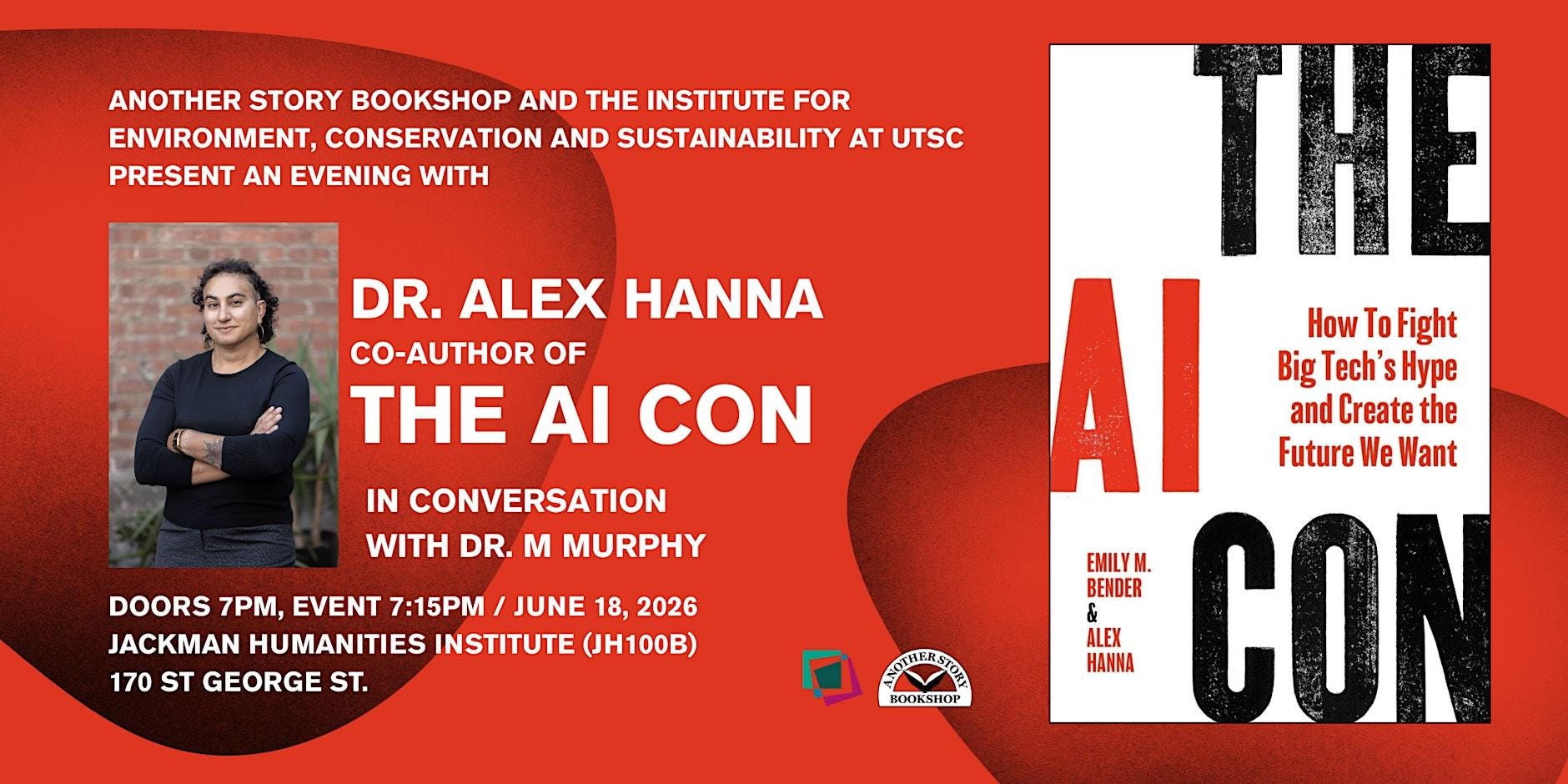
Last night I had the pleasure of going to a book talk with Dr. Alex Hanna, the director of research at the Distributed AI Research Institute (DAIR) and co-author of the brilliant book, The AI Con.
Hanna, along with her collaborators at DAIR and elsewhere, have been at the forefront efforts to probe the political economy of AI and push back on AI hype. The talk covered a lot of ground. This included the necessity to go beyond the term “AI” and focus on the tech does, the centrality of data centre opposition, ways to organize, and the varying effectiveness of different tactics.
These are topics that I will return to, but today I want to pick up on another of the themes from Hanna’s remarks: what alternative visions of technology development look like.
It is easy be branded as anti-technology, anti-innovation, a neo-Luddite, or even an extremist, as Hanna has been, if you oppose AI hype and the sense of inevitability that comes with it. However, this is often a willful misrepresentation. As Brian Merchant argued in his book Blood in the Machine about the original Luddites, opposition to revolutionary technologies does not stem from being against the technology itself. Instead, it stems from a rejection of the wider political economy of that tech.
In the case of the original Luddites, they did not hate the technologies being introduced. They hated the ways in which “entrepreneurs” were using them to accumulate power and wealth, and in the process transform social relations, all at the expense of workers.
A similar process is at play today. Hanna and her co-author Emily M. Bender argued in The AI Con how AI is:
a bill of goods you are being sold to line someone’s pockets. A few major well-placed players are poised to accumulate significant wealth by extracting value from other people’s creative work, personal data, or labor, and replacing quality services with artificial facsimiles.
For the rest of us, the ways in which these players are developing and pushing out AI technologies are “threatening stable careers and replacing them with gig work, slashing personnel in government, cheapening our social services, and degrading creativity.”
This is not an inevitable outcome. As Hanna urged, we can push back on this and instead create other models of technology development that work in the interest of the many, not the few.
This is where the “Distributed” comes in from DAIR’s name. A distributed model of technology development is one where innovation happens in communities, led by local people that are focused on solving local problems and embracing local opportunities. It is very different to today’s dominant model of innovation that is centred in an “imperial core” in Silicon Valley and that extracts wealth from the periphery.
Fortunately, models of distributed innovation are happening right now. It just does not get the same kind of attention as models cultivated by the hype machine of the interlinked systems of Big Tech, venture capital, and the mainstream media.
An example that Hanna cited is the work of Ciira wa Maina, a lecturer at Dedan Kimathi University of Technology in Nyeri, Kenya and a board member of DAIR. His research includes leveraging machine learning and bioacoustics to use audio recordings to assess local biodiversity and developing sensor systems to monitor river basins to address water management challenges. It is work rooted in the community, for the community.
Similar types of distributed innovation happen in Canada too. I have had the opportunity through Orbit Policy to do a project on Canada’s applied research ecosystem, looking into the fascinating work that is going on in colleges and institutes from coast-to-coast-to-coast. These organizations work in their communities, for their communities, helping local businesses, municipalities, and nonprofits to leverage technology and innovation. Yet this kind of work gets a fraction of the attention and the funding as the flashier innovation coming out of universities, or out of Silicon Valley.
The fact these kinds of models exist helps us to see how there is nothing inevitable about the future Big Tech and tech-bros want to force on us. That type of imperialistic innovation, and the technologies stemming from it, can be, and should be rejected. Instead, we need to pursue technological solutions and innovations that are developed within our communities directly, and that serve our interests. That is how we get to the kinds of future we want for us and for future generations.
No posts
Comments
Nothing yet. Say the first thing.
Sign in to join the conversation.