
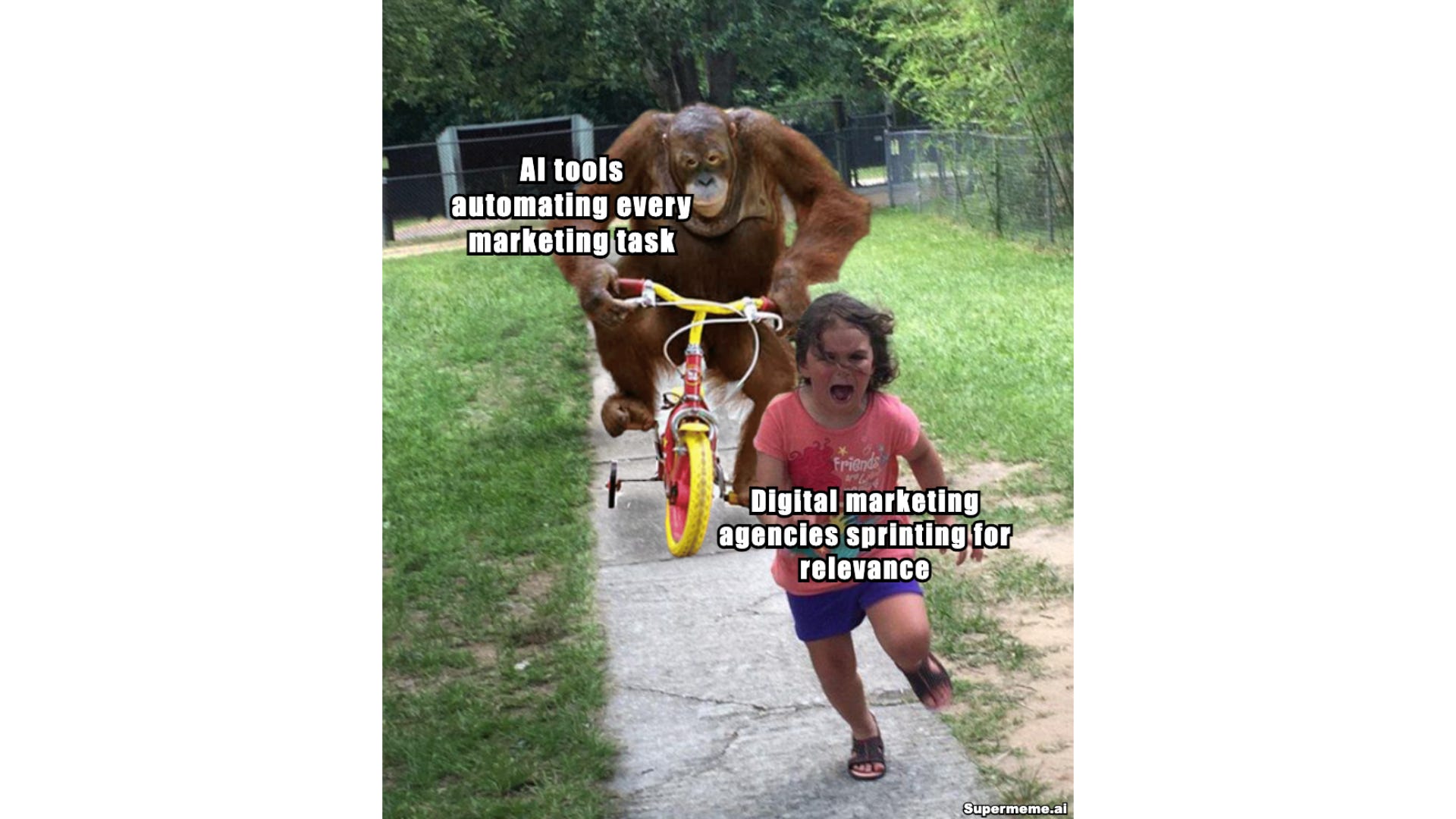
For the first time in many years, businesses are asking a very fair question:
Why should we hire a marketing agency anymore?
It is not a cynical question.
It is not an uninformed question.
It is probably the most important question the agency industry has had to face in a long time.
Because today, a founder can use ChatGPT to write copy. Claude can help write code. Lovable can build a landing page. Canva can create designs. Runway, Descript, CapCut, and other AI tools can simplify video creation. SEO tools can generate article outlines, keyword clusters, briefs, and even full drafts.
A business owner can now create in one weekend what used to require a copywriter, designer, developer, editor, and content team.
So yes, something fundamental has changed.
And agencies that pretend otherwise are not paying attention.
AI is not a small productivity upgrade. It is a structural shift in how marketing work gets produced.
McKinsey’s 2025 State of AI research shows that AI adoption is now widespread across business functions, with marketing and sales among the areas where companies most commonly report revenue benefits from AI use. (McKinsey & Company) Salesforce also reports that generative and predictive AI have become mainstream in marketing, with marketers using AI to create, predict, personalize, and integrate work at scale. (Salesforce)
So let us start honestly.
AI will replace a lot of agency work.
Generic blogs.
Basic ad copy.
Templated social posts.
Simple landing pages.
First-draft email sequences.
Basic video edits.
Stock-style visuals.
Keyword-led content production.
Simple website builds.
These were once billable agency deliverables. Increasingly, they are AI-assisted tasks.
That is the uncomfortable truth.
But here is the more important truth.
AI has not made marketing easy. It has made marketing noisier.
For years, marketing had a production bottleneck.
Companies needed agencies because execution was slow, expensive, and dependent on skilled specialists.
That bottleneck is disappearing.
The new bottleneck is not content creation.
The new bottleneck is decision-making.
Most businesses do not struggle because they cannot create enough marketing assets.
They struggle because they do not know:
who exactly they are selling to
what problem they should own
what message the market will believe
which channels deserve investment
what content should be created first
what must be ignored
how to separate activity from progress
why leads are coming but not converting
why traffic is growing but pipeline is not
why campaigns get clicks but not trust
AI can generate more options.
But more options do not automatically create better decisions.
In fact, the biggest risk in the AI era is not lack of output.
It is strategic confusion at scale.
A business can now produce 100 posts, 50 ads, 20 blogs, and 5 landing pages very quickly.
But if the positioning is weak, the audience is wrong, the offer is unclear, or the buyer journey is broken, AI will only help the company fail faster.
This is where the role of agencies changes.
The agency is no longer valuable because it can “make things.”
The agency is valuable when it can help decide:
What should be made, why it should be made, who it is for, how it should be distributed, and how success should be measured.
The traditional agency model was simple.
Sell deliverables.
Eight posts per month.
Ten blogs per month.
Four creatives per campaign.
One landing page.
One newsletter.
One monthly report.
This model worked when production itself was scarce.
But AI has changed the pricing logic.
If a business owner believes AI can create a decent blog in 10 minutes, paying an agency only for “blog writing” becomes harder to justify.
This does not mean content has lost value.
It means undifferentiated content production has lost value.
The same applies to design, video, websites, and even code.
A website is easier to build now.
But a website that understands the buyer, differentiates the company, supports conversion, reflects trust, answers objections, and integrates into a growth system is still not easy.
A blog is easier to write now.
But a content engine that builds authority, maps to buying intent, earns trust, supports sales conversations, and survives AI search disruption is still difficult.
A LinkedIn post is easier to draft now.
But a founder voice that builds credibility over 12 months is still difficult.
An ad is easier to generate now.
But knowing what to test, what to stop, what to scale, and what insight to extract from weak performance is still difficult.
So the agency’s work moves from:
production → intelligence
execution → orchestration
content → market learning
campaigns → growth systems
monthly activity → business accountability
That is a very different agency model.
And frankly, it is a better one.
This is one of the most important points.
AI has made it easier for every company to publish.
But that also means buyers are surrounded by more sameness.
More blogs.
More carousels.
More emails.
More landing pages.
More generic “thought leadership.”
More content that sounds polished but says nothing new.
At the same time, trust is becoming harder to earn.
The 2025 Edelman Trust Barometer surveyed 33,000 respondents across 28 countries and continues to show that trust is a central business issue, not just a communications issue. (Edelman) Edelman’s work also points to a broader trust gap around institutions, leadership, and information ecosystems, which matters deeply for brands trying to persuade buyers in crowded markets. (Axios)
This matters because AI-generated marketing can easily create the illusion of professionalism.
But professionalism is not the same as credibility.
A company can now sound polished without being trusted.
It can publish frequently without being remembered.
It can rank for keywords without being preferred.
It can automate outreach without building relationships.
It can generate leads without creating confidence.
This is where human-led marketing becomes more important, not less.
Not because humans write better first drafts than AI.
But because trust still comes from:
real experience
real opinions
real proof
real customer stories
real expertise
real trade-offs
real founder conviction
real market understanding
AI can package these things.
But it cannot invent them honestly.
A good agency’s job is no longer to manufacture generic content.
It is to extract the company’s real intelligence and convert it into market-facing trust.
That is a very different skill.
For years, many agencies sold SEO as a traffic engine.
Find keywords.
Write articles.
Optimize meta tags.
Build backlinks.
Track rankings.
That model is now under pressure.
Google’s AI Overviews and zero-click search behavior are changing how people consume information. Pew Research found that users who encountered an AI summary clicked a traditional search result in 8% of visits, compared with 15% when no AI summary appeared. (Pew Research Center) Ahrefs found that AI Overviews reduced clicks to top-ranking informational content by 34.5% in its 2025 study, and later reported an even sharper decline in updated research. (Ahrefs)
This does not mean SEO is dead.
But it does mean SEO must evolve.
The old question was:
How do we rank?
The new questions are:
How do we become the source AI systems trust?
How do we become visible across Google, ChatGPT, Perplexity, YouTube, Reddit, LinkedIn, review platforms, communities, and industry conversations?
How do we create content that is useful enough to be cited, shared, referenced, and remembered?
This is why the agency role becomes more strategic and more operational at the same time.
Companies will need help with:
topical authority
original insights
expert-led content
customer proof
comparison pages
founder POV
community visibility
review ecosystem
AI search visibility
distribution beyond Google
content that supports sales, not just traffic
In the AI era, SEO cannot be only about ranking pages.
It has to become authority architecture.
This is especially important for B2B businesses.
B2B buyers are doing more research independently. Gartner has reported that many B2B buyers prefer a rep-free buying experience, but also notes that self-service digital buying can increase purchase regret when buyers do not get the contextual guidance they need. (Gartner) Gartner’s 2026 sales research also reported that 45% of B2B buyers used AI during a recent purchase, showing that AI is now entering the buyer journey itself. (Gartner)
This is a major shift.
Your buyer is no longer only searching Google.
They may be asking ChatGPT.
They may be asking Perplexity.
They may be comparing vendors using AI summaries.
They may be asking LinkedIn communities.
They may be checking Reddit.
They may be consuming your content without ever filling a form.
They may be forming a shortlist before your sales team even knows they exist.
6sense’s buyer research also notes that buyers can complete a large portion of their journey before engaging with sellers. (6sense)
This means marketing has to work harder before the buyer ever speaks to the company.
The job is not only lead generation.
The job is to create enough market trust so that when the buyer is ready, the company is already in the consideration set.
That requires more than AI-generated content.
It requires:
sharp positioning
differentiated messaging
proof of expertise
category education
buyer journey mapping
objection handling
consistent visibility
sales and marketing alignment
credible distribution
trust signals across touchpoints
AI can support all of this.
But someone still has to design the system.
The agency of the future will not survive by saying:
“We create content.”
“We run ads.”
“We build websites.”
“We manage social media.”
Those statements are too weak now.
The stronger agency role is:
We help you build a marketing operating system that combines AI speed with human judgment, market understanding, trust creation, and measurable business outcomes.
That is where agencies remain relevant.
Not as task vendors.
But as operating partners.
A post-AI agency should help businesses across seven areas.
AI can summarize a market.
But it cannot automatically understand which insight matters for your business.
Companies need help identifying:
ideal customer segments
buying triggers
category shifts
competitor gaps
customer pain points
message-market fit
objections and anxieties
decision-making patterns
The agency becomes the team that turns scattered market information into usable growth intelligence.
In a world where everyone can produce content, a clear point of view becomes a growth asset.
HubSpot’s 2026 marketing report emphasizes that as AI floods the market with content, brands without a clear point of view risk getting lost, and growth increasingly depends on distinctiveness, trust, and relevance. (HubSpot)
This is exactly where many businesses struggle.
They know what they sell.
But they do not know how to say it in a way the market remembers.
They sound like everyone else.
AI often makes this worse because AI tends to produce average language based on existing patterns.
So the agency’s role is not just to write.
It is to sharpen:
what the brand stands for
what it rejects
what problem it owns
what language it should use
what category narrative it should build
what makes the company meaningfully different
AI can help draft the message.
But the point of view must come from human judgment and business clarity.
AI makes volume easy.
But volume without editorial judgment creates noise.
The agency must help answer:
Which content should exist?
Which content should not exist?
Which content supports awareness?
Which content supports evaluation?
Which content supports sales?
Which content builds authority?
Which content should come from the founder?
Which content should come from customer proof?
Which content should be repurposed?
Which content should be retired?
This is not a writing problem.
It is an editorial and business judgment problem.
Most businesses do not fail because they lack content.
They fail because content does not reach the right people repeatedly enough.
AI can generate content.
But it does not automatically build distribution.
Distribution means:
SEO
LinkedIn
founder-led content
newsletters
communities
partnerships
paid campaigns
remarketing
webinars
events
sales enablement
review platforms
analyst or industry visibility
WhatsApp or email nurture
YouTube or short-form video
account-based outreach
The agency’s job is to design the distribution system.
Not just create assets.
AI allows faster experimentation.
But experiments still need structure.
Many companies run campaigns and learn nothing.
They change too many things at once.
They judge too early.
They optimize for the wrong metric.
They confuse cheap leads with good leads.
They stop content before it compounds.
They scale ads before message-market fit exists.
A strong agency brings discipline.
It defines:
what hypothesis is being tested
what metric matters
what result is acceptable
what should be changed
what should be continued
what insight was learned
what the next test should be
This is where AI plus agency becomes powerful.
AI increases speed.
The agency increases learning quality.
The more AI-generated the internet becomes, the more proof matters.
Buyers will increasingly look for signals that a company is real, experienced, and safe to trust.
This includes:
case studies
testimonials
founder credibility
customer stories
product demos
comparison pages
transparent pricing logic
detailed FAQs
original research
community presence
credible third-party mentions
practical examples
strong sales collateral
AI can help structure these assets.
But the raw material has to come from real customer experience.
The agency’s role is to extract, package, and distribute that proof.
This may be the biggest point.
AI does not take responsibility.
A tool does not join your review meeting and say:
“This campaign failed because the offer was weak.”
“This audience is too broad.”
“This landing page is attracting the wrong intent.”
“This content is getting traffic but not commercial movement.”
“These leads are cheap because they are irrelevant.”
“This positioning sounds good internally but does not matter to buyers.”
“This is not a marketing problem. It is a sales follow-up problem.”
A good agency gives uncomfortable clarity.
That is valuable.
Because many businesses do not need more content.
They need someone to tell them the truth about what is not working.
In the AI era, businesses should stop buying agency services as isolated deliverables.
Do not buy “10 blogs.”
Buy a search and authority system.
Do not buy “social media posts.”
Buy a founder-led visibility and trust-building engine.
Do not buy “performance marketing.”
Buy a structured experimentation and demand-generation system.
Do not buy “a website.”
Buy a conversion-ready digital presence that communicates positioning, proof, and buyer confidence.
Do not buy “SEO.”
Buy discoverability across search engines, AI engines, communities, and buyer research journeys.
Do not buy “content writing.”
Buy market education, category authority, and sales enablement.
This is the mindset shift.
The deliverable still exists.
But the value is no longer in the deliverable alone.
The value is in the thinking behind it, the system around it, and the business result it supports.
Agencies also need to change.
They should stop selling work that AI has already commoditized.
They should stop hiding behind activity reports.
They should stop charging premium retainers for generic production.
They should stop pretending that every blog is thought leadership.
They should stop selling SEO without understanding how AI search is changing discovery.
They should stop treating social media as a calendar-filling exercise.
They should stop reporting vanity metrics without explaining business impact.
AI will expose weak agencies faster.
And that is not a bad thing.
The agencies that survive will be the ones that can combine:
AI fluency
business understanding
buyer psychology
strategic clarity
creative judgment
data interpretation
content intelligence
growth operations
execution discipline
This is not the death of agencies.
It is the death of agencies that were only selling effort.
At Orange Owl, we do not believe AI reduces the need for marketing.
We believe AI raises the standard for marketing.
Because when every company can create, the market rewards companies that are clearer, sharper, more trusted, and more consistent.
The future of marketing is not humans versus AI.
It is not agencies versus tools.
It is business clarity plus AI-enabled execution.
AI should absolutely be used.
It should reduce repetitive work.
It should make research faster.
It should improve first drafts.
It should help generate variations.
It should speed up analysis.
It should make teams more efficient.
But AI still needs direction.
And direction requires judgment.
That is where agencies must evolve.
A modern marketing agency should help clients answer:
Where should we compete?
Who should we focus on?
What should we say?
Why should the market believe us?
Which channels should we prioritize?
What should we automate?
What should remain human-led?
What should we test first?
What should we stop doing?
What should we measure?
How do we turn marketing into a repeatable growth system?
This is the work.
Not just writing.
Not just posting.
Not just designing.
Not just running ads.
The work is to help companies make better marketing decisions and execute them consistently.
AI has made one thing very clear.
Agencies can no longer justify their value through production alone.
The question is no longer:
Can you create this?
The question is:
Can you help us understand what matters, build trust, reach the right audience, and create measurable business movement?
That is the real test.
AI can create copy.
But it cannot own your market position.
AI can write a blog.
But it cannot decide your category narrative.
AI can generate an ad.
But it cannot fully understand why your buyer hesitates.
AI can build a website.
But it cannot guarantee that your business is saying something worth believing.
AI can produce more.
But marketing was never only about producing more.
Marketing is about creating preference.
Creating trust.
Creating demand.
Creating memory.
Creating confidence.
Creating movement.
And in a world flooded with AI-generated sameness, those things may become more valuable than ever.
If your company is currently asking:
“Do we still need an agency?”
That is the right question.
But maybe the better question is:
Do we need more execution, or do we need sharper marketing intelligence?
If you only need basic production, AI may be enough.
But if you need clarity, positioning, content direction, demand generation, trust-building, channel strategy, and disciplined execution, then the role of an agency is not disappearing.
It is becoming more important.
Just very different.
At Orange Owl, we are building for that version of marketing.
Less noise.
More signal.
Less random activity.
More business-aligned growth.
Less content for the sake of content.
More marketing that actually helps companies move forward.
No posts
Comments
Nothing yet. Say the first thing.
Sign in to join the conversation.