
“If you saw Atlas, the giant who holds the world on his shoulders, if you saw that he stood, blood running down his chest, his knees buckling, his arms trembling but still trying to hold the world aloft with the last of his strength, and the greater his effort the heavier the world bore down upon his shoulders - What would you tell him?"
I…don't know. What…could he do? What would you tell him?"
To shrug.”
— Ayn Rand, Atlas Shrugged, 1957
Over the last few months, there has been an explosion of content, writing, research, speeches, and headlines about progress. Alex Karp, in The Technological Republic, launches an attack on Silicon Valley’s lack of real progress and its retreat from aligning technology with national interests. In Boom, Tobias Huber and Byrne Hobart plead for real risk-taking and invention to return to the technology industry in order to drive progress. Derek Thompson and Ezra Klein hold up a mirror to the American Left and ask why progressives have come to hate progress so much that they seem to actively block it in the name of process and fear of power. Jason Crawford approaches the subject of progress head-on in his Roots of Progress work and book The Techno-Humanist Manifesto, where he is trying to inspire a new age of innovation and solutionism rather than solving problems by shutting down the things that created them. Marc Dunkelman asks Why Nothing Works and what happened to the government of the past, which could actually build things. Much of this work traces its origin back to the 2019 progress studies article written by Tyler Cowen and Patrick Collison, who also hosts a list of progress-related content on his website.
While they all approach from different angles, all of these people are asking the same core question: why can’t the West and its institutions build or take real risk anymore? What is happening to our progress? We can’t build housing, roads, rail, energy production, and countless other large-scale projects. While we’ve built the greatest software businesses in the world, our planes fly at the same speed they did 50 years ago, the infrastructure we use every day crumbles beneath us, and the physical world around us barely changes.
I am not here to write another book summary - though I will draw inspiration from many of them - but instead want to propose two more ideas to consider when thinking about this new abundance agenda that hopefully will become adopted or at least acknowledged more widely.
First, there is a cultural element to this Western ineptitude when it comes to building new things. It has to do with our love of the past. Put simply, the West has come to value what we have built more than what we could build. We look to the past nostalgically, while in much of the developing world the past is something to forget and, in many cases, run away from. China and many of its peers are looking to the future because they believe their best days are ahead, while many in the West believe their best days are those of the 20th century and not the 21st. Noah Smith’s recent article does an incredible job summarizing this phenomenon: “It’s America [..] that is turning up its nose at new inventions that are remaking the map of global power. We really are becoming a technophobic civilization.” We are so in awe of the past that it blocks us from envisioning the future.
Second, the new proponents of progress ignore the importance of the individual and how individual people will be the driving force behind progress. If the abundance movement wants to become part of the progressive policy going forward, it must celebrate ambitious individuals rather than vilify them. I think Ezra Klein and Derek Thompson especially miss the mark in this regard. The fear of individual power is aptly explained by Marc Dunkelman in his book and the comparison he draws between Hamiltonian and Jeffersonian power distribution throughout America’s history. Progress in any form does not manifest out of thin air. We must have individuals who push everyone forward to the future. Empowering and encouraging the individual to take real risk is a prerequisite for a return to real progress and those fearful of centralized power must accept this trade-off. Behind every great accomplishment, there is an individual who organized, motivated, and drove progress forward.
Let’s first begin with a case study of failed progress. The California High-Speed Rail Project (HSR) is an often-cited example of government incompetence. The grand infrastructure project was introduced in 2008 as part of Proposition 1A when California voters approved a rail line to connect LA and San Francisco, with further service expansion to Sacramento and San Diego. The HSR has become the most tangible example of government ineptitude as the California government has spent $13 billion and has nearly nothing to show for it - not a single inch of functional railway has been put into service so far.
There has been endless documentation and coverage of the HSR debacle over the last two decades. In Abundance, Ezra and Derek cover it and cite plenty of facts and figures, including the depressing but mind-boggling statistic that China has built 23,000 miles of rail in the same time California has failed to build any. Frustratingly, I have yet to find a deeper analysis of the HSR odyssey that looks into where capital has gone, the specific reasons for delays at every step, and a real understanding of what led to its 20 years of stagnation. Most chalk it up to vague delays, environmental reviews, and bureaucratic processes. What I am interested in though are the specific moments in time where people made decisions that led to a stoppage of work, or didn’t allow work to begin in the first place. While the HSR is a complex project, there are individuals who did or didn’t do something and hindered progress. I want to understand the reasons behind these decisions and their ultimate impact on the now nearly 20-year hold-up of California’s greatest infrastructure failure. There is the generally accepted fact that government projects like the HSR are bureaucratic and slow, but this claim always bothers me because it is overly simplistic.
I have always wondered what would happen if some construction crew just started laying down track without the endless approvals and sign-offs by the powers that be. Would the State and Local government officials physically come out and stop them? One image that continues to come up in my mind is a government official sending a cease and desist letter to people actually doing work to build a railway. It would be a wonderfully ironic illustration of the situation we find ourselves in with a government official using a legal process to stop actual progress.
A good framework to remember is the timeless Stafford Beer axiom: The purpose of a system is what it does (POSIWID). People often argue about the intention of an organization, company, team, or system but as Beer goes on to say, “There is no point in claiming that the purpose of a system is to do what it consistently fails to do. At the end of the day, its purpose is what it does.”
So, what is California HSR’s purpose?
The simple, yet perhaps naive, answer is “to build a railroad.” That is, after all, what Californians (well, 52% of them at least) voted for 17 years ago. It is right there in the name!
Sadly though, one could be convinced otherwise when reading the HSR’s reports. On page 19, the HSR outlines its “Accomplishments to Date” - I will also point out the irony of not mentioning any accomplishments until the 19th page. Nearly 20 years into a project, one would think talking about how many miles of rail were constructed or the number of passengers transported would be front and center when highlighting the “accomplishments” of a high-speed rail project. Or, the case of the HSR, where neither of these things have happened, at least some focus on the preparations for that work to be done.
You would be wrong. The first section of the accomplishments section highlights the “economic impact” and jobs created by the HSR. Of course, jobs are important and large-scale government programs, like FDR’s New Deal, are often used to spur job creation. The New Deal came at a time when the US economy was failing. Unemployment was over 15% and GDP per capita was contracting. Today, that is not the case and is especially not true in California where unemployment is still near historic lows. The HSR report states that 14,744 construction jobs have been created since work began (again, this is now almost 20 years ago so this is an amortized 2 jobs per day) and a total of $8.3B in labor income has been generated. These are nice figures when taken at face value, but not when you adjust for the cost to get to them. The HSR annual report references “109,000 job-years of employment” but does not give a total number of direct (i.e. the 14,744 construction jobs) or indirect jobs. If only ~15,000 jobs were created, that would imply a cost of $850,000 per new job. FDR’s New Deal cost ~$900B in 2024 inflation-adjusted dollars and best estimates put total job creation at around 20M, suggesting a $45,000 per job cost or nearly 1/20th the cost of HSR’s job creation. While the payback period on that investment is nearly impossible to calculate given so many second-order effects, it is fair to say that spending nearly $1M of taxpayer capital per construction job, which pays an average ~$50,000 per year, is not something to be proud of nor is fiscally rational.
Returning to the point of the individual mentioned in the introduction, I wanted to better understand specific events that caused delays or stoppages of work. The nebulous “state” that everyone references doesn’t shut things down, people do. When we discuss “state capacity” we are actually discussing the ability and motivation of individuals to get something done. So, here are a few individuals from the last two decades that have who singuarly hindered the progress of putting rail tracks into the ground:
Judge Michael Kenny: In 2013, Michael Kenny, who oversaw The Sacramento County Superior Court, blocked an $8 billion California State bond sale using the legal defense that the HSR was violating the law in continuing work without having the necessary funding in place for project completion. Now, I know that I along with many others have complained and pointed out how much capital the HSR has consumed but it is pretty ironic for a judge to block further funding because the project doesn’t have a clear view on total funding.
Harvey Hall, Bakersfield Mayor: In 2014, Harvey Hall partnered with a local residential real estate developer and sued the HSR on grounds that the planned route negatively impacted his community by forcing too many people and businesses to move in order to make way for the rail tracks. This lawsuit led to a nearly two year delay where HSR was forced to create an alternative routing and reach resolution with Harvey Hall.
US Secretary of Transportation Elaine Chao: In 2019, SecTran Chao blocked the disbursement of a $1B federal grant that had been earmarked for the HSR. Chao declared that the HSR had not made enough progress and therefore withdrew the funding.
One funny irony is that during the decades of HSR delays, the cost of commercial air travel has come down so much that you can now fly multiple times a day in each direction between LA and San Francisco for $50-60 one way and complete the trip in <3 hours even with commute and airport terminal times baked in. The air travel itself is only 90 minutes. Let’s imagine that the HSR were magically completed tomorrow with no additional cost and the entire route from LA to San Fransisco was opened. Let’s also assume that ridership was double that of the Acela DC to NYC line (3.2M) with the HSR moving 6.4M people per year. Let’s even assume that the ongoing operations of the HSR were zero - meaning no employees, no maintenance, no repairs, and no admin costs. Finally, let’s assume the HSR priced tickets at the same rate that airlines charge customers for the same route at $50 - ignoring the fact that the Accela D.C. to NYC route is ~$120 for a 30% shorter distance. With all of these best-case assumptions, the HSR would pay back, just breakeven, on its to-date investment in ~40 years or earn ~2% a year in return on investment unadjusted for inflation and cost of capital.
While it is likely the most infamous at this point, the HSR is just one of the numerous large-scale projects that the public sector cannot figure out how to deliver efficiently or even deliver at all. In times of crisis, the public sector and the people in it can accomplish just about anything. Two often referenced examples are Operation Warp Speed and Pennsylvania Governor Shapiro’s 12-day complete bridge rebuild on I-95. Both of these case studies didn’t follow the processes and laws setup to guide them - Warp Speed scientists just ignored the normal process and Shapiro utilized EOs to skirt around the usual construction permitting and approval laws. There is something cruelly ironic that the government seemingly can only deliver results when it gets rid of the very laws it created itself.
Here is an odd and somewhat unrelated (I couldn’t think of a better section to put it in) question to consider: What amount of corruption would you allow for in exchange for a more efficient system of government? If the California government could have spent only $10B in total capital, of which $1B was spent on clearly corrupt payments, but completed the project in a decade as originally planned, would that be better than $13B spent so far on completing no rail in over two decades? It is an uncomfortable question to even think about, and one that will likely remain rhetorical rather than taken seriously. What if instead of going through decades of environmental reviews, private property legal disputes against eminent domain, RFP processes, small business empowerment, and countless other procedural mazes, the HSR commission just used $1 billion dollars (10% of total cost to-date) as a piggy bank to pay people off in an effort to get them out of their way? What is the optimal amount of corruption? The utopic view is obviously none but at what point does not getting what you need outweigh the costs of corruption? I would gladly sponsor a research study that examines large-scale projects or government systems broadly, and how corrupt practices hinder or accelerate their completion. In my brief research, I only found a 2016 paper that studied the impact of corruption on the bureaucratic process of building tunnels in Russia - talk about a niche paper!
The word “progress” is a hard word to use as a central rallying cry in the first place. Everyone will define progress differently and therefore prioritize different things. Building cheap urban housing will excite one group of people who need cheaper rents but will inevitably upset the neighboring homeowners who believe their property values will decline and don’t want to see their community change. So who’s progress should we serve and what should we be progressing towards? Owners or renters? Old people or young people? Jobs of today or jobs of tomorrow? These are all questions that have been argued over since time immemorial, so I am not sure if we’ll find answers in this blog post. One unfortunate flaw of democracy is that it serves the constituents of today and not tomorrow.
While I disagree with much of what he writes, given how nihilistic it all is, Samuel Matlack does pose an interesting question in response to the famous (or infamous) Marc Andreessen manifesto by asking what exactly are we progressing towards? In Abundance, Ezra and Derek open the book by describing a future utopia where everything functions well, energy is cheap, people are healthy, food isn’t designed to make you addicted to it, and everything you may need is available to you without friction. These seem like objectively good end goals that everyone, I’d hope given the above tensions around progress’s direction, can agree on. But, Samuel Matlack argues that many of the new wave “techno-progressivists” - i.e. Andreesen, Thiel, Ezra Klein, Huber / Hobart, etc. - are vouching for progress because progress itself is intrinsically valuable and not necessarily because we know if the end state is good. If we are moving forward, whatever “forward” is, then there must be progress happening somewhere. Hold onto this thought for a moment as we take a brief detour and explore an example.
Recently, there’s been a wave of social media posts highlighting Chinese cities, specifically Chongqing, and their impressive infrastructure, futuristic transportation systems, and endless blocks of skyscrapers. It's become quite common now to see Western travel bloggers go to China and be blown away by its grand physical spaces, seamless transportation services, and highly functioning society. A rebuttal that pops up from the pro-American (or anti-China, depending on your view) side in response to these photos and discussions about Chongqing is that the median income (adjusted for PPP) is $28,800 per year and the median income for the poorest U.S. state of Mississippi is $30,000. This is, of course, a crude and arguably inappropriate comparison in many ways but let’s consider it briefly. Take Laurel, Mississippi for example: a fairly average and representative town in Mississippi with a median income of $28,000 according to U.S. Census data. These are two fairly representative photos of the downtown areas of these two places:
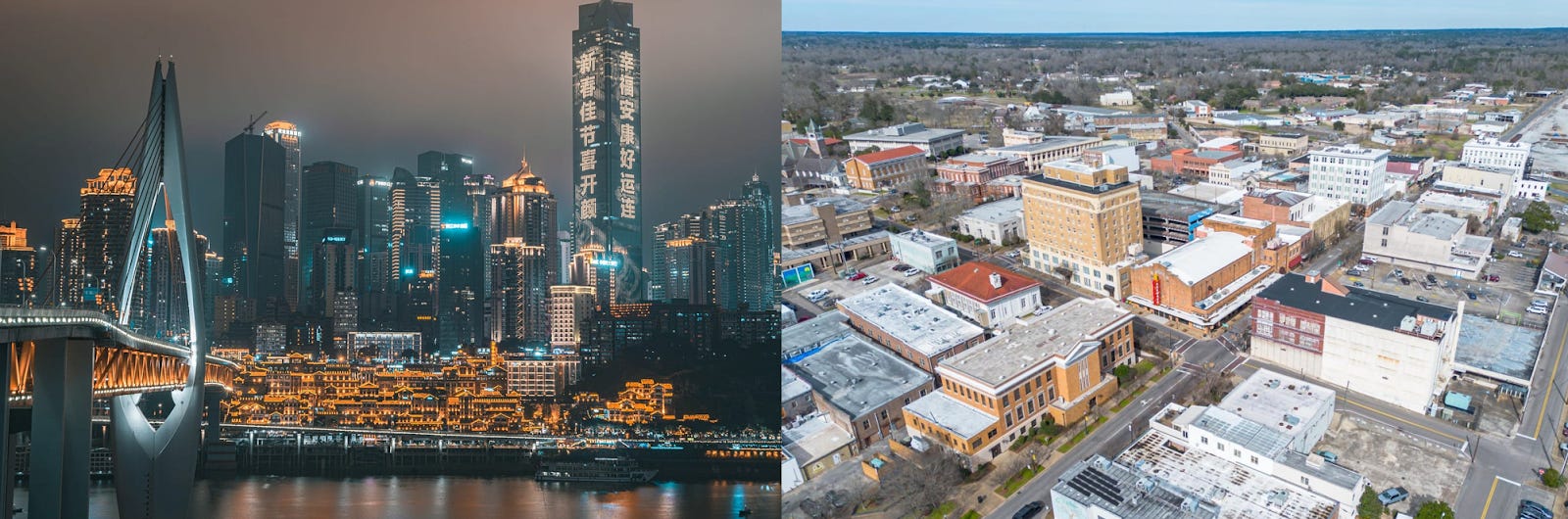
Again, while this is an overly simplistic comparison on many levels, it does give two important points to contemplate. While I have long been a supporter of the “its the economy, stupid” camp of believing that financial well-being supersedes almost any other concern, median incomes or PPP GDP per capita are still imperfect measurements of progress and well-being. It is hard to look at the two pictures above - yes, its hard to judge a population based on one photo - and conclude that these two populations have the same overall quality of life.
Second, and more importantly, this is a perfect example of how much more important the relative growth rate is than the absolute level of a financial measurement, or any measurement really. While these two populations have similar median incomes today, the trajectory of the last 10-20 years has been drastically different. Adjusted for inflation, household incomes in Laurel have remained stagnant for nearly 15 years, whereas in Chongqing they have increased 150% in the same period. People must feel that their lives are moving in the right direction. Growth, even from a low base, is more valuable than high levels of static wealth for people to feel fulfilled. The Chinese person in Chongqing may not care that their liberties are limited. They are seeing the world around them change and, at least economically and, maybe, superficially, they are doing better. That is worth a lot.
Returning to the question of the direction of progress, this crude comparison provides an interesting case study. Should Laurel, Mississippi aim to be more like Chongqing where infrastructure is safe and affordable, well-paying jobs are readily available, anything is available at a moment’s notice, and growth is everywhere? Or should Chongqing aim to be more like Laurel where freedom of speech and media is a given, independent liberties reign over all else, land ownership is possiblem, and wealth is higher but not growing? Which vectors of progress are more important?
Or, are these qualities inherently mutually exclusive? Ezra Klein talks about the tradeoff between getting thousands of miles of railway built in China meant the complete destruction of private property throughout the country. In contrast, the HSR takes years to get a single storage facility to make way for the rail tracks. What is the right tradeoff to make? Do we want a 21st-century version of Robert Moses?
American political parties have come to use history as this all-important reference point that must, in their eyes, guide all policy. On the Right, the conservatives look back to history, specifically the post-war 1960s-1970s era, as this time we must return to. It was an era defined by middle-class-driven prosperity, American hegemony, and a certainty that tomorrow would be better than today. These three things have all but vanished from modern America and the Right wants to rewind the clock to an America of yesteryear because they believe they can recreate the environment that led to the prosperity.
On the American left, the Democratic Party has come to use history as a warning sign. The past is full of examples of atrocities we must pay for, leaders we must pledge not to reelect, and centralized power that we cannot allow to reemerge. In many ways, Democrats find most of history to be something that cannot be repeated. In his book, Marc Dunkelman devotes a lot of time to discussing the problem of Hamiltonian power and the subsequent Jeffersonian backlash of the last 50 years. Democrats have come to serve procedure and process rather than results. Ironically, both American parties find common ground in this aspect. They both have mastered the weaponry of law and vetocracy in an effort to preserve the little marginal power they may have when legislative and judicial power is nearly balanced between the parties. What we, the constituents, end up with is a complete gridlock of progress.
The Biden presidency’s Inflation Reduction Act aimed to build large-scale green energy production and distribution projects. Everyone quickly found out that the NEPA, originally created by Democrats in an effort to protect the environment, had made all new green energy construction nearly impossible. On average, environmental impact studies take upwards of three years and the reports have a median length of 1,200 pages. This spans across almost every domain in Liberal states, as Ezra Klein states repeatedly in Abundance. Democratic cities (Chicago, NYC, San Francisco, etc.) want to support cheap housing but the rules they created to enforce them end up making the public affordable housing more expensive than even regular, privately funded housing. Once again, the government hinders itself and doesn’t allow for the very progress it wants. Unfortunately, things are no better across the aisle.
Early on, one hope for the 2024 Republican presidential and congressional wins was that the idea of technological superiority and moving towards the future would become a foundational part of the party’s policy. While this has happened in some areas - AI data centers, recent nuclear EOs, and onshoring of chip fabs, although that was mostly Biden’s CHIPS Act - there is still a core of the party that is allergic to fundamental progress. We saw examples of this luddite policy with Trump’s backing of L.A.'s dockworker union’s pushback against automation within the port operations. We saw it with the bizarre excitement around bringing back coal jobs. We continue to see it (at least at the time of this writing) with the focus on low-skilled manufacturing jobs that Republicans seem to want to get back from Asia. Arguably worst, we see it in the slicing of scientific research in the name of efficiency and ridding the scientific domain of waste, fraud, and bad science. Sadly, the ripple effect is that scientists all around the world are now viewing the US as a place they cannot do research in. This will almost surely set America back for years to come as important IP across biology, chemistry, physics, robotics, and countless other fields sits outside of the American borders. There are plenty of things wrong with science, I even wrote about it five years ago in the context of innovation vs. invention, but the amount of collateral damage being done now is far worse than the existing issues.
In his “Liberation Day” speech, President Trump stated: “the day American industry was reborn” and “the day America’s destiny was reclaimed.” The word selection and verb tense here is important. Again, Trump elects to use nostalgic phrasing to recall an era that we’ve seemingly lost. Trump recalls the coal mining industry that powered much of Appalachia decades ago. Yes, this industry has all but vanished and is one of the driving reasons for the abject poverty and drug use that has taken over vast parts of West Virginia, Ohio, and Kentucky. But, for reasons that are obvious enough I hope to not need to go through in detail here, this industry is not coming back even if it was fiscally supported by every subsidy and tax cut the administration could throw at it. Yet, it is the specific industry that Conservatives decide to call out and use as a rallying cry. Looking at the actual data, it is striking how insignificant the coal industry in America is in economic and employment terms. In aggregate, the coal industry today employs fewer than 50,000 people in the US. That is a mere fraction of the number of coffee baristas in the US (400,000) or even MTA employs in NYC (70,000). It is true that coal, or rather the energy industry more generally, has more strategic importance than coffee but the lack of economic prioritization and rather political reminiscence is bizarre.
This policy-by-nostalgia is a dangerous approach. Throughout history, countries such as China, Japan, and Germany have allowed nostalgia to influence their policies. Every time it failed miraculously. As they became insular, the world marched forward without them and their societies were left in the dust technologically. The U.S. is at risk of this today even with our existing leadership in so many domains. The American system has come to rely on political protection - tariffs, bans, and other blunt policy instruments - rather than innovation to maintain its place in the world. This artificial insulation works for a bit, especially when the country in question is still the largest economy in the world and the center of gravity. But eventually, market forces will do their job and even with the barriers in place, fundamentally better solutions will find their way to market. Jason Crawford spends time highlighting the power of “solutionism” and shows how everytime the West has overcome seemingly insurmountable obstacles with technology, innovation, and
When you look at some of the data, it paints an interesting picture. Government spending on upskilling and retraining programs peaked in the 1960s-1980s at 0.2-0.3% of GDP, the exact era that so many politicians want to return to. It was the era of American manufacturing when towns like Milwaukee, Birmingham, and Pittsburgh were global leaders. Today, the best estimates place that spending figure at 0.03%, an 80+% reduction. Of course, correlation is not causation and there are many other factors at play beyond government retraining programs. Still, it is an accurate symbol of the changing mindset between dynamism and protectionism.
There are early signs of change. The recently announced repeal of CEQA in California is one small step towards an abundance-driven Democratic party. It should be highlighted that the California governor has taken such a drastically different stance only 105 days after the publication of Abundance which focused on these core housing issues in California. I think it is a bit dramatic to argue that the book was the singular reason for this change but it was certainly a triggering event for people to wake up and take some form of action. The UK Labour and Canada have legislation in their parliaments that would cut back on large scale project approval timelines.
Four years ago, I wrote a piece titled 'What Happened to I?' where I explored the individual's downfall, even villainization, in much of Western society. In almost all current discourse on progress, people point to policy, institutions, governments, and collective action. Pundits explain how the institutions themselves must be fixed and how it’s just poor policy getting in the way. Not a single chapter of any of the books or a sound bite of any interview talks about the importance of the individual wanting progress or having real agency. While I hope that the abundance agenda becomes a core pillar of the Liberal Party, they must also be willing, if not eager, to support the power of the individual. While supportive policy is important, it is not what creates things. Saying “progress” 100 times in a mirror does not magically cause great things to manifest out of thin air. People themselves must want to act. Policy is an important and enabling element of this, but it goes much deeper into the culture of America and much of the West.
As Mana Afsari heard from a young man at a recent NatCon event, “Never in my life [have I] remembered a time when the Democratic Party supported ambitious people.” It is hard for me to imagine a world where the Democratic Party in America can become the party of abundance without the individuals who will inspire, lead, and organize the movement. For much of our postmodern times, the Left has feared the ambitious individual, as I wrote about in 2020. Progress and ambition go hand in hand. I’d even argue that ambition is a prerequisite for any real, enduring progress.
There is a new trope on social media, namely X, where people post “you can just do things” when discussing individuals with high agency who decide to start a company, build a product, or change something that others believed to be unchangeable. Many within the West have come to expect that their institutions are the only things that can do things rather than individuals themselves. We often wait for some nebulous institution like the government or our employer to give us permission to act. Kelsey Piper and Jasmine Sun hit it dead on in their discussion about the abundance mindset starting at the home and neighborhood level. Even simple community-scale initiatives - a new playground, getting rid of aggressive dogs, etc. - are nearly impossible to get approval for, even if there is unanimous support from all constituents.
In his recent book, Michael Lewis does an incredible job of highlighting the specific individuals who actually power our government. He and his coauthors highlight the people by name to humanize these institutions that most people only know by their common few-letter acronyms. We need more of this. We must celebrate the people who decide to take on the risk to effectuate change, however big or small it may be. If we continue to demonize individuals trying to create change then they will altogether stop and take their efforts elsewhere. As Reihan Salam writes, “Harass him enough, and Atlas eventually shrugs.”
We can’t afford to live in a world where a few great individuals decide to stop trying. We can’t let Atlas shrug.
No posts
Comments
Nothing yet. Say the first thing.
Sign in to join the conversation.