
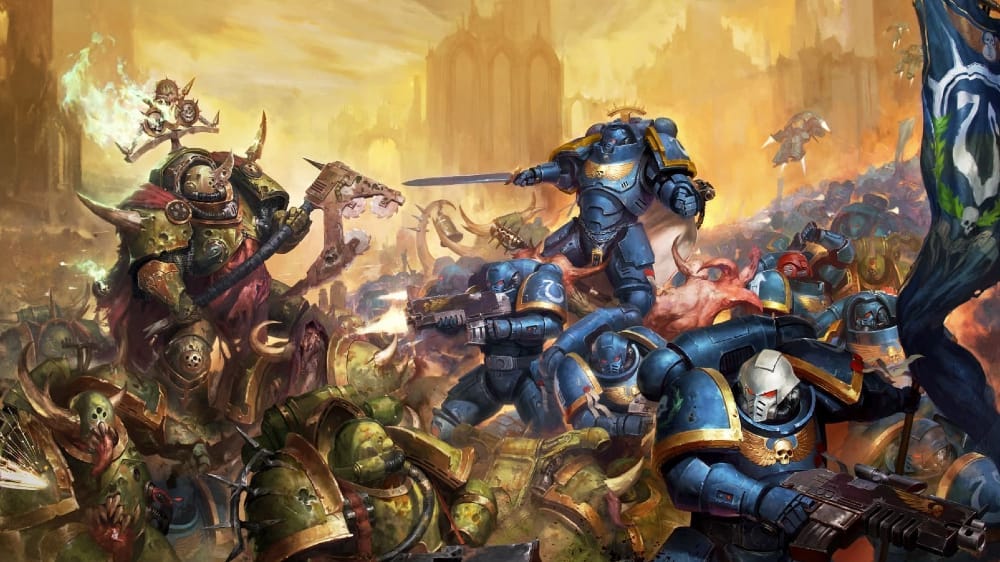
Warhammer 40,000’s ultra-dystopian world is quite fantastical and entertaining — in a very dark, over-the-top sort of way — but sadly, it’s attracted an element of the Far Right who’ve overlooked the franchise’s satirical aspects.
Many of 40k’s foundational themes deliberately evoked the political and socioeconomic tumult of the 1980s and the late Cold War as Margaret Thatcher restructured the British economy along neoliberal lines. Some of the earliest editions of both the original Warhammer and 40k made their contemporaneous satire explicit. One of the mightiest and bloodthirstiest and most human-hating Orks in the 40k universe is called Mag Uruk Thraka, for goodness’ sake.
In 40k, whole worlds are destroyed by a casual “Exterminatus” order that cauterizes threats to the Imperium with nuclear fire. The real-world English industrial town Birmingham, degraded by Thatcher’s policies in our timeline, became the name for a dark, backwards industrial planet in 40k’s distant future; it receives so few visitors that “its inhabitants have become linguistically and culturally isolated.” The punk rock and the counterculture movements of the Seventies and Eighties were a major influence on the art of Warhammer and have remained a constant undercurrent for its unique hyper-Gothic medieval futurism.
All of which is to say, Warhammer has always been political.
Forget about the ’80s. The next generation of MAGA is finding inspiration in the ’90s, aka, the last time that America got it right.
The Cold War was over. The Soviet Union had collapsed. By decade’s end, the U.S. was running a budget surplus for the first time in a generation. China had not yet joined the World Trade Organization, the move many blame for hollowing out American manufacturing. It was, in many ways, the last moment of American supremacy — before 9/11, before the 2008 financial crisis, before Covid, before the long cascade of failures this generation inherited.
[…]
This next generation, more often than not, is reaching not for the decade’s feel-good touchstones like Friends, Titanic or Mariah, but for the decade’s darker and more anti-establishment canon: hip-hop, grunge, alt-rock and Tarantino.
Not surprisingly, MAGA’s appropriation of ’90s cultural touchstones, be it Nirvana’s grunge or films like Pulp Fiction and Boyz n the Hood, often misses or overlooks their transgressive nature. Which leads to things like Pete Hegseth’s Pulp Fiction prayer.
Various companies, including Netflix, are looking to purchase Letterboxd, a popular site for cinephiles to keep track of their movie watching. But some are worried about the potential deal.
The prospect of the likes of Netflix, Sony or Paramount owning Letterboxd would appear to introduce inherent conflicts — raising questions of whether they would somehow give preference to their own titles. Note that film-rating site Rotten Tomatoes was part of NBCUniversal for years, and some critics have slammed that ownership structure as being problematic. Meanwhile, IMDb is owned by ecommerce colossus Amazon.
If you don’t care about the social aspect of cinephilia, you can always build your own system for keeping track of your movies. Of course, you can always check out some of the Letterboxd alternatives.
New Zealand actor Sam Neill, whose long career included The Hunt for Red October, Jurassic Park, Peaky Blinders, Hunt for the Wilderpeople, and even a guest spot on The Simpsons, died this week at the age of 78.
Screen Producers Australia CEO Matthew Deaner said: “Sam Neill was one of the great figures of Australian and New Zealand screen. His extraordinary talent and professionalism enriched countless productions and inspired generations of filmmakers and performers. Australian producers were privileged to work alongside Sam on so many landmark productions. His contribution to Australian storytelling and to our screen culture is immeasurable, and his legacy will continue to inspire audiences and the industry for generations to come.”
Neill had been previously diagnosed with lymphoma, but earlier this year, announced that he was cancer-free. His final roles include Godzilla x Kong: Supernova and The Last Resort.
Related: Steven Spielberg, who directed Neill in Jurassic Park, paid tribute to the actor. “I adored making all the Jurassic movies with him. Along with Laura Dern and Jeff Goldblum, we will always have our Jurassic family and Sam will never be forgotten by us or his many millions of fans around the world.”
Fans and artists are starting to create their own movie posters that are arguably better than anything the studios are creating.
While there are no strict rules for creating the best movie posters, often new releases will fall back on formulaic design, which soon becomes oversaturated. Demonstrating the diversity of film poster design, these ingenious fan-made works show how non-Hollywood budget creatives can create posters just as impactful and iconic.
I particularly like the imagery of that Devil Wears Prada 2 poster, which evokes the cover of some vintage fashion magazine. This Alien poster is pretty cool, too.
Wad laments how AI — and suspicions of AI-generated writing — is forcing human writers to change how they write (e.g., stop using em dashes).
There is something so insulting about having a tool that was trained on human writing turn around and make human writers doubt themselves. We gave it every sentence, every habit, every little stylistic tick that makes one person’s voice different from another’s. And the price we are apparently paying for that is that we now have to write around our own instincts to prove we had them in the first place.
I’ve said it before, and I’ll keep on saying it: AI can have my em dashes when it can pry them from my cold, dead fingers. (That holds true for the rule of three, as well.)
A recent hack reveals the extent to which AI music generator Suno scraped (i.e., stole) music from other services to train its AI models.
The hacked material includes source code that appears to be from 2023 and 2024 that includes scraping instructions and details about the scope of at least some of the scraping. For example, the comments in one file note that they will pull from “genius_hq, youtube_music, freesound, jamendo, imp, deezer, ytm_tagged,” and that “non-music will be filtered out.” A file called “youtube_music” notes that at the time the file was last updated, it had ingested “2,013,545 music clips.” Another file contains comments about different datasets Suno had created, which included “113,879 hours of youtube_music,” “17,615 hours of genius_hq,” “410 hours of free sound,” “19,514 hours of imslp,” “3,726 hours of jamendo,” “62,117 hours of pond5_music,” “12,287 hours of deezer,” “152,162 hours of ytm_tagged,” and “103 hours of musescore_lyrics.” In total, this is at least decades worth of music.
Earlier this year, I wrote about Suno and the emptiness of the music that it creates.
O. Alan Noble laments how tech companies continue to “pillage” our digital common spaces.
In allowing AI companies to scrape our commons, our content, our labor, our creations, we are doing their work which they then turn into profits. And probably the most nefarious part of all this is that 99.9% of us had no clue this is where we were headed when we started sharing content in 2007 or 2010 or whenever it was. We were sold one vision of social media and the Internet, and then that content was used for another purpose and sold back to us.
The return of the CD continues apace as demands and affinity for physical media continues to rise.
In a time when superfans care just “as much about aesthetic ownership and direct financial support for the artist,” as Luminate puts it, physical sales continue to climb, whether it’s vinyl or CDs. But CDs in particular saw a major bump this year thanks to K-pop, which is responsible for over half the 16% rise in sales thanks to hits from BTS, ATEEZ and others. Plus, buying behavior for physical media is changing too. Now, big box retailers like Walmart and Target are seeing uplifts at the expense of indie store and e-commerce sales, likely, in part, due to in-store exclusives only available at the major chains.
Via 1440.
Some of us never stopped loving CDs, by the way.
This post is available to everyone (so feel free to share it). However, paying subscribers also get access to exclusives including playlists, podcasts, and sneak previews. If you’d like to receive those exclusives — and support my writing on Opus — then become a paid subscriber today for just $5/month or $50/year.
No posts
Comments
Nothing yet. Say the first thing.
Sign in to join the conversation.