
Still free to subscribe to this nearly daily newsletter! Greg Mitchell is author of fourteen books and director of five films for PBS since 2022 including “Atomic Coverup” and “The Atomic Bowl.” . His latest film “Woody Guthrie and The Ghost of Tom Joad Today” is now streaming everywhere via PBS.
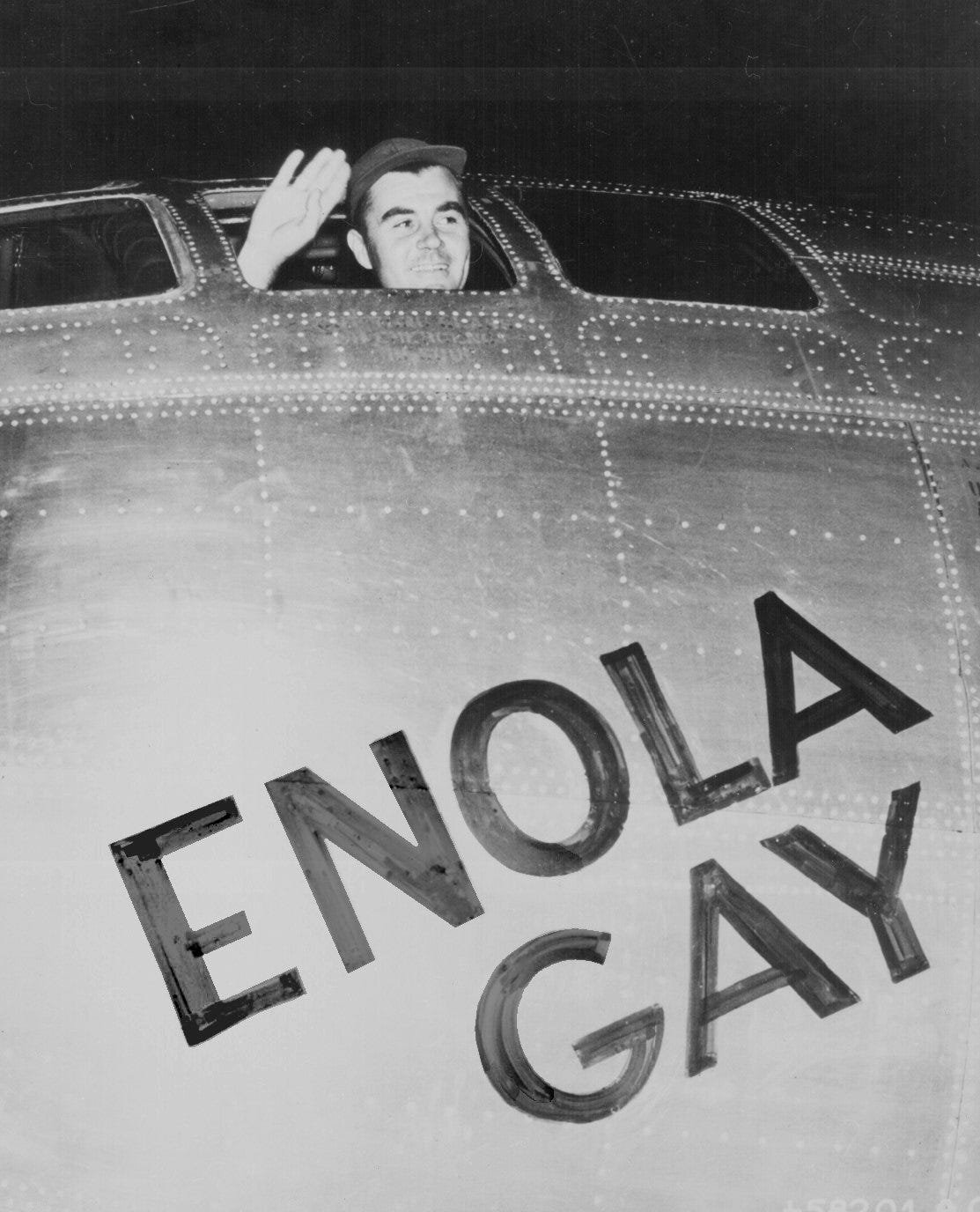
In Christopher Nolan’s “Oppenheimer,” we did not witness the twin, tragic, missions to Hiroshima and Nagasaki…the usual images of B-29s in flight, pilots in command and bombardiers finding their targets, and bombs away. (And, of course, no sign of what then happened on the ground). We never did meet the two pilots. This is also true of the previous, long ago, Hollywood movie on this subject, “Fat Man and Little Boy.”
But I did. In fact, I wonder if I am the only person who chatted with both of the pilots as well as dozens of Japanese survivors of the payloads they carried.
Paul W. Tibbets, pilot of the Enola Gay (named for his mother), which dropped the first “gadget” over Hiroshima on August 6, 1945, died at 92 in 2007, defending the bombing to the end of his life. Some of the obits noted that he had requested no funeral or headstone for his grave, not wishing to create an opportunity for protestors to gather. Kind of sad. But revealing.
I had a chance to interview Tibbets more than forty years ago for Mother Jones magazine. Later, in 1995, I got to meet and talk with the pilot of Bock’s Car who dropped the plutonium bomb over Nagasaki, Charles Sweeney, in the green room for Larry King’s CNN show. He took even more pride than Tibbets in what he had done in August 1945, even though the Nagasaki mission was even more questionable than the Hiroshima holocaust.
Far as I know, however, he never did re-create the atomic bombing at an air show, which Tibbets once did.
The hook for my Tibbets interview was this: While spending a month in Japan on a grant in 1984, I met a man named Akihiro Takahashi. He was one of the many child victims of the atomic attack, but unlike most of them, he survived (though with horrific burns and other injuries), and grew up to become a director of the memorial museum in Hiroshima.
Takahashi showed me personal letters to and from Tibbets, who then headed Executive Jet Aviation in Columbus, Ohio, which had led to a remarkable meeting between the two elderly men in Washington, D.C. At that meeting, in a park, Takahashi expressed forgiveness, admitted Japan’s aggression and cruelty in the war, and then pressed Tibbets to acknowledge that the indiscriminate bombing of civilians was always wrong.
But the pilot (who had not met one of the Japanese survivors previously) was non-committal in his response, while volunteering that wars were a very bad idea in the nuclear age. Takahashi swore he saw a tear in the corner of one of Tibbets’ eyes.
In our interview, the polite but crusty Tibbets would confirm the meeting with Takahashi (which he agreed to only “out of courtesy”) and most of the details, but scoffed at the notion of shedding any tears over the bombing. That was, in fact, “bullshit.”
“I’ve got a standard answer on that,” he informed me, referring to guilt. “I felt nothing about it. I’m sorry for Takahashi and the others who got burned up down there, but I felt sorry for those who died at Pearl Harbor, too....People get mad when I say this but -- it was as impersonal as could be. There wasn’t anything personal as far as I’m concerned, so I had no personal part in it.
“It wasn’t my decision to make morally, one way or another. I did what I was told -- I didn’t invent the bomb, I just dropped the damn thing. It was a success, and that’s where I’ve left it. I can assure you that I sleep just as peacefully as anybody can sleep.” When August 6 rolled around each year “sometimes people have to tell me. To me it’s just another day.”
In fact, he wrote in his autobiography, “The Tibbets Story,” that President Truman at a meeting in the White House after the bombing had instructed him not to lose any sleep over it. “His advice was appreciated but unnecessary,” Tibbets explained. No “blood on my hands” moment for Tibbets as there was for Oppenheimer.
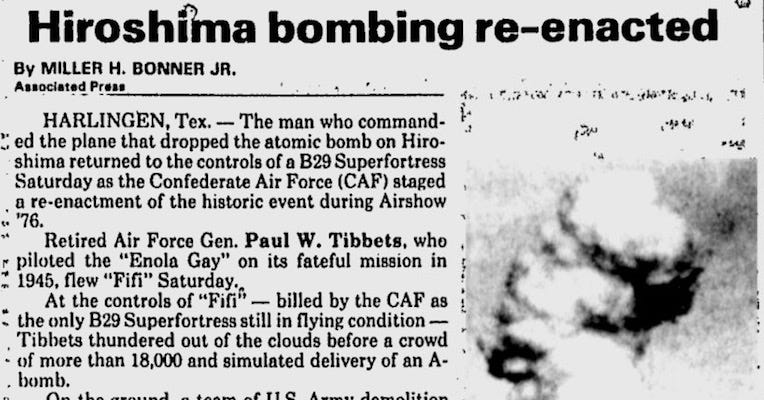
In any event, Tibbets (like Truman) had acted in a consistent manner for decades, while at times traveling under an assumed name to avoid scrutiny. In speeches, he called Hiroshima and Nagasaki “good virgin targets” -- they had been untouched by pre-atomic air raids -- and ideal for “bomb damage studies.” In 1976, as a retired brigadier general, he re-enacted the Hiroshima mission at an air show in Texas, with a smoke bomb set off to simulate a mushroom cloud. He intended to do it again elsewhere, but international protests forced a cancellation.
He told a Washington Post reporter, for a favorable profile, in 1996, “For awhile in the 1950s, I got a lot of letters condemning me...but they faded out.” On the other hand, “I got a lot of letters from women propositioning me.”
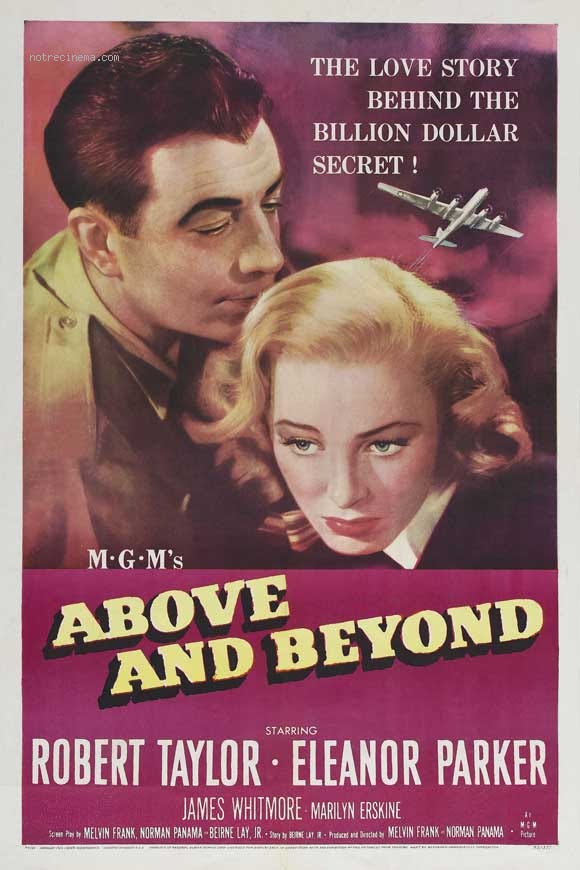
In my recent book The Beginning or the End: How Hollywood--and America--Learned to Stop Worrying and Love the Bomb, I recall Tibbets’ role as a paid consultant to the 1953 MGM movie, Above and Beyond, with Robert Taylor in the pilot role. Much of the movie focuses on how keeping “the billion dollar secret” before August 1945 nearly wrecked his marriage. In a key scene, after releasing the bomb and watching Hiroshima go up in flames below, Taylor radios in a strike report. “Results good,” he says. Then he repeats it, bitterly and with grim irony.
But that was not in the Tibbets-approved original script for the film. It was added later, presumably to show that the men who dropped the bomb recognized the tragic nature of their mission.
Tibbets slammed the scene when the film came out.
Comments
Nothing yet. Say the first thing.
Sign in to join the conversation.