
Every year at this time I trace the final days leading to the first use of the atomic bomb against two cities, Hiroshima and Nagasaki, in August 1945, with close up probes of individual days. In this way the fateful, and in my view, tragic decisions made by President Truman, his advisers, and others, can be judged more clearly in “real time.” As some know, this is a subject that I have explored in hundreds of articles, and in four books (including one with Robert Jay Lifton) since 1984, and now in my award-winning PBS films “Atomic Cover-up” and “The Atomic Bowl” and soon to arrive “Hollywood Bomb,” plus companion books. You can still subscribe free:
—On Tinian, Little Boy is ready to go, awaiting word on weather, with General Curtis LeMay to make the call. With the weather clearing near Hiroshima, still the primary target, taking off the night of August 5 appears the most likely scenario. Secretary of War Stimson writes of a “troubled” day due to the uncertain weather, adding: “The S-1 operation was postponed from Friday night [August 3] until Saturday night and then again Saturday night until Sunday.”
—Hiroshima remains the primary target--indeed, the very center of the highly-populated city, not its major military base--with Kokura #2 and Nagasaki third.
--Gen. Douglas MacArthur, who directed the U.S. war in the Pacific, and would soon become the head of our occupation of Japan, had still not been told of the existence and planned use of the new bomb. Norman Cousins, the famed author and magazine editor, who was an aide to MacArthur, would later reveal: "MacArthur's views about the decision to drop the atomic bomb on Hiroshima and Nagasaki were starkly different from what the general public supposed....When I asked General MacArthur about the decision to drop the bomb, I was surprised to learn he had not even been consulted. What, I asked, would his advice have been? He replied that he saw no military justification for the dropping of the bomb. The war might have ended weeks earlier, he said, if the United States had agreed, as it later did anyway, to the retention of the institution of the emperor." As we noted earlier, both General Eisenhower and Truman's top aide, Admiral Leahy, both protested the use of the bomb against Japan in advance.
—Paul Tibbets, pilot of the lead plane, finally briefs others in the 509th Composite Group who will take part in the mission at 3 pm. Military police seal the building. Tibbets reveals that they will drop immensely powerful bombs, but the nature of the weapons are not revealed, only that it is “something new in the history of warfare.” When weaponeer Deke Parsons says, “We think it will knock out almost everything within a three-mile radius,” the audience gasps.
Then he tries to show a film clip of the recent Trinity test—but the projector starts shredding the film. Parsons adds, “No one knows exactly what will happen when the bomb is dropped from the air,” and he distributes welder’s glasses for the men to wear. But he does not relate any warnings about radioactivity or order them not to fly through the mushroom cloud.
—On board the ship Augusta steaming home for the USA after the Potsdam meeting, President Truman relaxes and plays poker with one of the bomb drop’s biggest booster, Secretary of State Jimmy Byrnes. Truman’s order to use the bomb had simply stated that it could be used any time after August 1 so he had nothing to do but watch and wait. The order included the directive to use a second bomb, as well, without a built-in pause to gauge the results of the first and the Japanese response—even though the Japanese were expected, by Truman and others, to push surrender feelers, even without the bomb, with Russia’s entry into the war on August 7. Hence: assembly-line massacre in Nagasaki.
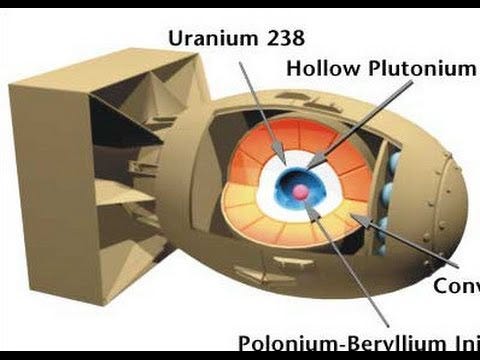
—There is some evidence that Los Alamos director J. Robert Oppenheimer thought the bombing would be carried out at night with more adults and children at home and not out in the open, thereby not killing quite as many.
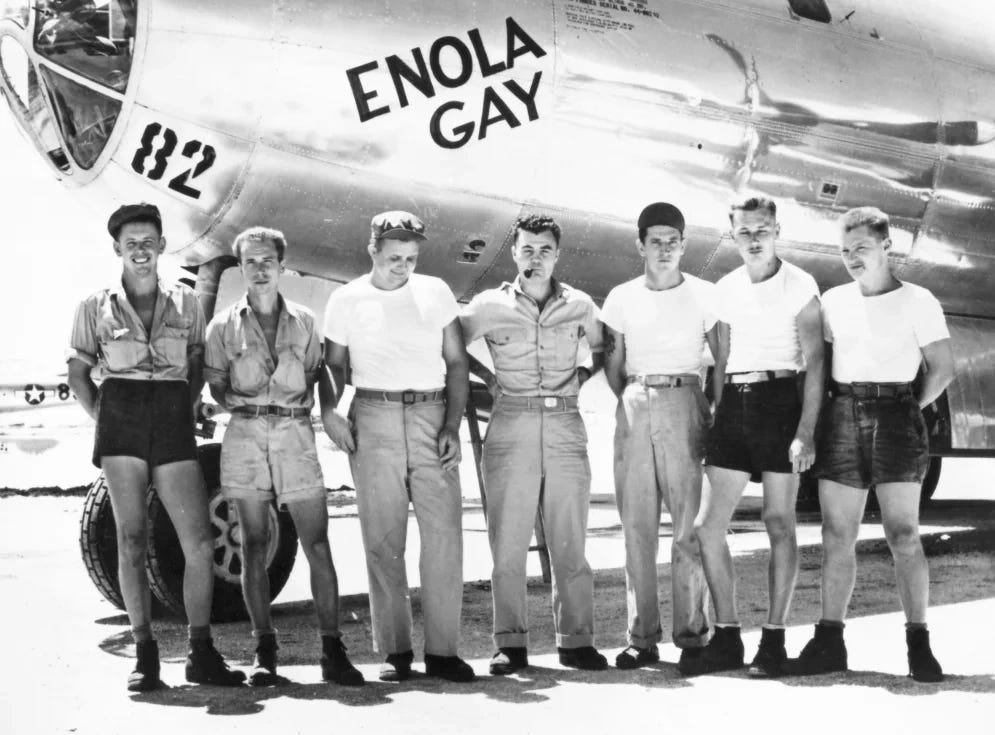
—Pilot Paul Tibbets formally names the lead plane in the mission, #82, after his mother, Enola Gay. A B-29 that would take photos on the mission would be named, wait for it, Necessary Evil.
—Also on Tinian, at 3:30 p.m., in an air-conditioned bomb assembly hut, the five-ton bomb as loaded (gently) on to a trailer. Crew members scribbled words onto the bomb in crayon, including off-color greetings for the Japanese. Pulled by a tractor, accompanied by a convoy of jeeps and other vehicles, the new weapon arrives at the North Field and is lowered into the bomb pit.
--The bomb is still not armed. The man who would do, before takeoff, according to plan, was Parsons. But he had other ideas, fearing that the extra-heavy B-29 might crash on takeoff and taking with it “half the island.” He asked if he could arm the bomb in flight, and spent a few hours—on a hot and muggy August day—practicing before getting the okay.
—Pilot Tibbets tries to nap, without much success. Then, in the assembly hall just before midnight, he tells the crew, that the new bomb was “very powerful” but he did not mention the words “nuclear,” “atomic’ or “radiation.” He calls forward a Protestant chaplain who delivers a prayer he’d written for this occasion on the back of an envelope. It asks God to “to be with those who brave the heights of Thy heaven and who carry the battle to our enemies.”
— The Soviets are two days from declaring war on Japan and marching across Manchuria. Truman had just written in diary “Fini Japs” when the Soviets would declare war, even without the Bomb. (Many historians now believe it was the Soviet declaration of war, more than the atomic bombing, that was the decisive factor in Japan’s surrender.)
—Halfway around the world from Tinian, on board the ship Augusta steaming home for the USA after the Potsdam meeting, President Truman relaxes. His announcement on the bombing--calling the large city merely a “military base”--has already been written. Truman’s order to use the bomb had simply stated that it could be used any time after August 1 so he had nothing to do but watch and wait.
Comments
Nothing yet. Say the first thing.
Sign in to join the conversation.