
The last light settles across the Wando.
Tide moves slow against the pilings.
Spartina stands quiet. A heron holds the shallows without moving.
From the Fixed Perch the river carries what it has always carried.
Tonight the current brings older names.
Why these stories sit on the dock is simple.
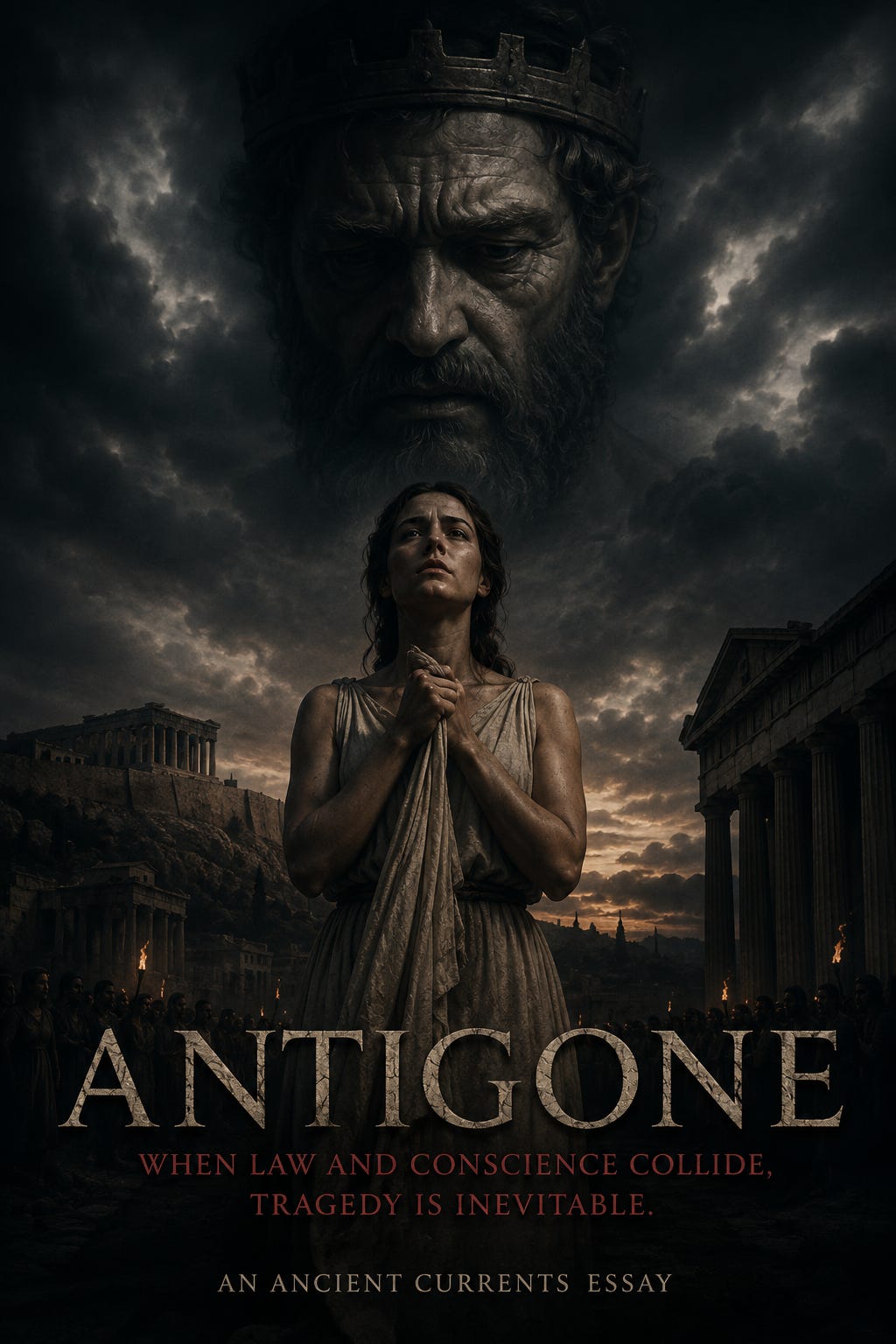
Antigone.
Ajax.
The Iliad.
Medea.
Oedipus.
Cicero.
They do not sit here because they are beautiful, though many of them are.
They do not sit here because they are old, though all of them are.
They sit here because they teach the same lesson, and the lesson has never left.
History changes. The posture does not.
The names change. The cities change. The weapons and the laws and the flags change.
The posture does not.
That is why the current keeps bringing them back to this dock.
The river turns.
The Lowcountry fades. The pluff mud and the live oaks fall away. The current carries us east and older, across water that has no memory of this continent.
We arrive in Thebes.
Morning. Smoke still hangs low over the seven gates. The city is quiet in the way a place is quiet after blood has been spilled. Two bodies lie outside the walls. One will be buried with honor. The other will not.
A new king has spoken.
And two sisters stand at the palace gates before the sun is fully up.
Antigone speaks first.
She tells her sister what the king has ordered. She asks for help.
Ismene answers the way most people answer when the cost is clear. She measures the power of the new king. She remembers what their family has already suffered. She says no.
Antigone does not argue long.
She says the thing that will not move:
“I will bury him myself.
And even if I die in the act, that death will be a glory.
I will lie with the one I love, guiltless in my crime.
For I owe a longer allegiance to the dead than to the living.
In that world I shall abide forever.
But if you think it best, then be a coward and dishonor the laws the gods have set.”
Ismene is left behind at the gate.
Antigone goes alone into the dark to do the work that must be done.
The Chorus of Theban elders enters as the sun rises. They sing of victory. They do not yet know what the night has cost.
Creon arrives and addresses them. He restates the decree. He speaks of loyalty to the city above blood. He is clear. He is certain. He believes the ground will hold beneath his words.
A Guard comes running, out of breath and terrified. Someone has sprinkled dust on the body that was ordered left unburied. The rites have been performed in secret.
Creon is furious. He threatens the Guard with death if the one who did it is not found.
The Guard leaves.
Before the two of them meet face to face, the Chorus pauses over mankind itself. The question is no longer only whether one burial was lawful. It is whether human greatness means anything when skill outruns wisdom.
The elders of Thebes speak:
There are many strange and wonderful things, He snares the light-winged flocks of birds, He’s taught himself speech and wind-swift thought, The qualities of his inventive skills
but nothing more strangely wonderful than man.
He moves across the white-capped ocean seas
blasted by winter storms, carving his way
under the surging waves engulfing him.
With his teams of horses he wears down
the unwearied and immortal earth,
the oldest of the gods, harassing her,
as year by year his ploughs move back and forth.
herds of wild beasts, creatures from deep seas,
trapped in the fine mesh of his hunting nets.
O resourceful man, whose skill can overcome
ferocious beasts roaming mountain heights.
He curbs the rough-haired horses with his bit
and tames the inexhaustible mountain bulls,
setting their savage necks beneath his yoke.
trained his feelings for communal civic life,
learning to escape the icy shafts of frost,
volleys of pelting rain in winter storms,
the harsh life lived under the open sky.
That’s man—so resourceful in all he does.
There’s no event his skill cannot confront—
other than death—that alone he cannot shun,
although for many baffling sicknesses
he has discovered his own remedies.
bring arts beyond his dreams and lead him on,
sometimes to evil and sometimes to good.
If he treats his country’s laws with due respect
and honours justice by swearing on the gods,
he wins high honours in his city.
But when he grows bold and turns to evil,
then he has no city. A man like that—
let him not share my home or know my mind.
Skill without justice is still skill. But a city that forgets the second is already preparing its own ruin.
The Guard returns, this time with Antigone.
She does not deny what she has done.
Creon asks if she knew of the decree. She says she knew.
He asks why she dared to break it.
She answers with the lines that have never left the current:
“It was not Zeus who made that proclamation.
Nor did Justice, who dwells with the gods below,
establish such laws among men.
I did not think your edicts strong enough
to overrule the unwritten and unfailing laws of the gods,
laws that live not for today or yesterday
but for all time, and no one knows when they first appeared.
I was not about to pay the gods the penalty
for breaking those laws out of fear of any man’s pride.”
Here the collision reaches its center.
The Greeks had a word for the law that is spoken and written: nomos. The decree of the city. The order a ruler can proclaim and enforce. Creon stands on nomos. He believes that without it the city collapses into private blood and private feeling. He is not wrong that cities need order. He is wrong about what order can command.
Against that stands the law that is not written. The natural law. The one that does not begin when a king speaks and does not end when a king dies. Antigone stands on that ground.
Every community, every city, every government, every country, and every non-state order has faced this same tension. There is always the law that can be written down and enforced by men with power. And there is always the law that men did not invent and cannot erase.
That is the posture that does not change.
This is the question Sophocles leaves beneath every government that followed Thebes.
What happens when the law and conscience no longer agree?
There is no painless answer.
If every person obeys only private conscience, the city can no longer hold. Law becomes preference, and common life fractures beneath competing claims of personal righteousness.
But when the city demands obedience to something conscience knows is wrong, compliance does not preserve order. It merely gives injustice the appearance of law.
Antigone chooses the authority she believes existed before Creon and will remain after him. She accepts that the city may take her life, but refuses to let it decide what is sacred.
Creon makes the opposite choice. He treats resistance to his decree as resistance to the city itself. From that moment, he can no longer reconsider without believing the throne has been weakened.
That is where power becomes trapped.
The decree can still be changed. The burial can still be permitted. The girl can still be spared. But correction now feels like humiliation, and pride would rather endure catastrophe than be seen yielding.
When law and conscience no longer agree, the first casualty is often not order.
It is the ability to listen.
Creon condemns her. She is to be taken to a rock-hewn chamber and left there to die.
Ismene tries to share the guilt. Antigone refuses her.
Haemon, Creon’s son and Antigone’s betrothed, enters and tries to reason with his father. He speaks carefully at first. Then more directly.
“The city is on her side.
The people say she does not deserve to die
for the most glorious of deeds.
She would not leave her brother unburied
to be torn by dogs and birds.
Is she not worthy of golden honor?”
Creon will not bend. Father and son break. Haemon leaves with a warning that the house itself will suffer.
The Chorus sings of love.
Not the soft kind. The kind that arrives uninvited and takes the steering of a man’s life. The kind that makes a son stand against his father, that makes a girl walk alone into a death chamber, that turns reason into something smaller than the force moving through the blood. The elders of Thebes know what they are looking at. They have seen this power before. It does not ask permission.
Antigone is led away toward the rock-hewn chamber.
Until this moment she has spoken mostly in the language of duty. Now Sophocles makes us hear the life that duty will cost her.
She speaks to the city and to the dark that waits for her:
Look at me, citizens of my native land,
as I go on my final journey,
as I look on the last of the sunlight
I shall ever see. Hades who brings all to sleep
is leading me living to the banks of Acheron.
I have had no wedding, no bridal song,
no share in the joy of marriage or the rearing of children.
No — I go in sorrow to the grave,
unwed, still a living bride of Death.O tomb, O bridal chamber, O deep-dug home
that will keep me forever,
where I go to join my own,
those many who have died and been received by Persephone.
I am the last of them and the most miserable,
going down before my time.
But I nurture the strong hope
that my coming will be welcome to my father,
and welcome to you, my mother,
and welcome to you, my brother.
For when you died, with my own hands
I washed you and dressed you and poured the libations at your graves.
And now, Polynices, for burying your body
I win this reward.Yet those who think rightly will say
I did well to honor you.
If I had been a mother of children,
or if my husband had been rotting in death,
I would never have taken this task on myself
in defiance of the citizens.
What law do I speak of when I say this?
A husband lost, another might be found,
and a child from another man if I lost this one.
But with my mother and father hidden in Hades,
no brother could ever be born again.
By such a law I honored you above all,
but Creon thought it a crime and a terrible daring,
my brother.
And now he leads me by the hands,
without a wedding, without a bridal song,
without any share in marriage or the rearing of children,
a lonely woman without friends,
alive to the hollowness of the dead.
She goes into the dark chamber.
Tiresias arrives, led by a boy.
The blind prophet tells Creon the signs are bad. The altars will not take the offerings. The birds are screaming with the flesh of the unburied. The gods are offended.
He warns Creon directly: Yield. Do not kill the girl. Do not leave the dead unburied. The cost is already moving toward the house.
Creon rages at first. Then the weight lands. He changes course, too late, but he changes.
He orders the body buried properly. He goes himself to free Antigone from the rock.
Antigone has hanged herself with her own veil. Haemon is already there. When Creon enters, the son draws his sword, misses his father, and drives the blade into his own side. He dies holding the body of the woman he was to marry.
The news reaches the palace. Eurydice, Creon’s wife, hears it. She goes inside without a word and takes her own life beside the altar.
Creon returns carrying the body of his son. He learns of his wife. He is left alone on the stage with the wreckage of every rigid choice he made.
The Chorus closes the play:
“Wisdom is the supreme part of happiness.
And reverence toward the gods must be safeguarded.
The great words of the proud are paid in full
with great blows of fate.
In old age they teach us wisdom.”
The current turns again.
Thebes fades. The palace gates, the rock chamber, the unburied body, the broken king, all of it is carried downstream.
We return to the Wando.
The Fixed Perch is still here. The tide still moves against the pilings. The heron has not left the shallows.
Antigone’s posture is still here too.
So is Ajax’s refusal to live on any terms but his own.
So is the rage and the honor that drive the men of the Iliad.
So is Medea’s terrible clarity about what she will not accept.
So is Oedipus walking into the truth that destroys him.
So is Cicero naming in clean prose the law that no ruler can invent and no city can erase.
Law without conscience can compel obedience, but it cannot escape judgment.
And conscience without cost is merely opinion.
History changes. The posture does not.
If we do not know where we have gone, how can we know where to go?
Night settles.
The current continues.
The Fixed Perch holds.
Throne Steady. Kingdom Vigilant. Unbroken 🔥
King of Cainhoy🇺🇸🔥
Source Book. Antigone RC Jepp translation
No posts
Comments
Nothing yet. Say the first thing.
Sign in to join the conversation.